Go West / Battling Butler Blu-ray Movie
HomeGo West / Battling Butler Blu-ray Movie 
Kino Lorber | 1925-1926 | 2 Movies | 183 min | Not rated | Sep 27, 2011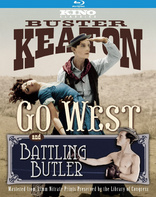
Price
List price:Listed on Amazon marketplace

Movie rating
Movie has not been rated yetBlu-ray rating
| Users |  | 0.0 |
| Reviewer |  | 4.0 |
| Overall | | 4.0 |
Overview
Go West / Battling Butler (1925-1926)
In Go West, Keaton plays an idealistic young man who rides the rails to a dude ranch, forms a sentimental attachment with an especially lovable cow, and, in the film's breathtaking climax, finds himself at the center of a cattle stampede through the streets of Los Angeles. Based on the popular stage musical, Battling Butler stars Keaton as a pampered socialite who pretends to be a famed prizefighter in order to impress his girlfriend's bullying brothers.
| Drama | 100% |
| Comedy | 30% |
| Western | 22% |
Specifications
Video
Video codec: MPEG-4 AVC
Video resolution: 1080p
Aspect ratio: 1.33:1
Original aspect ratio: 1.33:1
Audio
English: LPCM 2.0
Subtitles
None
Discs
50GB Blu-ray Disc
Single disc (1 BD)
Packaging
Slipcover in original pressing
Playback
Region free
Review
Rating summary
| Movie | | 4.0 |
| Video | | 4.0 |
| Audio | | 4.0 |
| Extras |  | 2.0 |
| Overall | | 4.0 |
Go West / Battling Butler Blu-ray Movie Review
Bovines and Boxing: A Buster Keaton Double Feature
Reviewed by Casey Broadwater September 27, 2011After releasing spectacular high definition editions of The General, Steamboat Bill, Jr., Our Hospitality, a double feature of Sherlock, Jr. and Three Ages, and the exhaustive, three-disc Buster Keaton Short Films Collection, Kino International is only a few films away from releasing every independent Buster Keaton movie. That is, those that were produced before “the Great Stone Face” made his ill- fated move from United Artists—which granted him almost complete freedom—to Metro Goldwyn Mayer, where he was regarded as little more than a studio asset, stripped of creative control after orchestrating his last great silent classic, The Cameraman. Of his pre-MGM output, only The Navigator, Seven Chances, and College remain to be released on Blu-ray now that Kino has put out this combo of Go West and Battling Butler, two of Keaton’s most under-seen and underappreciated pictures. It would be easy to write these off as “lesser” Keaton vehicles—they’re not nearly as iconic, action-packed, or laugh-inducing as some of his other work from the 1920s—but I prefer to think of them as simply different. While they may not have as many memorable gags, each film presents a side of Keaton that audiences previously hadn’t seen before; Go West shows a nearly Charlie Chaplin-esque sentimentality, and Battling Butler reveals a capability for genuinely brutal violence.
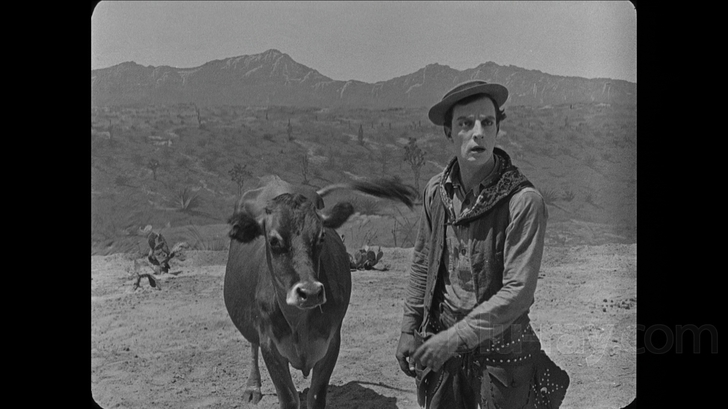
Keaton and "Brown Eyes."
In Go West, Keaton plays Friendless, a rural Midwestern hayseed with no family, no roots, and no money, who sets off in a train car for New York, hoping to find his fortune. After a disastrous day in the big city—he literally gets trampled underfoot—Friendless heeds Manifest Destiny- espousing politician Horace Greeley’s advice to “go west, young man, go west,” and hops a train heading in the other direction, stowing himself away inside a barrel. In classic Keaton fashion, the barrel rolls out of the boxcar, down a hill, and bursts apart, leaving Friendless alone in the Arizonan desert wilderness with nothing to his name but a comically tiny single-shot pistol—a woman’s handgun. When he stumbles across a ranch, he appropriates some cowboy gear—he has to tie a string to his gun so he can find it inside his comparatively enormous holster—and talks his way into a day-laboring gig as a cowhand. Of course, he makes a horrible herder, tripping over his chaps, narrowly escaping a bull’s horns, and expecting the cows to milk themselves. Sad and lonely—none of the other cowpunchers will have anything to do with him—he befriends an expressive bovine named Brown Eyes and makes it his personal mission to save her from branding and slaughter. This leads to a bust-up finale where Friendless accidentally looses hundreds of steer in the streets of Los Angeles—yes, a china shop is trampled—and, knowing that cows are attracted to the color red, dons a hilariously tight devil costume in order to round them up again.
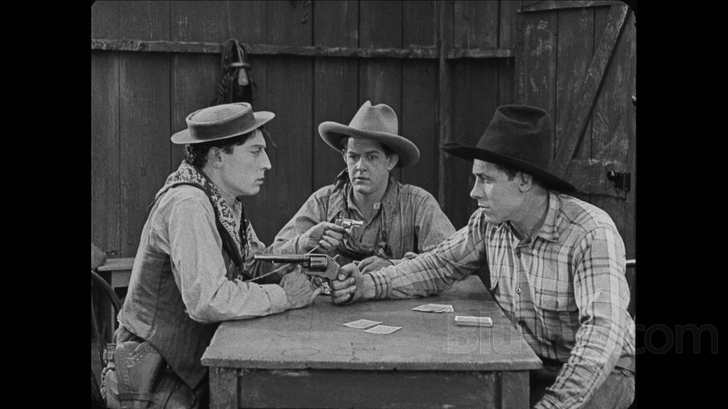
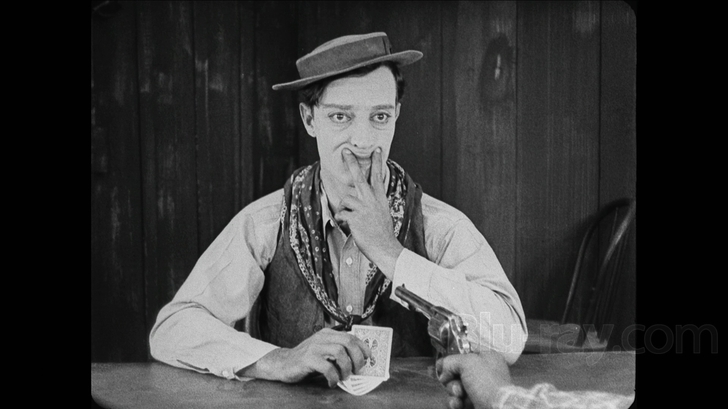
Keaton’s straight-faced persona made all of his characters seem a little sad and disconnected from society, but Friendless is perhaps his most pathetic creation, and I mean pathetic in the original sense—pathos—of provoking pity. There’s a tenderness to Friendless’ protective relationship with Brown Eyes, an undeniably bittersweet-bordering-on-syrupy quality that seems more in line with Chaplin’s films than Keaton’s normally deadpan demeanor. Critics have always been divided about this. Is Keaton being genuine, making a real concession for heartwarming emotion, or is he lightly parodying Chaplin’s sense of sentiment? I think it’s probably a mix of both. If it is satire directed at Chaplin, it’s certainly not sharp-barbed, and Keaton actually inserts a wonderful scene where he pokes fun at his own screen personality. When Friendless calls out another cowhand for dealing off the bottom of the deck in a game of poker, the man pulls a gun and orders, “When you say that—SMILE.” And Buster can’t, not even at gunpoint. The best he can do is push the corners of his mouth up with his pointer fingers, as if he were molding a clay bust of himself. The “Stone Face” proves malleable, but just barely.
Keaton’s character in 1926’s Battling Butler, based off a successful English stage play, is quite different. Here, he’s Alfred Butler, the ennui- afflicted son of fabulously wealthy parents. He even has a personal valet—played excellently by pint-sized character actor Snitz Edwards—to ash his cigarettes and place them back in his mouth again. Hoping that some self-sufficient time in the wilderness will make a man of him, Alfred’s parents send him camping, but instead of roughing it, Alfred basically goes “glamping”—that is, glamorous camping—in a massive safari tent complete with a brass bed, a portable gramophone, and his valet at his every beck and call. In a great scene where Alfred, decked out in formal hunting attire, claims “there doesn’t seem to be a thing here to shoot”—despite a comic overabundance of wildlife—he narrowly misses hitting a buxom mountain girl (Sally O’Neill) with a spray of shotgun pellets. Naturally, they fall in love, spending all night talking at the camp table, the legs of which gradually get pushed deeper and deeper into the ground by the weight of their elbows as they lean ever closer to one another. (A clever, if understated gag.) The girl’s father and brother, however, see Albert—rightfully so—as a 90lb weakling, unfit to marry into the family, so the valet convinces them that Albert is actually “Battling” Butler, an up-and-coming professional boxer newly heralded in that morning’s newspaper. The ruse works, and Alfred gets to marry the girl, but then he has to keep up the illusion that he’s an honest-to-goodness prizefighter.
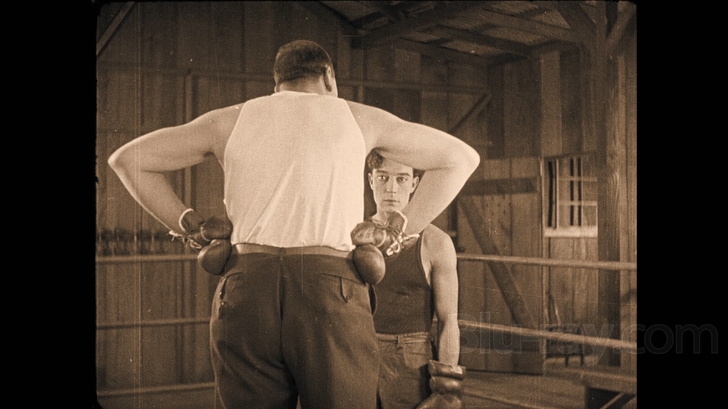
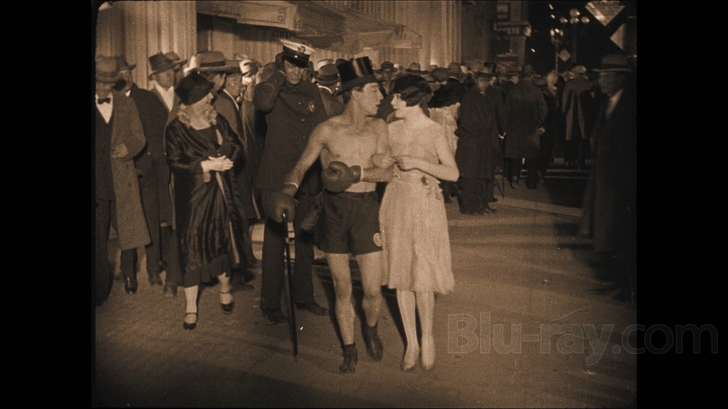
Rocky he ain’t. When Alfred gets in the ring for a training match—a process that involves becoming hopelessly entangled in the ropes—he gets knocked down stone cold with the very first blow to his chin. Whatever the opposite of “floats like a butterfly, stings like a bee” is, that’s what Buster is here, flailing and windmilling his arms in an utterly inept mimicry of the sweet science. He’s slated to fight the Alabama Murderer—a grizzled pugilist with the face of a feral dog—and we fully expect a slaughter. Alfred never makes it to the bout with the Murderer, but he does end up crossing gloves with the real Battling Butler in a locker room brawl that’s mean, scrappy, and surprisingly violent. We’re just not used to seeing Keaton like this; usually his characters overcome by sheer luck—or sometimes a combination of intellectual and acrobatic cunning—but here, with his young bride looking on, Alfred stages a comeback and lays into his opponent mercilessly, somehow emerging victorious. When he was making Raging Bull, Martin Scorsese remembered this scene and said, “The only person who had the right attitude about boxing in the movies for me was Buster Keaton.” That’s high praise coming from the director of what is arguable the greatest boxing movie ever. Battling Butler also has one of the all-time great Keaton endings. Wearing boxing shorts, a top hat, and nothing else, Alfred walks with his proud bride through throngs of rubbernecking people on a busy city street. It’s an image that suits Keaton perfectly—high-brow and low-brow, always making a scene.
Go West / Battling Butler Blu-ray Movie, Video Quality
Restored from nitrate elements preserved by the Library of Congress, Go West and Battling Butler arrive on Blu-ray with striking 1080p/AVC-encoded transfers that instantly outdate previous DVD releases. If you've been following Kino's steady output of Keaton films over the past year and a half, you'll know exactly what to expect here—a faithful-to-source picture, untouched by harsh digital restoration attempts, noise reduction, or edge enhancement, and unblemished by heavy compression or other encode issues. In both films, there's an expected level of age-related wear and tear—frequent scratches and white specks, light brightness flickering, mild staining, and some warping—but nothing out of the ordinary. After all, these films are quickly approaching the ninety-year-old mark, and film deterioration has taken its irreversible toll. As an experiment, I'd love to see what Criterion would do with these source materials, but I'm more than happy with Kino's presentation. Clarity is markedly improved over standard definition releases—you'll notice textures and details that would be impossible to see before—and it's clear that every attempt has been made to give a natural looking black and white gradient, taking into account the fact that some of the footage has inevitable become a bit washed out with age. Blacks are plenty deep, whites are bright without looking blown out, and contrast—with the exception of certain scenes—seems to be right where it needs to be. Go West is presented in pure black and white, while Battling Butler has a light sepia toning. Both look wonderful.
Go West / Battling Butler Blu-ray Movie, Audio Quality
Kino has previously loaded up many of the Keaton releases with various commissioned and archival score options, but for Go West and Battling Butler you'll only find a single track each, the former by Eric Beheim and latter by Robert Israel, both presented in uncompressed Linear PCM 2.0. The scores suit their respective films well— they're complementary rather than overpowering—and the orchestral, appropriately old-timey music is decently rich and dynamic. The only oddity I noticed was that in Go West, some of the "sound effect" elements of the score—like pounding drums when Keaton is buried in barrels on the train—are accompanied by an audible hiss that cuts out as soon as the effect is over. This happens several times, and I'm not sure why it wasn't addressed when the audio for this disc was being mastered. Still, it's not terribly distracting—more a temporary irk than anything.
Go West / Battling Butler Blu-ray Movie, Special Features and Extras
- "Go West" (1080p, 11:58): A 1923 western comedy short produced by Hal Roach that features a story enacted entirely by trained monkeys. No joke. The star monkey is even wearing a Keaton-style flat hat!
- Buster Keaton: Screenwriter (audio only, 59:19): A rare 60-minute audio recording listens in on Buster Keaton in 1958 hashing out a script proposal for the western TV series "Wagon Train."
- Battling Butler Remake Script Excerpts: A gallery with excerpts from an unproduced remake of Battling Butler that Keaton wrote in 1947.
- Stage Production Photos: A gallery with eleven photos from the 1922 stage production of Battling Butler.
- Stills: An additional gallery with fifteen stills from Keaton's Battling Butler.
Go West / Battling Butler Blu-ray Movie, Overall Score and Recommendation
Go West and Battling Butler are under-seen gems, and both show us sides of Buster Keaton that we never really see elsewhere. Like just about all of Keaton's work, they're also funny and clever and basically impossible not to like. If you've never really given silent comedies a chance, start with Keaton, and start anywhere—there's a lot to explore and just about all of it is more than worthwhile. Highly recommended!