GMO OMG Blu-ray Movie
HomeGMO OMG Blu-ray Movie 
MPI Media Group | 2013 | 85 min | Not rated | Jul 22, 2014
Price
List price:Third party: $20.71 (Save 31%)
Listed on Amazon marketplace

Buy it from YesAsia:
Movie rating
5.9 | / 10 |
Blu-ray rating
| Users |  | 0.0 |
| Reviewer |  | 4.0 |
| Overall | | 4.0 |
Overview
GMO OMG (2013)
A father and his family go in search for information about GMOs ("genetically modified organisms") in the food supply and are surprised by what they learn.
Starring: Jeremy Seifert, Finn Seifert, Scout Seifert, Jennifer Seifert, Pearl SeifertDirector: Jeremy Seifert
| Documentary | 100% |
Specifications
Video
Video codec: MPEG-4 AVC
Video resolution: 1080p
Aspect ratio: 1.78:1
Original aspect ratio: 1.85:1
Audio
English: DTS-HD Master Audio 5.1 (48kHz, 16-bit)
English: LPCM 2.0 (48kHz, 16-bit)
Subtitles
English SDH
Discs
25GB Blu-ray Disc
Single disc (1 BD)
Playback
Region A (B, C untested)
Review
Rating summary
| Movie | | 4.0 |
| Video |  | 4.5 |
| Audio | | 4.0 |
| Extras |  | 2.5 |
| Overall | | 4.0 |
GMO OMG Blu-ray Movie Review
Waiting for Monsanto
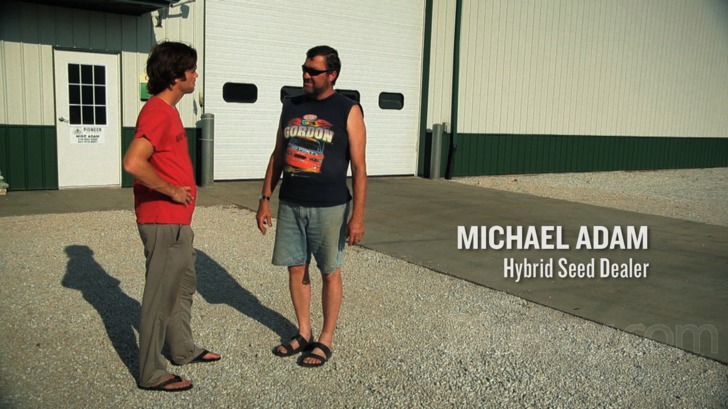
Reviewed by Michael Reuben July 25, 2014Monty Python fans will recall the famous sketch in which a health inspector investigates a candymaker for marketing a product called "Crunchy Frog". Far from being fancifully named, the sweet does indeed contain an actual chocolate-covered frog, complete with bones ("If we took the bones out, it wouldn't be crunchy!"). That fictional confectioner was a paragon of disclosure compared to Monsanto and the other chemical giants who have quietly introduced bio-engineered mutations (primarily corn and soybeans) into most of the U.S. food supply during the past fifteen years without so much as a mention on product labels. Indeed, the companies who create, patent and market these laboratory creations have vigorously opposed any effort to require that their presence be revealed to the average consumer, even though, when pressed, they defend their technologies as breakthroughs that will "feed the world". Why not embrace that mantra for its PR potential? Documentary filmmaker Jeremy Seifert set out to investigate this paradox and to learn what he could about GMOs (or "genetically modified organisms") in the food supply. He quickly discovered that reaction to the subject falls into two camps. The first, as reflected in a revealing montage at the beginning of his film, GMO OMG, can be described as "What's a GMO?" Most people have never heard of these things, even though they consume them every day. The second, much smaller camp is full of passionate partisans, arguing for and against the use of GMOs, each side citing studies that are far from conclusive on the health risks (or lack thereof) from daily consumption of such technological marvels as corn that has been genetically altered to produce its own pesticide (or dairy products from cows that have fed on such corn or chicken raised on it or products made with corn syrup derived from it, etc.). Within this hypercharged world, the subject of GMOs is so toxic that the mere announcement of Seifert's documentary at Blu-ray.com elicited charges and countercharges not usually occasioned merely by the news that a Blu-ray disc is being released. Seifert’s documentary is well worth seeing in this fine Blu-ray presentation from MPI Media Group. The film is both entertaining and informative, and unlike many documentaries on contentious topics, its approach is refreshingly low-key. Seifert presents himself as a concerned parent who would like to know what he's feeding his kids. He doesn't ambush his interview subjects, and he lets them say their piece, including several who have no quarrel with GMOs. He would have happily let representatives of Monsanto or other proponents of GMOs explain their benefits, if any had been willing to appear, but none would. Contrary to what some may expect, Seifert does not declare GMOs a health hazard, because no one knows whether they are or aren't. In fact, no one knows that much about them, because so little testing was done before they were disseminated en masse throughout the food supply. All Seifert wants is for products to be labeled either "GMO" or "GMO-free"—an apparently uncontroversial notion on the surface, but agri-business can't abide it.

Seifert's greatest asset as both a narrative device and a constant reminder of the stakes at issue are his three small children, two sons and an infant daughter, who, along with their mother, Jennifer, accompany Seifert on much of his factfinding tour as a family adventure. The boys in particular have a natural camera presence and an obvious rapport with their "director" such that they're a welcome contrast to the exposition and interviews that form the bulk of the film. The children also demonstrate, just by being there, what all this talking is really about. As the boys laugh and joke with their father about GMOs, they also scarf down fast food and ice cream, because kids want what they want. Without saying a word, Seifert is able to make the point that, even before people are old enough to read and understand labels, they already have consumed massive amounts of GMO-laden food. It really is important to know whether this stuff has been thoroughly tested for its long-term health effects. (As it turns out, it really hasn't been.) Even the most diligent of parents can't be sure what they're feeding their kids, as Seifert discovers when he goes from store to store, quizzing employees and management about product contents. Even the proudly organic Whole Foods cannot guarantee Seifert a GMO-free cart at the checkout line. Modified crops have so thoroughly pervaded our ecosystem that, when Seifert takes his boys fishing in an apparently pristine stream in California's Sequoia National Forest, the rainbow trout they catch and cook turns out to have been raised in a hatchery where it was fed on pellets made from GMO soy meal. Seifert interviews farmers, scientists and plant specialists about the use of genetically modified crops, and he does a nice job of breaking down the complicated science into comprehensible terms. GMOs represent a scientific response to historical problems that have plagued "monocropping", which is the cultivation of a single crop on a massive scale. The practice is vulnerable to multiple risks, including weeds and pests. By altering the crop at the cellular level, science hopes to reduce or eliminate these risks, at least in theory. The example on which Seifert focuses is the genetic alteration that makes crops immune to Monsanto's weedkiller, Roundup, the most commonly used herbicide in American agriculture. Crops with a specifically engineered gene can be doused with Roundup and survive, while the weeds around them die. What no one knows (because no peer-reviewed studies have been done) is how much Roundup is absorbed by the crops themselves and ultimately consumed by humans. The main ingredient in Roundup, glyphosate, is toxic in sufficient doses. Whether or not it is carcinogenic over the long term is still debated. Perhaps more importantly, though, nature is not known for standing still; in the famous phrase from Jurassic Park, it "finds a way". Farmers are already seeing Roundup-resistant weeds, like the ragweed that one grower shows Seifert. Similarly, insects that are immune to the pesticide-producing GMO plants have appeared, just as, decades ago, the widespread use of chemical pesticides created bugs that could tolerate the toxins. Nature adapts to our creations, and who knows what kind of chimera will result? Many of Seifert's interviewees celebrate organic farming as an alternative to monocropping, because the organic approach attempts to mimic nature's use of bio-diversity to control pests and nourish crops. Seifert visits the Rodale Institute in Pennsylvania, which claims to have demonstrated over a thirty-year side-by-side comparison that organic farming outperforms conventional chemical agriculture in the long run. But this is the weakest strand in GMO OMG, because "the long run" is no answer to a farmer struggling to make this year's target so that he can remain current on his bills. The economics of the U.S. (let alone worldwide) farm industry are too complex to be addressed in such summary fashion. Seifert's strongest material comes from agri-business itself, whenever it stonewalls inquiries about their thriving trade in GMOs or refuses any attempt at transparency on the subject. Whether it's a security guard ushering Seifert out of Monsanto's offices when he seeks an interview, or the intensive lobbying effort that torpedoed the labeling bills introduced by former Rep. Dennis Kucinich of Ohio, or the industry-funded campaign that defeated California's Proposition 37 in 2012 (which would have required labeling of GMOs), or the refusal to release data from their own studies on GMO safety and side effects, the industry continues to behave as if it has something to hide. While Seifert was working on GMO OMG, a French scientist named Gilles-Eric Séralini released a study showing that rats fed on GMOs over a period of two years developed tumors and other illnesses at significantly higher rates than a control group. Even though Séralini's methodology (including the species of rat) was essentially the same used by Monsanto to get GMOs approved by the EU—after only a three-month trial—the study was immediately pummeled by industry advocates. An update during the film's credits informs the viewer that the study's publisher subsequently withdrew it over the protest of numerous scientists, thereby confirming that the debate over GMOs is far from over. At least, though, thanks to people like Seifert asking questions, there are fewer people every day in the camp that responds: "What's a GMO??"
GMO OMG Blu-ray Movie, Video Quality

Cinematographer Rod Hassler, a veteran of reality TV, shot GMO OMG digitally with post-production completed on a digital intermediate. The image on MPI Media Group's 1080p, AVC-encoded Blu-ray is typical of a professionally shot digital video production, in that it's sharp, clear and colorful, with only an occasional hint of aliasing or noise to betray the limitations of what was almost certainly a 2K DI. The film's naturalistic palette can be memorably vivid, given the scenic beauty of some of the rich farm country that Seifert visits on his travels. Even the artificially colored ice cream cones that his children find so delicious look appealing. The average bitrate of 22.45 Mbps is respectable for digitally originated documentary material, and artifacts (other than those mentioned above) were not observed.
GMO OMG Blu-ray Movie, Audio Quality
Because of a longstanding interest in the subject, GMO OMG attracted the interest of a professional sound mixer and recordist, Daniel S. McCoy, who supervised the location recording and prepared the final mix. McCoy's involvement no doubt accounts for the unusually smooth quality of the voice recordings on the film's soundtrack, presented on Blu-ray in a choice of lossless formats, either DTS-HD MA 5.1 or PCM 2.0. The lively and eclectic score consists of original music primarily composed by San Diego-based guitarist and singer Cameron Fraser and performed by Jubilee Singers (a band that includes Fraser and Seifert), as well as songs from Willie Nelson, Mumford & Sons and Polyphony.
GMO OMG Blu-ray Movie, Special Features and Extras

- Bonus Interviews (1080p; 1.78:1): The most substantive among these "deleted scenes" is the interview with Fred Kirschenmann, who is described as a "Distinguished Fellow at the Leopold Center and President of Stone Barns Center"; Kirschenmann stresses that GMOs aren't good or bad in and of themselves; it's a question of how they are used. The most frivolous of these extras scenes is the fake "interview" with Secretary of Agriculture (and former Governor of Iowa) Tom Vilsack, who, in fact, refused to be interviewed; so Seifert "constructed" a mock encounter from Vilsack's published quotes, which are spoken by a puppet. It's a device for a comedy show, not a documentary, and Seifert was wise to delete it.
- Claire Hope Cummings (1:39)
- Don Young (2:29)
- Finn's Dream (1:26)
- Francis Thicke (4:12)
- Fred Kirschenmann (10:56)
- Goggles Galore (2:13)
- James Burkholder (1:48)
- Tom Vilsack (5:12)
- Trailer (1080p; 1.78:1; 2:18).
- Short Film: "The Scarecrow" (1080p; 1.78:1; 3:34): In this animated short sponsored by Chipotle Mexican Grill, a scarecrow leaves his job in the food processing industry to create wholesome dishes from fresh-picked produce.
- Additional Trailers: At startup, the disc plays trailers for other MPI documentaries (Weekend of a Champion, Fightville, John Mellencamp: It's About You and Citizen Koch), which can be skipped with the chapter forward button and are not otherwise available once the disc loads.
GMO OMG Blu-ray Movie, Overall Score and Recommendation

Despite GMO OMG's discussion of organic farming and "natural" food and its occasionally soaring rhetoric, the film is not the work of a starry-eyed idealist. Seifert makes a point of showing his wife and kids eating deli meats and snack food that would make a proper vegan blanch. His is a mainstream American household that came to the realization one day that their daily diet contained chemical additives that weren't disclosed on the packaging. Now they'd like to know more about those additives, and you should too. You've been eating them for years. Highly recommended.