Francofonia Blu-ray Movie
HomeFrancofonia Blu-ray Movie 
Music Box Films | 2015 | 87 min | Not rated | Jun 28, 2016

Movie rating
6.9 | / 10 |
Blu-ray rating
| Users |  | 0.0 |
| Reviewer |  | 3.5 |
| Overall | | 3.5 |
Overview
Francofonia (2015)
A history of the Louvre during the Nazi occupation and a meditation on the meaning and timelessness of art.
Starring: Louis-Do de Lencquesaing, Aleksandr SokurovDirector: Aleksandr Sokurov
| Documentary | 100% |
| Drama | Insignificant |
| History | Insignificant |
Specifications
Video
Video codec: MPEG-4 AVC
Video resolution: 1080p
Aspect ratio: 1.67:1
Original aspect ratio: 1.37:1, 1.85:1
Audio
Russian: DTS-HD Master Audio 5.1
Russian: DTS-HD Master Audio 2.0
Subtitles
English, French, German, Dutch
Discs
Blu-ray Disc
Single disc (1 BD)
Playback
Region A (C untested)
Review
Rating summary
| Movie | | 3.5 |
| Video |  | 4.0 |
| Audio | | 4.0 |
| Extras |  | 3.0 |
| Overall | | 3.5 |
Francofonia Blu-ray Movie Review
French Ark.
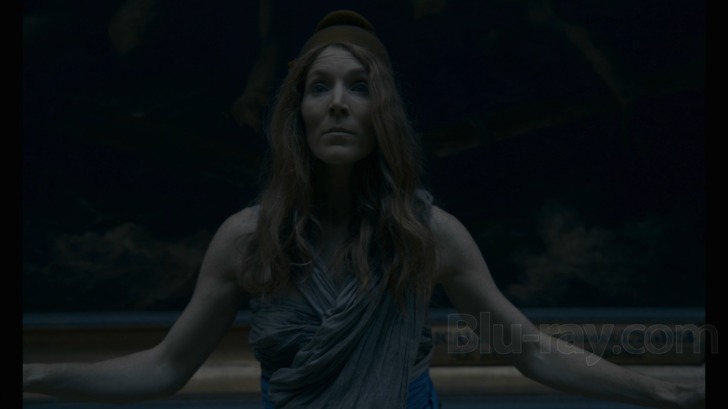
Reviewed by Jeffrey Kauffman July 6, 2016If you’ve never seen Alexander Sokurov’s acclaimed 2002 documentary about Russia’s Hermitage museum, Russian Ark, there’s probably nothing I could say to adequately describe Sokurov’s Francofonia. If you have seen Russian Ark, there’s probably nothing more I really need to say than, “This time it’s the Louvre.” Russian Ark was as much about form as it was about substance, gaining understandable acclaim for the fact that Sokurov managed the near impossible seeming logistical feat of covering hundreds of years of Russian history and a vast amount of geographical space within the Hermitage in a single, unedited take lasting over 90 minutes. Sokurov’s “tour” of the Louvre in Francofonia is a decidedly more (intentionally) jumbled affair, with lots of edits and video bells and whistles, along with some “meta” aspects that some viewers may find artistically questionable if philosophically relevant. Much as with Russian Ark, Sokurov is on hand in Francofonia, albeit as a “character” called the Author rather than as a ghost. There is a ghost haunting the Louvre, rest assured, though this time it’s a female spouting the well worn trifecta of the French Revolution, “Liberty, equality, fraternity.” Also on hand are Napoleon Bonaparte and various executives and soldiers during the Nazi era, not to mention the untold treasures that are housed within France’s most famous museum. The film’s main “story” (if it can be called that) is the interaction between the invading armies of Germany during World War II and the officials at the Louvre, but the film (much like Russian Ark) ventures far and wide temporally to establish certain core principles, the most central of which seems to be Sokurov’s thesis that Art (capital A, not necessarily relegated to paintings, sculpture and the like) is constantly under attack and vulnerable to being destroyed.
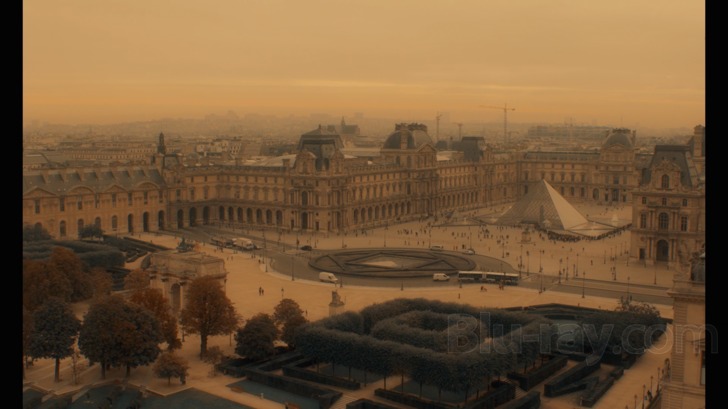
Fans of films like The Train or (perhaps more saliently) The Monuments Men may find Francofonia inherently fascinating, even if Sokurov’s presentational aspects are intentionally provocative and therefore may be (for some at least) slightly off putting. The Germans’ march into Paris was such a shocking event for the world in general, but obviously most devastatingly for the French, that Sokurov’s discursive treatment of it may seem to be giving short shrift to what is after all a central building block of Francofonia’s “plot” dynamics. But that fact in and of itself may provide a central clue to the fact that Sokurov is ultimately not that concerned with the interactions between the Nazis and the Louvre, and is instead utilizing that epochal moment in history to underpin his greater vision of Art (capital A again) under attack.
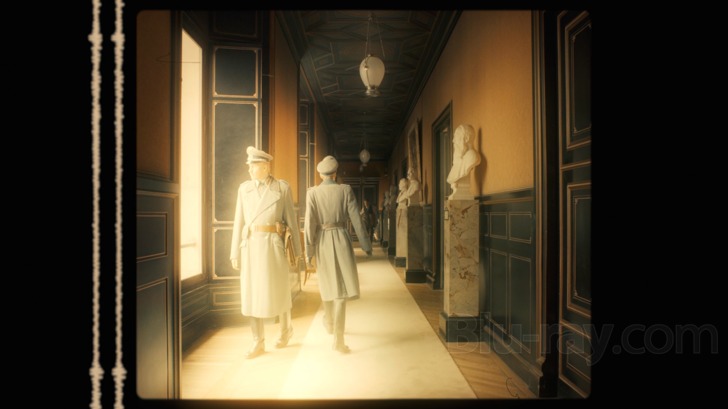
While Sokurov’s peripatetic camera darts and dollies in the labyrinthine halls of the Louvre, Francofonia is also filled with a glut of archival stills and footage, but even here Sokurov doesn’t just offer material “as is”, instead tweaking things visually at virtually every turn, often in some kind of odd but effective ways. The still photographs are often squeezed and warped, along with being rotoscoped, in ways that frankly induced a kind of queasy feeling in my stomach (the effect is eerily similar to Hitchcock’s vaunted “Vertigo effect”). Several of the dramatic reenactments featuring the Louvre’s “monument man” Jacques Jaujard are anamorphically squeezed, with a “recreation” of the soundtrack running up the left side of the frame (see screenshot 3). Other elements in this often kind of bizarre hodgepodge includes things like video sourced from a treacherous freighter ship fighting The Perfect Storm, a ship supposedly trying to get a bevy of valuable art to a safe port, in one of Sokurov’s perhaps too “on the nose” metaphors for threats facing Art.
It may seem kind of odd for a Russian to be examining the relationship of the Nazis with the French, especially since for at least part of the time depicted in the film, Russia (or more appropriately the USSR) was ostensibly an ally of the Germans and therefore perhaps tangentially culpable in any of the “hoarding” the Germans undertook when they captured caches of invaluable art. But, again, Sokurov’s aim is not this singular incident, or even in fact the more generalist proclivities of the Germans elsewhere during World War II, but his underlying premise that Art, even Art that seems inherently Eternal, is in fact a vulnerable commodity, one prone to the vagaries of history and the marauding nature of Mankind.
Francofonia Blu-ray Movie, Video Quality
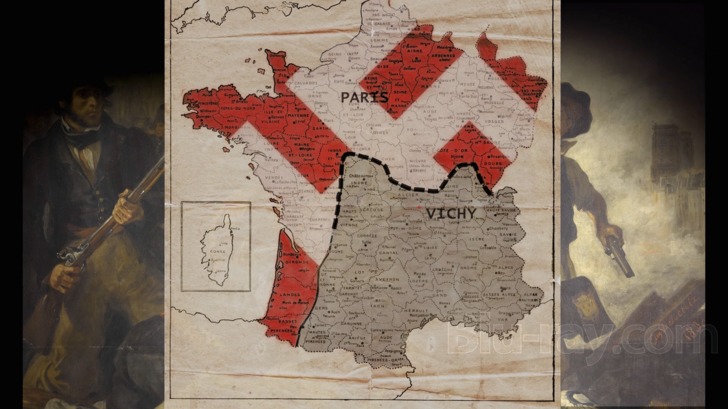
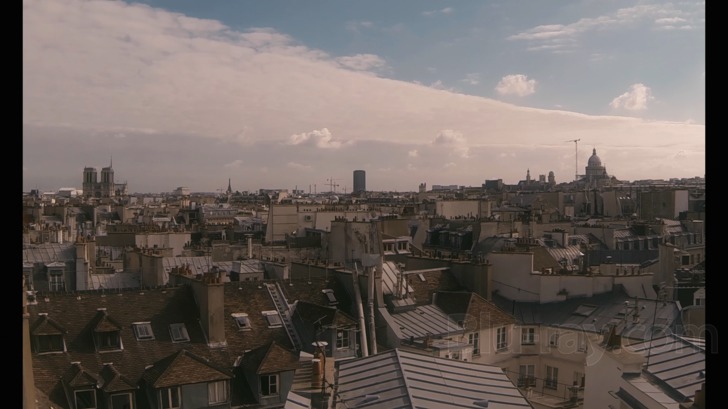
Francofonia is presented on Blu-ray courtesy of Music Box Films with an AVC encoded 1080p transfer in 1.67:1. The IMDb lists the Arri Alexa as the technology utilized for the film, but it's obvious that a huge array of various source elements was cobbled together to create a patchwork quilt of sorts, and as such, quality variances are rather wide, leading to a heterogeneous appearance a lot of the time. The cartwheeling tours through the Louvre have the sleek, smooth appearance of the Arri camera, and detail is at least decent, though Sokurov's tendency to shoot in dim light tends to tamp down fine detail at times. Contrast in some moments is also a bit underbaked, further undermining detail levels. There's some very bad macroblocking in some of the video sequences featuring the freighter ship during the storm, but whether that is inherent in the source material or a compression anomaly is up for debate. Video noise also intrudes in a number of darker scenes, something that probably is attributable to the capture technology. Some of the more "filmic" (as in actual, good old fashioned celluloid) elements, notably the flashback sequences that are anamorphically squeezed with the "soundtrack" data wiggling up the left side of the frame, are rather gorgeously color graded in a slightly yellowish way that nicely evokes a forties' Technicolor ambience.
Francofonia Blu-ray Movie, Audio Quality
Unless words like "nyet" and "da" are suddenly French, the disc's listing of French soundtracks is in error, and in fact Francofonia sports Russian language tracks in DTS-HD Master Audio 5.1 and 2.0. There's not a whale of a lot of difference between these two iterations due to the fact that the film is largely built out of sonic elements like single people talking directly to the camera, or at best small "scenes" involving two people (as in the flashback scenes featuring Jaujard). There's some subtle but immersive content with occasional ambient environmental sounds as well as Murat Kabardokov's score.
Francofonia Blu-ray Movie, Special Features and Extras
- Visitors to the Louvre: The Making of Francofonia (1080p; 53:33) is a well done examination with some good behind the scenes footage and commentary from Sokurov.
- The Man Who Saved the Louvre (1080p; 58:33) is an Emmy winning documentary about the German occupation's effects on the museum. This offers the choice of either a French soundtrack with English subtitles, or an English language soundtrack.
- Theatrical Trailer (1080p; 1:52)
Francofonia Blu-ray Movie, Overall Score and Recommendation
As a history lesson, Francofonia is both fascinating and frustrating. A lot of the information contained in this piece is intrinsically compelling, but Sokurov is not one to go the "Ken Burns" route and simply offer it straight, no chaser (so to speak). Therefore, one needs to tolerate certain stylistic flourishes the director brings to the subject in order to get to that content. Form and substance are once again equal partners in Francofonia as they were in Russian Ark, and fans of that earlier film will most likely also like (and maybe even love) this newer one. Those not yet up to speed with Sokurov's presentational excesses may best prepare themselves for Francofonia by deciding they're about to watch an Art Film (pun unavoidable, but relevant) rather than a documentary. Technical merits are generally strong, the supplemental package excellent, and Francofonia comes Recommended.
Similar titles
Similar titles you might also like
(Still not reliable for this title)

Dawson City: Frozen Time
2016

The Look of Silence
2014

The Insult
L'insulte
2017

Faces Places
Visages villages
2017

The Salt of the Earth
Le Sel de la Terre
2014

Jodorowsky's Dune
2013

Fire at Sea
Fuocoammare
2016

Transit
2018

The Last of the Unjust
Le dernier des injustes
2013

The Atomic Cafe
1982

The Two of Us
Le vieil homme et l'enfant | 50th Anniversary Edition
1967

Touki Bouki
1973

The Sorrow and the Pity
Le chagrin et la pitié
1969

The Image Book
Le livre d'image
2018

An Inconvenient Sequel: Truth to Power
2017

The Overnighters
2014
Missing
1982

Stray Dogs
郊游 / Jiao you
2013

City of Life and Death
南京!南京! / Nanjing! Nanjing!
2009

Never Look Away
Werk ohne Autor
2018