Frances Blu-ray Movie
HomeFrances Blu-ray Movie 
Kino Lorber | 1982 | 140 min | Rated R | Feb 18, 2025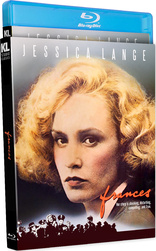
Price
List price:Amazon: $10.19 (Save 32%)
Third party: $10.19 (Save 32%)
Only 17 left in stock (more on the way).

Movie rating
6.9 | / 10 |
Blu-ray rating
| Users |  | 0.0 |
| Reviewer |  | 3.0 |
| Overall | | 3.0 |
Overview
Frances (1982)
The story of Frances Farmer's meteoric rise to fame in Hollywood and the tragic turn her life took when she was blacklisted.
Starring: Jessica Lange, Sam Shepard, Kim Stanley, Bart Burns, Jonathan BanksDirector: Graeme Clifford
| Drama | Uncertain |
| Biography | Uncertain |
| Romance | Uncertain |
Specifications
Video
Video codec: MPEG-4 AVC
Video resolution: 1080p
Aspect ratio: 1.85:1
Original aspect ratio: 1.85:1
Audio
English: DTS-HD Master Audio 2.0 Mono
Subtitles
English SDH
Discs
Blu-ray Disc
Single disc (1 BD)
Packaging
Slipcover in original pressing
Playback
Region A (B, C untested)
Review
Rating summary
| Movie | | 3.0 |
| Video |  | 3.5 |
| Audio |  | 4.0 |
| Extras | | 3.0 |
| Overall | | 3.0 |
Frances Blu-ray Movie Review
Reviewed by Jeffrey Kauffman February 23, 2025 Note: Around two or so years ago, a couple of regular
readers of my reviews here knowing of my well documented
inquiry into Frances
Farmer's
life
reached out and asked if I'd
take a look at a Spanish release of Frances
, since at that time
there was no official Region A Blu-ray release of the film,
something this new Kino Lorber edition remedies. This
review
incorporates some of that prior review, along with some new
"tidbits".
Frances bears the oft used imprimatur "based on [a]
true story", but that "based" part needs to be taken with a
rather liberal grain
(pillar?)
of
salt in this particular instance, as the film is in its own way as
"fictionalized" as the source novel which allegedly inspired it.
In that regard, here's a
little
homework assignment for anyone interested in the at times
almost comically variant accounts of Frances Farmer and
what "really" happened to
her: take a gander at
this video, a wonderful (if sloppily edited) archival interview with Farmer
and her
newly minted
third
husband Lee Mikesell filmed in 1958 shortly after she was
conveniently "discovered" (courtesy of Mikesell) working as a
reservations agent in the
San
Francisco Sheraton hotel. Is the woman in this video
anything like the ostensibly affectless, robotic and
zombiefied creature described in
that
aforementioned source tome (and shown briefly in the film's
coda) as what Farmer supposedly became after the
("fictionalized") late 1940s
lobotomy featured prominently in that book
and then rather
horrifyingly
portrayed in the climax of this film?
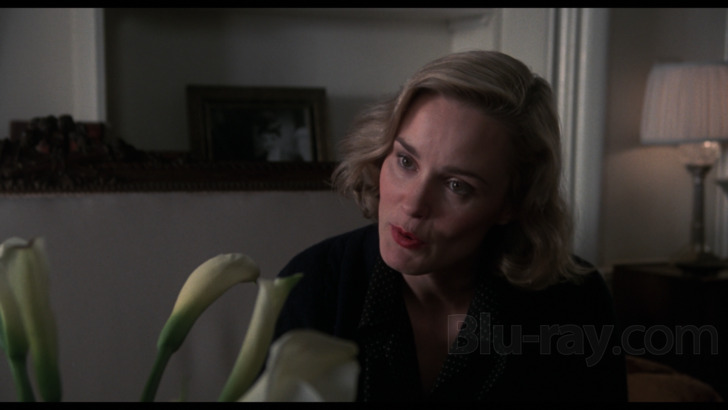
The real life story of Frances Farmer is indeed, as this film's log line (reproduced on the front cover) states, "shocking", "disturbing" and "compelling", but this film is most definitely not "true" in any substantially consistent way, arguably not just with regard to the film's incredibly disturbing climax, but perhaps even more especially in the way it portrays some of the admittedly complicated dynamics between Farmer (Jessica Lange) and her imperious mother Lillian (Kim Stanley). In that regard, those interested in a probably lengthy and undeniably picayune deconstruction of the source book and this film I provided decades ago here can find provided cited references from Farmer's comeback period in the late 1950s where she overtly stated it was she who wanted to stay in show business in the 1940s despite her well publicized breakdowns, and that it was her family (including her mother) who kept recommending she get out while she could, so to speak.
While the relationship between mother and daughter was undeniably contentious on occasion (Lillian passed along a certain stubborn streak to her youngest daughter) and even physically violent during Frances' erratic years, Lillian probably especially gets short shrift in this depiction. Aside from her aforementioned counsel to her daughter to get out of show business if it would help stabilize things, she also undeniably came to Frances' rescue at least twice during the troubled mid 1940s, when Frances was first arrested for violating a dim out zone with her headlights, and then even more saliently later when Frances ran away from the Kimball Sanitarium ("Hotel California") to escape insulin shock therapy. I also have in my personal collection some really touching correspondence between Frances and Lillian that easily disproves the notion that they were at each others' throats constantly.
That simple fact basically undercuts a lot of the inherent if obviously manufactured drama of Frances, though the screenplay by Eric Bergren, Christopher De Vore and Nicholas Kazan (who certainly should have known better, given that his father worked with Frances when Frances was a much more prominent star than Elia) at least gives Lange and Stanley several remarkable showdown scenes (both actresses received Academy Award nominations for their performances). The film is further hobbled by a completely fictional character played by Sam Shepherd, who shows up repeatedly as a veritable Deus ex Machina. (Anyone who really believes Harry York was based on a crackpot named Stewart Jacobsen should probably do a bit more digging, including somewhat hilariously in the March 21, 1983 issue of People, which has an article which relates directly to the Brooksfilm lawsuit I discuss in some detail in my research.)
Frances is so rife with historical inaccuracies that it is probably useless to document them here, but at least a couple are mentioned in my Frances Blu-ray review of the Spanish release, and there's a much longer list in my research linked to above. I was actually approached many years ago by a Hollywood producer who was attempting to "package" a "new" Frances Farmer biopic that he wanted to feature January Jones (though I'm frankly not sure he had even mentioned it to Jones, somewhat hilariously), and who was asking for some technical advice, but the effort seemed to be geared toward the same sensationalistic perspective that this film offers, and as is probably clear to anyone following Jones' career, it never got off the ground in any case. That still seems to support the idea that there continues to be rather remarkable interest in Farmer in film circles, and I can state emphatically that there is rarely a week that goes by that I don't hear from random members of the global Farmer aficionado club (I have dubbed those sharing this peculiar interest Franatics).
An accurate accounting of the life of Frances Farmer is probably still waiting to be told in film form, and aside from her stratospheric rise and then fall in Hollywood, it also includes both latter day triumph (she hosted the top rated afternoon show in the Indianapolis market for six years, often six days a week), as well as tragedy (again conflicting with the source book's assertion that she would "never again" cause controversy or confront authority after that supposed lobotomy, she had several well publicized run ins with both Indy station management and the law during the 1960s). The made for television entry Will There Really Be a Morning?, based on Farmer's ghost written "autobiography", probably comes a bit closer, but has its own issues (for those interested, there are actually two cuts, one which was broadcast in the UK, the other in the US).
For those armchair researchers willing to actually read something (that's a joke, maybe), two strong personal recommendations include: first, the brief but comprehensive chapter on Frances in my late friend Patrick Agan's The Decline and Fall of the Love Goddesses, which included contributions from interviews Patrick did with Lois Kibbee, who had been hired to ghost Frances' autobiography (Patrick sent me copies of cassettes of these interviews many years ago, and they're absolutely fascinating, as Kibbee had herself tape recorded Frances in preparation for writing the book); and second, while longer and even more picayune than my piece linked to above (also a joke, maybe), and also containing a few potentially un-PC issues, Look Back in Love, a self published book by Frances' sister Edith Farmer Elliot (this can be quite expensive if you can find it, since Edith only printed a relatively few copies). Edith lived in my hometown of Portland for much of her later life, though had moved to Sequim, Washington by the time I met her.
Frances Blu-ray Movie, Video Quality
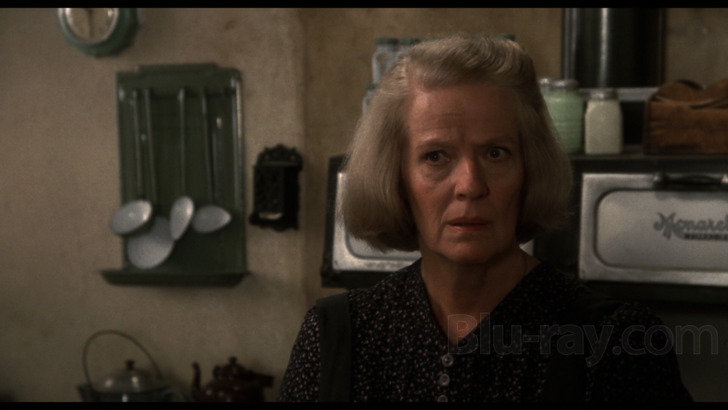
Frances is presented on Blu-ray courtesy of Kino Lorber with an AVC encoded 1080p transfer in 1.85:1. There's kind of interestingly if disappointingly no technical information offered on the packaging of this release, and that may well be by design, as this looks more or less identical to the Divisa release. Since both releases bear the Studio Canal masthead, I'm assuming they may have been culled from the same master. That said, as I mentioned in the review of the older Blu-ray, there's an appealingly golden burnished hue to a lot of this presentation which nicely replicates the original theatrical exhibition (which needless to say I've seen repeatedly). Densities are mostly secure as well and in outdoor material in particular, the palette pops beautifully, emphasizing László Kovács' really sumptuous cinematography. Things can fare a little worse in darker moments, as well as some interstitial scenes where clarity can ebb. Speaking of darker, I'd probably argue this has a just slightly darker appearance than the Divisa, something that may actually help boost a perception of suffusion. As with the Divisa release, there are very minor signs of age related wear and tear.
Frances Blu-ray Movie, Audio Quality
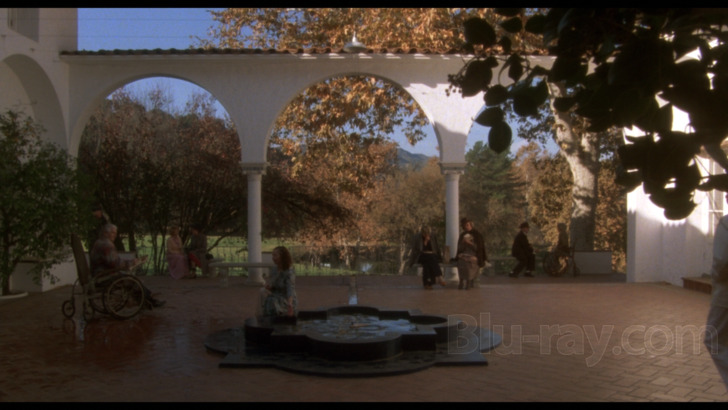
Frances features a nice sounding DTS-HD Master Audio 2.0 Mono track. One of the film's most moving elements is its gorgeous and haunting John Barry score, which prominently features the mournful sound of a harmonica, and all of his cues sound just fine. Dialogue is rendered cleanly and clearly throughout. Optional English subtitles are available.
Frances Blu-ray Movie, Special Features and Extras
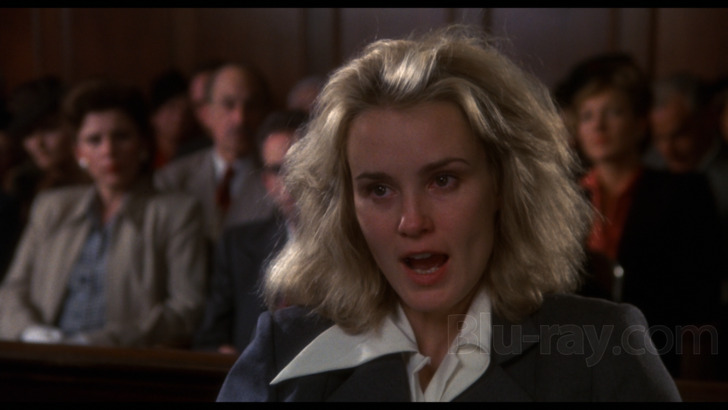
- Audio Commentary by Film Historian David Del Valle and Film Historian/Producer Dan Marino is exclusive to this edition. I may be writing a new article about it (and, yes, I'm probably joking).
- Audio Commentary by Director Graeme Clifford and Film Historian David Gregory is the archival piece that was on the old DVD release.
- A Hollywood Life: Remembering Frances (SD; 30:54) is an archival documentary from 2002 that was also on the old DVD.
- Theatrical Trailer (SD; 2:17)
Frances Blu-ray Movie, Overall Score and Recommendation
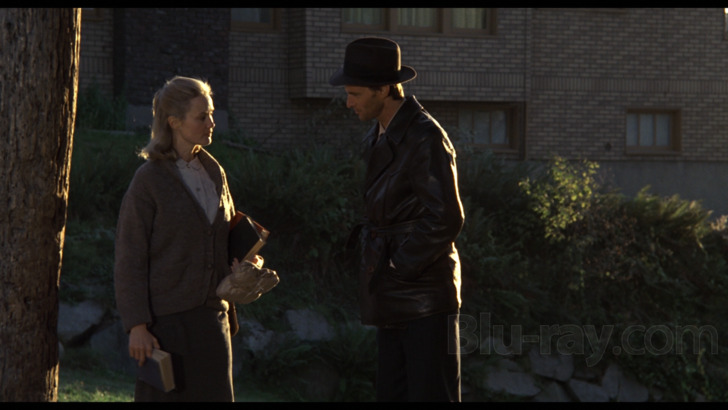
Considering the weighty (if "fictionalized") elements in Frances, I'll close with something maybe a bit lighter and more humorous. As alluded to above, in doing my insanely deep dive into this woman's history, I have accumulated a rather daunting (to my heirs at least) archive of Farmer material. In that regard and vis a vis a further example of Farmer's lasting impact, the famous Kurt Cobain song about her, I thought it would be hilarious (considering another fractious relationship at least somewhat like the one depicted between Lillian and Frances in this film) to open an honorific venue here and then put up a billboard on I-5 south maybe a bit north of Tacoma stating "Frances Farmer has had her revenge on Seattle. The Frances Farmer Museum is in Portland". Joking aside, the real Frances Farmer is starting to be available on Blu-ray, and I highly recommend those intrigued by her to check out Badlands of Dakota, where she plays Calamity Jane with considerable gusto, and/or Among the Living, where she frankly doesn't have much to do, but looks mah-velous and gets to have her famously husky speaking voice dubbed with a coloratura soprano scream. I have it on good authority that even more films with Frances may be imminent on Blu-ray relatively soon. This disc offers generally solid technical merits and unlike the Divisa disc, has some appealing supplements, for anyone who may be considering making a purchase.
Similar titles
Similar titles you might also like
Christine
2016

Room at the Top
1959

The Magnificent Ambersons
1942

A Star Is Born
Restored Edition | Warner Archive Collection
1937

Endless Poetry
Poesía sin fin
2016

Waves
2019

Stella Dallas
1937

Harlow
1965

Mass
2021

Inside Daisy Clover
Warner Archive Collection
1965

Saint Laurent
2014

Make Way for Tomorrow
1937

A Quiet Passion
2016
I Know Where I'm Going! 4K
1945

The Children's Hour
1961

Bastards
Les Salauds / Slipcover in Original Pressing
2013

Torment
L'enfer
1994

Miss Annie Rooney
1942

Tom of Finland
2017

Kill Your Darlings
2013