Forgetting the Girl Blu-ray Movie
HomeForgetting the Girl Blu-ray Movie 
Film Movement | 2012 | 85 min | Not rated | Apr 01, 2014

Movie rating
6.9 | / 10 |
Blu-ray rating
| Users |  | 0.0 |
| Reviewer |  | 4.0 |
| Overall | | 4.0 |
Overview
Forgetting the Girl (2012)
A photographer who specializes in head shots of young women asks each of his subjects on a date in an awkward effort to make a human connection and overcome a childhood trauma.
Starring: Christopher Denham (II), Lindsay Beamish, Elizabeth Rice, Anna Camp, Paul SparksDirector: Nate Taylor
| Thriller | Insignificant |
| Drama | Insignificant |
Specifications
Video
Video codec: MPEG-4 AVC
Video resolution: 1080p
Aspect ratio: 2.34:1
Original aspect ratio: 2.39:1
Audio
English: Dolby Digital 5.1 (640 kbps)
English: Dolby Digital 2.0
Subtitles
None
Discs
25GB Blu-ray Disc
Single disc (1 BD)
Playback
Region A (B, C untested)
Review
Rating summary
| Movie | | 4.0 |
| Video | | 4.0 |
| Audio | | 4.0 |
| Extras |  | 3.5 |
| Overall | | 4.0 |
Forgetting the Girl Blu-ray Movie Review
Aesthetic Amnesia
Reviewed by Michael Reuben March 31, 2014Forgetting the Girl is hard to characterize and even more difficult to describe. It could be called a psychological thriller, except that it lacks all the usual mechanisms of suspense. You know from the opening scene that there's something "off", but for a very long time it's unclear exactly what. By the time enough information has been revealed to give you some idea of what you've been watching, you could just as easily call the film a "character study". Then again, Psycho could be called a "character study" of Norman Bates. The difference is that Hitchcock's classic offers viewers the thrill ride of being scared and then relieved, with a clear understanding at the end of who did what to whom and why. Forgetting the Girl offers no such satisfaction. A few events are clearly rendered and the appearance of an explanation is offered, but the film leaves you with the cold, clammy realization that you're still not sure exactly what happened—or who the central character really is. This unsettling little film is the collaboration of first-time director Nate Taylor and first-time screenwriter Peter Moore Smith, who first partnered in 2003 and optimistically expected their modest project could be easily funded. Eight years and one financial crisis later, they struggled across the finish line at a fraction of their initial $1 million budget and began making the rounds of the festival circuit. Still, as Taylor notes, the delay did bring them one benefit, which was that their previously unknown cast had become recognizable in the interim. Star Christopher Denham, who carries the film, was seen in Shutter Island and Argo. Paul Sparks was cast as Mickey Doyle on Boardwalk Empire. Anna Camp appeared in The Help and on True Blood, as well as dating Don Draper in Season 4 of Mad Men. Elizabeth Rice landed an even larger recurring role on Mad Men as Roger Sterling's daughter. If nothing else, these budding careers vindicated Taylor's casting choices. Arthouse distributor Film Movement, through its RAM Releasing label, eventually acquired Forgetting the Girl and has chosen the film for its first Blu-ray release.
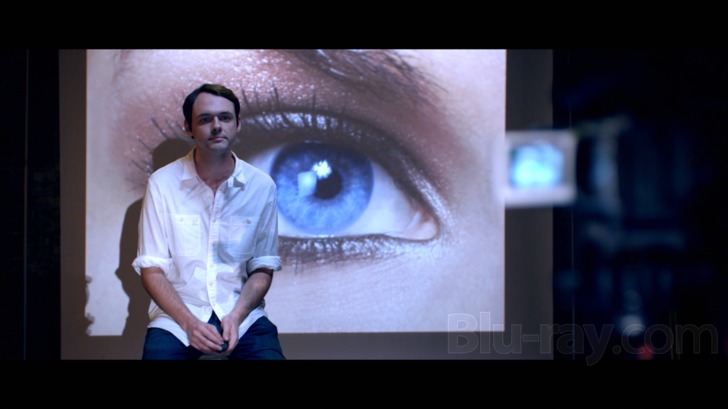
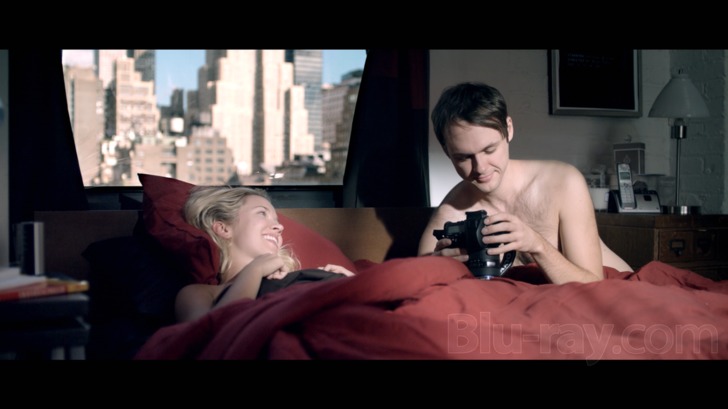
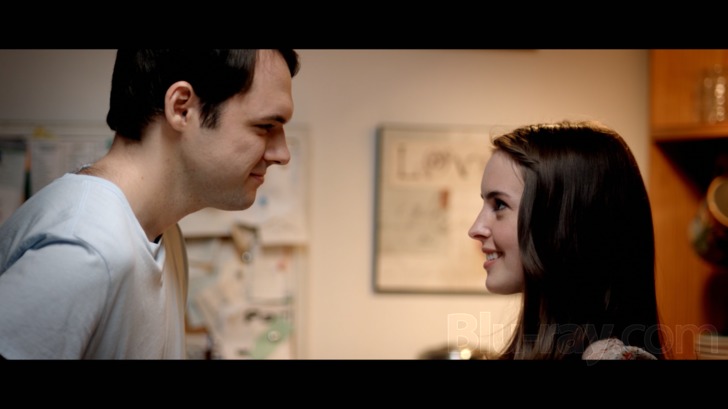
Kevin Wolfe (Denham) is a photographer in New York who specializes in reasonably priced head shots for aspiring actresses and models. Much of Forgetting the Girl is narrated by Kevin in the form of a video diary. Kevin gets much of his trade from do-it-yourself ads posted on street signs and lampposts. Kevin suffered a terrible loss as a child, the exact nature of which is only gradually revealed, but it has left him shy, withdrawn and unsure of himself, except in the studio, where the camera gives him confidence. Since he would like to find someone with whom to share his life, he takes advantage of the parade of young women who pass before his lens by asking each of them for a date. Most say no, but occasionally one says yes. As Kevin informs us, however, it never works out. Usually there's a lot of awkwardness that is painful to remember; so Kevin has perfected the discipline of "forgetting the girl" and moving on. Some girls are harder to forget than others. One of them is Adrienne (Camp), who is both beautiful and impulsive. She and Kevin seems to bond almost immediately, but then Adrienne abruptly changes her mind. Since we see her entirely from Kevin's perspective, we don't know what motivates her. We just know that Kevin has a particularly hard time letting this one go. Later comes Beth (Rice), who takes things more slowly than Adrienne and for whom Kevin has high hopes. A few people are regular fixtures in Kevin's life. One is the grandmother who raised him, Ruby (Phyllis Somerville), whom he visits regularly. Kevin's landlord and neighbor, Tanner (Sparks), is a smug afficionado of porn, internet and otherwise, who assumes from Kevin's profession that they share the same taste and can't understand why Kevin doesn't enjoy the explicit sexual imagery of which Tanner can't get enough. The person Kevin sees the most (indeed, so much that he doesn't really see her) is his assistant, Jamie (Lindsay Beamish). A permanently depressed Goth who does all the makeup for Kevin's photography subjects, Jamie watches silently while he asks out each of them. She clearly has a crush on her boss but lacks the courage to say anything. Instead, she asks him to join her and her gay friend, Derek (Joel de la Fuente, Law and Order: SVU), on outings like a camping trip. The differences among these personalities are fraught with dramatic potential, and as Kevin's video diary unfolds, it's clear that there's been a noteworthy event. But whether we're dealing with a nervous breakdown, a murder mystery, a suicide in progress or something else altogether remains unclear to the very end—and even then, plenty of questions remain unanswered. Forgetting the Girl is unsettling precisely because the person telling you the story keeps morphing into someone else. Just when you think you know him, you discover you don't.
Forgetting the Girl Blu-ray Movie, Video Quality
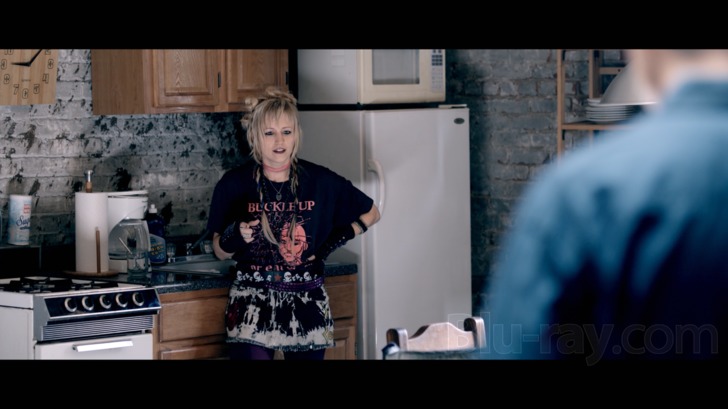
Forgetting the Girl was shot on Red cameras by cinematographer Mark Pugh (X: Night of Vengeance), then extensively color-corrected on a digital intermediate. RAM Releasing's 1080p, AVC-encoded Blu-ray was presumably sourced from digital files and reveals all the usual virtues of digital capture. The image is clean, sharp, detailed and noiseless, although it lacks the digital harshness that sometimes accompanies Red-originated footage. This may be a result of the specific lenses chosen by Pugh (which director Taylor discusses with enthusiasm in his commentary). Blacks are solid, and contrast levels are appropriate. The color palette in Kevin's studio has a soft, warm cast, reflecting the heightened emotional state in which Kevin works; a similar palette appears when Kevin is out with someone who raises his emotional temperature. Other scenes, where Kevin is more detached, are cooler. Interspersed with the Red imagery is occasional Super8 footage from Kevin's childhood and a few examples of magnified consumer-grade video recordings from Kevin's diary. These are obviously of lesser quality, but they are accurate to the source. Indeed, the Super8 sections have intensified colors, because they serve as memories of key events from Kevin's past. Even though Red footage typically compresses well, RAM has provided an average bitrate of 30.01 Mbps, which is admirably high, but as discussed below, RAM might have been better advised to devote some of those bits to the audio side of the disc.
Forgetting the Girl Blu-ray Movie, Audio Quality
As is so often the case when a studio first steps into the Blu-ray arena, RAM has not included a lossless audio option. I'm no militant on this issue, and I share the belief of many professionals that a Dolby Digital 5.1 track at 640 kbps, which is what RAM has provided, is transparent to the master. But the market reality is that any Blu-ray publisher who wants to be taken seriously must provide a lossless audio option. Blu-ray fans have come to expect nothing less. Forgetting the Girl's DD 5.1 track is more than up to the challenge of a sound mix that stresses dialogue and voiceover. The film doesn't have any "big" sequences, but it has several important sound effects (I can't be more specific) that need to register with volume and impact, which they do. The surrounds are used primarily for environmental ambiance and to support the minimalist score by Robert Miller (Teeth). A DD 2.0 track, also at 640 kbps, is also available.
Forgetting the Girl Blu-ray Movie, Special Features and Extras
- Commentary with Director Nate Taylor: Taylor provides both a history of the project and a detailed account of the production, with numerous details of the cast's and crew's adjustments to accommodate a tight production schedule. He talks about practical lessons he learned (e.g., don't schedule production during the summer on sets without air conditioning) and recounts one prime example of how disregarding the advice of a department (in this case, makeup) cost a lot of time and money in post-production to rectify the error. Taylor also points out subtle visual elements designed to amplify the film's themes subliminally. There are several instances in the commentary where the sound drops out for several seconds (at time marks 9:00 and 21:40); I suspect that these were mandated by legal concerns regarding clearances or other issues.
- Deleted Scenes (w/Optional Commentary) (1080p; 2.34:1): A "play all" function is included. Taylor's commentary on the last scene is particularly informative.
- Cherry Scene (2:06)
- Peep Show (0:52)
- River Walk (1:41)
- Suicide Note (1:23)
- Exclusive Web Videos: A "play all" function is included.
- Drown (720p; 1.78:1; 0:20)
- Jamie (1080p; 2.34:1; 0:28)
- Slides Fall (1080p; 1.78:1; 0:24)
- Playback (1080p; 2.34:1; 0:32)
- Tour (1080p; 2.34:1; 0:32)
- Trailers (1080p; 2.34:1)
- Forgetting the Girl
- Hide and Seek
- App
Forgetting the Girl Blu-ray Movie, Overall Score and Recommendation
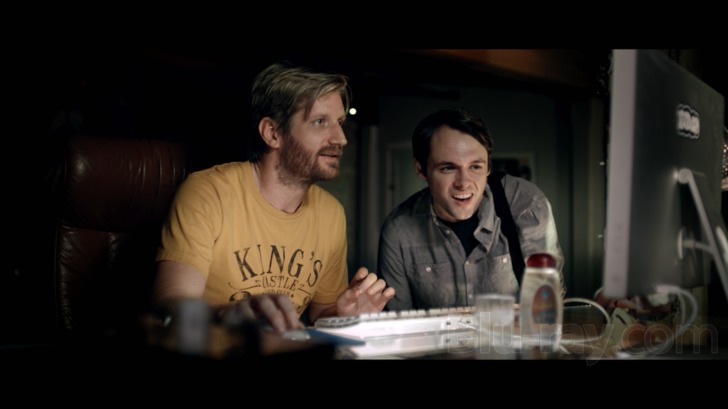
At first glance, Forgetting the Girl may appear to belong to a familiar cinematic genre that implicates the viewer in exploring voyeurism as a deviant, possibly dangerous activity. Hitchcock's films return constantly to this theme, and one of its purest expressions is Michael Powell's 1960 masterpiece, Peeping Tom (which effectively ended Powell's directing career). But Moore's script is not so easily categorized. Pay close attention to everything that happens—and I'm afraid I have to remain vague here—and it becomes clear that, in Moore's and Taylor's version, voyeurism isn't what it used to be. In a world where viewing entertainment is a major life activity, there's nothing odd about saying "I like to watch". Watching doesn't necessarily mean soulless detachment from others. The broken souls who insist on remaining apart do so by choice. What makes them that way? Moore and Taylor leave us wondering. Despite the lack of lossless audio, highly recommended.
Similar titles
Similar titles you might also like
(Still not reliable for this title)

Johnny Belinda
1948

Possessed
Warner Archive Collection
1947

Black Widow
Limited Edition to 3000
1987

Scarlet Street
Classics Edition
1945

The Three Faces of Eve
Fox Studio Classics
1957

Agnes of God
1985

Don't Bother to Knock
Limited Edition to 3000
1952

The Silent Partner
1978

The Strange Love of Martha Ivers
4K Restoration
1946

The Chalk Garden
1964

Mirage
1965

The Dark Mirror
1946

The Little Drummer Girl
Warner Archive Collection
1984

Freud
Freud: The Secret Passion
1962

The Forbidden Room
2015

Obsession
Indicator Series | Limited Edition
1949

So Evil My Love
1948

The Killer is Loose
1956

The Chase
Special Edition
1946

Witness to Murder
1954