Floating Clouds Blu-ray Movie
HomeFloating Clouds Blu-ray Movie 
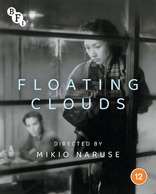
浮雲 / UkigumoBFI Video | 1955 | 123 min | Rated BBFC: 12 | Jul 01, 2024

Movie rating
6.7 | / 10 |
Blu-ray rating
| Users |  | 0.0 |
| Reviewer |  | 4.5 |
| Overall | | 4.5 |
Overview
Floating Clouds (1955)
A tragic social drama set in post war Japan and concerns a lonely woman trying to find purpose and stability in a devastated Tokyo.
Starring: Hideko Takamine, Masayuki Mori (I), Yaeko IzumoDirector: Mikio Naruse
| Foreign | Uncertain |
| Drama | Uncertain |
| Romance | Uncertain |
Specifications
Video
Video codec: MPEG-4 AVC
Video resolution: 1080p
Aspect ratio: 1.37:1
Original aspect ratio: 1.37:1
Audio
Japanese: LPCM 2.0 Mono
Subtitles
English
Discs
Blu-ray Disc
Single disc (1 BD)
Playback
Region B (locked)
Review
Rating summary
| Movie | | 4.5 |
| Video | | 4.5 |
| Audio |  | 5.0 |
| Extras | | 5.0 |
| Overall | | 4.5 |
Floating Clouds Blu-ray Movie Review
Reviewed by Dr. Stephen Larson April 16, 2025The British Film Institute's release of Mikio Naruse's FLOATING CLOUDS (UKIGUMO, 1955) comes with several extras: an audio essay about Naruse by author Catherine Russell, an exclusive audio commentary by film historian Adrian Martin, two archival interviews about the director and this film, a selected-scenes analysis, and an illustrated booklet. In Japanese, with optional English subtitles. Region "B" locked.
The work of Japanese auteur Mikio Naruse is not often discussed in the same breath as are the oeuvres of fellow luminaries such as Akira Kurosawa, Kenji Mizoguchi, and Yasujiro Ozu. Also, Naruse is probably not as well known the world over as later directors from his country are, including Shohei Imamura, Nagisa Oshima, Kaneto Shindo, Masahiro Shinoda, and Hiroshi Teshigahara. Why is this? Well, Naruse's movies are not as widely available or seen in the West. In her book, The Cinema of Naruse Mikio: Women and Japanese Modernity (Duke University Press, 2008), Catherine Russell notes there is a "scarcity" of them. She documents that just one of Naruse’s first sixteen films has survived with the firebombing of Tokyo in 1945 cited as a significant reason for this dearth. According to Russell, sixty-seven of the eighty-nine titles in Naruse’s filmography have survived and yet, not many have been seen. The situation improved somewhat in the 2000s when, in the UK, Eureka's Masters of Cinema series released Naruse: Volume One (Repast, Sound of the Mountain, and Flowing). The BFI put out their own box set containing Floating Clouds, Late Chrysanthemums, and When a Woman Ascends the Stairs. In the US, Criterion also issued When a Woman Ascends the Stairs, and its Eclipse series released the three-disc Silent Naruse (Apart from You,Every-Night Dreams, Flunky, Work Hard, No Blood Relation, and Street Without End). Along with Toho's BD-50 from a few years back, this BFI release represents the only editions of any Naruse title on Blu-ray.
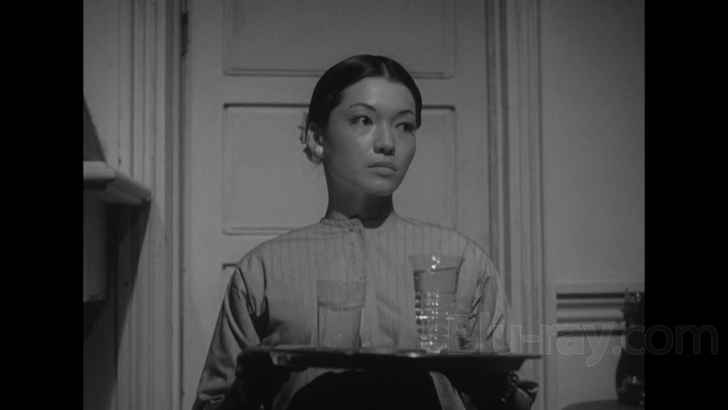
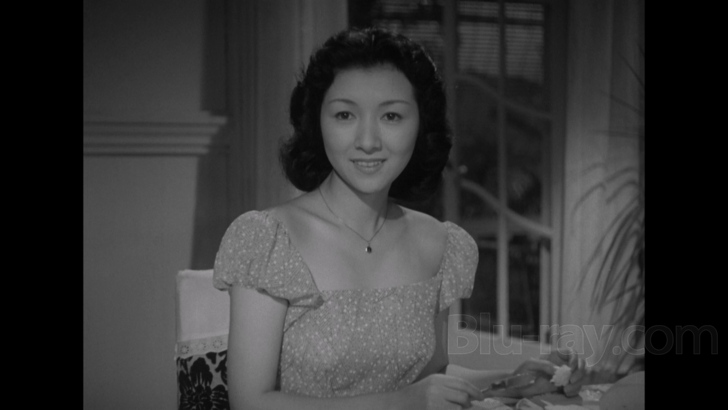
Floating Clouds is Naruse's most popular film in Japan and one of many "women's issues" movies that he made. It begins in the winter of 1946 with the repatriation of Koda Yukiko (Takamine Hideko) and other Japanese citizens who spent the war years elsewhere in French Indochina. Yukiko worked as an office worker in the Imperial Forestry Ministry at Da Lat where she met and fell in love with Tomioka (Mori Masayuki), an official. She hopes that she can rekindle her romance with Tomioka but when she locates him at his home, he is tending to his ailing wife. Tomioka had promised Yukiko that they could be together when they returned to Japan but he has changed his mind. But Yukiko remains persistent to keep their affair afloat. She has difficulty adjusting to postwar life and challenging economic conditions, though. While Tomioka struggles launching a lumber business, Yukiko experiences even harsher times. She works as a prostitute and keeps having bad luck, as well as maltreatment, at the expense of men. For example, years earlier she had a bad experience with her amoral cousin Iba (Yamagata Isao), who visits upon her return. Tomioka himself is unfaithful and a womanizer. He meets and has an affair with a woman named Osei (Okada Mariko) while lounging at a warm-springs resort in Ikaho with Yukiko. Only later does Tomioka realize the value and warmth Yukiko has brought to his life.
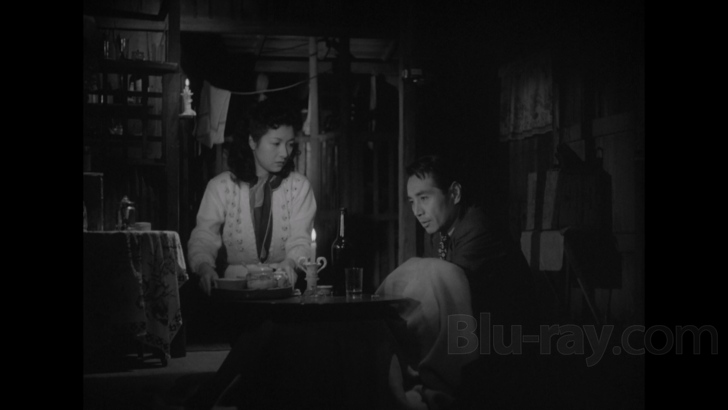
Floating Clouds is beautifully crafted by Naruse. He incorporates a continuity editing technique by form-cutting between different time periods while maintaining the same sound design. Unlike the classical Hollywood era of continuity editing which employs voice-overs, cue cards, and/or dissolves to link time and place, Naruse dispenses of all devices. He incorporates graphic matches between shots with the same characters that are seamless but viewers must reorient themselves because they're transported to a different locale they haven't yet seen.
The irony of Floating Clouds is that Yukiko and Tomioka are happier during the war than in the period after it has ended. Naruse makes some stark photographic contrasts between this span. For example, the outdoor scenes in Da Lat where Tomioka and Yukiko spend their time together is sunny and idyllic. The viewer can differentiate those brighter moments with the dank interiors the two principals occupy after they have returned to Japan. Weather is a major factor in reflecting their dour moods. For instance, monsoon-like rains descend when Tomioka takes Yukiko to the island of Yakushima in Kyushu in southern Japan. Floating Clouds paints a devastating postwar portrait of their lives and souls.
Floating Clouds Blu-ray Movie, Video Quality
The following text appears in the booklet:
Floating Clouds has been restored by Toho Co., Ltd. in 4K resolution and is presented in High Definition in its original aspect ratio of 1.37:1 with original mono audio.I watched the film separately in 1080p and upscaled to 4K on my region-free Sony Blu-ray player. While I don't have the BFI's 2007 DVD to compare, this restored transfer is nothing short of stunning and almost perfect. Whites look silky and the grayscale levels are luminous. Grain and texture appear natural. Contrast is remarkably good considering there are a lot of dimly-lit scenes with candles or sparse natural light present. There are some very small specks in one scene. I also noticed a few damage marks that crop up during a scenic transition that could have been present for a reel change on the print Toho used. But all in all, the transfer is mostly speckless. This MPEG-4 AVC-encoded BD-50 boasts a mean video bitrate of 36921 kbps. My video score is 4.75/5.00.
Technical producers Peter Stanley, Douglas Weir (BFI)
Blu-ray producer Vic Pratt
Disc authoring Visual Data Media Services
Thanks to Hisako Amano, Shion Komatsu (Toho Co., Ltd)
Twelve scene selections accompany the 123-minute feature.
Floating Clouds Blu-ray Movie, Audio Quality
The BFI has supplied a LPCM Dual Mono mix (2304 kbps, 24-bit) in the film's native Japanese. This monaural track sounds outstanding for a tightly-budgeted 1955 production. Spoken words are clear and comprehensible throughout except for one scene between two of the main characters where the dialogue either fades or rolls off. (The pitch levels are also different here.) The original music is by Ichirô Saitô. The score sounds bright with some high frequencies delivered during the main titles. Naruse and his composer incorporate a Middle Eastern-sounding theme that is performed as an ostinato on the film's non-diegetic track. According to Dr. Stephen O. Murray, this is an adaptation of the Scottish song, Auld Lang Syne, which was composed by Robert Burns in the 1780s. To my ears, the recurring piece sounds like an instrumental version of the Dance of the Seven Veils.
The BFI's optional white English subtitles are clear and legible.
Floating Clouds Blu-ray Movie, Special Features and Extras
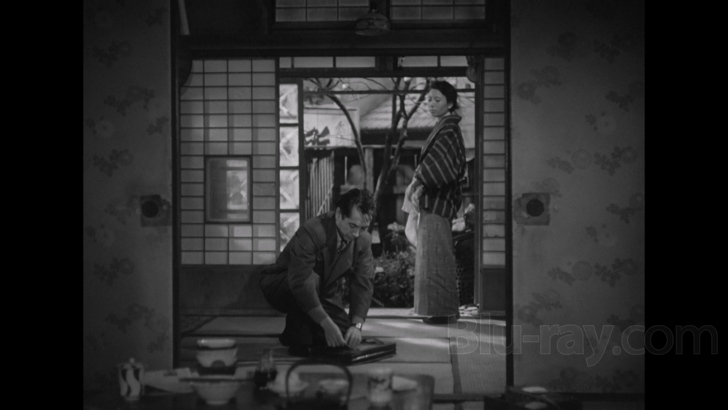
The BFI has retained three bonus features from its DVD, added a feature-length commentary as well as an older recording featuring a scholar's talk on Naruse.
- NEW Audio Commentary by Writer and Film Critic Adrian Martin - another great commentary track from the Australian cinephile. Martin compares and contrasts the similarities and differences Floating Clouds has with the original novel it is based on by Hayashi Fumiko. Martin also analyzes the film's mise-en-scène, staging, and editing. He additionally discusses the integral roles time and money play in Naruse's cinema. This is an in-depth commentary that covers a wide range of topics. In English, not subtitled.
- Mikio Naruse: Auteur as Salaryman (2016) (73:00) - this talk by academic Catherine Russell was recorded at BFI Southbank about nine years ago. An expert in the cinema of Naruse, Russell assesses the director's career, touches on some of his biography, and his predilection for doing women's films. Russell makes several stylistic and thematic comparisons between Naruse and Ozu's films. (She cogently explains their differences.) Moreover, Russell delves into Naruse's technique of "flowing" and rhythmic pacing as well as the use of color in his later films. Russell speaks for over 54 minutes and then answers questions for the remaining 18 minutes. The Q&A contains insights into Naruse's collaborators (e.g., scriptwriters) and his working methods. Russell's lecture can be selected via the menu's extras. It plays over the first half of Floating Clouds (accessible on Audio Track 3 of your player). Russell and audience members speak in English. Not subtitled.
- Interview with Japanese Film Expert Freda Freiberg (2007) (10:18, upconverted from 576i to 1080i) - In this archival program, Freiberg places Floating Clouds in the context of Naruse's career and how it generally compares to his other films. She also discusses Fumiko Hayashi's novel on which the film is based on. Freiberg compares how Kengo Tomioka is treated in the movie versus his portrayal in the book. Additionally, she talks about how postwar Japan is represented in Floating Clouds and how certain aspects of its milieu is reflected by its characters. In English, with optional English subtitles.
- Paul Willemen on Floating Clouds (2007) (7:07, upconverted from 576i to 1080i) - In this archival interview, Willemen examines the characters and thematic tropes of Naruse's 1955 feature. In English, with optional English subtitles.
- Floating Clouds Selected Scenes Commentary (2007) (10:27, 1080p) - Freda Freiberg examines a key sequence from the film. She explains how it fits with the rest of the picture. Freiberg also describes a couple major themes and recurring motifs. In English, with optional English subtitles for the commentary.
ADDITIONAL CONTENT
- Illustrated Booklet - a 30-page booklet featuring three essays on Floating Clouds. The first is a piece by Catherine Russell revised and expanded from a section she devoted to the film from her book on Naruse. She gives more space here to the movie's style. Two additional essays were previously published and reprinted here. Adrian Martin examines what he describes is the "walking journey motif" in the film. He also discusses Naruse's work in the context of postwar European cinema. Freda Freiberg unpacks the "materialist ethic" of Naruse. She explains why film academics in the West have branded Naruse a second-rate director and why he deserves a renewed place alongside his country's master filmmakers. Freiberg also looks closely at Naruse's silent movies and several of his later works. The booklet contains numerous stills from Floating Clouds and provides a list of credits.
Floating Clouds Blu-ray Movie, Overall Score and Recommendation
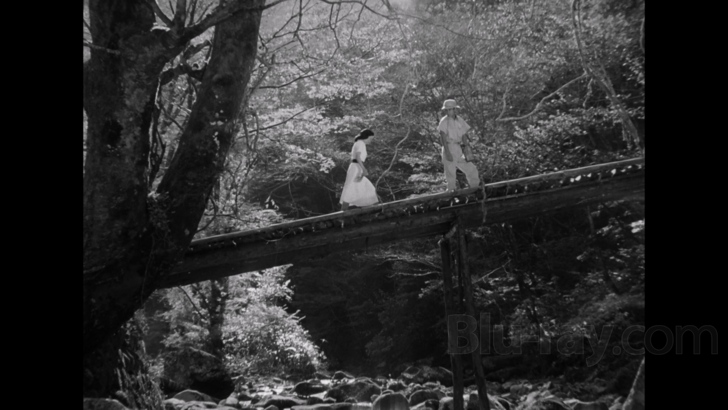
If you are new to Naruse's work like I was, Floating Clouds serves as a very fine introduction. Some of themes cross-pollinate with those of Ozu's but I would argue that Naruse's material is darker. While this isn't a cheerful film, Naruse should be commended for developing the pathos well and not allowing the melodrama between Yukiko and Tomioka to become too schmaltzy. Toho and the BFI's image/sound transfers are phenomenal. The supplementary items add great value to the film's content and context. VERY HIGHLY RECOMMENDED.
Similar titles
Similar titles you might also like

Norwegian Wood
Noruwei no mori
2010

The World
世界 / Shì jiè / Masters of Cinema
2004

Tokyo Sonata
トウキョウソナタ / Tôkyô sonata / Masters of Cinema
2008

A Simple Life
桃姐 | Tou ze / Sister Peach
2011

The Green Ray
Summer / Le rayon vert
1986

Suzhou River
苏州河 / Sūzhōu hé | Standard Edition
2000

The Immortal Story
Histoire immortelle
1968

Tokyo Decadence
トパーズ / Topâzu | Standard Edition
1992

2046
2004
Phantom
Masters of Cinema
1922

Guilty of Romance
恋の罪 / Koi no tsumi
2011

The Cranes Are Flying
Летят журавли / Letyat zhuravli
1957

Akasen chitai / Yôkihi
赤線地帯 / 楊貴妃 | Street of Shame / Princess Yang Kwei-Fei | Masters Of Cinema
1956

The Marriage of Maria Braun
Die Ehe der Maria Braun / Arrow Academy
1978

Record of a Tenement Gentleman
長屋紳士録 / Nagaya shinshiroku
1947

Early Summer / What Did the Lady Forget
麦秋 / Bakushū / The Ozu Collection
1951

Journey to the Shore
岸辺の旅 / Kishibe no tabi | Masters of Cinema
2015

Mountains May Depart
山河故人 / Shān hé gù rén
2015

Lourdes
2009

An Autumn Afternoon
秋刀魚の味 / Sanma no aji | The Ozu Collection
1962