Film Noir Collection: Volume 1 Blu-ray Movie
HomeFilm Noir Collection: Volume 1 Blu-ray Movie 
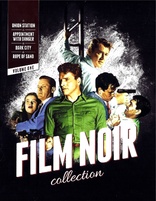
Union Station / Appointment with Danger / Dark City / Rope of SandOlive Films | 1949-1951 | 4 Movies | 371 min | Not rated | Nov 13, 2012

Movie rating
Movie has not been rated yetBlu-ray rating
| Users |  | 4.0 |
| Reviewer |  | 3.0 |
| Overall | | 3.0 |
Overview
Film Noir Collection: Volume 1 (1949-1951)
| Film-Noir | 100% |
| Drama | 36% |
| Crime | 20% |
| Romance | 9% |
| Mystery | 2% |
| Adventure | Insignificant |
| Thriller | Insignificant |
Specifications
Video
Video codec: MPEG-4 AVC
Video resolution: 1080p
Aspect ratio: 1.34:1
Original aspect ratio: 1.37:1
Audio
English: DTS-HD Master Audio Mono
Subtitles
None
Discs
25GB Blu-ray Disc
Four-disc set (4 BDs)
Playback
Region A (locked)
Review
Rating summary
| Movie | | 3.0 |
| Video | | 3.0 |
| Audio | | 3.0 |
| Extras |  | 0.0 |
| Overall | | 3.0 |
Film Noir Collection: Volume 1 Blu-ray Movie Review
Maybe not noir exactly, but at least gris.
Reviewed by Jeffrey Kauffman November 8, 2012Note: The scores above are averages spread over the contents of the box set. For individual scores, see below.
Where would we be without French film critics? We’d have no auteur theory and we’d probably still be calling low
budget B-movies from the forties and fifties, well, low budget B-movies, instead of the infinitely more colorful (no pun
intended) film noir, a phrase that was first utilized by Nino Frank in 1946 but didn’t really come into wide
acceptance (at least in the United States) until decades later. The noir genre is often widely misunderstood, and
that misunderstanding may be further exacerbated by this odd assortment of four films. At least some of the entries in
this box set would have a hard time proving their noir bona fides, but that’s not to say that each isn’t relatively
entertaining in its own way. Even if one were to agree that these four were indeed films noirs (a highly debatable
premise), few would probably rate any of these at or near the top of this lauded idiom. But there are some really
interesting elements to each of these films, including a wealth of fantastic supporting performances and at least a couple
of unexpected characterizations by actors who would go on to become legendary in the annals of Hollywood.
The four films in this set are:
Union Station
Film: 3.0 stars
Video: 3.0 stars
Audio: 3.5 stars
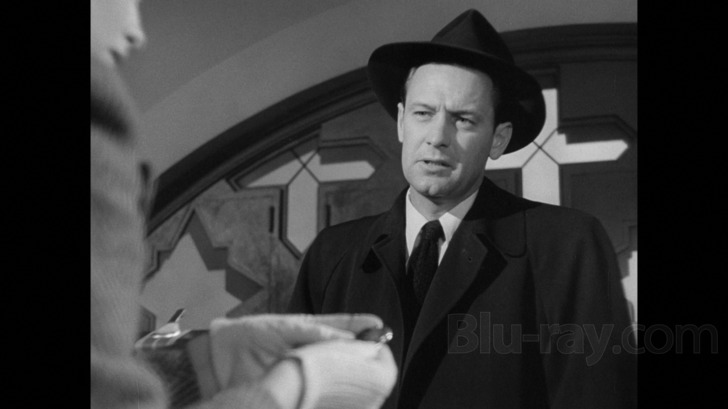
Quick! Name a 1950 noir starring William Holden and Nancy Olson. Probably the vast majority will immediately think of Billy Wilder’s immortal Sunset Boulevard, but there’s actually another film that meets that criterion, the (much) lesser known Union Station. Set in Chicago (and largely in the Windy City’s main train terminal), Union Station deals with a hardnosed cop named William Calhoun (William Holden) whose beat is the train station. Calhoun is a no nonsense kind of guy who upbraids a new underling who has the temerity to question Calhoun’s modus operandi (and to mention Calhoun's nickname), but Calhoun is also a soft touch when it comes to damsels in distress, and that’s where comely young secretary Joyce (Nancy Olson) comes into the story. Joyce is convinced she’s seen some bad guys getting away from a crime scene and then boarding her commuter train, and she reports that information to Calhoun. That turns out to be at least a bit of a red herring in terms of the actual focus of Union Station, for what ensues is a kidnap drama that involves the blind daughter of Joyce’s wealthy employer.
Truth be told, Union Station really only flirts with some noir staples, mostly in terms of how it deliberately shades the actions of the police to make them only slightly less reprehensible than the bad guys. It’s rather unusual to see Holden playing a role like this, though if one thinks of that other 1950 film he starred in with Olson, it becomes apparent that despite his usually heroic trappings, he was an unusually nuanced actor who often played roles that had troubling characteristics. Calhoun rides roughshod over not just his underlings (less so with his city inspector partner, played by Barry Fitzgerald), but (not to state the obvious) the various villains that permeate this film.
Despite its somewhat claustrophobic feeling, especially in the train station segments, this is probably a too “wide open” film to really be considered a traditional noir. (Fans of Hugo may get a kick out of one of the hiding places from which the police spy on the goings on in the station.) Still, it’s an often exciting little action film with some great performances. It’s a minor outing in Holden’s oeuvre, but one which shows what a perhaps unexpectedly versatile performer he really was.
Appointment With Danger
Film: 2.5 stars
Video: 3.0 stars
Audio: 3.5 stars
The world of cops and robbers is filled with various niches, but you’d be hard pressed to find a weirder nook and/or cranny than the one that Appointment With Danger inhabits, namely the vicious, violent and backstabbing universe of (wait for it) postal inspection. Yes, that’s right, noir star non pareil Alan Ladd stars as a detective named Al Goddard (what is it with these early fifties outings with characters bearing the same names as their stars?) who works for the United States Postal Inspection Service. Lest you think Appointment With Danger deals with some arch nemesis who is marauding through the world of philately, there’s actually a murder involved which Goddard is investigating. The only eyewitness to the murder turns out to be a nun, Sister Augustine (Phyllis Calvert), and Goddard’s attempts to crack the case put both him and the Sister in appropriate peril.
Appointment With Danger, despite its odd sounding premise, is actually much more in tune with basic noir tropes. That said, the film starts out with an unintentionally hilarious little “documentary” lauding the incredible efficiency of the post office and how proud we American citizens are of this fantastic government agency. That then segues to a scene of two toughs (played by future Dragnet partners Harry Morgan and Jack Webb) who have just killed a man. When these two guys stop with their murder victim, Morgan makes the mistake of helping a nun open her umbrella in the pouring rain. The nun is suspicious and alerts a nearby police officer, and soon a postal inspector is found dead in an alleyway where the bad guys have left his body.
We meet Ladd’s character Goddard as he’s proving that the dead postal inspector couldn’t have been ambushed in an attack. Goddard’s method of proof is sending another investigator into a karate backflip. Meanwhile everyone around Goddard is prone to discussing just how tough a guy he is. Goddard traces the bad guys to Gary, Indiana with the help of Sister Augustine, but unfortunately in the process the Sister is seen by the Webb character. It’s kind of fun to see stalwart Joe Friday playing such a vicious bad guy in this film (he doesn’t just go after the poor nun, he takes out one of his accomplices with a bronze statue).
Goddard infiltrates the bad guys in order to figure out why they would want to kill a postal inspector. A major robbery scheme turns out to be in the works. Appointment With Danger is often quite taut, but it’s going to provoke unintentional giggles in cynical modern day audiences when the great Victor Young’s “rah rah” patriotic score whips up in a brass fanfare fueled frenzy every time we see shots of a post office.
Dark City
Film: 3.5 stars
Video: 3.0 stars
Audio: 3.0 stars
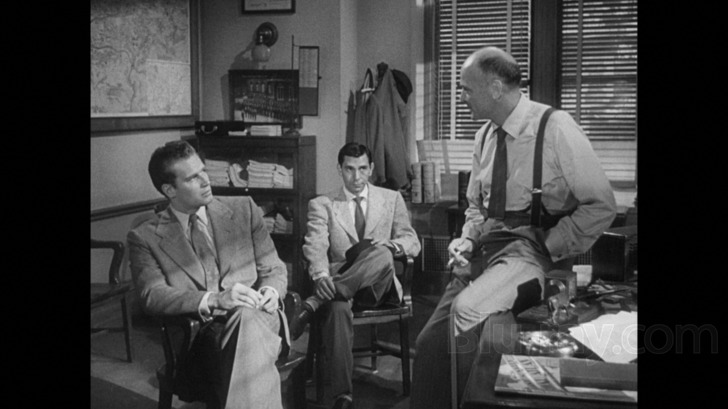
Charlton Heston made his film debut in Dark City (not to be confused with Alex Proyas’ science fiction film of the same name). Heston plays Danny Haley, a two bit crook who runs a book making operation that is raided by the cops in the film’s opening scene. Police captain Garvey (Dean Jagger) lets Danny know that Garvey is going to get the goods on him sooner or later, despite the fact that Danny evidently has a clean rap sheet. In the meantime, Danny’s girlfriend, nightclub singer Fran Garland (Lizabeth Scott) is urging Danny to go straight. Danny and his minions Barney (Ed Begley) and Augie (Jack Webb, yet again, and again paired with his future Dragnet co-star Harry Morgan) help rope in a sucker named Arthur Winant (Don DeFore) to a rigged poker game, where they initially let the hapless guy win, and then lure him back to basically rob him blind. The results are so devastating that Winant ends up committing suicide. And then suddenly the predator becomes the prey, as Winant’s vicious brother (Mike Mazurski, not really seen until the film’s climax) shows up to exact revenge on the guys he feels basically murdered his brother.
This is probably the all around best film of the four included in this set, one helped immeasurably by old pro William Dieterle’s to the point direction. The simultaneous cat and mouse games between Danny and Detective Garvey and Danny and Winant’s brother are handled with a lot of suspense and, at least in the scenes between Garvey and Danny, some crackling good dialogue. Things get a little smarmy when Danny starts romancing the dead guy’s widow (Viveca Lindfors) in order to track down the mysterious brother, and the film does have an oddly unsatisfying ending, where Danny ditches the poor widow without a second thought and also never really has to pay the piper for his involvement in Winant’s death, however tangential that connection might be.
Dark City is an interesting film for Heston, who of course would go on to portray some of the most legendary heroes in cinema history. Here’s he’s in a somewhat similar position to Kirk Douglas’ debut in another noir featuring Lizabeth Scott, The Strange Love of Martha Ivers. Both actors began their screen careers cast completely against what would later become their type, though it’s perhaps worth noting that producer Hal Wallis must have recognized Heston’s intrinsically heroic qualities, since he hedges Danny’s crooked tendencies in the film’s closing moments.
Rope of Sand
Film: 3.0 stars
Video: 3.5 stars
Audio: 2.5 stars
Burt Lancaster evidently despised Rope of Sand, but the film holds up surprisingly well in hindsight. It’s an unapologetic potboiler which perhaps has its greatest cachet in reuniting three stars of Casablanca, Paul Henreid, Claude Rains and Peter Lorre. Henreid does a complete about face from his noble Casablanca character, and here essays a vicious martinet named Vogel who runs a police force protecting a South African veldt that is rich in diamonds. Rains is somewhat closer to his Casablanca character, once again a sort of two-faced cad who is somewhat lovable despite being morally questionable (at the very least), here in his guise as Martingale, the Chairman of the Board of the company that Henreid works for. Lorre has a colorful supporting role as the wonderfully named Toady, a kind of lush who befriends Lancaster’s character, Mike Davis, a man with a history with Vogel.
The basic plot of Rope of Sand sees Davis returning to South Africa after having been viciously tortured by Vogel several years previously for not revealing the location of some diamonds after a client of Davis’ had mistakenly wandered onto the protected diamond region and discovered a treasure. Is Davis back to reclaim the booty? Or does he have a more personal revenge motive up his muscular sleeve? Vogel wants to beat the information out of Davis, but Martingale, who has an ambiguous relationship with Vogel to begin with, believes he can coax more out of Davis by utilizing a French coquette named Suzanne (Corinne Calvet). Rope of Sand was Calvet’s first American film, and she’s attractive (and notably physically reminiscent of Rita Hayworth), but her thick accent and lack of dramatic gravitas helps to deprive the film of both coherence and the necessary romantic sparks to ignite the central love story.
Rope of Sand, like Dark City, was directed by William Dieterle, who brings a workmanlike efficiency to this tale which wants to trade on the faux exoticism of Casablanca, but never manages to work up much of a froth, despite a riveting performance from Henreid, who has never been so nasty on screen. The film plays with some noir tropes, especially in its closing act, but the rest of the film, some of it supposedly in the wide open South African dunes and seaports, hardly qualifies as the dark, shadowy world that usually typifies this genre. Lancaster, despite his qualms about the film and his role, comes off quite well, able to withstand the occasionally risible dialogue and on a more visceral level, the horrible beatings he undergoes (repeatedly) at Vogel’s command throughout this outing.
Film Noir Collection: Volume 1 Blu-ray Movie, Video Quality
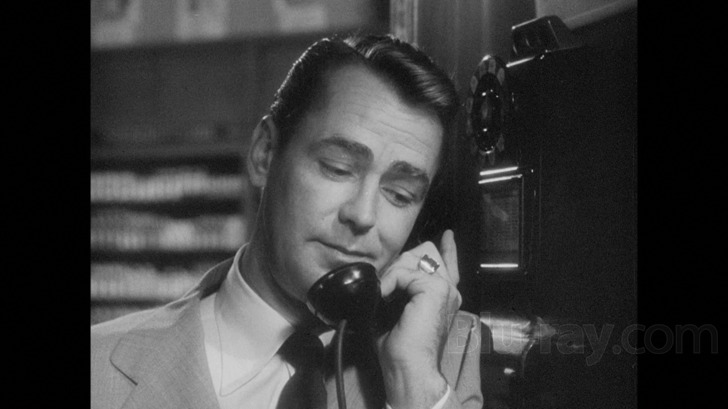
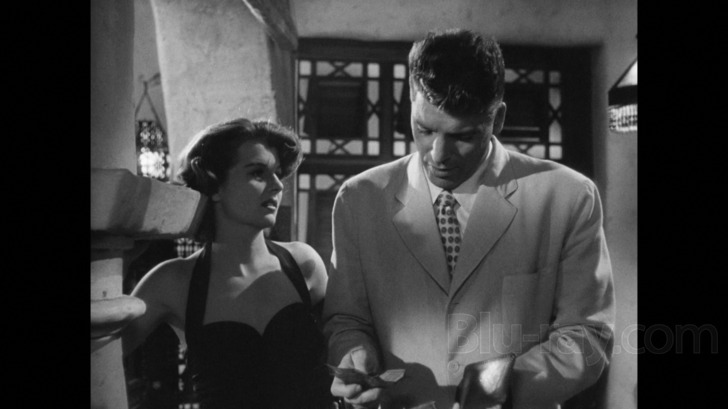
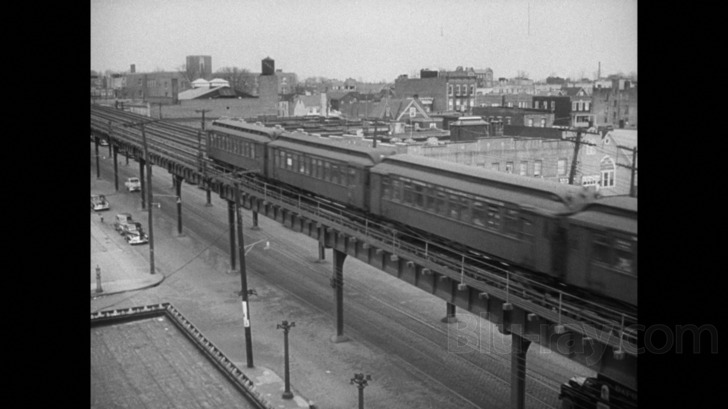
Note: screenshots are distributed among the four films in the following way:
Union Station: 1, 5, 9, 13, 17
Appointment With Danger: 2, 6, 10, 14, 18
Dark City: 3, 7, 11, 15, 19
Rope of Sand: 4, 8, 12, 16, 20
All four of these films are presented on Blu-ray courtesy of Olive Films with AVC encoded 1080p transfer in 1.34:1. All four
films are culled from elements which show quite a bit of age related wear and tear as well as other damage. Union
Station and Appointment With Danger both exhibit variable contrast and occasional print through and emulsion
mottling. The final few minutes of Dark City is especially bad, with a milky white overlay that resembles splotches of
bleach that have permeated the image. While Rope of Sand has the same print through issues, they're mostly
limited to the first few minutes, after which things improve dramatically, and this has the strongest transfer in the bunch,
with generally superior contrast and nicely modulated gray scale. Despite the damage on display, all of the films offer
decent fine detail and as is Olive's wont, none have undergone any digital tweaking, so all four films are replete with
natural grain (which in some dark scenes gets perilously close to digital noise in a couple of occasions).
Film Noir Collection: Volume 1 Blu-ray Movie, Audio Quality
All four films in this collection feature lossless DTS-HD Master Audio mono mixes, and all sound fine, within reason, with only occasional slight age related tinniness and lack of really expressive midrange on display. Strangely, Rope of Sand, which boasts the overall strongest video transfer, has the most distortion in its audio, with some ugly brittleness in that same midrange that makes playing the film at higher volumes a bit problematic. But given reasonable expectations, no one should be very disappointed with any of these tracks, even if they're simultaneously not very impressed.
Film Noir Collection: Volume 1 Blu-ray Movie, Special Features and Extras
No supplements are included on any of the four discs included in this set.
Film Noir Collection: Volume 1 Blu-ray Movie, Overall Score and Recommendation
These four films are really only tangentially what I personally would consider true film noir, but that doesn't mean they're not enjoyable on their own, non-genre related, terms. None of these films is any great neglected masterpiece, but all four of them offer certain pleasures. Union Station has an interesting early William Holden performance, while Appointment With Danger and Dark City offer some fascinating turns by an actor one would hardly associate with devious criminal types, Jack Webb. Rope of Sand also features what is probably Paul Henreid's single most villainously masochistic portrayal. All four films have ambience to spare (well, maybe not Appointment With Danger, but I digress), and each has technical competence that helps to overcome their obvious B-movie roots. Video and audio quality is occasionally problematic on all four of these transfers to one degree or another, but there's nothing here that should shock anyone with realistic expectations for what these second tier films should look and sound like after so long. With caveats noted, this collection comes Recommended.