Fellini, Jazz & Co. Blu-ray Movie
HomeFellini, Jazz & Co. Blu-ray Movie 
Shostakovich / Rota / RespighiEUROARTS | 2011 | 105 min | Not rated | Feb 28, 2012

Movie rating
7.3 | / 10 |
Blu-ray rating
| Users |  | 5.0 |
| Reviewer |  | 4.0 |
| Overall | | 4.0 |
Overview
Fellini, Jazz & Co. (2011)
| Music | 100% |
Specifications
Video
Video codec: MPEG-2
Video resolution: 1080i
Aspect ratio: 1.78:1
Original aspect ratio: 1.78:1
Audio
English: DTS-HD Master Audio 5.1
English: LPCM 2.0
Subtitles
None
Discs
25GB Blu-ray Disc
Single disc (1 BD)
Playback
Region A (B, C untested)
Review
Rating summary
| Movie | | 4.0 |
| Video |  | 3.5 |
| Audio |  | 4.5 |
| Extras |  | 0.0 |
| Overall | | 4.0 |
Fellini, Jazz & Co. Blu-ray Movie Review
Reviewed by Jeffrey Kauffman March 18, 2012My introduction to the magical world of Federico Fellini came in a college Film Theory class where I was excited to finally see 8 ½, a film I had heard about for years but which had never been shown on television or theatrically when I was growing up. This was in the days before the internet, and even before commercial VHS tapes had really taken hold, and so we were at the mercy of television stations (usually Public Broadcasting for films like this) or art house cinemas to be able to catch fare like Fellini or Bergman or Antonioni or frankly even vaunted American classics of yore like Citizen Kane (a film I also saw for the first time in that very same Film Theory class). 8 ½ immediately swept me up into its surreal world; I remember to this day being gobsmacked by the opening sequence where Guido flies above the traffic, and I realized instantly I was experiencing a once in a lifetime film event that was going to forever change my perception of what movies were and could be. Something subliminal struck me as being just slightly “off” about 8 ½, something I slowly began to realize more and more as I watched other Fellini films, but it wasn’t until I learned a few years later that it was standard operating procedure in Italian cinema to film silently and post-loop dialogue and sound effects later (a trend that continued until surprisingly recently) that I finally was able to consciously formulate at least one element that gave Fellini’s films such an odd, otherworldly character: the soundtracks were often just slightly divorced from the action. That otherworldly character often got a boost of another sort from Fellini’s long association with composer Nino Rota, who contributed scores to many (even most) of the legendary director’s iconic films. Despite having an incredibly long and storied international career that included at least a handful of American films along the way, Rota was probably not that well known in America until his score for Franco Zeffirelli’s 1968 version of Romeo and Juliet became a major hit, especially after the theme was given a lyric and released in a pop version as “A Time for Us”. A few years later Rota was back on the American pop charts with his Godfather score, whose love theme was, as with Romeo and Juliet, given a lyric and released as “Speak Softly Love”.
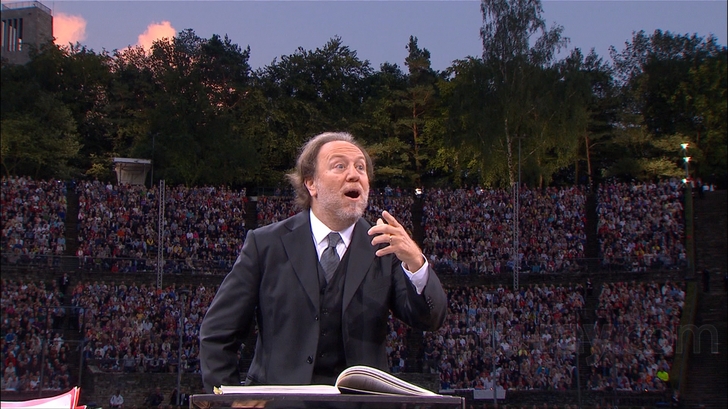
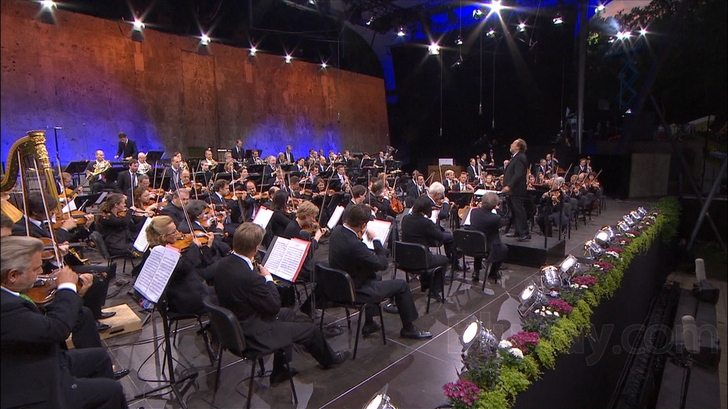
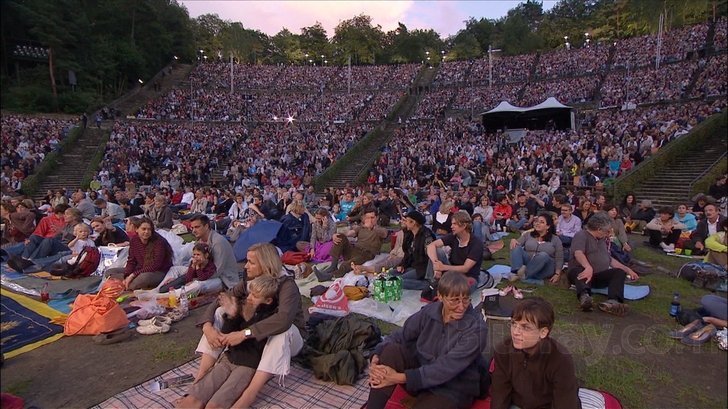
Rota might seem to be an odd choice for a “classical” concert, but his “La Strada Ballet Suite” proves to be an incredibly lyrical and winning piece that weaves several of his evocative themes from Fellini’s bittersweet masterpiece together into a winning whole. It also seems to be a near perfect piece to accompany a lazy summer evening in the great outdoors of Berlin’s massive Waldbühne, where the Berlin Philharmonic gives its annual summer concerts. This gargantuan amphitheater can hold upwards of 20,000 people, and the Philharmonic’s summer outings there have become a major draw. Often the concerts feature a nice mix of warhorses and lighter concert fare (and they always end with a fun singalong of Paul Lincke’s Berliner Luft), and that’s the case again here with this fun 2011 performance conducted by a positively ebullient Riccardo Chailly.
Chailly and the Philharmonic start the concert out with Dmitri Shostakovich’s Suite No. 2 for Jazz Orchestra (Suite for Variety Orchestra), a piece that perfectly sums up the ethos of the Waldbühne concerts. As with a lot of Shostakovich’s writing, there’s a pungent, almost astringent, quality that can be quite challenging to listen to, and yet the entire piece is suffused with such a feeling of caprice and joy that the discordances seem to waft by like brief clouds in an otherwise clear blue sky. The dialectic between supposedly “serious” and “light” classical music is rather wonderfully encapsulated by this piece and it serves as a fitting introduction for an afternoon and evening that toes the line rather well between the two extremes.
Following the Rota piece, which comes second, we’re off into a sumptuous reading of Ottorino Respighi’s twin odes to the Eternal City, Fountains of Rome and Pines of Rome. These sibling tone poems have become so well known that they’re often thought of in the same dismissive way that, say, Ferde Grofe’s Grand Canyon Suite is, namely as being colorful examples of expressive melody and especially orchestration that may not have any real substance to them. That of course is ridiculous (as it is with the Grofe piece). These are stunningly structured and written, and Chailly’s innate joie de vivre infuses both of them with a loving care that makes them both incredibly evocative serenades for the picnicking audience.
Shostakovich and Respighi each receive an encore of sorts, with the Allegretto Shostakovich’s Lady Macbeth of Mtsensk Suite and Respighi’s Danza gueresca from Belkis, Regina di Saba presented before the customary goofy finale of Berliner Luft. These two musical depictions of infamous women may not exactly spring to mind when one mentions an outdoor summer concert festival, but Chailly has actually done something very smart here, programming extremely colorful snippets that may intrigue listeners enough to find out more about these pieces. Interestingly, Rota also scored a version of Belkis (the Queen of Sheba) for a 1952 Italian film of the same name.
This 2011 Waldbühne concert shows off the Berlin Philharmonic in an unusual setting that is a bit more about fun than the typical classical concert, but which sacrifices little if any of the Philharmonic’s vaunted musicianship. Chailly is a force of nature here, jumping, dancing and gesticulating wildly, but always keeping things under control. And for anyone who ever says classical music is inevitably stuffy, there’s the wackiest finale ever, one which sees an entire audience in the tens of thousands change magically into children, no matter what their ages.
Fellini, Jazz & Co. Blu-ray Movie, Video Quality
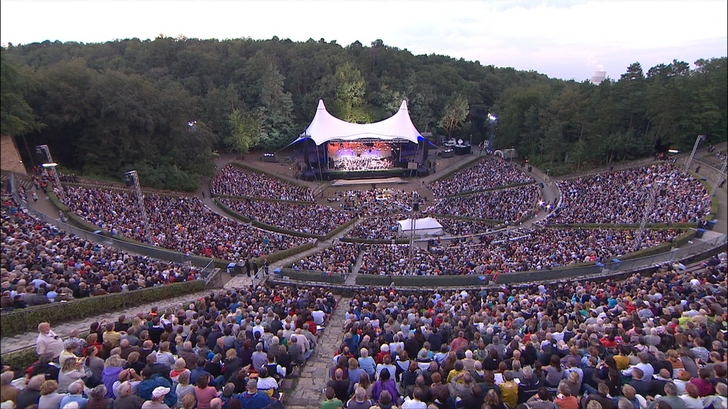
Fellini, Jazz and Co. is presented on Blu-ray courtesy of EuroArts with an MPEG-2 encoded 1080i transfer in 1.78:1. It's getting rarer and rarer to see the "granddaddy" of compression codecs on Blu-rays nowadays, but in terms of clarity and sharpness with this high definition presentation, few will have anything to complain about. The image here is wonderfully clear and well detailed and the slowly chaning light as afternoon turns to evening and then night is handled with aplomb and good, consistent contrast and black levels. So why only a 3.5 score? This video presentation has a couple of really odd "stuttering" moments that must have been either introduced via faulty cameras, storage media or in the authoring and mastering phases. What's so odd about these is that they don't seem to be related to one specific camera. For instance, a crane shot swooping down on the stage right performers suddenly looks like it misses a frame or two, yet there's no associated disruption of the soundtrack. An even stranger example comes toward the end of the concert with a full head on perspective of Chailly, where the conductor seems momentarily caught in a weird tape loop, repeating a little snippet of an arm movement, yet once again there's no problem with the soundtrack. If you can look past these extremely odd and inexplicable anomalies, this is otherwise a very nice looking presentation.
Fellini, Jazz & Co. Blu-ray Movie, Audio Quality
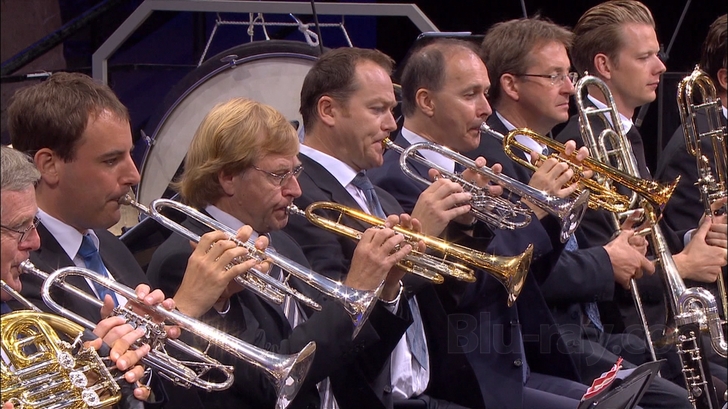
Fellini, Jazz and Co. has two lossless audio options, a DTS-HD Master Audio 5.1 surround mix and an uncompressed LPCM 2.0 stereo fold down. Both of these tracks offer sterling fidelity and very expressive dynamic range. Despite being outside, there's a good focus of orchestral sound in both of these tracks, though some listeners may actually prefer the LPCM 2.0 mix as it sounds somewhat less diffuse than the DTS-HD Master Audio 5.1 option. There are some issues with audience noise creeping into the quieter moments of some of the selections here, but that's part of the trade off of an outdoor concert like this, especially one that's being given in front of such a massive audience.
Fellini, Jazz & Co. Blu-ray Movie, Special Features and Extras
No supplements other than Trailers for other EuroArt releases (which I never use in scoring supplements) are offered.
Fellini, Jazz & Co. Blu-ray Movie, Overall Score and Recommendation
Fellini, Jazz and Co. is a wonderful example of how much fun these annual Waldbühne Berlin Philharmonic concerts seem to be. Riccardo Chailly has programmed a very smart assortment of well known and lesser known gems, with an emphasis on Italy through the music of Rota and Respighi. The Shostakovich pieces might seem like the odd men (or women, considering Lady Macbeth) out, but they fit in quite nicely to a performance that has just enough substance without sacrificing any of the fun of an outdoor concert. This Blu-ray has a couple of really odd video anomalies which may bother the more persnickety, and it has no real supplements to speak of, but the audio is largely sterling. Overall, this release comes Recommended.