Fade to Black 4K Blu-ray Movie
HomeFade to Black 4K Blu-ray Movie 
4K Ultra HD + Blu-rayShout Factory | 1980 | 102 min | Rated R | Jul 29, 2025


Movie rating
6.8 | / 10 |
Blu-ray rating
| Users |  | 0.0 |
| Reviewer |  | 4.0 |
| Overall | | 4.0 |
Overview
Fade to Black 4K (1980)
A shy, lonely, film geek goes on a killing spree against those who bully and browbeat him, while at the same time, he stalks his idol; a Marilyn Monroe look-alike.
Starring: Dennis Christopher, Tim Thomerson, Gwynne Gilford, Norman Burton, Linda KerridgeDirector: Vernon Zimmerman
| Horror | Uncertain |
| Thriller | Uncertain |
| Comedy | Uncertain |
Specifications
Video
Video codec: HEVC / H.265
Video resolution: 4K (2160p)
Aspect ratio: 1.85:1
Original aspect ratio: 1.85:1
Audio
English: DTS-HD Master Audio 2.0 Mono (48kHz, 24-bit)
Subtitles
English SDH
Discs
Blu-ray Disc
Two-disc set (2 BDs)
4K Ultra HD
Packaging
Slipcover in original pressing
Playback
Region A (B, C untested)
Review
Rating summary
| Movie |  | 3.5 |
| Video | | 4.0 |
| Audio |  | 5.0 |
| Extras | | 5.0 |
| Overall | | 4.0 |
Fade to Black 4K Blu-ray Movie Review
Reviewed by Dr. Stephen Larson August 14, 2025The only prior high-def edition of Vernon Zimmerman's Fade to Black (1980) was Vinegar Syndrome's 2020 features-laden Blu-ray, which was reviewed by my colleague Brian Orndorf. For Brian's coverage of the film, a/v transfers, and supplements, please refer to the link above.
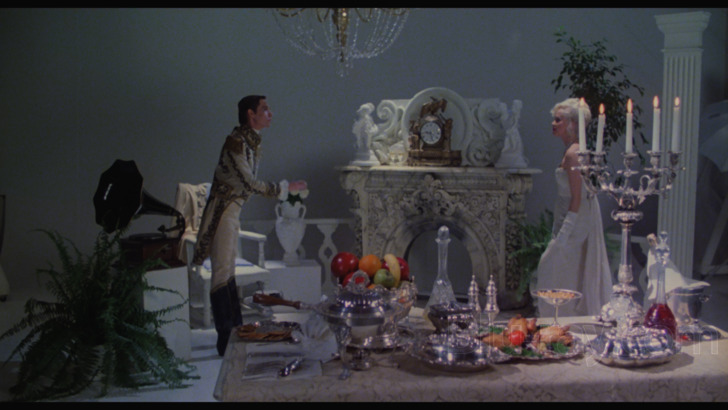
A reenactment of THE PRINCE AND THE SHOWGIRL?
Fade to Black 4K Blu-ray Movie, Video Quality
Scream Factory's two-disc "Collector's Edition" comes with a slipcover featuring identical artwork as what appears in the sleeve (though it's not the original
theatrical art, which would have been nice). The 4K Ultra HD disc is a BD-66 and sports a healthy encode. The 102-minute feature boasts an average
video bitrate of 81.8 Mbps while the whole disc carries an overall bitrate of 86.0 Mbps. The UHD employs a Full Enhancement Layer (FEL). Scream's
regular 1080p Blu-ray comes on an MPEG-4 AVC-encoded BD-50, which contains all the extras. The feature carries a mean video bitrate of 32000 kbps.
Before discussing the most recent presentations of Fade to Black, it needs to be underscored how important Vinegar Syndrome's restoration of the
film was five years ago. The movie had essentially been relegated to the dustbin of cinema history for two decades until VS rescued it from oblivion.
Fade to Black had only been sporadically available on home video in the '80s and '90s. The most significant release had been an anamorphic
widescreen 1999 DVD put out by Anchor Bay whose transfer this review compares with the two Scream discs. In the UK, a label called MIA issued a pan-
and-scanned transfer, which is discussed by a participant of The Hysteria Continues Podcast for a VS commentary ported over on the two discs. I also was
aware of a German DVD released by CMV Laservision but recall that Amazon.de never regularly had it in stock.
VS stated that it culled "35mm negative elements" for its 1080p presentation. This leads me to believe that it may not have been struck from the original
camera negative but possibly from a dupe negative and/or internegative. I don't have VS' disc handy but it seems that the Scream discs are sourced from
the same master. Scream advertises it as a "new 2025 4K restoration," which probably indicates that it underwent a new Dolby Vision and HDR grade. I
know at least some readers are wondering if Fade to Black looks essentially the same when upscaling the standard Blu-ray to 4K as it does when
viewing the UHD in DV or HDR10. There are differences. For example, I noticed a finer grain field on the UHD. I also spotted pockets of the frame
that reveal increased clarity and sharper textures. There's also an uptick in detail when watching it in native 4K.
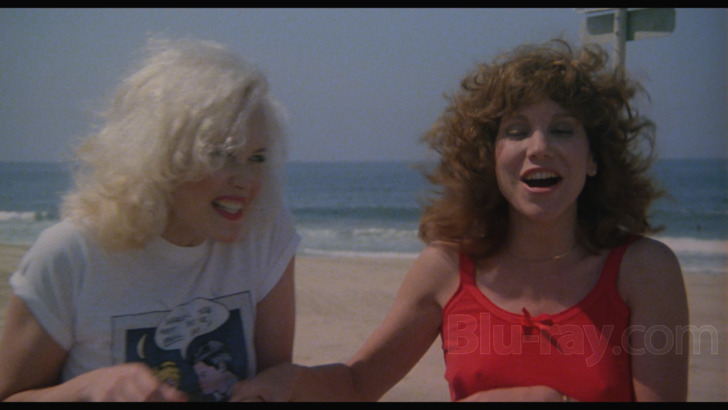
There are some notable discrepancies between the Anchor Bay and Scream transfers. For instance, notice how some of the lights on the neon "M" sign in
Screenshot #22 (on the AB) illuminate a cool blue, while on the Scream, they are light turquoise (#23). In other shots in different scenes of this sign on
the Scream, the lights are cool blue. There's some photochemical stains on the image during a shot where Eric Binford (Dennis Christopher) converses
with Marilyn O'Connor (Linda Kerridge) in a diner (see frame grab #17). I don't see any stains on the AB (#18). The AB and Scream each have different
damage marks and age-related artifacts. The AB has larger speckles that pop up periodically. Scream has smaller, more minor nicks and dirt. The AB and
Scream each have a tramline on the left side of Eric's face where he gazes up at the photos above his mirror (see frame grabs 19-20). There are double
and/or triple tramlines on Scream's image beginning with the scene where Eric informs Stella Binford (Eve Brent Ashe) that he's going out on a date. The
tramlines also show up during a daytime scene. Overall, though, the Scream transfers (especially the UHD) look much more film-like than the AB.
My video score for the UHD is 4.25/5.00 and 3.75/5.00 for Scream's 1080p Blu-ray.
Screenshot #s 1-15, 17, 19, 21, 23, 25, 28, 31, 34, 37, & 40 = Scream Factory 2025 4K Ultra HD BD-66 (downsampled to 1080p)
Screenshot #s 16, 18, 20, 22, 24, 26, 29, 32, 35, & 38 = Anchor Bay 1999 DVD (upscaled to 720p)
Screenshot #s 27, 30, 33, 36, & 39 = Scream Factory 2025 BD-50 (from a 4K scan)
Scream's UHD and Blu-ray include ten chapter breaks that are only accessible via remote control. (They are not listed on the menus.)
Fade to Black 4K Blu-ray Movie, Audio Quality
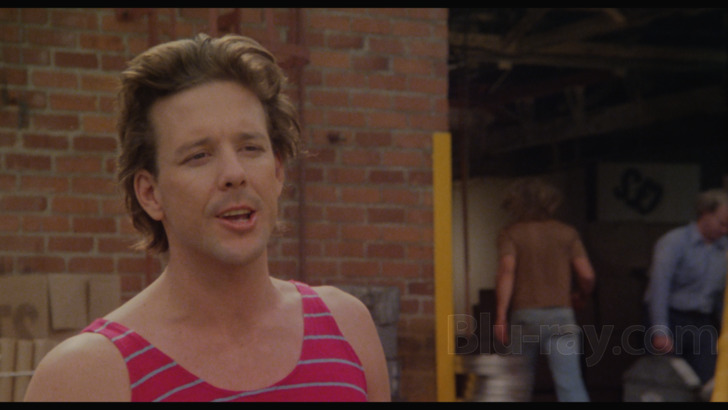
Scream has supplied a DTS-HD Master Audio Dual Mono mix (1881 kbps, 24-bit). I compared AB's Dolby Digital 2.0 Mono track with Scream's; they each
sound very similar. Fortunately, there are no signs of noise management or EQing. Spoken words are always relatively clear and intelligible. There are
occasional moments when volume and pitch rise. For example, the track becomes louder when Stella turns on some jazz music in Eric's bedroom.
Composer Craig Safan's diverse score is an integral part of the film's sound design. (I highly recommend watching the terrific interview Safan gave VS,
which is on Scream's Blu-ray.) I will draw upon information Safan gave there and an interview he conducted with film music historian Randall D. Larson in
the liner notes for a 2009 promotional CD album of Safan's score released by Perseverance Records and limited to 500 units. (Buysoundtrax has since re-
issued it as a digital download with 24-bit sound.) Safan had a relatively small instrumental ensemble. It comprised a string section: violin, viola, and cello
(about twenty in all). He also used a harp, piano, percussion, electric guitars, and synths. Michael Boddicker, who went on to become a highly prolific synth
player on many film scores, did all of the electronics. A major reason Safan's score sounds loud on the AB, VS, and Scream discs is because he close-miked
the piano (to deliver strong resonance), a harp, and an electric guitar (to generate tremolo effects). He told Larson he also incorporated bell hits and chimes
in the score. All music was recorded live onto a 24-track tape.
Note: in the audio commentaries, it is mentioned that Chris Stein, guitarist for the rock band Blondie and a friend of Dennis Christopher's, was going
to perform a song for the end titles. Not only that, but Larson reports in the liner notes that Stein was going to be hired to compose a full score. But a
contract was never finalized.
Scream's optional English SDH track does a pretty thorough job of transcribing dialogue and sound effects. It misses the line, "Strange bird." uttered by a
postwoman, though.
Fade to Black 4K Blu-ray Movie, Special Features and Extras
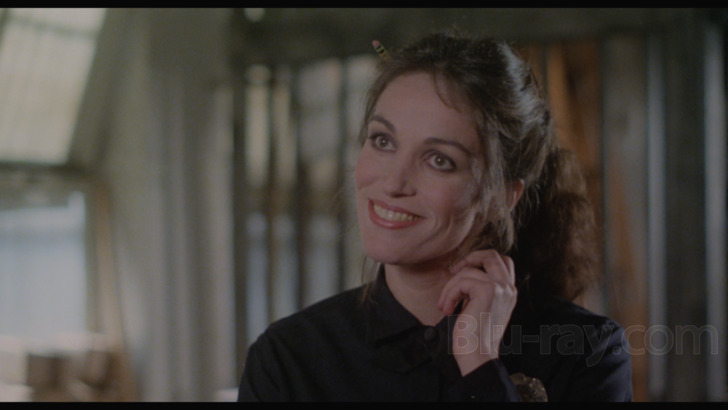
Vinegar Syndrome's extras were all produced in 2020 and have been carried over to Scream's UHD and standard Blu-ray. Scream has added one
commentary track of its own. My score of 5.0/5.0 reflects VS' fabulous package of bonus materials.
DISC ONE: 4K Ultra HD
- NEW Audio Commentary with Film Critic Drew McWeeny - McWeeny is intimately familiar with Fade to Black' s filming locales in Venice, California since he worked at a movie theater in town. (It's apparently shown as an exterior in the film.) He provides a lot of historical perspective about what life and culture was like in that area ca. 1980. The first half of his commentary is excellent. He delivers an abundance of production anecdotes and analysis of the film. There are some gaps during the second half with McWeeny taking a reactive approach to what's transpiring on screen. Still, an enjoyable listen. Overall, I think it's a really good commentary! In English, not subtitled.
- Audio Commentary with Actor Dennis Christopher Moderated by Brad Henderson - Christopher has a great memory about what happened while making Fade to Black, which he shares with Henderson and viewers. He shares his recollections of working with writer/director Vernon Zimmerman, executive producer Irwin Yablans, and several of his fellow actors. Even though Christopher declined the lead for this movie at least once, it eventually became a passion project for him. He speaks with passionate conviction about the decisions Eric Binford (and the screen characters he assumes or dresses up as) makes throughout Fade to Black. Henderson asks Christopher good questions and rarely, if ever, interrupts him. There are a couple of times where Christopher misunderstands what Henderson is asking him. He provides alternate answers and Henderson clarifies the information he initially sought, which the actor later provides. In English, not subtitled.
- Audio Commentary with The Hysteria Continues podcast - this is a fine fan commentary by four or so contributors to The Hysteria Continues podcast. While it is frequently not screen specific, it was recorded while they are watching the film. A couple of its commentators sometime quote from critical reviews of the film. There are actually a lot of reviews cited in this track. At least one read a draft of the screenplay in preparation. Overall, this is a pretty engaging discussion of Fade to Black. All speak in English, not subtitled.
- Audio Commentary with Film Historians Amanda Reyes and Bill Ackerman - an information-packed track that I think will disappoint no one! Reyes and Ackerman deliver highly detailed and comprehensive coverage of Fade to Black's production, many of the filmmakers and cast members, as well as a plethora of genre films on both the small and big screen. Ackerman delineates several of the differences between the script and finished film. He also read the movie's novelization, which he discusses a bit here. Reyes makes a fascinating connection between Jacques Lacan's theory of "The Law of the Father" with a familial relationship and subplot in the film. She has an encyclopedic knowledge of TV movies and feature films, which she puts on display here. She makes a pretty convincing argument that Fade to Black should be considered a box-office success and provides some revealing evidence. The rigor of her research reminds me of my own. (She cites a 2014 dissertation and relates aspects of it to the film.) In English, not subtitled.
DISC TWO: Blu-ray
- NEW Audio Commentary with Film Critic Drew McWeeny - McWeeny is intimately familiar with Fade to Black' s filming locales in Venice, California since he worked at a movie theater in town. (It's apparently shown as an exterior in the film.) He provides a lot of historical perspective about what life and culture was like in that area ca. 1980. The first half of his commentary is excellent. He delivers an abundance of production anecdotes and analysis of the film. There are some gaps during the second half with McWeeny taking a reactive approach to what's transpiring on screen. Still, an enjoyable listen. Overall, I think it's a really good commentary! In English, not subtitled.
- Audio Commentary with Actor Dennis Christopher Moderated by Brad Henderson - Christopher has a great memory about what happened while making Fade to Black, which he shares with Henderson and viewers. He shares his recollections of working with writer/director Vernon Zimmerman, executive producer Irwin Yablans, and several of his fellow actors. Even though Christopher declined the lead for this movie at least once, it eventually became a passion project for him. He speaks with passionate conviction about the decisions Eric Binford (and the screen characters he assumes or dresses up as) makes throughout Fade to Black. Henderson asks Christopher good questions and rarely, if ever, interrupts him. There are a couple of times where Christopher misunderstands what Henderson is asking him. He provides alternate answers and Henderson clarifies the information he initially sought, which the actor later provides. In English, not subtitled.
- Audio Commentary with The Hysteria Continues podcast - this is a fine fan commentary by four or so contributors to The Hysteria Continues podcast. While it is frequently not screen specific, it was recorded while they are watching the film. A couple of its commentators sometime quote from critical reviews of the film. There are actually a lot of reviews cited in this track. At least one read a draft of the screenplay in preparation. Overall, this is a pretty engaging discussion of Fade to Black. All speak in English, not subtitled.
- Audio Commentary with Film Historians Amanda Reyes and Bill Ackerman - an information-packed track that I think will disappoint no one! Reyes and Ackerman deliver highly detailed and comprehensive coverage of Fade to Black's production, many of the filmmakers and cast members, as well as a plethora of genre films on both the small and big screen. Ackerman delineates several of the differences between the script and finished film. He also read the movie's novelization, which he discusses a bit here. Reyes makes a fascinating connection between Jacques Lacan's theory of "The Law of the Father" with a familial relationship and subplot in the film. She has an encyclopedic knowledge of TV movies and feature films, which she puts on display here. She makes a pretty convincing argument that Fade to Black should be considered a box-office success and provides some revealing evidence. The rigor of her research reminds me of my own. (She cites a 2014 dissertation and relates aspects of it to the film.) In English, not subtitled.
- Celluloid Heroes - Interview with Executive Producer Irwin Yablans (26:12, 1080p)
- A Brush with Darkness – Interview with Stylist Patricia Bunch (14:35, 1080p)
- Living and Dying for the Movies – Interview with Dennis Christopher (17:12, 1080p)
- Experimenting with Sound – Interview with Composer Craig Safan (12:30, 1080p)
- Finishing the Story – Interview with Editor Barbara Pokras (8:46, 1080p)
- Audio Interview with Actress Linda Kerridge (31:19)
- Taking the Hits – Interview with Special Effects Artist Wayne Beauchamp (11:39, 1080p)
- A Shiny Quality - Interview with Actor Marcie Barkin (18:43, 1080p)
- Still Gallery (10:08, 1080p) - a slide show comprising 119 distinct images from Fade to Black's production and its publicity campaigns in the US and overseas. There are publicity snapshots, lobby cards, and behind-the-scenes photos in both B&W and color. Especially valuable are stills from outtakes and scenes that were deleted from the theatrical cut. (Marcie Barkin makes reference to an omitted scene in an archival interview.) In addition, there are glossy photos from American Cinema Releasing's press kit as well as pictures/info from other kits and exhibitor manuals reproduced here in English and different languages.
- Theatrical Trailer (3:04, possible upconversion to 1080p) - an official trailer for Fade to Black presented in 1.85:1 anamorphic widescreen. It hasn't been fully restored.
Fade to Black 4K Blu-ray Movie, Overall Score and Recommendation
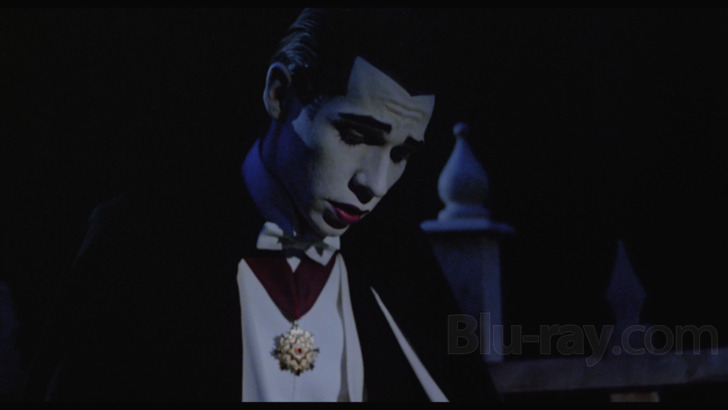
A legitimate case can be made that Dennis Christopher should be considered a primary co-auteur of Fade to Black along with Irwin Yablans
and Vernon Zimmerman. Christopher brought in his own movie posters and magazines for his character's bedroom decor, came up with a scene on his own
that was not in any of the scripts, and added a section to the film. Fade to Black is definitely a film that was made for cinephiles. The movie's
weaknesses are that it has narrative gaps, plot holes, and illogicalities (e.g., How does the main character know where other characters are going to be at
certain points in time?)
If you don't own Vinegar Syndrome's slipcover or standard editions, then I wouldn't hesitate picking up Scream's two-disc set. However, if you purchased the
VS, then I would wait for a sale or price reduction. While the transfer looks very good in DV/HDR10, Scream uses the same master as the VS Blu-ray. I
would stop short of calling it the definitive presentation because I believe some additional restoration work and cleanup can make it look better. Drew
McWeeny's feature-length commentary is quite informative so it's a solid addition. WORTH OWNING.
Other editions
Fade to Black: Other Editions

Fade to Black
Slipcover #1 | Slipcover Edition
1980

Fade to Black
Slipcover #2 | Slipcover Edition
1980

Fade to Black
1980
Similar titles
Similar titles you might also like

976-EVIL
1988

What Keeps You Alive
2018

Before I Wake
2016

Otis
Uncut
2008

The Burning 4K
Collector's Edition
1981

Stitches
2012

Prom Night
Special Edition
1980

Red Christmas
2016

Massacre at Central High
1976

Scary Stories to Tell in the Dark 4K
2019

Wish Upon
Director's Unrated Cut
2017

The Lesson
2015

#Horror
2015

Fear No Evil
1981

Tamara
2006

Dracula A.D. 1972
1972

Silent Madness 3D
Standard Edition
1984

Basket Case 4K
Limited Edition
1982

Frightmare
The Horror Star
1983

Unfriended
2014