Dvorak: Symphonies No.7 & 8 Blu-ray Movie
HomeDvorak: Symphonies No.7 & 8 Blu-ray Movie 
Naxos | 2011 | 74 min | Not rated | Feb 22, 2011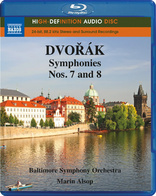

Movie rating
Movie has not been rated yetBlu-ray rating
| Users |  | 0.0 |
| Reviewer |  | 4.0 |
| Overall | | 4.0 |
Overview
Dvorak: Symphonies No.7 & 8 (2011)
Recorded at Joseph Meyerhoff Symphony Hall, Baltimore, USA.
| Music | 100% |
Specifications
Audio
Music: DTS-HD Master Audio 5.1
Music: LPCM 2.0
Discs
25GB Blu-ray Disc
Single disc (1 BD)
Playback
Region A (B, C untested)
Review
Rating summary
| Movie | | 4.0 |
| Video | | 0.0 |
| Audio |  | 5.0 |
| Extras | | 0.0 |
| Overall | | 4.0 |
Dvorak: Symphonies No.7 & 8 Blu-ray Movie Review
Dvorák's Seventh and Eighth Symphonies receive respectful, but sometimes curiously passionless, readings from Marin Alsop and the Baltimore Symphony.
Reviewed by Jeffrey Kauffman February 6, 2011It’s perhaps more than a little ironic that a Czech composer mentored by one of the most towering and iconic figures of 19th century German music should have helped, at least in part, to redefine what constituted “American” music. The 19th century saw the United States music establishment, and composers in particular, still under the considerable sway of the European tradition, and few writers, if any, had sought to develop a uniquely American voice which would speak to the heart of this still young nation’s soul. But when Antonin Dvorák first established himself as the leading symphonic interpreter of his native Czech musical source material, bringing a wealth of folk (or at least folklike) melodies to his oeuvre, and then, in a visit to the United States, wrote his most famous piece, his Ninth Symphony, he suddenly showed American composers how to draw upon their own intrinsic traditions to craft their own distinctive musical language. If Dvorák’s Ninth is still rather firmly in the European tradition, not yet full of the bracing vocabulary of Charles Ives or the charming Americana of Aaron Copland, it still augured a way forward for American composers.
The Ninth has become such a piece of international standard repertoire that the rest of Dvorák’s rather considerable, and often quite gorgeous, output is either forgotten or ignored. Marin Alsop and the Baltimore Symphony have been recording a Dvorák Symphonic Cycle over the past several years, and the first two hi-def audio releases of that cycle have been released. Alsop is one of a growing number of women who have been able to forge impressive careers in a field long dominated by males. (In full disclosure mode, I should state I played under Alsop’s baton at an Oregon Symphony Gospel Christmas performance where I was one of the featured pianists). Alsop has been Music Director of the Baltimore Symphony for a few years now (her contract was recently extended to 2015), and she’s helped raise the group’s profile with a series of well received recordings. If her Dvorák cycle so far lacks a bit of fire sometimes, there are manifold pleasures to be had, and they’re fully on display in this new release offering us Dvorák’s two immediate precursors to his famous Ninth.
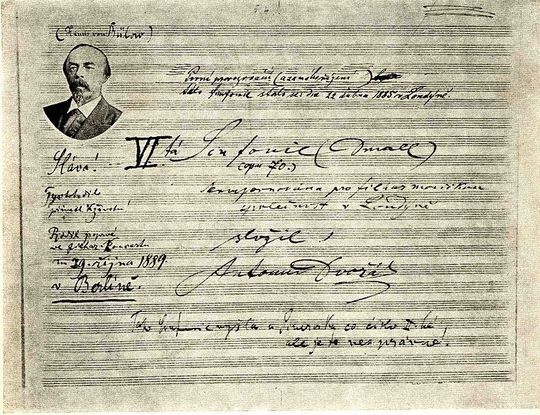
The autograph title page of Dvorák's Seventh, with the composer's homage to Hans von Bülow.
Dvorák was mentored by none other than Johannes Brahms, and the Brahmsian influence on Czechoslovokia’s first “national” composer is nowhere more evident than in Dvorák’s Seventh Symphony in D minor. While there’s no disputing the fact that Dvorák heard a performance of Brahms’ Third Symphony, and that gave him the inspiration for his Seventh, there’s a perhaps more interesting question lurking just beneath the surface of this tumultuous piece. Did Dvorák hobnob with Brahms sometime during 1884, when Brahms was crafting his final piece in the symphonic realm, his soaring Fourth Symphony in E minor? If not, Dvorák must have picked up something in the ether, as Dvorák’s Seventh bears a certain stylistic and even at times thematic resemblance to the Brahms piece, perhaps even more than Brahms’ Third. Alternately stormy and sunny, the Seventh is a piece of at times alarming contrasts, as if the composer were experiencing a manic depressive episode. It’s all of course perfectly restrained in that late 19th century classical (albeit Romantic with a capital “r”) way, but there’s a surging intensity to this piece that makes it a perfect companion to the cloudy shores of Brahms’ final symphony. Alsop misses some opportunity for intensity in the opening movement. She seems to be more at home with lyrical, expressive, even meditative, movements at times, and though her Seventh is perfectly professional, the first movement especially seems simply too restrained for its own good. The strengths of this performance are undoubtedly the Adagio, as well as the Brahmsian lower strings, which the Baltimore Symphony offers in resplendence.
Dvorák took a 180 degree turn with his Eighth Symphony, and it receives a somewhat more natural interpretation from Alsop and her players. If the Seventh was resolutely Brahmsian, with sunlight glinting through ominous clouds, the Eighth is a piece more reflective of Dvorák’s lifelong quest to introduce audiences to his Czech homeland and its evocative music. This piece is imbued with the folk sounds of Bohemia and it might be seen as the composer’s jauntiest work. Though Alsop’s Allegretto Grazioso tends to emphasize the wistful aspects of the movement, and never in fact reaches anything approaching a real Molto Vivace, the rest of the Symphony is played with a good combination of force and nuance. Once again the Baltimore Symphony’s strings especially sound wonderfully riched and burnished.
One of the problems in releasing a Dvorák cycle, in hi-def or not, is that there is such a long history of releases which Alsop’s readings will inevitably be compared to. Though his recordings are now a generation or more old, and were in fact the first complete recorded cycle of Dvorák symphonies, Hungarian István Kertész’s readings of these pieces are often thought to be by many classical music aficionados the touchstone by which all other interpretations should be measured. While that’s certainly debatable, the fact is Kertész’s recordings with the London Symphony (available on CD in a nice boxed set) show that Alsop is at least occasionally perhaps too measured in her approach to these works. Dvorák is unquestionably a composer of classical restraint and architectural symmetry, but he also displays flashes of temperament and tumult that must be approached at a minimum with vigor if not vitriol. Sometimes being too respectful can make things sound slightly anemic. While Alsop brings a fine degree of intelligence and decorum to her interpretations, it might be time for her to let her hair down just a little and let her heart rather than her head lead the way through some of the most gorgeous and evocative music of the 19th century.
Dvorak: Symphonies No.7 & 8 Blu-ray Movie, Audio Quality

Naxos brings us these symphonies in often luscious lossless formats, a DTS-HD Master Audio 5.1 mix (24-bit/96kHz) and an LPCM 2.0 mix (also 24-bit/96kHz). Whatever passing qualms one may have about Alsop's interpretations of these beautiful works, one can't fault the playing of the Baltimore Symphony or, more importantly when it comes to audiophile releases, the recordings themselves. These are simply gorgeous sounding recordings, with the 5.1 perfectly spacious without sounding overly ambient. While dynamic range is somewhat limited due to Alsop's reserve, when moments like the timpani eruptions in the Eighth's opening movement do occur, they show that both mixes are capable of astounding fidelity even at extreme frequency registers. The dark string and wind sounds of both of these pieces are reproduced wonderfully here, with a deep and richly burnished sound that is both completely "accurate" in terms of the composer's soundworld, but also just plain ingratiating to listen to.
Dvorak: Symphonies No.7 & 8 Blu-ray Movie, Overall Score and Recommendation

Both of these symphonies are unduly neglected in the wake of Dvorák's more famous Ninth Symphony. The recordings here are stupendously effective, with brilliant fidelity and gorgeous ambience. Those with a long history with this composer may find occasional fault with Alsop's interpretations, but overall these are respectful and often glowing accounts of these beautiful works. Alsop may err on the side of caution a bit too much, especially with regard to the stormy Seventh Symphony, but she brings a finely tuned awareness to the architecture of both pieces, something which the Baltimore Symphony responds to accordingly. Recommended.