Donizetti: L'elisir d'amore - Glyndebourne 2009 Blu-ray Movie
HomeDonizetti: L'elisir d'amore - Glyndebourne 2009 Blu-ray Movie 
Opus Arte | 2009 | 129 min | May 25, 2010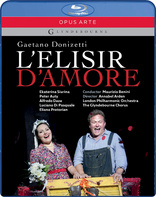

Movie rating
Movie has not been rated yetBlu-ray rating
| Users |  | 0.0 |
| Reviewer |  | 4.5 |
| Overall | | 4.5 |
Overview
Donizetti: L'elisir d'amore - Glyndebourne 2009 (2009)
Starring: Ekaterina Siurina, Peter Auty, Alfredo Daza, Luciano DiPasquale, Eliana PretorianDirector: Robin Lough, Annabel Arden
| Music | 100% |
Specifications
Video
Video codec: MPEG-4 AVC
Video resolution: 1080i
Aspect ratio: 1.78:1
Audio
Italian: DTS-HD Master Audio 5.1
Italian: LPCM 2.0
Subtitles
English, French, Spanish, German, Italian
Discs
25GB Blu-ray Disc
Single disc (1 BD)
Playback
Region A (B, C untested)
Review
Rating summary
| Movie | | 4.5 |
| Video | | 4.5 |
| Audio |  | 5.0 |
| Extras |  | 2.0 |
| Overall | | 4.5 |
Donizetti: L'elisir d'amore - Glyndebourne 2009 Blu-ray Movie Review
Take a break from all the histrionics of a lot of opera, and just bask in the warm glow of this lovely little "elixir."
Reviewed by Jeffrey Kauffman June 4, 2010A guy walks into a bar and sidles up to another man who looks morose and despondent. “It looks like you might understand what I’m going through,” the first man starts, and then launches into a litany of his misfortunes. “My wife left me—for another woman. I just got fired by my boss—who’s 25 years younger than I am. My house is in foreclosure, I owe tens of thousands in credit card debt, and I just found out I have a terminal disease.” The second guy looks up, nonplussed. “You think you have problems? I review opera for a living!” OK, OK, so that joke has a pretty minor target audience, but maybe you get the idea: the life of an opera reviewer is filled with torment, despair, mismatched lovers, jealousy, rage, tragedy and just your everyday malaise and sadness. And that, of course, is just what’s found on stage! Opera is perhaps the last bastion of the oversized emotion and the hyperbolic expression. Even the lighter than air soufflés of, say, Mozart’s buffas can drive the audience crazy with their convoluted plots and wending side trips. How wonderful, then, to get at least a temporary reprieve from all the sturm und drang that is a mainstay of the operatic idiom. And reprieve in more ways than one is indeed what the opera lover will get with Gaetano Donizetti’s lovely paean to love conquering all, L’Elisir D’Amore, in this sterling Glyndebourne production from 2009.
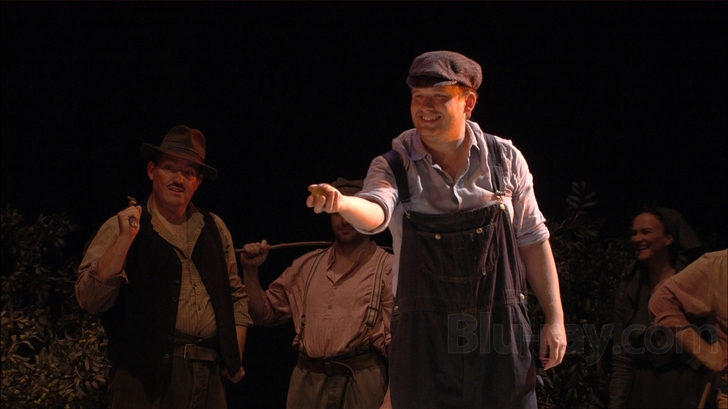
Peter Auty as Nemorino
L’Elisir d’Amore doesn’t fool around with manic subplots or overly clownish characters, despite being rather firmly in the buffa idiom. Nemorino (Peter Auty) is a poor peasant who is hopelessly in love with a member of the landed gentry, Adina (Ekaterina Siurina), a match not exactly made in a class conscious heaven. Adina delights the townfolk one day by reading from Tristan and Isolde, whereby Nemorino gets the idea in his head that a miraculous love potion may help lower Adina’s resistance. Adina may actually have a bit of a yen for Nemorino, but doesn’t want to let on and instead flirts with a local military man, Sergeant Belcore (Alfredo Daza), even accepting his spur of the moment proposal. Enter the lovable charlatan Dr. Dulcamara (Luciano Di Pasquale), who hawks his cure-all potions, including a love tonic (actually your everyday red wine), which he sells to Nemorino. Nemorino, more than a bit tipsy from the concoction, starts playing hard to get with Adina, which throws her for a loop and helps push up her betrothal to Belcore to that very day.
Act Two becomes slightly more convoluted, but not distressingly so, as Adina puts off Belcore for at least a minute or two. Nemorino is hopeless, out of money for more elixir, until Belcore urges him to join the army for the recruiting bonus it will immediately provide him. Of course, Belcore has the ulterior motive of shipping his nemesis off to battle. In the meantime, fate lends Nemorino a helping hand in the form of a large inheritance from a deceased uncle, which the women of the town find out about before Nemorino himself. In the meantime Nemorino has consumed large portions of the love potion, and misconstrues the new interest of the town’s women in him (due to his riches) as being due to the love elixir. Adina runs into Dr. Dulcamara, who, not realizing she is the object of Nemorino’s affection, spills what he thinks is a hilarious story about an idiot peasant who spends all of his money on an unobtainable love. Adina realizes that Nemorino has a pure heart and that she is in love with him. A few more twists and turns, and a happy ending is assured.
This is a breezy and lightweight piece that nonetheless overpowers by virtue of its very simplicity. There are no disguises, no really misunderstood motivations, everything is there on the surface, and beautifully so, and it’s supported by one of the most delicately wrought and lusciously melodic scores of 19th century opera. Donizetti saw his art form as the weaving together of songs, rather than the later convention of sung drama (emphasis on drama quite a bit of the time), and that predilection is fully on display throughout L’Elisir d’Amore. Though “Una furtive lagrima” is arguably the best known aria from the opera (and one of the most iconic in the entire history of the art form), the entire piece is filled with ravishingly beautiful melodies, from Nemorino’s opening paean to Adina’s allure (“Quanto è bella, quanto è cara”), to Adina’s heartfelt “Prendi, per me sei libero” which comes at the denouement of Act Two.
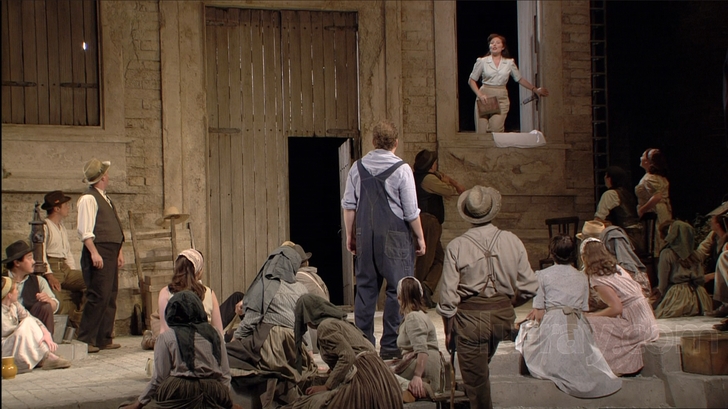
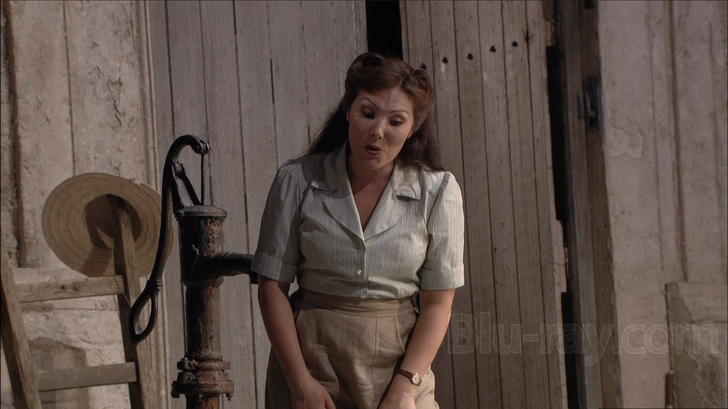
The updating of the setting of the piece to the mid-20th century by director Annabel Arden doesn’t seriously detract from the opera’s sincerity, and in fact helps to show that the rather subtle themes of the allure of money versus the allure of love are timeless and not relegated to some dim vestiges of history. Auty is a near perfect Nemorino, with a guilelessness that perfectly suits the character. Siurina (who missed her opening night at Glyndebourne due to a throat infection) is both spunky and vulnerable as Adina. Daza and Di Pasquale are both excellent in their supporting roles. The London Philharmonic and the Glyndebourne Chorus play and sing marvelously under the crisp direction of Maurizio Benini.
If you’re an opera fan, but one tired of all the Drama (with a capital D), there could be no finer potion you yourself could consume than L’Elisir d’Amore. Like Dr. Dulcamara’s perhaps magical wine, it will fill your heart with warmth and make the world’s problems float away for at least a couple of hours.
Donizetti: L'elisir d'amore - Glyndebourne 2009 Blu-ray Movie, Video Quality
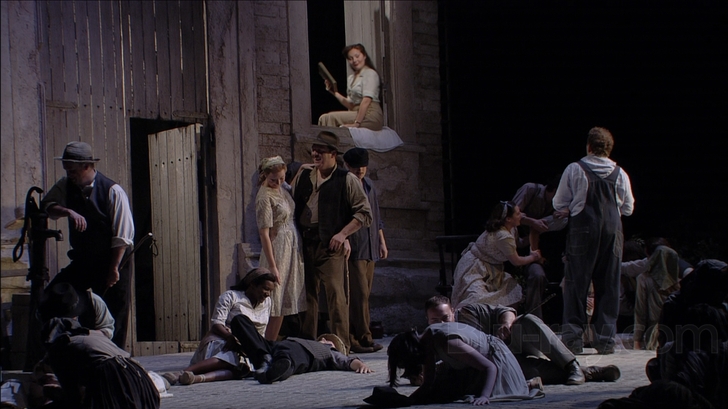
Director Annabel Arden's decision to cast this L'Elisir in a sort of dark and dowdy mid-20th century village may disappoint some hi-def aficionados who want their operas bright and bawdy. But if you take this AVC encoded 1080i image (in a 1.78:1 aspect ratio) on its own terms, there's very little here that should disappoint. Colors, while not overly brilliant, are robust in and of themselves, with, for example, Adina's brightly colored floral print dress in Act II wonderfully vibrant and well saturated. Black levels are strong and consistent and fine detail is also quite evident, especially in close-ups. While it's true that the bulk of this opera plays out in tones of beige and brown, everything is crisp, well delineated and pleasing, if somewhat subdued.
Donizetti: L'elisir d'amore - Glyndebourne 2009 Blu-ray Movie, Audio Quality
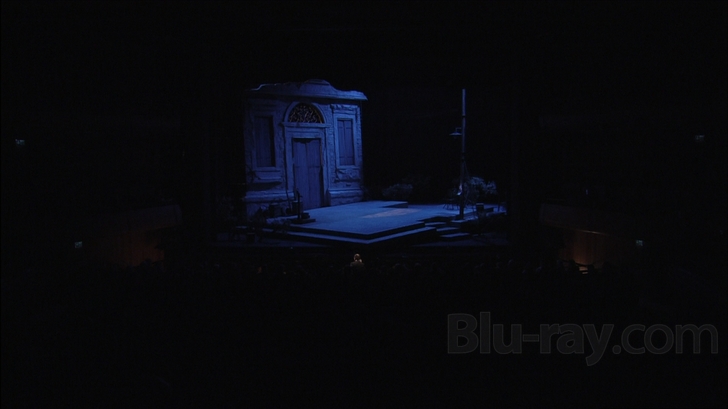
What a lovely pleasure it is to hear Donizetti's effortlessly enchanting melodies spill forth from two lossless options, a DTS-HD MA 5.1 mix and an LPCM 2.0 fold down. While there's not an overabundance of contrapuntal genius at work here, what there is is a virtually nonstop array of gorgeous harmonies and melodies, all of which are presented in crystal clarity on the DTS track. The orchestra is scintillatingly fresh throughout, with beautifully burnished strings and very warm and expressive brass and reeds. Siurina and Auty sound great, both together and separately, and Auty's "Una furtiva lagrima" may well bring a furtive tear to your eye with its expressive beauty. Glyndebourne's vaunted hall ambience is wonderfully on display in the DTS offering. The 2.0 fold down is unusually spacious sounding, with a fulsome tone and excellent fidelity.
Donizetti: L'elisir d'amore - Glyndebourne 2009 Blu-ray Movie, Special Features and Extras
The typical illustrated synopsis and cast gallery are included on the disc itself, and the insert booklet has a nice essay giving some background on Donizetti and this opera in particular.
Donizetti: L'elisir d'amore - Glyndebourne 2009 Blu-ray Movie, Overall Score and Recommendation
OK, I'm ready for the "real" Tristan und Isolde again. Maybe. Take my advice and spend a couple of hours with Nemorino and Adina. This charming and heartfelt piece restores a lot of the joy and beauty that got lost somewhere around the mid-19th century in the operatic world. This Glyndebourne production comes very highly recommended.