Don Quixote Blu-ray Movie
HomeDon Quixote Blu-ray Movie 
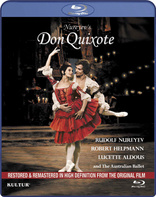
Nureyev and the Australian BalletKultur | 1973 | 122 min | Not rated | Mar 27, 2012
Price
List price:Listed on Amazon marketplace

Movie rating
Movie has not been rated yetBlu-ray rating
| Users |  | 0.0 |
| Reviewer |  | 3.5 |
| Overall | | 3.5 |
Overview
Don Quixote (1973)
A film adaptation of the Ludwig Minkus ballet, completely re-orchestrated and with additional music by John Lanchbery.
Starring: Rudolf Nureyev, Robert Helpmann, Ray PowellDirector: Robert Helpmann, Rudolf Nureyev
| Music | 100% |
Specifications
Video
Video codec: VC-1
Video resolution: 1080p
Aspect ratio: 1.78:1
Original aspect ratio: 1.78:1
Audio
English: LPCM 2.0
English: Dolby Digital 5.1
Subtitles
None
Discs
25GB Blu-ray Disc
Single disc (1 BD)
Playback
Region A (B, C untested)
Review
Rating summary
| Movie |  | 4.0 |
| Video |  | 2.0 |
| Audio | | 4.0 |
| Extras | | 2.0 |
| Overall | | 3.5 |
Don Quixote Blu-ray Movie Review
The windmills of his mind.
Reviewed by Jeffrey Kauffman March 26, 2012Live performance videos are often fraught with a disparity by their very nature: they’re a video documenting a performance, rather than a performance itself. Despite any number of directorial tricks of the trade, more often than not performance videos offer an audience eye’s view of a proscenium stage and there’s somehow a greater distance between the video audience than the one that naturally separates the performers from those actually in attendance. Of course many are willing to trade off a certain vicarious aspect to this experience for the mere opportunity to actually see (and hear) any given performance. Sometimes in the world of classical music there have been attempts to meld a more cinematic approach to otherwise pure idioms; one thinks especially of the 1984 film version of Carmen with Julia Migenes, which sacrificed little of the operatic content (and approach) of Bizet while brilliantly opening the project up to the opportunities afforded by the medium of film. Some eleven years earlier and even more unlikely suspect was afforded much the same treatment when ballet superstar Rudolf Nureyev both starred in and co-directed a cinematic revisioning of the somewhat musty Ludwig Minkus ballet Don Quixote. Minkus was something of a house composer at the St. Petersburg Imperial Theaters, and while his scores are almost always colorful affairs, they also lack that certain something extra that has catapulted more famous compositional names into a stratosphere that Minkus has obviously never inhabited. This film version of Don Quixote was released in a time when even video versions of ballet were rare things, and film versions were largely unheard of. The film attracted widespread positive critical assessments (including several outright raves), but there simply wasn’t an audience for it, and it seemingly disappeared into the mists of time. Incomplete versions of the film turned up now again spread across various continents, but only a five year restoration process finally managed to reassemble Don Quixote in its original form, and it’s now being released on Blu-ray courtesy of niche label Kultur in assocation with Warner Classics.
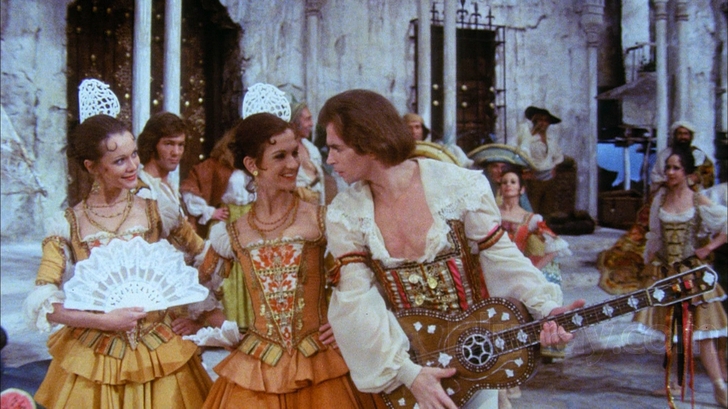
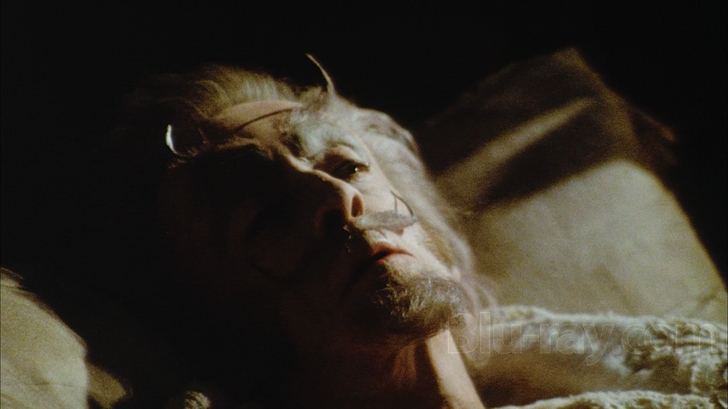
Video releases of ballets have come a long way since the “Dark Ages” of the early seventies, and so what may have seemed incredibly innovative in 1973 might not strike contemporary audiences as anything very special. Large swaths of Don Quixote in fact play out exactly as one might expect them to in any current day release, with dancers on a proscenium stage with a minimum of set dressing. However interpolated between these segments are several much more filmic elements that help establish the milieu of the Cervantes novel quite effectively. The first of these introduces the elderly Don Quixote as he lies in his bed, and the film repeatedly returns to sequences like this as it moves along. Some of the more cinematic sequences do not feature dance in any major way and instead help to establish mood and place.
Nureyev is not the title character here, but instead the romantic lead, Basilio, a barber who is in love with Kitri (Lucette Aldous), the local innkeeper’s daughter. Don Quixote is played by Nureyev’s co-director for the film, Sir Robert Helpmann. Royal Opera and Ballet favorite John Lanchbery has reworked Minkus’ original music, reorchestrating and rearranging it, as well as adding many original bridging sequences. Likewise, Nureyev himself adapted the original Marius Petipa choreography for this film version.
This Don Quixote is actually at least as much about the star-crossed young lovers at the core of its reworked story as it is about the elderly windmill chaser, and while that has no doubt endeared it to ballet lovers through the decades, it means this is in some ways a Don Quixote in name only. Helpmann does make for a very appealing and lovable title character, and Ray Powell is an incredibly lovable Sancho Panza. Nureyev is at the height of his athletic prowess here, and his Basilio is a leaping, towering affair who completely dominates the stage every time he’s on it. The two lovers have several wonderful moments together, set to some of Minkus’ typically sweeping melodies.
This production was evidently filmed in an abandoned airplane hangar in Australia, and it features the corps from the Australian Ballet. The cinematic elements probably more completely show off the gargantuan attempts at production design here, as the more traditionally staged proscenium elements are somewhat more hemmed in, spatially speaking, though the stage does seem to have immense depth. This is a hugely colorful affair, with evocative costumes and, at least in the cinematic moments, very nicely done sets that really go a long way toward developing a palpable feeling for Cervantes’ world.
Don Quixote Blu-ray Movie, Video Quality
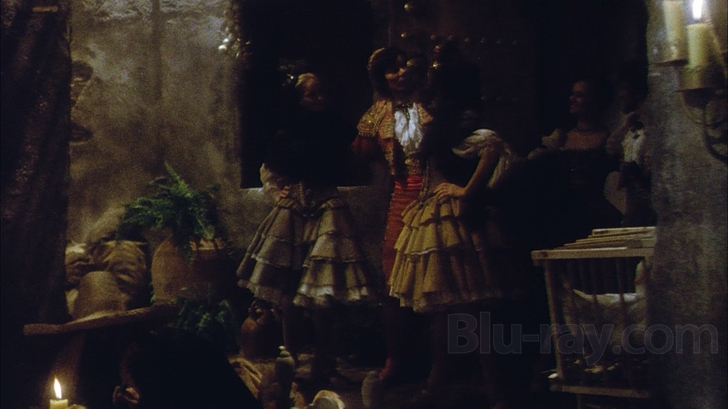
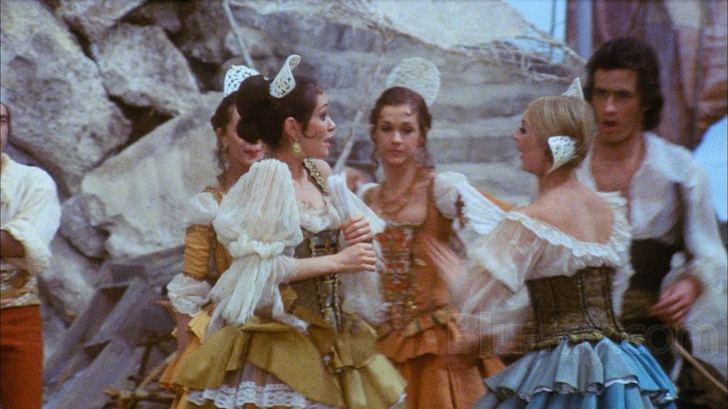
Don Quixote is presented on Blu-ray courtesy of Kultur (in association with Warner Classics) with a VC-1 encoded 1080p transfer in 1.78:1. Significant restoration has been done on this title, as evidenced by the brief featurette showing split screen comparisons of the unrestored version side by side with this version. The most noticeable difference is the improvement in color. The elements utilized for the restoration show really badly faded color and quite a bit of damage. While the color has been remarkably improved, there is at least some damage still remaining, with a few errant flecks, specks and scratches to be seen. The overall image is often still incredibly soft and at time seems to have been sourced more from 16mm than the advertised 35mm. (Note that it is next to impossible to get "clean" screencaptures in releases like this that feature almost nonstop action, so some blur in appendages accompanies most of the caps included with this review.) Fine detail is lacking in all but extreme close-ups, with some of the midrange and far shots being fairly murky, generally speaking. The oddest thing about this presentation is a quasi-slow motion effect that I assume must be attributable to conversion from PAL somewhere along the way. I have a question about this very matter into Kultur and will update the review if more information is forthcoming.
Don Quixote Blu-ray Movie, Audio Quality
Don Quixote features a lossless uncompressed LPCM 2.0 stereo mix as well as a lossy Dolby Digital 5.1 mix. Most listeners will probably want to opt for the LPCM mix, as it offers a much more present, unfiltered account of the Minkus – Lanchbery score than the Dolby Digital rendering, which sounds muffled and distant, despite its surround channelization. Minkus' music may not be the stuff of masterpieces, but it's hugely enjoyable, with grand, soaring melodies and ornate and colorful orchestration, and Lanchbery's contributions are similarly opulent and detailed. Fidelity here is excellent, and while the track does reveal just a hint of hiss in the upper registers, overall things here sound quite nice indeed, with good representation throughout all registers. Dynamic range is also excellent throughout the ballet.
Don Quixote Blu-ray Movie, Special Features and Extras
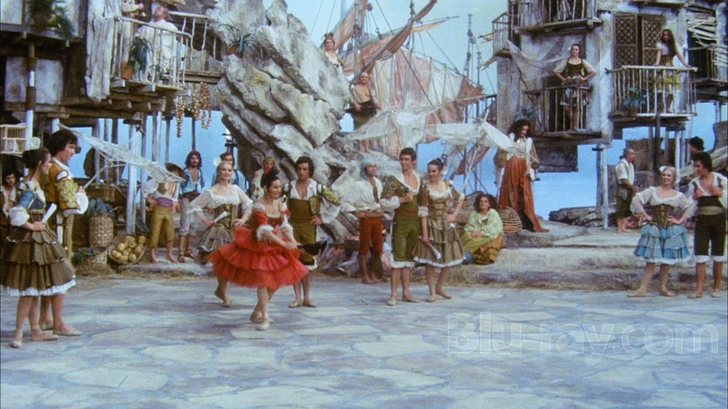
- Documentary: A Little of Don Quixote (HD; 17:19) is a vintage featurette that shows backstage footage, including of the airplane hangar where the film was shot, as well as interviews with the principal cast and crew. Video quality is a bit spotty on this, and this, like the main feature, also bears some signs of having undergone conversion from PAL.
- Don Quixote Restoration Process (HD; 2:38) offers some split screen comparisons of just how much work was done on this restoration. The color correction is pretty astounding to see.
- Biographies features text biographies of John Lanchbery, Rudolf Nureyev, Robert Helpmann and Lucette Aldous.
Don Quixote Blu-ray Movie, Overall Score and Recommendation
Don Quixote has attained something of a cult status through the years, no doubt due to the fact that no one seemed to be able to find it anywhere, at least not in its extant form. Looking at it now from the vantage point of at least a couple of decades of regular home video releases of classical music titles, including ballets, the production doesn't seem quite as breathtakingly innovative as it must have in 1973. It still offers a nice cinematic sweep and it is a wonderful chance to see a still relatively young Nureyev at the peak (or near peak) of his athletic prowess. Nureyev commands this production, despite not being the titular character. The more cinematic elements here offer some sumptuous production design and the entire ballet is filled with really bright and appealing costumes. Minkus' music is similarly bright and colorful and the Lanchbery interpolations are equally enjoyable. The video quality is the biggest hang-up here. While color correction is near miraculous, the image is still distressingly soft and there's a bizarre quasi-slow motion look to the proceedings that may well turn off ardent videophiles. That anomaly is balanced by an appealing audio presentation and some excellent supplementary material. With caveats noted, this release comes Recommended.