Die Nibelungen Blu-ray Movie
HomeDie Nibelungen Blu-ray Movie 
Deluxe Remastered Edition | Siegfried / Kriemhild's RevengeKino Lorber | 1924 | 2 Movies | 280 min | Not rated | Nov 06, 2012

Price
List price:Listed on Amazon marketplace

Movie rating
Movie has not been rated yetBlu-ray rating
| Users |  | 0.0 |
| Reviewer |  | 4.5 |
| Overall | | 4.5 |
Overview
Die Nibelungen (1924)
One of the greatest artistic and technical achievements of the German silent cinema, Fritz Lang's Die Nibelungen is a passionate retelling of Nordic legend, invested with all the resources of the colossal Ufa Studios.
| Drama | 100% |
| Adventure | Insignificant |
| Fantasy | Insignificant |
Specifications
Video
Video codec: MPEG-4 AVC
Video resolution: 1080p
Aspect ratio: 1.32:1
Original aspect ratio: 1.33:1
Audio
Music: DTS-HD Master Audio 5.1
Music: LPCM 2.0
Subtitles
English
Discs
50GB Blu-ray Disc
Two-disc set (2 BDs)
Packaging
Slipcover in original pressing
Playback
Region A (B, C untested)
Review
Rating summary
| Movie | | 4.5 |
| Video |  | 4.0 |
| Audio |  | 5.0 |
| Extras |  | 3.5 |
| Overall | | 4.5 |
Die Nibelungen Blu-ray Movie Review
Here be dragons...and dwarves...and magic...and proto-fantasy filmmaking of the highest order.
Reviewed by Casey Broadwater November 7, 2012Three years before director Fritz Lang delivered a hypothetical sci-fi view of Germany's future in his iconic Metropolis, he looked back on the
teutonic nation's mythic past with Die Nibelungen, a fantastical five-hour epic split into two parts. Made during the middle of the Weimar
Republic—that unstable political period between the end of WWI and the rise of the Nazi Party—the film was at least partially intended to bolster
national spirits by celebrating traditional German lore. Co-written by Lang's then-wife Thea von Harbou—later, a Nazi sympathizer who remained in
Germany when Lang fled to America—the story draws from Das Nibelungenlied, a 2,400-stanza poem of the 12th or 13th century that had
been previously adapted numerous times, most famously by Richard Wagner for his operatic Ring Cycle.
The tale was familiar to German audiences, and the Ufa production company—hoping to compete with the large-scale motion pictures coming out of
Hollywood at the time—set out to make the grandest retelling yet, giving Lang an enormous budget and full use of its massive studio at Neu-
Babelsberg. The result is one of the silent era's most impressive spectacles, laying the groundwork for future cinematic fantasy epics like The Lord
of the Rings—J.R.R. Tolkien was inspired by the original norse versions of the germanic legends—and even Star Wars. The large-scale
battles, the special effects wizardry, the archetypal characters—all are here in Die Nibelungen, which the has been recently restored in high
definition by the Friedrich-Wilhelm-Murnau Foundation.
Siegfried
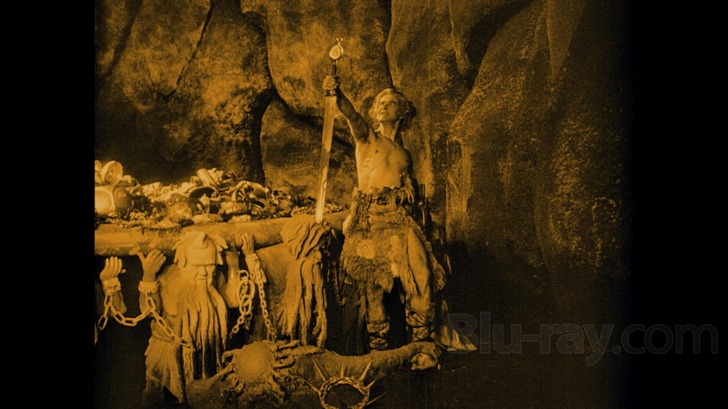
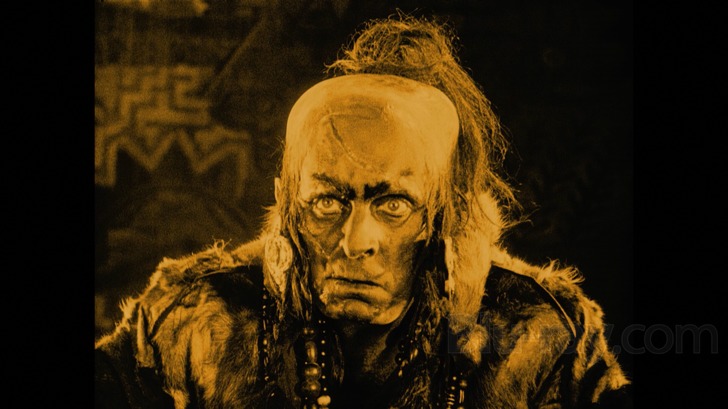
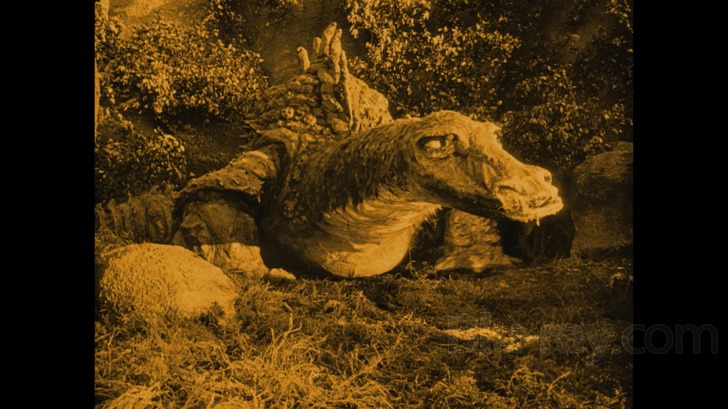
The first part, Siegfried, is concerned with the adventures of the titular character (Paul Richter), an Aryan posterchild with long, wavy blond hair and a ripped physique. (We'll get to the Nazi Party's appropriation of the film in a second.) Son of King Siegmund of Xanten, Siegfried has been sent to apprentice with the master swordsmith Mime, an apish teacher who's envious that his student's abilities have surpassed his own. When Siegfried asks directions to the Kingdom of Burgandy—he intends to wed Princess Kriemhild (Margarete Schön)—Mime sends him on a dangerous path through the Wood of Woden, where he runs afoul of a smoke-fuming dragon. The leviathan looks a bit goofy now, but in its day it was a feat of engineering, requiring seventeen puppeteers to operate. Siegfried slays the beast and—at the urging of a bird our hero can somehow understand— bathes in its blood, affording him invincibility. There's only one problem; while taking this sanguinary shower, a lime leaf lands on Siegfried's back, keeping the blood from doing its magical work on this one particular, still-vulnerable spot. Like Achilles' heel, Siegfried's shoulder will be his undoing.
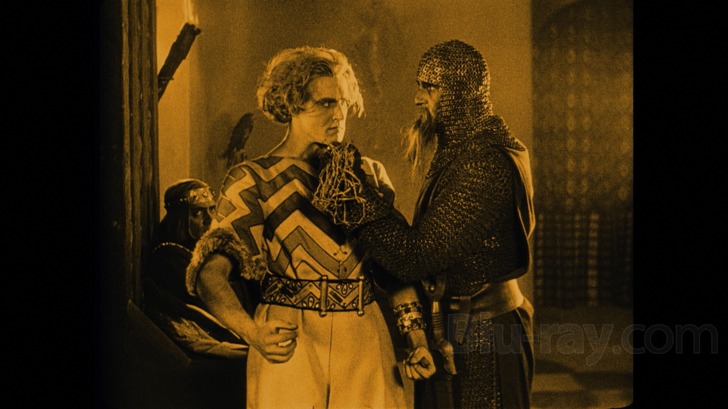
En route to Burgundy, our teutonic hero also defeats Alberich, King of the Nibelung Dwarves, gaining a hoard of gold and an invisibility cloak in the process. Both come in handy, the gold as a dowry for Kriemhild's hand, and the cloak in a quest that Siegfried must complete before taking the princess as his bride. The weakling King Gunther (Theodor Loos) is in unrequited love the with the unmarried warrior queen of Iceland, Brunhild (Hanna Ralph), who demands that any suitor must best in her three battle challenges. Gunther's advisor Hagan von Tronje (Hans Adalbert Schlettow)—the primary villain of the epic—demands that Siegfried take Gunther's place and pass Brunhild's tests, using trickery and mistaken identity. It works—Siegfried and Gunther each marry their respective love interests—but Brunhild's suspicions lead to series of lies and jealousies, ending in Siegfried's fated, no-spoiler- alert-required demise at the end of Hagan's spear.
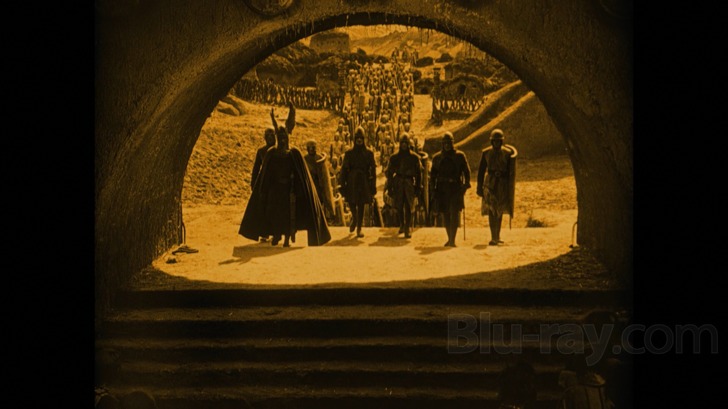
Though tragic, the first film is all magic and fantasy and wonder—gnomes turning into stone, a sleeping dragon, an animated dream sequence with crows attacking a dove—while the second movie, Kriemhild's Revenge, skews comparatively darker and more grimly realistic, a tale of vengeful bloodlust and longwinded medieval politicking. (Think Game of Thrones instead of Lord of the Rings.) When loyalty prevents Gunther from killing Hagan—who has also stolen the princess' dowry of Nibelung gold—Kriemhild marries none other than asiatic warlord Attila the Hun (Rudolph Klein-Rogge), whose vassal Ruediger (Rudolph Rittner) has sworn to help her get retribution for Siegfried's death. Kriemhild invites Gunther and the wary Hagan to celebrate the winter solstice in Hun territory—they arrive with their armies—and of course war breaks out between the Huns and the Burgundians. Short on the graceful mythicism of Siegfried, Kriemhild's Revenge goes for all-out martial bombast, staging one huge-scaled battle sequence after another, complete with hundreds of extras and horses. The narrative climax is a raging palace fire that traps Gunther and his nefarious aide, a sequence that's as terrifying and violent as it is visually arresting.
As in Metropolis, Lang's refined sense of mise-en-scene dominates the viewing experience; the story pales next to the cinematography and stately compositions, impressive both for the scale of the sets and the meticulousness of the arrangements. Lang's shadow looms large over "genre" cinema; he's the granddaddy of noir, the progenitor of high-concept science fiction, and here, a proto-Peter Jackson, delivering an epic fantasy story in action-packed installments. If there's a taint to Die Nibelungen's reputation, it's that Siegfried—with its national pride and Aryan heroics—was co-opted by the Nazis in the 1930s, truncated, and reworked into propaganda. This naturally infuriated the half-Jewish Lang, who refused an offer from Joseph Goebbels to lead Ufa Studios and instead fled to Paris and eventually the U.S., where he had a long and prolific Hollywood career. Image—in Lang's films—trumps ideology, and today we can once again see Die Nibelungen for the imaginative and ambitious work of fantasy filmmaking that it is.
Die Nibelungen Blu-ray Movie, Video Quality
Before either film begins, a disclaimer appears onscreen, detailing the restoration process:
"Despite its rich history and reputation, no complete, German version of Die Nibelungen exists today, neither in the form of original distribution
prints nor camera negatives. This photochemical restoration is derived from incomplete camera negatives. Missing parts were supplemented with various
dupe negatives and surviving distribution prints. The tinting follows the color scheme of the original prints and utilizes the authentic photochemical
method: the creation of a black and white print, which is then colored in a dye bath. The German intertitles were digitally restored, taken from preserved
prints and negatives. Reconstructed titles are indicated with the logo of the Murnau foundation. For the HD mastering, the picture was corrected in some
places and severe film damage was digitally repaired."
Considering the fact that this new print was apparently cobbled together from several sources, the 1080p/AVC-encoded transfer of Die
Nibelungen looks fairly consistent in clarity and tonality. There are a handful of shots that were obviously taken from lower quality materials—16mm
dupes, probably—but these are rare and fleeting and mostly occur in the second part. On the whole, the picture is wonderfully preserved. Print damage is
noticeable throughout—specks and vertical scratches and light staining—but never to the extent of becoming a distraction, particularly if you're used to
watching silent films. It's clear that the Friedrich-Wilhelm-Murnau-Stiftung put a lot of work into the digital restoration. (Although not quite as much
work as they did with the Metropolis remaster.) Grain is still natural-looking, no obvious edge enhancement has been performed, and there are
no apparent compression issues. The level of clarity fluctuates somewhat from scene to scene, but fine detail is usually visible, and if you've seen the
film(s) before, you'll definitely appreciate the intricate costume/set design even more here. The originally specified orangish/bronzed tinting complements
the storybook quality of the epic tale, and contrast is handled well too, although there are some fluctuations due to print age/damage. It's probably no
exaggeration to say that this is the best Die Nibelungen has looked since it was appropriated by the Nazis in the 1930s.
Die Nibelungen Blu-ray Movie, Audio Quality
For a large-scale production, an equally large-scale score. Recorded by the HR-Sinfonieorchester and the Frankfurt Radio Symphony Orchestra, this recreation of the long-lost original film music by Metropolis composer Gottfried Huppertz might not have the hard Germanic sturm und drang of Wagner's Ring Cycle—which the Nazi's used when they rereleased Siegfried in the 1930s—but it's much more appropriately cinematic, with twinkling, magical-sounding motifs that recall future fantasy-epic accompaniment, like John Williams work on Star Wars. When called for, the music sounds huge here, spread throughout each channel of the default lossless DTS-HD Master Audio 5.1 surround track. A Linear PCM 2.0 stereo mix-down is also included, but if you've got a capable home theater setup, stick with the immersive multi- channel track. Note that removable white subtitles are provided for the German gothic-script intertitles.
Die Nibelungen Blu-ray Movie, Special Features and Extras
- The Legacy of Die Nibelungen (HD, 1:08:36): The second disc in the set includes a fantastic new 10-part, 68-minute retrospective/making-of feature produced by the Friedrich-Wilhelm-Murnau-Stiftung and the Filmmuseum Potsdam. The documentary takes us through Lang's production techniques, the film's large scale spectacles, and it's U.S. release, but this is just the start. We also get a dissection of Nazi Germany's appropriation and plagiarism of the film, a detailing of the restoration process, and a behind-the-scenes view of the recreation of the original score by Gottfried Huppertz. Narrated in English, with English subtitles whenever German is spoken.
- Fritz Lang on Set (HD, 1:44): Excerpted from the German short Film im Film, this short piece offers a behind-the-scenes look at the Ufa Studios in Neu-Babelsberg and shows Fritz Lang at work on set, catching an anachronistic detail that needed to be removed from one shot. (An extra is wearing a wrist-watch.)
- Essay by Film Scholar Jan-Christopher Horak: The essay is only accessible on a computer with a BD-ROM drive, so chances are, you're probably not going to be reading it.
Die Nibelungen Blu-ray Movie, Overall Score and Recommendation
Before The Lord of the Rings, before Game of Thrones, before Star Wars, there was Fritz Lang's Die Nibelungen, a two- part, five-hour fantasy epic that undeniably helped set the visual and dramatic tone for the genre. Though it isn't as well-known as Lang's following film, Metropolis, it's just as grand in scale, featuring innovative special effects for its time and some remarkably enormous battle sequences. Kino's new Blu-ray set is pretty epic too, featuring a gorgeous new high definition remaster of both films, a recreated mix of the original orchestral music, and an hour-long documentary about the project's production and legacy. Highly recommended!