Diary of a Chambermaid Blu-ray Movie
HomeDiary of a Chambermaid Blu-ray Movie 
Journal d'une femme de chambreCohen Media Group | 2015 | 96 min | Not rated | Oct 04, 2016

Price
List price:Listed on Amazon marketplace

Movie rating
6.4 | / 10 |
Blu-ray rating
| Users |  | 0.0 |
| Reviewer |  | 3.5 |
| Overall | | 3.5 |
Overview
Diary of a Chambermaid (2015)
A scheming servant works for a wealthy couple in France during the late 19th century.
Starring: Léa Seydoux, Vincent Lindon, Clotilde Mollet, Hervé Pierre, Mélodie ValembergDirector: Benoît Jacquot
| Foreign | Insignificant |
| Drama | Insignificant |
Specifications
Video
Video codec: MPEG-4 AVC
Video resolution: 1080p
Aspect ratio: 2.39:1
Original aspect ratio: 2.39:1
Audio
French: DTS-HD Master Audio 5.1
French: Dolby Digital 5.1
Subtitles
English
Discs
Blu-ray Disc
Single disc (1 BD)
Playback
Region A, B (C untested)
Review
Rating summary
| Movie | | 3.5 |
| Video |  | 4.5 |
| Audio |  | 4.0 |
| Extras |  | 1.0 |
| Overall | | 3.5 |
Diary of a Chambermaid Blu-ray Movie Review
Reviewed by Jeffrey Kauffman October 11, 2016Octave Mirbeau’s 1900 novel The Diary of a Chambermaid was a shocking (for its time, anyway) exposé of some of the moral turpitude in the supposed noble classes of France, as seen through the eyes of its titular servant, a woman who herself wasn't exactly a paragon of virtue. The novel served up a number of salacious details, including elements of fetishism, an aspect that could hardly be depicted in any overt way when the property first matriculated to the film world as the 1946 feature Diary of a Chambermaid. As I mentioned in our Diary of a Chambermaid Blu-ray review, the tone of that film veered wildly from farce to horror, never really finding an appropriate balance and certainly never examining the class conflicts at the heart of the story as one might have expected in a film directed by the legendary Jean Renoir. When another legendary director, Luis Buñuel, made his own version of the novel in 1964, there was a more permissive air available and therefore Buñuel’s version did in fact feature at least some of the scandalous behaviors (especially the sexually charged ones) that made Mirbeau’s original novel such a cause célèbre. That said, Buñuel also invested the tale with a whole onslaught of political subtext (and actual text, frankly) that wasn’t part of Mirbeau’s formulation, not to mention the fact that Buñuel reframed the story’s time period by several decades, moving it forward into a more fractious period of history where these political elements were part of the cultural zeitgeist. And so we come to the third cinematic “at bat” for this now fairly well known tale, and it’s interesting to note both the restraint and occasional provocations that Benoit Jacquot’s 2015 film offers. At least passably more consistent in tone than the Renoir version, and perhaps thankfully lacking at least some of the political shenanigans that inform Buñuel’s version, this may be the most faithful adaptation of Mirbeau’s novel, which is not to say that the film really finds a convincing way to display the “adventures” of its (anti?) heroine, Célestine (Lea Seydoux). The film is an often fascinating study of class differences in 19th century France, with an ambience that may remind some of Upstairs Downstairs or even Downton Abbey: The Complete Collection, despite the obvious differences between the properties in terms of timeframe or even nationality.
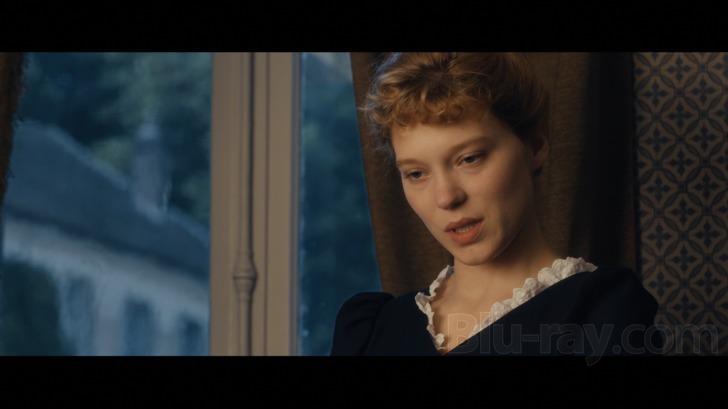
There’s an interesting interchange at the beginning of this version of The Diary of a Chambermaid where Célestine has a rather odd back and forth with her supervisor at what seems to be an employment agency that places servants at various homes. The supervisor both upbraids and compliments Célestine on her behavior, while also seeming to hint that if Célestine would simply make herself “available” to her (male) employers, her career would skyrocket. Célestine, in an ambiguous response that mirrors her supervisor’s own bifurcated comments, both agrees with and dismisses this “offer”. It’s an unsettling conversation, and one that seems to serve to point out the precarious nature of working women during this time period. It’s revealed that Célestine has regularly left the employ of other well appointed homes, for reasons which aren’t exactly clear but which are not related to her job performance (her employers have all been satisfied with her work). Already the film is off on a kind of seesawing ambience, one made even more visceral due to Jacquot’s modernizing influence of a handheld camera.
Célestine unenthusiastically accepts an appointment at an estate in Provence, though it’s hinted that she prefers the hustle and bustle of Paris. In a telling moment that reveals some of the character’s duplicity, when she’s introduced to the grand doyenne of the home, Madame Lanlaire (Clotilde Mollet), she says exactly the opposite, averring that she prefers the quiet of the country to the excitement of the city. Madame Lanlaire takes Célestine on a quick tour of the rooms of the mansion, repeatedly pointing out supposedly priceless heirlooms which she warns Célestine to take care of. More “user friendly” is the husband, Monsieur Lanlaire (Hervé Pierre), though perhaps not for entirely honorable reasons.
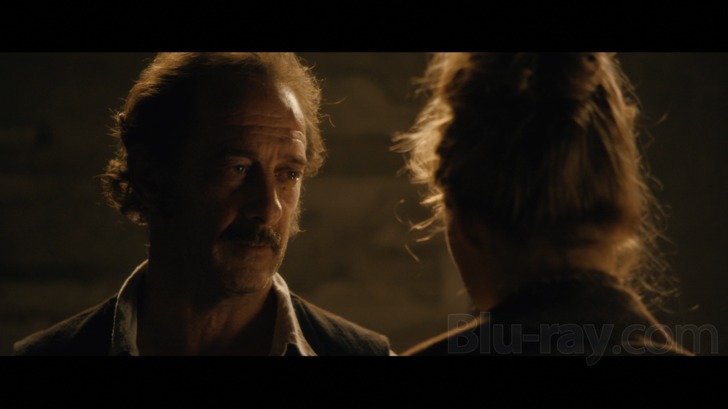
A number of other interrelationships are also introduced, most saliently one with Joseph (Vincent Lindon), the glowering valet and footman of the estate who obviously has eyes for Célestine. That romantic angle tends to inform the second half of the film more deliriously than the first, which is more concerned on a kind of comedy of manners as Célestine comes to understand the patent eccentricities of her employers (with fetishistic tendencies showing up in both genders). When the film tips over into a kind of crime ambience, some may feel that the foregoing elements haven’t really prepared the way adequately, ironically in somewhat the same way that things felt oddly disparate in the 1946 version of the film.
Despite these tonal imbalances, this Diary of a Chambermaid is often fascinating, with a standout performance by Seydoux, especially once Célestine’s own less than honorable proclivities start holding sway. There is a bit of a political angle here that's detailed with regard to Joseph's bigoted tendencies, something that may unite this film a little more strongly with the Buñuel account than with the Renoir. Jacquot also offers what is easily the most scenic tour through Mirbeau’s tale, with some luscious, almost Vermeer-esque, framings of both the gorgeous French countryside as well as the interiors of the Lanlaire estate.
Diary of a Chambermaid Blu-ray Movie, Video Quality
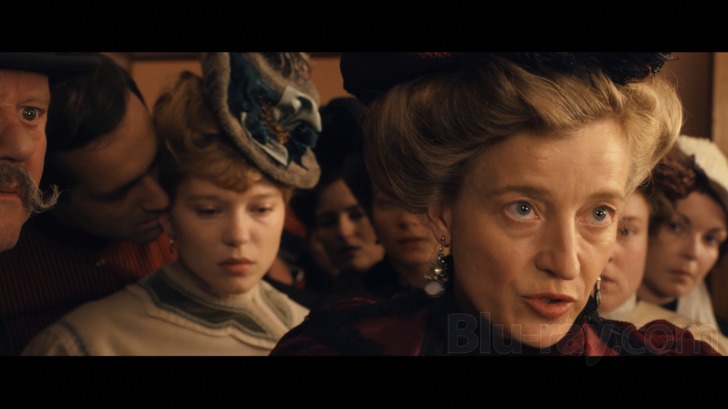
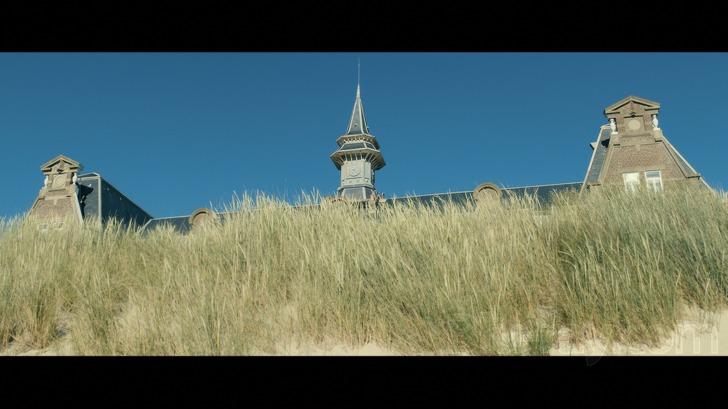
Diary of a Chambermaid is presented on Blu-ray courtesy of Cohen Media Group with an AVC encoded 1080p transfer in 2.39:1. Digitally shot at a source 4K resolution with Sony CineAlta cameras and finished at a 4K DI (according to the IMDb), this is an often spectacularly sharp and well detailed presentation. One of the film's greatest strengths is the sumptuousness of its production design, and there are several impressive moments in the film where one can almost count the threads in the opulent costumes or fabrics on things like draperies and furniture. The palette is just a little muted at times, but that in fact only helps to create an evocative atmosphere as Célestine begins working in Provence. Contrast is strong and helps the film segue from sun dappled exteriors to what on several occasions are either naturally lit or candlelit interior sequences. There are no issues with compression artifacts and no problems with image instability.
Diary of a Chambermaid Blu-ray Movie, Audio Quality
Diary of a Chambermaid features a nice sounding DTS-HD Master Audio 5.1 track, though in my continuing alerts concerning the audio on Cohen releases, the disc has been authored to default to a lossy Dolby Digital 5.1 track (both tracks are in the original French, with optional English subtitles). A nice sounding, often quasi-chamber, score by Bruno Coulais provides nice spreads through the surround channels, and several outdoor sequences have nicely placed ambient environmental effects. Dialogue is cleanly rendered and always well prioritized, though there's not a lot of competition going on most of the time, with the film tending to traffic in longer conversational sequences than anything overtly "showy".
Diary of a Chambermaid Blu-ray Movie, Special Features and Extras
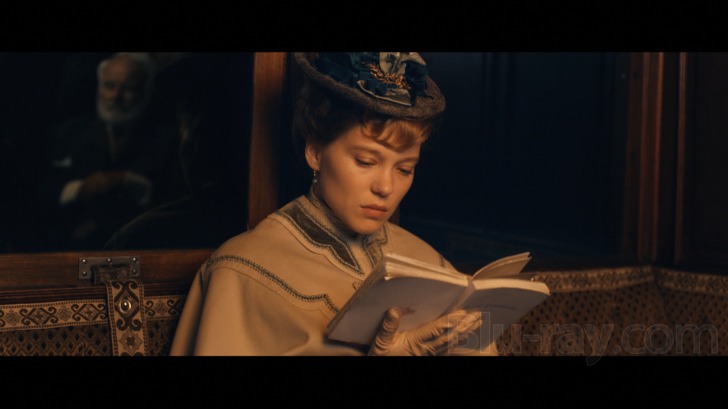
- Theatrical Trailer (1080p; 2:11)
- The Making of Diary of a Chambermaid (1080p; 18:40) is a decent EPK with some fun behind the scenes footage and interviews.
Diary of a Chambermaid Blu-ray Movie, Overall Score and Recommendation
There's a moment in this version of Diary of a Chambermaid when the sexual proclivities of Madame Lanlaire are revealed with a shocking but hilarious sequence where she's forced to show an item of self gratification to a railroad inspector. It's a moment that will no doubt stand out to anyone who has seen either the Renoir or Buñuel versions of this story, since it's so intentionally provocative and "free spirited", aspects that weren't able to be fully exploited in the previous versions. That kind of "shocking" content helps to give this iteration of Mirbeau's story a little edge, but there are still the same kind of odd tonal imbalances at play here that were also evident in the previous versions. Seydoux is a standout in the role, however, and the film is often quite lush and scenic. Technical merits are strong, and Diary of a Chambermaid comes Recommended.
Similar titles
Similar titles you might also like
(Still not reliable for this title)

Aquarius
2016

The Hundred-Foot Journey
2014

Bastards
Les Salauds / Slipcover in Original Pressing
2013

Her Smell
2018

Plenty
1985

Things to Come
L'avenir
2016

The Last Mistress
Une vieille maîtresse / Slipcover in Original Pressing
2007

Transit
2018

Intimacy
2001

Cymbeline
2014

Love 3D
2015

Emmanuelle 4K
1974

Life of Riley
Aimer, boire et chanter
2014

The Image Book
Le livre d'image
2018

A Woman Is a Woman
Une femme est une femme
1961

Code Unknown
Code inconnu: Récit incomplet de divers voyages
2000

Veronika Voss
Die Sehnsucht der Veronika Voss
1982

Out 1
Out 1, noli me tangere
1971

Mandabi
1968

Soleil Ô
Oh, Sun
1967