Detroit Blu-ray Movie
HomeDetroit Blu-ray Movie 
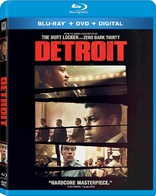
Blu-ray + DVD + UV Digital Copy20th Century Fox | 2017 | 143 min | Rated R | Dec 12, 2017

Movie rating
7.2 | / 10 |
Blu-ray rating
| Users |  | 0.0 |
| Reviewer |  | 4.0 |
| Overall | | 4.0 |
Overview
Detroit (2017)
A police raid in Detroit in 1967 results in one of the largest citizen uprisings in the United States' history.
Starring: John Boyega, Will Poulter, Algee Smith, Jacob Latimore, John KrasinskiDirector: Kathryn Bigelow
| History | Uncertain |
| Drama | Uncertain |
| Thriller | Uncertain |
Specifications
Video
Video codec: MPEG-4 AVC
Video resolution: 1080p
Aspect ratio: 1.85:1
Original aspect ratio: 1.85:1
Audio
English: DTS-HD Master Audio 5.1 (48kHz, 24-bit)
Subtitles
English SDH, French, Spanish
Discs
Blu-ray Disc
Two-disc set (1 BD, 1 DVD)
UV digital copy
DVD copy
Packaging
Slipcover in original pressing
Playback
Region A (locked)
Review
Rating summary
| Movie | | 4.0 |
| Video | | 4.0 |
| Audio |  | 4.5 |
| Extras |  | 1.5 |
| Overall | | 4.0 |
Detroit Blu-ray Movie Review
Reviewed by Jeffrey Kauffman December 13, 2017Director Kathryn Bigelow and writer Mark Boal have explored the intersection of politics and terror in The Hurt Locker and Zero Dark Thirty, and in some ways it could be argued the team is revisiting territory they’ve covered before in Detroit, though in this case that territory is geographically at least right here in the good old United States, a place where things like the abuse of police power and subjugation of the downtrodden is not “supposed” to happen. Detroit deals with a disturbing 1967 incident which may be largely unknown to many coming to this film “cold”, with simmering racial divisions which were already at a boiling point spilling over into riots and, ultimately, several deaths which were more or less blamed on over zealous police and/or paramilitary types. For several years in the mid-sixties, so called “race riots” became almost depressingly regular news, with outbreaks in areas as disparate (again, geographically speaking) as Watts in Los Angeles and Harlem in New York City. Detroit begins with a peculiar animated opening sequence that quickly documents the “great migration” northward by African Americans in the wake of the end of the Civil War, and how Detroit became a mecca of sorts for them. In the wake of the end of another epochal battle, World War II, this odd “cartoon” suggests that the flight of caucasians to the suburbs more or less created a kind of “automatic segregation” which kept black people in overcrowded, fetid urban environments where violence was almost guaranteed to result. Adding fuel to this particular fire is the fact that in the 1960s the police force of Detroit was almost exclusively white, meaning that so called “community policing” was not just difficult, but arguably well nigh impossible, since the police were almost by default not a part of the community, either territorially or, more importantly, socially and racially.
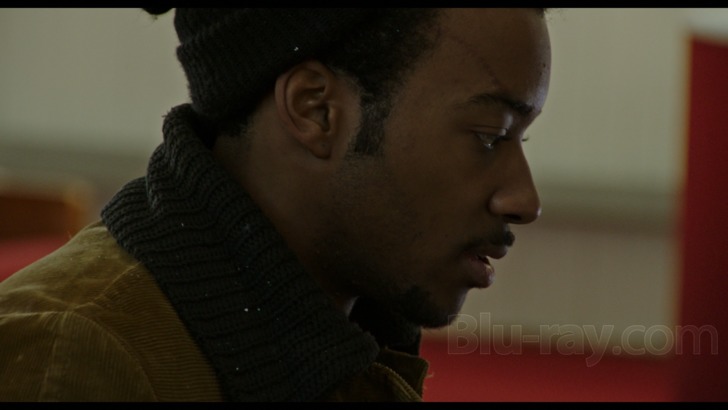
There’s a kind of interesting subtext underlying some of the opening moments of Detroit, where a so-called “unlicensed club” is hosting a party that includes several veterans who have evidently just returned from Vietnam. Here, in a nutshell, is a fascinating microcosm detailing how this particular community reacted to soldiers returning from an increasingly unpopular war. Think of any anecdotes you may have heard from white or black soldiers who fought in Vietnam, many of whom can share near horror stories of being spat upon or similarly disrespected when they came back “home” to the United States. But here, in an insular black community, the vets are repeatedly welcomed home, albeit in a kind of inherently sarcastic way at times, especially after an almost uniformly white police force shows up to arrest these “unlicensed” party goers. One slightly underdeveloped aspect to this opening vignette is how and/or why a seemingly lone black police officer is involved in the arrests, and how in fact he seems to have planted an undercover reveler in the midst of the unsuspecting celebrants.
What would seem to be a “legal” if kind of stupid, even boneheaded, show of force by Detroit’s constabulary quickly goes off the rails when the police are forced to trot the horde of merry makers out the front door of the facility, since some of the police can’t get through a hidden back door in an alley, where they’d prefer to make the arrests unseen by the rest of the neighborhood. That “unfortunate” turn of events means that the neighborhood does in fact see what’s going on, and while tensions quickly escalate, it’s arguable that Boal and Bigelow don’t really adequately address why the bystanders would suddenly “go postal”, destroying businesses in their own neighborhood, some of which one might reasonably assume are owned by or at least employ black people from this general area. That qualm aside, though, Detroit provides a brisk overview of violence running rampant throughout the community, which soon enough involves Governor George Romney and, ultimately, not just the police but the National Guard and other military types.
But what is kind of interesting from a structural standpoint is that Detroit isn’t actually really about the “main” riot, but instead a coterie of folks who end up at the nearby Algiers Motel when the maelstrom starts. This includes two members of the real life singing group The Dramatics (“In the Rain” and “Whatcha See is Whatcha Get”), Larry Reed (Algee Smith) and Fred Temple (Jacob Latimore), who quickly befriend two white women they meet at the Algiers, Julie Ann (Hannah Murray) and Karen (Kaitlyn Dever). There’s some anxiety already in this set up, since some viewers may expect that the mere interaction of black men with white women might lead to further violence, but in fact that doesn’t really play into the plot dynamics in any meaningful way.
Two other denizens of the motel, Aubrey (Nathan Davis, Jr.) and Carl (Jason Mitchell), also are folded into the chaos, and when one of them does something truly stupid (which won’t be spoiled here), all hell breaks loose, at which point the Algiers becomes the focal point for both police and the paramilitary forces which have assembled, including a seemingly unhinged cop named Philip Krauss (Will Poulter). An apparently well intentioned black security officer named Melvin Dismukes (John Boyega) also gets involved, and the film presents what might be perceived as “dueling perspectives” of the ensuing pandemonium from the points of view of Krauss and Dismukes.
Suffice it to say that things do not go overly well at the Algiers, though what exactly Boal and Bigelow sought to detail in this vignette laden enterprise may be questionable for some. On a micro level, Detroit is filled to the brim with fascinating characters, and the “siege” aspect of the whole Algiers affair is riveting, but what, if any, “macro lessons” can be learned? That’s a more tenuous proposition, for while there are obvious examples of police overreach (to say the least), and an imbalance in the racial makeup of the police that played into the fracas, I’m not sure there are any “meta” aspects to this story. There are also a couple of structural elements that are arguably either unhelpful or which might have been rejiggered to help support the story better. The opening animated sequence is a case in point: why deal with this history with a parade of almost playful imagery? Is it supposed to be intentionally ironic? Wouldn’t this same backstory have been more visceral had it been accompanied by archival stills or news footage? (This is especially relevant since there is archival news footage sprinkled throughout the film.)
At the “opposite” bookend (so to speak), the final section of the film deals with a trial that ensued, and I kept wondering how the film might have benefited had Boal made the trial the focus from the very beginning, something that might have introduced more of a Rashomon aspect to the proceedings, as various witnesses step up to recount their version of events. The film ends with some text cards detailing the eventual outcomes of various real life people involved in the incident, stating outright that there are still questions about what exactly transpired and that the filmmakers have taken “creative liberties” in their depiction. But that very fact seems to reveal that Boal and Bigelow are not in fact interested in any “Rashomon” ambiguities, and instead want to present a relatively clear accounting of American injustice, even if some “shades of gray” got left in the rubble along the way.
Detroit Blu-ray Movie, Video Quality
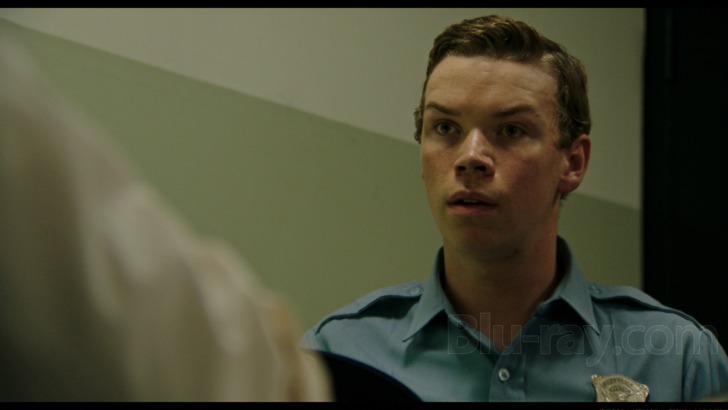
Detroit is presented on Blu-ray courtesy of 20th Century Fox Home Entertainment with an AVC encoded 1080p transfer in 1.85:1. While the IMDb lists the Arri Alexa Mini as having captured the imagery, this is a rather "film like" looking presentation, with a gritty, textured appearance that is perfectly in keeping with the subject matter. Unfortunately (in my estimation), Bigelow and and cinematographer Barry Ackroyd opt for a lot of handheld and other "jiggly cam" techniques, a strategy which contributes quite often to the perception of softness. When the camera settles down a bit, detail levels improve noticeably, though the film's prevalence of duskily lit hotel rooms sometimes keeps fine detail levels at a minimum. There are occasional uses of archival video and stills (often closer to Academy ratio) which show their age (especially with regard to the video). Perhaps the variety of lenses the IMDb lists also contributes to an arguably wider than average variance in clarity and sharpness levels. Some of the brightly lit outdoor daytime material has the most traditional "high definition" appearance, while a lot of the interior hotel material is somewhat softer and fuzzier looking quite a bit of the time.
Detroit Blu-ray Movie, Audio Quality
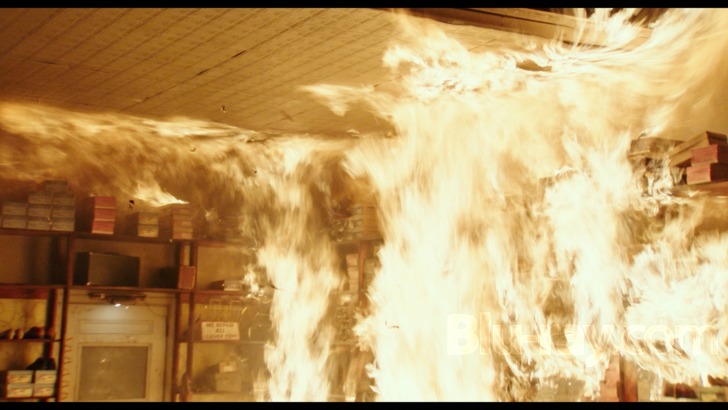
Detroit's DTS-HD Master Audio 5.1 track is often quite impressive, delivering regular surround activity courtesy not just from the expected crowd scenes and rabble once the riot takes hold, but also due to some of the "sidebar" material, like the aborted performance by The Dramatics in the Apollo-like concert hall. While elements like explosions and gunfire recur with enough regularity that adrenaline junkies will get their fill, the film is also nicely nuanced in some of the smaller, interior, scenes that take place in the hotel. Here even claustrophobic ambient environmental sounds are well placed in the various channels. Dialogue and score are rendered artfully and with smart prioritization throughout.
Detroit Blu-ray Movie, Special Features and Extras

Some of the following supplements didn't really need to be split into separate offerings, since several of them feature some of the same (real life) interview subjects covering general topics associated with Detroit in general and the Algiers incident in particular:
- The Truth of Detroit (1080p; 2:08)
- The Cast of Detroit (1080p; 2:11)
- The Invasion of Detroit (1080p; 2:06)
- The Hope of Detroit (1080p; 1:14)
- Detroit - Then and Now (1080p; 1:33)
- Algee Smith and Larry Reed: Grow (1080p; 3:35)
- Gallery (1080p; 1:05) features both an Auto Advance and a Manual Advance option. The timing is for the Auto Advance option.
- Theatrical Trailer (1080p; 2:27)
Detroit Blu-ray Movie, Overall Score and Recommendation
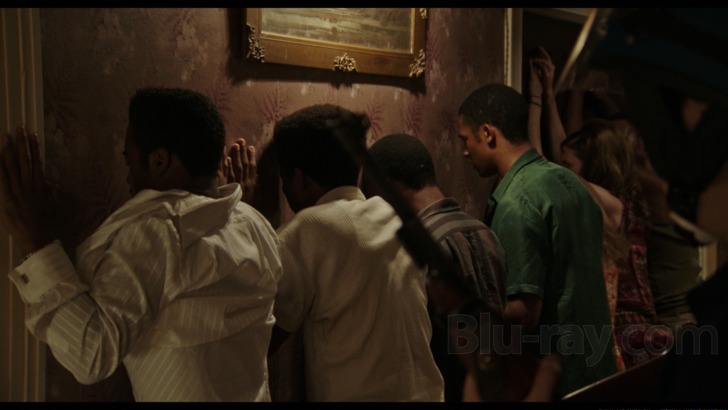
The back cover of Detroit mentions the "horrifying secret" that the Algiers incident has been for untold decades, and if the film's sole purpose was simply to force that secret into the cold, hard light of day, then Detroit is an unqualified success. But I couldn't help but wonder what the overarching theme is? That rogue cops are bad? That sometimes "party hearty" folks do really stupid things? The film is viscerally intense and features a glut of excellent performances, but Detroit may not be a location you'll want to revisit very often. Technical merits are strong, and at least for one viewing, Detroit comes Recommended.
Similar titles
Similar titles you might also like

Selma
2014

Philomena
2013

Hotel Mumbai
2018
The Stanford Prison Experiment
2015

The Current War
Director's Cut
2017

LBJ
2016

Mandela: Long Walk to Freedom
2013

12 Years a Slave
2013

Cesar Chavez
2014

Traffik
2018

Harriet
2019

The Best of Enemies
2019

All the Way
2016

Free State of Jones
2016

A Mighty Heart
Warner Bros. reissue
2007

The Great Debaters
2007

Colonia
2015

Amsterdam 4K
Ultimate Collector's Edition
2022

Jimmy's Hall
2014
Catch a Fire
2006