Desert Flower Blu-ray Movie
HomeDesert Flower Blu-ray Movie 
National Geographic | 2009 | 120 min | Rated R | Jul 19, 2011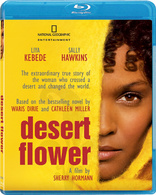
Price
List price:Listed on Amazon marketplace

Movie rating
6.9 | / 10 |
Blu-ray rating
| Users |  | 4.5 |
| Reviewer |  | 4.0 |
| Overall | | 4.2 |
Overview
Desert Flower (2009)
Based on the world best-selling book DESERT FLOWER by Waris Dirie - the autobiography of a Somalian nomad circumcised at 3, sold in marriage at 13, who became an American supermodel and is now at the age of 38, the UN spokeswoman against female circumcision.
Starring: Liya Kebede, Sally Hawkins, Timothy Spall, Anthony Mackie, Meera SyalDirector: Sherry Hormann
| Drama | Uncertain |
| Biography | Uncertain |
| Period | Uncertain |
Specifications
Video
Video codec: MPEG-4 AVC
Video resolution: 1080p
Aspect ratio: 1.85:1
Original aspect ratio: 1.85:1
Audio
English: DTS-HD Master Audio 5.1
English: DTS-HD Master Audio 2.0
Discs
25GB Blu-ray Disc
Single disc (1 BD)
Playback
Region A (C untested)
Review
Rating summary
| Movie | | 4.0 |
| Video | | 4.5 |
| Audio | | 4.5 |
| Extras |  | 2.5 |
| Overall | | 4.0 |
Desert Flower Blu-ray Movie Review
Supermodel with a secret.
Reviewed by Jeffrey Kauffman July 22, 2011Desert Flower is one of those movies which seems to be about one thing, until suddenly and irrevocably it takes a drastic left turn and you discover, in something of a major shock, that it’s really about something else. There is no way this review can avoid what the actual point (as opposed to the main subject matter) of Desert Flower is, so those who haven’t seen the film, or who are unaware with its heroine’s real life story, might want to stop reading here and now and simply move on to the technical aspects of the review. Still here? Chances are that you may already know about Somali supermodel Waris Dirie, an incredible woman who literally ran from Somalia at the tender age of 13 to escape an arranged marriage with a much older man, landed in London and through the vagaries of fate and/or chance, met a world famous fashion photographer who helped catapult her to the runways of international stardom. That would seem to be potent content for any film, and indeed Dirie’s autobiography Desert Flower, from which this film is culled, is subtitled The Extraordinary Journey of a Desert Nomad and gives a good approximation of this aspect of Dirie’s story. The film ping-pongs back and forth between several disparate locations and timelines, giving us the odd concatenation of Dirie’s ultra-glamorous London (and international) modeling career thrust up against the desperately poor, barren world of her agrarian Somali family. But here’s where the story of Desert Flower gets interesting, if also extremely disturbing: while it’s hinted at in one extremely upsetting scene fairly early in the film, Desert Flower actually gets quite explicit (as in quite explicit) about the African practice of female genital mutilation, a practice which is so alarmingly barbaric that it may actually cause some viewers to turn the film off in reactionary disgust. I’m personally not that squeamish of a viewer but I will go on record as stating there is one scene in this film that is so completely unsettling that I doubt anyone with a heart will be able to make it through completely unscathed. Forewarned is forearmed.
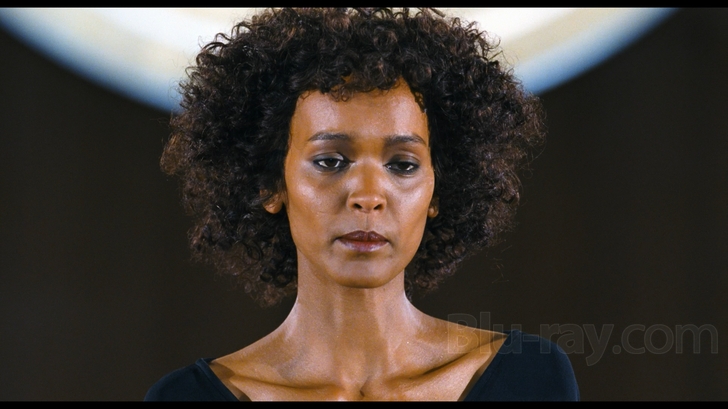
Waris Dirie might have been simply a poster child for incredible success after a rather rocky childhood and adolescence, and of course that’s part and parcel of the allure of her story. But there’s a sense of regret and perhaps even actual physical pain to the character as she’s portrayed in Desert Flower that lets the audience in on the fact that there’s something going on here that may not be completely evident on Dirie’s gorgeous surface. (Dirie is portrayed in the film by Ethiopian supermodel Liya Kebede in a neat piece of type casting). That gives Desert Flower an odd kind of subtextual dialectic from almost its first moments, a dialectic that only grows in import as the film hurtles toward one of the most shocking scenes ever caught on film. (Without spoiling the shock, how they did this scene, especially with regard to one of the “actors” in the scene, is one of the most disturbing elements about the film).
Desert Flower for all its power (some of which derives from its patent shock element) can’t quite get past the fact that it is at its core kind of schizophrenic. This is a film which lurches rather uneasily between low comedy (Waris doesn’t quite get how to walk in high heels and her early attempts at English are like something out of a surreal remake of Milla Jovovich in The Fifth Element) and outright melodrama. While supporting turns by Timothy Spall as the photographer who discovers Waris, Juliet Stevenson as the agent who manages her career, and Sally Hawkins as Waris’ kind of ditzy friend all do good work, they’re tonally at odds with the film’s serious import, at least some of the time. Stevenson especially seems to be playing two characters, or at the very least one character who’s seriously manic-depressive, as the agent is one moment charming and helpful and the next is screaming at the top of her lungs in disparagement. Well, maybe that’s realistic after all.
There are a couple of other troubling aspects about Desert Flower which keep it from fully achieving its aims. First of all, the film is too formulaic in its literal rags to riches story, and Waris’ ascendancy to the pinnacle of supermodel heights is dealt with in almost funny (not in a good way) montage sequence that is like something out of a 1940’s Warner Brothers potboiler with Joan Crawford and pages from a calendar peeling off one after the other. But more troubling, if perhaps a bit more subtle to spot, is the film’s focus on some at least questionable modeling sessions in which Waris partakes, sessions featuring full nudity. If one of the film’s tangential theses is the sexual subjugation and objectification of women, what does it say about these subjects that they’re handled in such a cavalier fashion when it involves high-priced British photographers instead of desert shamans?
But ultimately the majestic aspects of Waris’ story lift Desert Flower above its stereotypes and lack of consistency. Kebede proves herself quite an accomplished actress, one who is able to portray Waris in both her atavistic and glamorous modes with equal ease. (Kebede bears a rather odd resemblance to a young Whitney Houston at times). The supporting cast is uniformly wonderful, even when the film is tonally ambivalent about some characters. Hawkins’ character, for example, is largely shunted off to the sidelines for the middle third of the film after having played a central part in the opening scenes, and then just as suddenly she’s back for the big wrap up at the end. But the sheer incredulity with which a lot of people are going to react to Waris’ story is what gives Desert Flower its very unique momentum and dramatic impact. This is not an easy story to watch, but it’s one that perhaps needs to be seen.
Desert Flower Blu-ray Movie, Video Quality
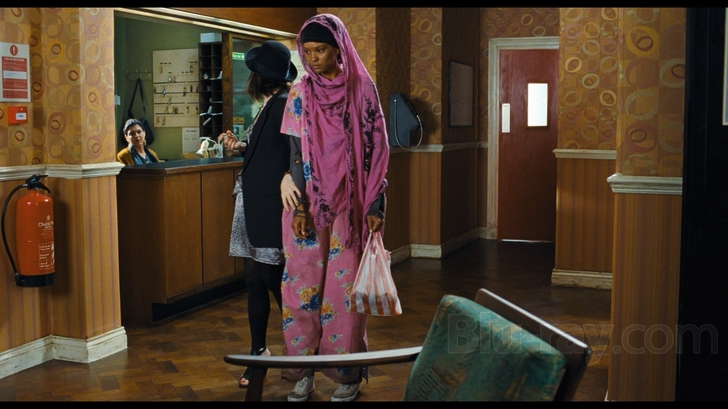
Desert Flower is presented on Blu-ray courtesy of National Geographic Entertainment and Virgil Films with an AVC encoded 1080p transfer in 1.85:1. The film looks largely gorgeous in both its African and international settings. Depth of field in the opening African shots is staggering. The horizon appears to be literally scores of miles away, and yet the deep focus keeps everything indelibly sharp. Colors are also astoundingly well saturated and incredibly varied. Some of the London footage has been filtered toward the blue end of the spectrum, but little if any fine detail is lost in the process, and contrast and black levels remain very strong throughout the film. There are some very minor, transitory aliasing issues on some of the rock strewn environments Waris stumbles through in Africa, but otherwise this is an artifact free presentation.
Desert Flower Blu-ray Movie, Audio Quality
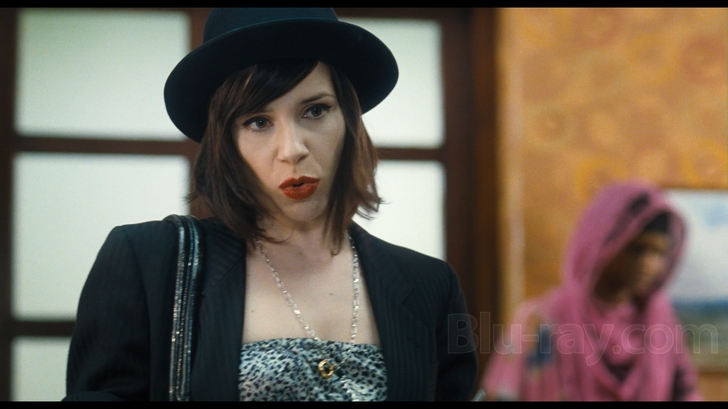
Desert Flower features two lossless tracks, a DTS-HD Master Audio 5.1 surround mix and a DTS-HD Master Audio 2.0 stereo fold down. Both of these tracks offer sterling fidelity, excellent dynamic range and very good balance between dialogue, score and the occasional environmental ambient effect. The surround mix is surprisingly immersive, from the wilds of Africa where the flutter of breezes or the caw of scavenger birds dots the soundfield, to the urban wilds of London, where both outdoor traffic and crowd scenes as well as indoor environments such as a club Waris visits bristle with surround activity. The bulk of the film is much quieter, devoted to smaller character moments between usually two or three actors, but those also sound great, if not as spatially varied. There's also a rather surprising low end throughout at least some sequences in the film, notably the thumping bass in the club scene.
Desert Flower Blu-ray Movie, Special Features and Extras
- Extended Interviews with Liya Kebede (SD; 16:41) offers the actress-model giving a lot of background information on the film from her initial meetings through auditions and casting and then shooting.
- Theatrical Trailer (HD; 2:01)
Desert Flower Blu-ray Movie, Overall Score and Recommendation
Someone with a very smart marketing plan is helping National Geographic expand its horizons. Back when I was growing up, when even cable was out of the ordinary, NatGeo meant occasional specials on broadcast television. While its own channel has increased its presence, and of course its flagship magazine is still a major success, recent wider reaching projects like the amazing documentary Restrepo and now Desert Flower show that NatGeo is attempting something new and at least partially unexpected. Desert Flower, in its own way like Restrepo, is a shocking piece of filmmaking that is not easy to sit through at times. But its valiant story of a woman overcoming incredible odds and baring her soul to untold millions should hopefully be an inspiration to others and, as the film makes clear in its epilogue, has already led to whole communities abandoning a hideous practice. Highly recommended.
Similar titles
Similar titles you might also like
(Still not reliable for this title)

The Color Purple
1985

Mr. Turner
2014

Nixon
1995

The Long Day Closes
1992

Miss Potter
2006

The Irishman
2019

The Iron Lady
2011

Great Expectations
2012

Allied 4K
2016

Bright Star
2009

Gandhi
1982

Malcolm X 4K
1992

The Last Emperor
1987

The Invisible Woman
2013

Coco Before Chanel
Coco avant Chanel
2009

A Man for All Seasons
Limited Edition to 3000 - SOLD OUT
1966

The Social Network
Collector's Edition
2010

J. Edgar
2011

Raging Bull
30th Anniversary Edition
1980

The Elephant Man
1980