Decasia Blu-ray Movie
HomeDecasia Blu-ray Movie 
Icarus Films | 2002 | 67 min | Not rated | Dec 04, 2012
Price
List price:Listed on Amazon marketplace

Movie rating
7.4 | / 10 |
Blu-ray rating
| Users |  | 0.0 |
| Reviewer |  | 4.0 |
| Overall | | 4.0 |
Overview
Decasia (2002)
Because it is chemically unstable, cellulose nitrate film stock begins decomposing the moment it is manufactured, a process that accelerates with the passage of time. But the actual picture that this relentless disintegration produces can sometimes be beautiful. A Luna Park rocket car explodes out of disintegrating chaos. A hag points a threatening finger at an appalled judge, and then turns back to us, metamorphosing into sheerest monstrosity. Lovers melt into embraces but are themselves melting and coming undone. (Adapted from Lawrence Wechsler, “Sublime Decay”, New York Times Magazine, Dec. 22, 2002.)
Director: Bill Morrison (II)| Documentary | 100% |
Specifications
Video
Video codec: MPEG-4 AVC
Video resolution: 1080p
Aspect ratio: 1.35:1
Original aspect ratio: 1.37:1
Audio
Music: DTS-HD Master Audio 5.1
Music: DTS-HD Master Audio 2.0
Subtitles
None
Discs
25GB Blu-ray Disc
Single disc (1 BD)
Playback
Region free
Review
Rating summary
| Movie | | 4.0 |
| Video |  | 4.5 |
| Audio | | 4.5 |
| Extras |  | 3.5 |
| Overall | | 4.0 |
Decasia Blu-ray Movie Review
Beyond Grain. WAY Beyond Grain.
Reviewed by Michael Reuben December 6, 2012The title of Decasia rhymes with "fantasia", and the film is the epitome of an obscure arthouse title. However, for fans of Blu-ray, and especially for regulars at Blu-ray.com, the subject matter should be anything but arcane. Participants in this site's lively forum have spent literally hundreds of hours debating the mechanics of film as it is represented in the digital medium of high definition. Discussions of grain, film stock, preservation and restoration are common, and the artistic and technical judgments of those tasked with translating images stored as film emulsion into the binary code of ones and zeroes are closely scrutinized. Decasia is a sort of elegy for analog images, a ceremony of last rites for a dying series of silver nitrate frames that, in their final moments, seem to be yielding up new insights into the world, except that they're now speaking in tongues. Peer at them long enough, and maybe you can decipher fragments of their mystical language. Then again, it might just be gibberish. Who knows? Director Bill Morrison is an experimental filmmaker who is best known for his work creating moving pictures to accompany musical performances. Decasia began as a visual accompaniment to a work by Michael Gordon, who was commissioned in 2001 to write a symphonic composition for the Basel Sinfonietta. Morrison assembled a series of "found" images that illustrated the theme of decay, which were projected on three screens surrounding the orchestra as it played Gordon's creation. But Morrison's project took on a life of its own, as he became fascinated by the tension that he discovered in some archival film, if he could catch it at just the right moment, between action still visible in the frame and the independent action of the dissolving emulsion. Aside from a strange beauty, the result seemed fraught with metaphor: life vs. decay, order vs. chaos, creation vs. destruction. After many searches through various archives, Morrison assembled a completed film just over an hour long. Built entirely of found images and accompanied only by Gordon's music, Decasia played at the Sundance Film Festival in 2002 and then failed to find distribution. A profile of Morrison late that year in the New York Times Magazine chronicled his efforts and his frustration.

By its very design, Decasia defies easy description. It has no plot or narrative, and once you've outlined Morrison's basic technique, there's little to say beyond describing the succession of images he's assembled—an exercise as pointless as describing abstract art. Indeed, watching Decasia often feels like sitting in front of a huge abstract canvas and allowing your mind to wander over its surface seeking patterns. The difference is that abstract paintings don't shift of their own accord, whereas Morrison's canvas is in constant motion. (For this reason, by the way, the screenshots accompanying this review provide only a hint of the experience.) It's not as if Morrison's assembly is entirely random. Like a musician playing themes, he returns to certain clips regularly. Decasia opens with several images that are relatively stable, in an obvious effort to ease the viewer into the experience: a whirling dervish (but in slow motion); giant banks of developing machines processing reels of film; men and camels progressing slowly across a distant horizon. Some of these images will be repeated at the film's end as a kind of "lead out". Footage of a volcano belching smoke serves as a transition to the decomposing footage, and from that point you're never certain what you're looking at. Figures materialize, dissolve, reappear and vanish, only to be replaced by other figures that may or not be related. At times you find yourself peering into the nitrate rubble and wondering whether the figures you're seeing are really there or have been spun from your fancy, like the cinematic equivalent of cloud animals. Some of Morrison's footage is truly remarkable. A clip shows kids jumping on an early model automobile—and its degenerating image appears to respond to their actions. You watch it and wonder whether it's pure chance or whether there's something about the patterns of silver molecules as they lined up in the emulsion that caused them to break down in just this way. Maybe it's more than just a figure of speech when directors and cameramen talk about capturing "energy" in a frame. Meditate on any portion of Decasia, and such trippy reflections come naturally. (The amusement park ride that seems to launch itself out of a boiling void is another favorite moment.) One does not emerge from Decasia with a new-found commitment to film preservation (although it is a wake-up call to the perils of neglect). Instead, Morrison's work leaves the viewer with a sense of film as an organic process, not quite a living being, but not quite dead either—more tissue than technology and an integral part of a human life cycle that encompasses birth, growth, love, conflict, aging, death and decay. That's a lot to cover in one 67-minute film, but perhaps it explains why Morrison had so much trouble finding distribution. He asks a lot from the viewer.
Decasia Blu-ray Movie, Video Quality
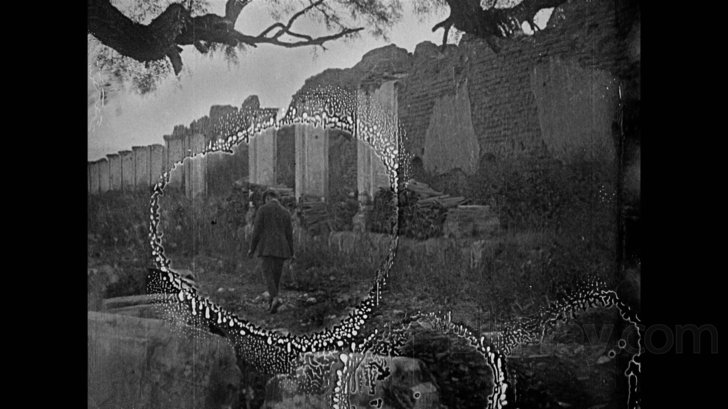
A video evaluation of Icarus Films's 1080p, AVC-encoded Blu-ray of Decasia defies all the usual criteria applied in Blu-ray reviews. How do you assess the black levels? The sharpness? The detail? The fidelity to the source? The images of Decasia constitute their own world, with no external reference or standard by which to judge them. One can say this much: There are true blacks on the disc, which suggests that the transfer and mastering were performed with accurately calibrated equipment. The pulsing, swirling, mottling and other distortions have a distinctly analog character, which is to say that they always appear to be elements of the source and not a digital by-product of the Blu-ray's creation. Indeed, classic digital artifacts, such as macroblocking or banding, would probably stand out more sharply here than in conventional material, because they would contrast so strikingly with the almost tactile nature of the decomposing frames that Morrison has assembled. That tactile sensation is essential to the experience of Decasia and explains why Icarus chose this film for their second venture on Blu-ray. The full 1080p resolution is essential to capturing the fleeting experience that Morrison was trying to convey. DVD's limited resolution might be sufficient to convey the idea, but not the whole experience. Ironically, it has taken a digital medium, with its promise of long-term durability, to obtain for Morrison the possibility of a wide audience. That was something he could never get from the medium in which he works and on which Decasia is a reflection.
Decasia Blu-ray Movie, Audio Quality

Don't be concerned when Decasia begins. The soundtrack is dead quiet at the start, and the sound only gradually rises to audible levels. Two lossless audio tracks are available, one stereo and one 5.1. Both are encoded as DTS-HD Master Audio. As is often the case, the stereo track is louder; so adjust your volume accordingly. (I am not in a position to compare, but I suspect the stereo track derives from Michael Gordon's separately released CD of Decasia.) The 5.1 track has excellent power and presence, and it makes full use of the surrounds to envelop the listener. However, one's enjoyment of the track will depend entirely on one's musical taste. Gordon belongs to the movement sometimes known as "post-minimalist", whose work can strike many listeners (including me) as an assault on the ear, at least when approached in isolation. Here, as an accompaniment to Morrison's images, it seems appropriate. Decasia's soundtrack features detuned pianos, an orchestra playing out of phase with itself (presumably through electronic manipulation) and various other techniques to create what Gordon calls a mix of "the sweet and sour". Gordon has said, "I like things a little dirty, I like to take something really beautiful and to mess it up a bit." His sound is as essential to the experience of Decasia as was the sound mix of 2001 to Kubrick's vision of space.
Decasia Blu-ray Movie, Special Features and Extras

- Light Is Calling (1080p; 1.33:1; 8:25): This 2003 companion piece to Decasia uses a single source, a 1926 film entitled The Bells, which has so deteriorated that only fragments of imagery are visible. Remarkably, though, the film keeps running and bits of narrative emerge, even as the story disappears behind an abstract fog (here, with an amber tint instead of black and white). The short is accompanied by a score composed for violins by Michael Gordon encoded with lossless DTS-HD MA 2.0. It has been given the same careful treatment as Decasia and encoded with the AVC codec.
- About Icarus Films
Decasia Blu-ray Movie, Overall Score and Recommendation

Morrison is better known in Europe, a function perhaps of his ongoing association with Gordon and other composers, since Europe continues to support a larger audience than America for orchestral music, both classical and contemporary. Icarus Films's release of Decasia on Blu-ray offers a chance for American film enthusiasts to rediscover a provocateur who was more ahead of his time than even he realized. When the author of the New York Times Magazine article cited above suggested to Morrison ten years ago that his own film had now been preserved "for all eternity", Morrison politely disagreed. "Just wait a few years", he replied with a smile. A few years later, there was Blu-ray. It may not be for eternity, but it's tougher than nitrate. Even now, Bill Morrison is probably thinking up a novel way to use our favorite technology to make us see the world differently. Highly recommended, but only for the adventurous.
Similar titles
Similar titles you might also like
(Still not reliable for this title)

The Look of Silence
2014

Harlan County USA 4K
1976

The Ambassador
2011

The Story of Film: An Odyssey
2011

America as Seen by a Frenchman
L' Amérique insolite
1960

The Great Buster: A Celebration
2018

Henri-Georges Clouzot's Inferno
Inferno / L'enfer d'Henri-Georges Clouzot
2009

The Act of Killing
2012

Cameraperson
2016

Dawson City: Frozen Time
2016

Jazz on a Summer's Day
1959

Man with a Movie Camera
Человек с киноаппаратом / Chelovek s kino-apparatom
1929

Flee
Flugt
2021

Häxan
includes 1968's "Witchcraft Through the Ages" version
1922

Forbidden Love
Slipcover in Original Pressing
1992

Made in England: The Films of Powell and Pressburger
2024

Ilsa, The Tigress of Siberia 4K
Kino Cult #44
1977

The Creeping Garden
Limited Edition
2014

Dick Johnson Is Dead
2020

Faya Dayi
2021