David Lean Directs Noël Coward Blu-ray Movie
HomeDavid Lean Directs Noël Coward Blu-ray Movie 
Criterion | 1942-1945 | 4 Movies | 409 min | Not rated | Mar 27, 2012


Movie rating
Movie has not been rated yetBlu-ray rating
| Users |  | 4.8 |
| Reviewer | | 5.0 |
| Overall | | 4.9 |
Overview
David Lean Directs Noël Coward (1942-1945)
See individual titles for their synopses.
| Drama | 100% |
| Romance | 37% |
| War | 12% |
| Supernatural | Insignificant |
| Comedy | Insignificant |
| Fantasy | Insignificant |
Specifications
Video
Video codec: TBA
Video resolution: 1080p
Audio
See individual releases
Subtitles
None
Discs
50GB Blu-ray Disc
Four-disc set (4 BDs)
Playback
Region A (locked)
Review
Rating summary
| Movie | | 5.0 |
| Video | | 5.0 |
| Audio | | 5.0 |
| Extras |  | 4.5 |
| Overall | | 5.0 |
David Lean Directs Noël Coward Blu-ray Movie Review
Reviewed by Dr. Svet Atanasov April 1, 2012Criterion's "David Lean Directs Noel Coward" collection contains four early films directed by David Lean: "In Which We Serve" (1942), "This Happy Breed" (1944), "Blithe Spirit" (1945), and "Brief Encounter" (1945). The collection also contains a wealth of supplemental features - video interviews with Noel Coward expert Barry Day; documentary films; featurettes; audio commentary by film historian Bruce Eder; original trailers; and more. The collection also arrives with a 44-page illustrated booklet featuring essays by Ian Christie, Terrence Rafferty, Farran Smith Nehme, Geoffrey O'Brien, and Kevin Brownlow. In English, with optional English SDH subtitles for each film. Region-A "locked".
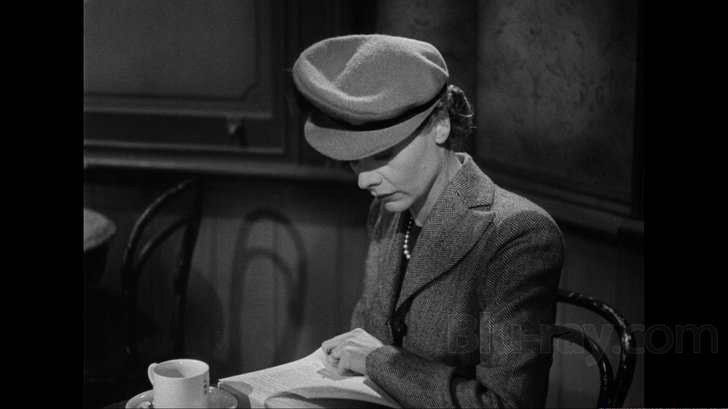
Celia Johnson
In Which We Serve (1942)
A British Naval ship, HMS Torrin, is attacked and destroyed by German bombers during the Battle of Crete. The captain, 'D' Kinross (Noel Coward), and a few of his men survive the attack and gather around a life raft floating freely well off the coast. As the bombers routinely come back and strafe the area, the men begin remembering the best days of their lives.
The rest of the film is structured as a series of flashbacks, linked by the presence of Torrin, in which the survivors are seen building friendships, falling in love, and making plans about the future. The high point in each flashback is the moment when the men step on Torrin and vow to defend their country from the enemy.
The film is informative and entertaining. Completed in 1942 - and inspired by the story of another ship, the HMS Kelly, which was also sunk by German bombers - it manages to capture well the spirit of the time. It is important to note, however, that it does not demonize the enemy; rather, it warns that a certain way of life could be lost if the Germans win the war.
Coward looks great as the brave captain. The short sequence at the end of the film where he delivers a speech and then shakes hands with his men is especially moving. Bernard Miles, John Mills, Michael Willding, Celia Johnson (in her first screen role), and the very young Richard Attenborough’s contributions to the film are also impressive.
Note: In 1944, In Which We Serve earned Oscar nominations for Best Picture and Best Writing, Original Screenplay (Noel Coward).
This Happy Breed (1944)
Completed two years after In Which We Serve, This Happy Breed is set between the end of the First World War and the beginning of the Second, and tells the story of a working-class family, the Gibbonses, from London.
Frank (Robert Newton) and Ethel (Celia Johnson) have just found a handsome new home (which is actually rather old and dampy) in the London suburb of Clapham. They will share it with Ethel’s mother, Mrs. Flint (Amy Veness), bubbly sister, Sylvia (Alison Leggatt), and their three children, son Reg (John Blythe), and daughters Vi (Eileen Erskine) and Queenie (Kay Walsh).
The children grow up and it soon becomes obvious that they will have different priorities in life. Reg befriends Sam (Guy Verney), a passionate liberal who likes Vi, and the two begin attending various demonstrations. Eventually, Sam and Vi get married, while Reg gets a lesson in politics from his conservative father. Queenie then informs the family that she wants a different life and quickly falls in love with a married man. Her announcement shocks her parents and seriously hurts Billy (John Mills), the neighbors’ son, who has been hoping to marry her.
While the Gibbonses try to sort out their problems, the world rapidly changes. Jazz music rocks the night clubs, the General Strike paralyzes London, and Hitler and the Nazi Party win big in Germany. There is a feeling in the air that another war might be just around the corner.
Based on a play by Noel Coward, This Happy Breed is David Lean's first color film. Like In Which We Serve, it blends propaganda and entertaining melodrama. However, this is the more realistic of the two films, with simpler characters facing common dilemmas.
The dialog is absolutely brilliant. It is sharp, witty, energetic, and at times deliciously sarcastic. The bickering between the women in the house, in particular, is pure gold. There are a couple of sequences where Frank Gibbons and his neighbor Bob Mitchell (Stanley Holloway) get drunk and remember the good old days that are also enormously entertaining.
The title of the film comes from a monologue of John of Gaunt's in Shakespeare's Richard II, act II, scene i. It reads: 'This happy breed of men, this little world, / This precious stone set in the silver sea, / Which serves it in the office of a wall, / Or as a moat defensive to a house, / Against the envy of less happier lands, / This blessed plot, this earth, this realm, this England.'
Blithe Spirit (1945)
Successful writer Charles Condomine (Rex Harrison) asks the extravagant medium Madame Arcati (Margaret Rutherford) to conduct a séance in his home. He hopes to include the experience in his next novel. When Madame Arcati agrees, Charles immediately invites two of his best friends to attend the event.
The séance disappoints Charles, his wife Ruth (Constance Cummings), and their two guests. Madame Arcati contacts someone on the other side, but the person refuses to talk. Before she leaves, she instructs the underwhelmed Charles to let her know if he notices any strange activities in the house in the following days.
Later that night, Charles’ deceased first wife, Elvira (Kay Hammond), crosses from the other side into the real world. Charles is stunned, but Ruth, who can’t see or hear Elvira speaking, gets annoyed and then seriously upset when he attempts to convince her that he has witnessed a miracle. As far as Ruth is concerned, Charles has simply had too much to drunk.
But Charles asks Elvira to do a couple of tricks and Ruth realizes that Elvira has indeed returned amongst the living. This upsets her even more because she does not like the idea of her husband possibly cheating on her with his ex-wife. Naturally, she immediately visits Madame Arcati and insists that she sends Elvira right back to where she came from. Much to her disappointment, however, the medium informs her that she is unsure how to do it.
Based on Noel Coward’s very successful play, Blithe Spirit is a light and entertaining film which was photographed in glorious Technicolor by legendary cinematographer and director Ronald Neame (The Poseidon Adventure, The Odessa File). The play was remade several times for TV. Noel Coward himself directed the 1956 remake, with Lauren Bacall and Claudette Colbert.
David Lean’s film is enormously entertaining. The dialog is sharp and witty and the acting is first-class. Margaret Rutherford, in particular, is tremendous as the kooky medium who does not quite know how good, or bad, she is at ghost summoning. Some of her facial expressions are so good that aspiring actors ought to study them.
The humor has an unmistakably British flavor. A few of the individual confrontations, in particular, are quite dry. A touch of sarcasm is also often easy to detect. However, the mannerisms and attitude of the main protagonists are never irksome.
Note: In 1947, Blithe Spirit won Oscar Award for Best Effects, Special Effects (Tom Howard).
Brief Encounter (1945)
Laura Jesson (Celia Johnson) encounters Dr. Alec Harvey (Trevor Howard) at a busy railway station. She is immediately drawn to him; he could hardly take his eyes off of her. The two begin to meet regularly. Eventually, they realize that because of their families and status there isn’t any future for what they have initiated. But instead of parting ways, the two decide to simply follow their hearts.
David Lean’s Brief Encounter is a simple film with a complex message. It tells a straightforward story about two people willing to go outside of their comfort zones to experience love. It also provides a curious picture of post-war England and its class ordinance.
Though Brief Encounter never clarifies whether Laura is still in love with her husband, Fred (Cyril Raymond), when he appears on screen it quickly becomes obvious why she has fallen for Dr. Alec Harvey - Fred lacks everything Alec possesses, from proper manners to looks.
Still, Laura is notably indecisive. It takes a long time for her to open up to Alec, and when she finally does it feels like plenty of the magic that attracted the two in the first place might have disappeared. A few weeks later, the affair is over.
Brief Encounter appears to be liked for a variety of different reasons. Some people are drawn to it because of its stunning cinematography. Others appreciate the simple but elegant love story it tells, which tends to resonate with female viewers in a manner few other classic romantic films do. There is also a large group of cinephilles who find the social overtones in Brief Encounter fascinating to deconstruct.
I like this much revered British film because it does not glamorize or overdramatize the relationship between its main protagonists. Furthermore, its narrative does an excellent job of capturing the polarized emotions an extramarital affair would spur as well as the social stigma that is immediately attached to it. Indeed, right and wrong in this film are effectively misplaced and granted a sense of realism few contemporary romantic films that I could recall have managed to replicate.
David Lean’s splendid black and white cinematography is complimented by powerful excerpts from Sergei Rachmaninoff’s Piano Concerto No. 2, Op. 18, in C minor. The music blends incredibly well with the numerous scenes from the railway station and it certainly adds a bit of a noir-ish vibe to the story. For example, during the second half of the film, where Laura’s indecisiveness becomes the focus of attention, there are very specific changes in the pacing of the story that are impossible to separate from the noir vibe mentioned above.
In 1974, Alan Bridges directed a made-for-TV remake of Brief Encounter, starring Sophia Loren and Richard Burton, but the film ended up being a commercial failure and a critical flop.
David Lean Directs Noël Coward Blu-ray Movie, Video Quality
The following text appears inside the booklet provided with this Blu-ray release:
"From 2006 to 2008, the BFI National Archive carried out an ambitious one-million-pound program to restore the first ten feature films directed by David Lean, in time for the centenary of his birth. The project was generously funded by the David Lean Foundation and undertaken in association with Granada International (now ITV Global Studios Entertainment) and Studio Canal. As a result, preservation materials now exist to ensure the survival of these classic films in their original state. The transfers included in this release were all created from these new restoration elements.
In Which We Serve: The new restoration was created in 4K resolution on an Oxberry 6400 liquid-gate scanner at Cineric, New York, from the original nitrate negative and sections of the nitrate fine-grain master.
Digital intermediate supervisors: Andrea Kalas, Kieron Webb/BFI National Archive, London.
Colorist: Daniel DeVincent/Cineric, New York.
Sound restoration: Richard Yeoman-Clark, Charles Fairall/BFI National Archive, London.
This Happy Breed: The new high-definition digital transfer was created at Technicolor Creative Services, London, on a Spirit Datacine from the restoration internegative, which was produced from the original YCM negatives.
Film restoration supervisor: Kieron Webb/BFI National Archive, London.
Color grader: Andrew Reid/Cineric, New York.
Telecine supervisor: Mark Stanborough/ITV, London.
Colorist: Dave Mason/Technicolor Creative Services/London.
Sound restoration: Richard Yeoman-Clark, Charles Fairall/BFI National Archive, London.
Blithe Spirit: This new high-definition digital transfer was created at Technicolor Creative Services, London, on a Spirit Datacine from the restoration internegative, which was produced from the original YCM negatives.
Film restoration supervisors: Andrea Kalas, Kieron Webb/BFI National Archive, London.
Color grader: Andrew Reid/Cineric, New York.
Telecine supervisor: Mark Stanborough/ITV, London.
Colorist: Dave Mason/Technicolor Creative Services, London.
Sound restoration: Richard Yeoman-Clark, Charles Fairall/BFI National Archive, London.
Brief Encounter: The new restoration was created in 4K resolution on a Spirit Datacine at Cineimage, London, from the best surviving duplicate safety negatives. Pixel Farm's PFClean was used for flicker correction.
Digital intermediate supervisors: Ben Thompson, Kieron Webb/BFI National Archive, London.
Colorist: Ray King/Cineimage, London.
Sounds restoration: Sound restoration: Richard Yeoman-Clark, Charles Fairall/BFI National Archive, London."
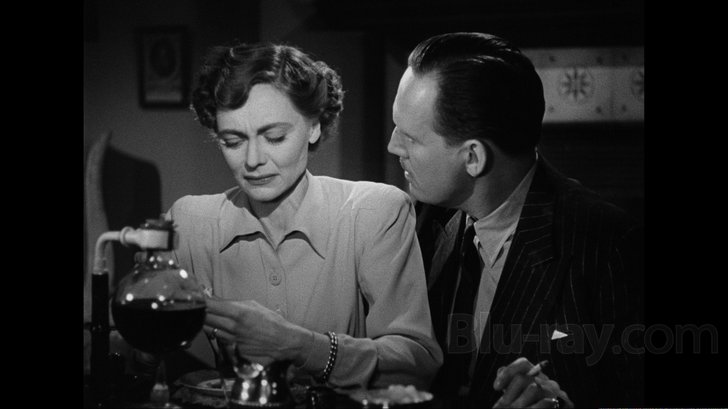
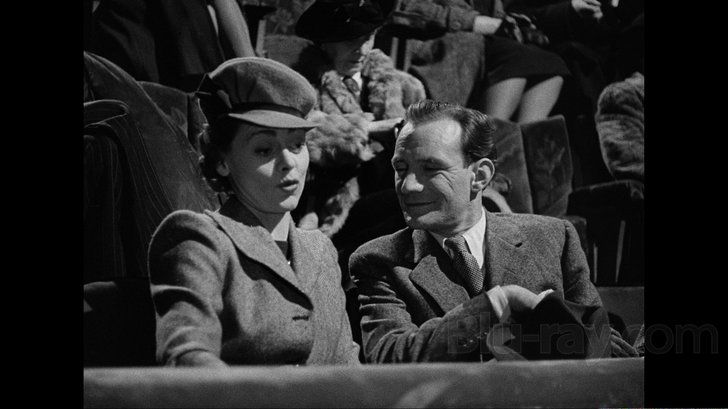
Note: The screenshots offered with this review appear in the following order:
1. Brief Encounter: 1-9.
2. In Which We Serve: 10-20.
3. This Happy Breed: 21-30.
4. Blithe Spirit: 31-40.
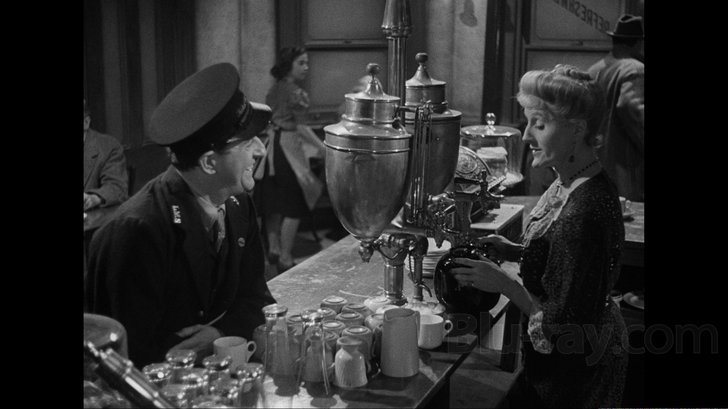
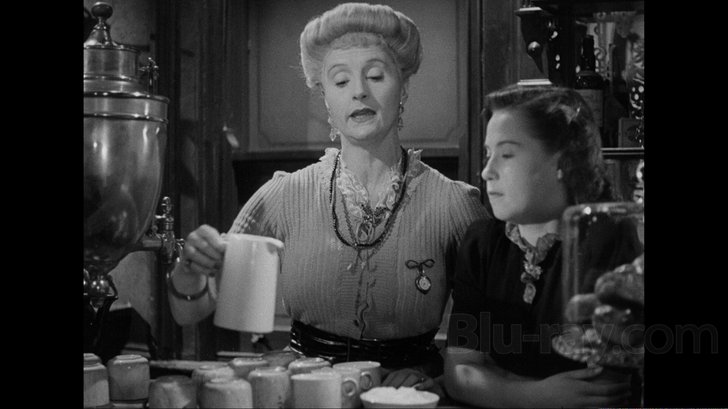
The restoration work has produced very impressive results and all four films now look spectacular in high-definition. In Which We Serve, in particular, looks as good as A Night to Remember -- the high-definition transfer conveys tremendous depth, even when light is restricted, while detail is consistently pleasing. The outdoor sequences also boast well balanced colors (with the blacks and grays, in particular, looking crisp and enormously rich) and stable contrast. Furthermore, grain is well resolved and evenly exposed throughout the entire film. Also, there are no traces of problematic sharpening or denoising corrections.
Brief Encounter also looks solid. Not only is depth and color stability substantially improved, but there are entire sections of the film where various small details have been revealed (compare screencapture #6 with screencapture #5 from our review of the UK release of the film from 2009). Needless to say, the new high-definition transfer also boasts well resolved and evenly distributed grain. As it is the case with In Which We Serve, no attempts have been made to apply compromising sharpening corrections. Lastly, there are no serious stability issues to report in this review either.
Aside from a few extremely small color pulsations, This Happy Breed looks excellent. Most close-ups convey excellent depth and pleasing object definition (take a look at screencapture #27 and see how well refined lines and curves are). More importantly, however, there is no color bleeding or edge shimmer, both of which are often present on dated releases of three-strip Technicolor films. Generally speaking, the colors here are thick and well saturated but at the same time, as intended, looking quite warm (director Lean wanted to enhance the sense of realism with his color preferences). Lastly, there are no traces of severe denoising corrections.
The fourth and final film in the collection, Blithe Spirit, also has a fresh new look. Detail and clarity are once again very convincing, while the various color stabilizations have clearly improved depth and fluidity (see screencapture #39). Brightness levels are slightly elevated and especially during the final third of the film there are also some intended contrast fluctuations. Obviously, the various effects here have plenty to do with the nature of the story the film tells, not with any transfer-specific anomalies. There are no traces of problematic denoising either.
(Note: The four Blu-ray discs in this collection are Region-A "locked". Therefore, you must have a native Region-A or Region-Free PS3 or SA in order to access their content).
David Lean Directs Noël Coward Blu-ray Movie, Audio Quality
Each film in the David Lean Directs Noël Coward collection arrives with an English LPCM 1.0 track. For the record, Criterion have also supplied them with optional English SDH subtitles.
Like the video treatments, the audio treatments are very impressive. Clearly, during the individual restorations various audio stabilizations have been performed on all four tracks, while hiss, hum, clicks, and pops have been removed as best as possible. As result, the dialog on all four films is stable, crisp, and easy to follow. Obviously, the loseless tracks are unlikely to test your audio system, but all four of them have pleasing organic qualities and give the films plenty of depth. In Blithe Spirit, for example, the improvements are very easy to recognize as the winds never sound anemic. In In Which We Serve the explosions are also well rounded and free of high-frequency distortions.
David Lean Directs Noël Coward Blu-ray Movie, Special Features and Extras
In Which We Serve:
- Trailer - original trailer for In Which We Serve. In English, not subtitled. (2 min, 1080p).
- Barry Day - in this video interview, Noel Coward expert Barry Day, author of Coward on Film: The Cinema of Noel Coward, discusses In Which We Serve. The interview was recorded exclusively for Criterion in October 2011. In English, not subtitled. (17 min, 1080p).
- A Profile of "In Which We Serve" - a short documentary on the making of In Which We Serve produced in London in 2000 for Carlton International Media. The documentary features interviews with cinematographer Ronald Neame, actor John Mills, associate producer Anthony Havelock-Allan, Noel Coward biographer Sheridan Morley, third assistant director Norman Spencer, and actress Lucy Fleming (Celia Johnson's daughter), among others. In English, not subtitled. (25 min, 1080i).
- Coward and Attenborough at the NFT - an audio recording of a discussion between actor and director Richard Attenborough and playwright Noel Coward, which took place at London's National Film Theatre on December 14th, 1969. In English, not subtitled. (66 min, 1080p).
- Trailer - original trailer for This Happy Breed. In English, not subtitled. (3 min, 1080p).
- Rerelease Trailer - the rerelease trailer for This Happy Breed. In English, not subtitled. (3 min, 1080p).
- Barry Day - in this video interview, Noel Coward expert Barry Day, author of Coward on Film: The Cinema of Noel Coward, discusses This Happy Breed. The interview was recorded exclusively for Criterion in October 2011. In English, not subtitled. (15 min, 1080p).
- The Golden Age - director, cinematographer, producer, and writer Ronald Neame, who was one of three partners in Cineguild Productions, together with David Lean and producer Anthony Havelock-Allan, discusses the shooting of In Whicn We Serve, various Cineguild Productions film projects, Noel Coward, etc. In English, not subtitled. (45 min, 1080p).
- Trailer - original trailer for Blithe Spirit. In English, not subtitled. (3 min, 1080p).
- Barry Day - in this video interview, Noel Coward expert Barry Day, author of Coward on Film: The Cinema of Noel Coward, discusses Blithe Spirit. The interview was recorded exclusively for Criterion in October 2011. In English, not subtitled. (12 min, 1080p).
- The Southbank Show: "Noel Coward" - this 1992 episode of The Southbank Show, hosted by Melvin Bragg, covers Noel Coward's life and career in theater, film, and music. It features archival footage and interviews with actors John Gielgud, Daniel Massey, and John Mills, biographer Philip Hoare, and playwright John Osborne, among others. In English, not subtitled. (51 min, 1080i).
- Trailer - original trailer for Brief Encounter. In English, not subtitled. (4 min, 1080i).
- Barry Day - in this video interview, Noel Coward expert Barry Day, author of Coward on Film: The Cinema of Noel Coward, discusses Brief Encounter. The interview was recorded exclusively for Criterion in October 2011. In English, not subtitled. (17 min, 1080p).
- A Profile of "Brief Encounter" - a short documentary on the making of Brief Encounter produced in London in 2000 for Carlton International Media. The documentary features interviews with director, cinematographer, producer, and writer Ronald Neame, producer Anthony Havelock-Allan, actresses Margaret Barton and Lucy Fleming (Celia Johnson's daughter), and actor John Sessions, among others. In English, not subtitled. (25 min, 1080i).
- David Lean: A Self Portrait (1971) - a wonderful documentary film, directed by Thomas Craven, featuring an extensive interview with David Lean, who discusses his career and work. In English, not subtitled. (59 min, 1080p).
- Commentary - this is the same audio commentary by film historian Bruce Eder, recorded in 1995, which appeared on Criterion's 2000 DVD release of Brief Encounter.
- Booklet - 44-page illustrated booklet featuring Ian Christie's essay "When Noel Met David..."; Terrence Rafferty's essay "Battle Stations"; Farran Smith Nehme's essay "Home Truths"; Geoffrey O'Brien's essay "Present Magic"; and Kevin Brownlow's essay "Riskiest Thing I Ever Did".
David Lean Directs Noël Coward Blu-ray Movie, Overall Score and Recommendation
This wonderful collection of early David Lean films is without a doubt a prime contender for release of the year. Recently restored, the four films in it - In Which We Serve, This Happy Breed, Blithe Spirit, and Brief Encounter - look simply outstanding on Blu-ray. Additionally, there is a wealth of outstanding supplemental features to explore. If you reside outside of North America but can play Region-A discs, you should definitely consider importing the collection. If you reside in North America, move it at the very top of your purchase lists. VERY HIGHLY RECOMMENDED.