David Byrne's American Utopia Blu-ray Movie
HomeDavid Byrne's American Utopia Blu-ray Movie 
Criterion | 2020 | 106 min | Not rated | Dec 16, 2025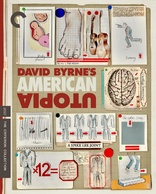

Movie rating
7.9 | / 10 |
Blu-ray rating
| Users |  | 0.0 |
| Reviewer |  | 4.0 |
| Overall | | 4.0 |
Overview
David Byrne's American Utopia (2020)
Spike Lee documents the former Talking Heads frontman's brilliant, timely 2019 Broadway show, based on his recent album and tour of the same name.
Starring: David ByrneDirector: Spike Lee
| Music | Uncertain |
| Documentary | Uncertain |
| Musical | Uncertain |
Specifications
Video
Video codec: MPEG-4 AVC
Video resolution: 1080p
Aspect ratio: 1.85:1
Original aspect ratio: 1.85:1
Audio
English: Dolby Digital 5.1
Subtitles
English SDH
Discs
Blu-ray Disc
Single disc (1 BD)
Playback
Region A (locked)
Review
Rating summary
| Movie |  | 4.5 |
| Video |  | 5.0 |
| Audio |  | 3.0 |
| Extras |  | 2.0 |
| Overall | | 4.0 |
David Byrne's American Utopia Blu-ray Movie Review
Reviewed by Jeffrey Kauffman April 21, 2026If someone were to invent some kind of visual dictionary where collaborators could nominate pop culture icons to illustrate various terms, I would be quite prone to suggest David Byrne as a prime example of "quirky". Even Bryne's ostensibly "straightforward" concerts like Stop Making Sense have some unusual moments that can verge on so-called "performance art", but that's part and parcel of Byrne's rather distinctive but undeniable charm, and I think even diehard Byrne fans (and I count myself among that group) would agree he's undeniably sui generis, again part of his peculiar allure. Performance art is certainly alive and well in David Byrne's American Utopia, and there are certainly tethers that can be drawn between this production and Stop Making Sense, but there may well be more differentiations than similarities in the long run. Perhaps the most notable (sorry, pun unavoidable) of these is the fact that this film does not feature Talking Heads, but instead a really interesting array of eleven musicians who join Byrne in some frankly odd choreography that might be jokingly referred to as marching band adjacent, at least insofar as the musicians are often carrying their instruments as they move about the stage. As perhaps evidenced by the very title of this piece, a title Byrne insists should not be taken ironically despite the fact that the film's logo features the second word upside down, American Utopia is also more overtly political than Stop Making Sense, and in its own way it could be argued it's both more theatrical and more cinematic (courtesy of director Spike Lee) than the earlier much beloved concert film.
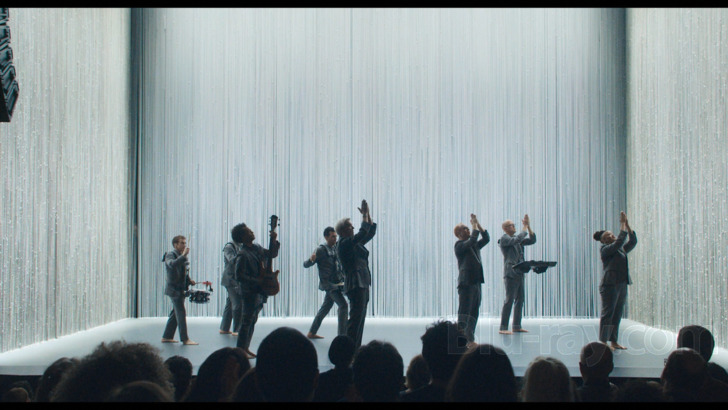
Stop Making Sense and David Byrne's American Utopia also differ vis a vis that aforementioned theatrical aspect due to the fact that this property actually made it to the Great White Way - twice. An original limited engagement played from October 20, 2019 to February 16, 2020, and then a "return engagement" actually ran a bit longer than the original, from October 17, 2021 to April 3, 2022. The Internet Broadway Database (yeah, film nerds, there's one of those for Broadway, too) lists that the same cast did both runs, and that may subliminally suggest how the twelve performers are kind of an organic whole in this piece, synched together via some kind of inherent understanding. This is especially salient since, at least somewhat unlike Stop Making Sense, the "action" here is not always Byrne-centric, and in fact the entire piece is kind of an ode to community and inclusion, a feeling probably diametrically opposed to the earlier concert's feeling of dissociation and isolation. That feeling of disconnection and imbalance is probably nowhere more obvious in Stop Making Sense than in the following redactions of the lyric to Once in a Lifetime:
[. . .]Contrast that with this redacted lyric from a song in American Utopia, which almost plays like a flip side of the above (including near quotes), maybe after a liberal dose of an anti anxiety medication:
And you may ask yourself, "Well, how did I get here?"
[. . .]
And you may ask yourself, "How do I work this?"
[. . .]
And you may tell yourself, "This is not my beautiful house"
And you may tell yourself, "This is not my beautiful wife"
Same as it ever was, same as it ever was
[. . .]
You may ask yourself, "What is that beautiful house?"
You may ask yourself, "Where does that highway go to?"
And you may ask yourself, "Am I right, am I wrong?"
And you may say to yourself, "My God, what have I done?"
… I wish I was a cameraAs interesting as the "subtext" delivered courtesy of Byrne's lyrics and some his interstitial spoken material, it may be the visual sense that Spike Lee brings to the production that sets it apart from Stop Making Sense just as much. The stage is bare, yes, but it's given an almost hallucinatory ambience courtesy of a surrounding curtain of LED lighting that changes colors (and brightness) and through which various participants pass at various points. Lee also exploits some vertiginious framings that ape Busby Berkeley with overhead shots that can have "geometrical" components.
I wish I was a postcard
I welcome you to my house
You didn't have to go far
A house and a garden
There are, there's plants and trees
Make a, a closer inspection
If you get, get down on your knees
… Now everybody's coming to my house
And I'm never gonna be alone
And everybody's coming to my house
And they're never gonna go back home
… I'm pointing and describing
And I can be your guide
The skin is just a roadmap
The view is very nice
Imagine looking at a picture
Imagine driving in a car
Imagine rolling down the window
Imagine opening the door
… Everybody's coming to my house
Everybody's coming to my house
I'm never gonna be alone
And they're never gonna go back home
David Byrne's American Utopia Blu-ray Movie, Video Quality
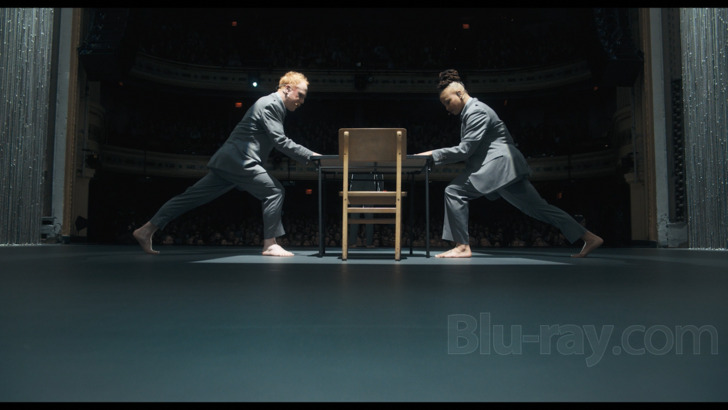
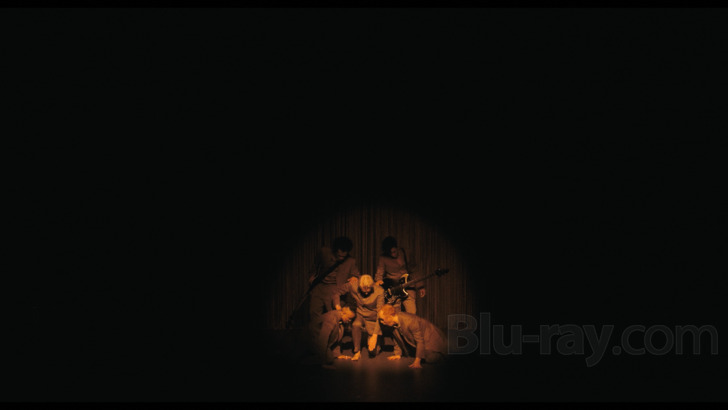
David Byrne's American Utopia is presented on Blu-ray courtesy of Criterion with an AVC encoded 1080p transfer in 1.85:1. Digitally captured with a variety of cameras and finished at 4K, this 1080 presentation is quite striking from both detail and palette perspectives, though it's probably the evocative stage lighting (not to mention the actual lights themselves) that will attract the most immediate attention. The palette is nicely vibrant, and some of the blue to teal tones especially expressive, and occasional interstitial moments of golden yellow can also be quite vivid. All of the performers are basically wearing the same kind of suits, but fine detail on the fabric is observable in close-ups when they're standing still (which frankly isn't all that often), and some of the detailing on the surrounding light curtain is surprisingly precise looking.
David Byrne's American Utopia Blu-ray Movie, Audio Quality
For reasons known only to the bean counters at Criterion, while their 4K release sports a nicely articulated DTS-HD Master Audio 5.1 track, this 1080 disc is granted only a lossy Dolby Digital 5.1 track. While there's nothing really problematic here in terms of surround activity (which basically mimics what is heard on the lossless track), there is a noticeable thinning of the midrange and low end in particular in this version when compared to the DTS- HD Master Audio 5.1 version, and I'd even argue an overall diminution in vibrancy in the music. Optional English subtitles are available.
David Byrne's American Utopia Blu-ray Movie, Special Features and Extras
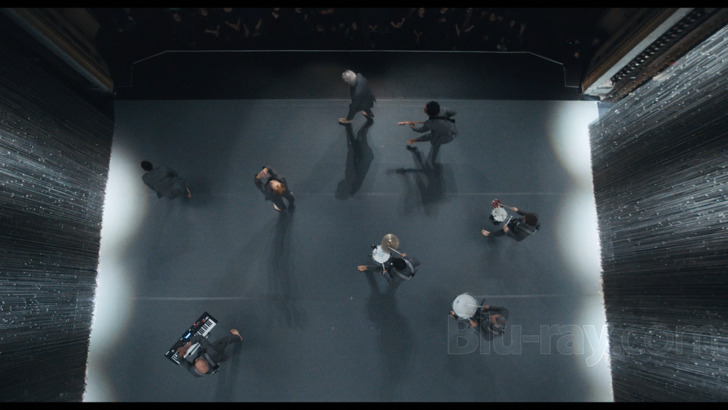
- Making American Utopia (HD; 55:13) is a 2025 documentary with some great interviews with Byrne, Lee and several other collaborators.
- A Conversation with Spike Lee & David Byrne (HD; 13:41) is an archival dialogue from 2020.
- Trailer (HD; 1:11)
David Byrne's American Utopia Blu-ray Movie, Overall Score and Recommendation
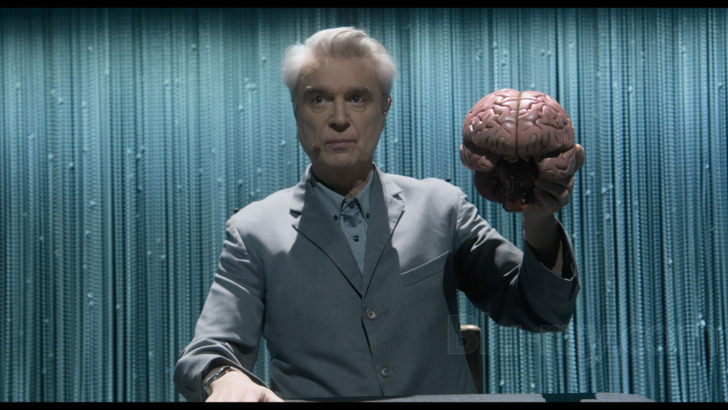
Maybe David Byrne's visage could also accompany a definition of "thoughtful" in the visual dictionary proposed above, as this often quite distinctively provocative piece proves. With absolutely no dig being aimed at Jonathan Demme's impressive work, American Utopia is arguably more theatrical and more cinematic than the earlier documentary. Lossy audio here is probably going to be the biggest complaint, and for that reason those with the appropriate equipment will probably want to opt for Criterion's 4K release, though that only features SDR. With caveats noted, Recommended.

Similar titles
Similar titles you might also like
(Still not reliable for this title)

Stop Making Sense
1984

Original Cast Album: "Company"
1970

Monterey Pop
Remastered
1968

Anima Mundi
1991

Rolling Thunder Revue: A Bob Dylan Story by Martin Scorsese
2019

Naqoyqatsi
2002

Buena Vista Social Club
1999

Sympathy for the Devil
One Plus One / The Rolling Stones
1968

Dont Look Back
1967

Jimi Plays Monterey & Shake! Otis at Monterey
1986-1987

Powaqqatsi
1988

Festival
1967

The Velvet Underground
2021

Koyaanisqatsi
Theatrical and Demo Versions
1982

One More Time with Feeling
2016

Gimme Shelter
Uncensored 30th Anniversary Version
1970

Shut Up and Play the Hits
LCD Soundsystem
2012

The Last Waltz
1978

In Heaven There Is No Beer?
1984

A Poem Is a Naked Person
1974