Cujo 4K Blu-ray Movie
HomeCujo 4K Blu-ray Movie 
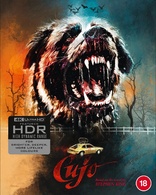
Limited Edition / 4K Ultra HD + Blu-rayArrow | 1983 | 1 Movie, 2 Cuts | 91 min | Rated BBFC: 18 | Oct 12, 2026
Price
List price:Amazon: £24.99 (Save 7%)
Third party: £24.99 (Save 7%)
Usually dispatched within 1 to 2 months

Movie rating
6.5 | / 10 |
Blu-ray rating
| Users |  | 2.5 |
| Reviewer |  | 3.5 |
| Overall | | 3.5 |
Overview
Cujo 4K (1983)
A friendly St. Bernard contracts rabies and conducts a reign of terror on a small town in New England. Based on the Stephen King novel.
Starring: Dee Wallace, Danny Pintauro, Daniel Hugh Kelly, Christopher Stone (I), Ed LauterDirector: Lewis Teague
| Horror | Uncertain |
| Thriller | Uncertain |
Specifications
Video
Video codec: HEVC / H.265
Video resolution: 4K (2160p)
Aspect ratio: 1.85:1
Original aspect ratio: 1.85:1
Audio
English: LPCM Mono
English: DTS-HD Master Audio 5.1
Subtitles
English SDH
Discs
Blu-ray Disc
Two-disc set (2 BDs)
4K Ultra HD
Packaging
Slipcover in original pressing
Playback
Region B (A, C untested)
Review
Rating summary
| Movie |  | 3.0 |
| Video |  | 4.5 |
| Audio |  | 4.0 |
| Extras |  | 5.0 |
| Overall | | 3.5 |
Cujo 4K Blu-ray Movie Review
Reviewed by Jeffrey Kauffman October 20, 2026 Note: Cujo has had several prior releases in Region A and Region B in both 1080 and 4K UHD formats, including my own review
of a Region A Olive
Films 1080 release from 2013. This review reprints portions of that review, as appropriate, but those interested may also want to look at both the
Cujo Blu-ray review and Cujo 4K Blu-ray review available on the site. This release offers two cuts of the film. As
I often mention, different reviewers
means different opinions.
Pantheism is the belief that a divine spirit inhabits all of creation, from the lowliest amoeba to inanimate objects like
rocks to the supposed crowning glory of humanity and beyond. Though it’s probably not an “official” belief system,
some might accuse Stephen King of being a pandemonist, for the ubiquitous author has built one of the modern
publishing era’s most fortuitous careers out of seeing evil in just about any and every object, living or otherwise,
imaginable. We’ve had haunted and/or nefarious vacation lodges, towns, diseases, cars, clowns, disaffected youths—
need we continue? Well, let’s add just one more: man’s best friend, the erstwhile dog. King is an expert in
making the reader (and by extension the viewer of the many film adaptations based upon his works) fear the everyday,
those mundane little things that drift in and out of most of our lives without a second thought. Cujo was
perhaps a more rational approach to horror than some of King’s more supernaturally themed opuses, for there’s a more
or less mundane cause to the rampaging titular dog’s evil behavior: rabies. That is a surprisingly concrete raison
d’être for nastiness in King’s oeuvre, as the author frequently likes to traffic in the opaque miasma of the
collective unconscious’ most deep seated terrors. But if the cause is at least a little less inchoate than in a lot of King’s
pieces, that doesn’t mean the horrifying effect is any less pronounced. Cujo is one of the most claustrophobic
film adaptations of any King work (quite remarkable given such confined efforts as The Shawshank Redemption), and if it’s not the
most successful King adaptation out there, it still has its share of thrills and chills, especially for dog lovers who look at
canines and automatically think that snuggling into their warm furry bodies is a natural thing to do.
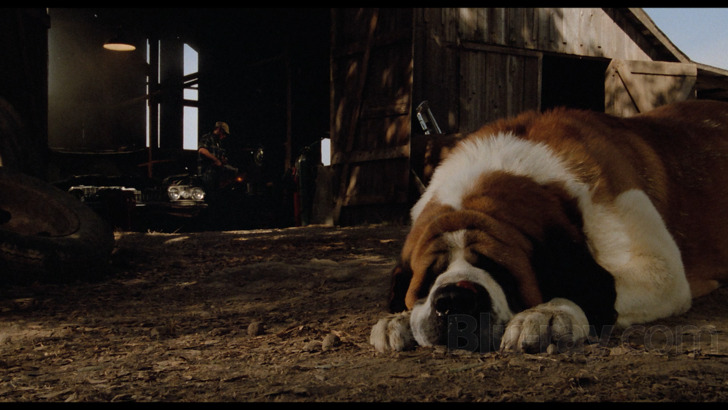
As surreptitiously undermining as evil usually is in Stephen King fare, there’s another encroaching nemesis that quite frequently afflicts the author’s characters, namely the much more pedestrian issue of family dysfunction. Over and over in King’s stories and novels, we have various family members more or less at war with each other, creating a roiling emotional atmosphere in which evil seems to thrive. Cujo is certainly no exception to that general rule. In fact one of the major detriments to this film adaptation is that it spends so much time setting up the roiling relationships between the disintegrating family unit at the core of the story that some viewers may in fact lose interest long before the evil rabid dog makes much of an impact.
The soap operatic aspect of Cujo fills up more or less the first half of the 90 minute or so running time of the film. We meet attractive young wife and mother Donna (Dee Wallace-Stone), who is dealing with a lot on her emotional plate. Her husband Vic (Daniel Hugh Kelly) is an ambitious advertising executive who is reeling from having his major account unspool before his very eyes due to an unfounded health scare. Meanwhile their son Tad (Danny Pintauro) is suffering from debilitating fears that there’s a monster in his closet, perhaps a psychological projection of the tension he senses between his parents. Donna has been attempting to soothe her troubled psyche in the arms of the local tennis stud, Steve (Wallace-Stone’s real life husband Christopher Stone), an affair which Vic stumbles into knowledge of one fateful day. Meanwhile Vic has attempted to get his sporty red convertible fixed at a rural mechanic’s home shop, and promises to have Donna’s faltering Pinto taken there soon.
The mechanic’s family also provides some low level turmoil as well. It’s obvious the mechanic is a heavy drinker and probably an abusive husband and father. His wife ends up winning $5,000 in the lottery and asks (begs, really) to be allowed to go visit her sister with their son. Meanwhile, the family’s dog Cujo has been exhibiting troubling behavior since having been bitten by a bat, though only the family’s son seems to be concerned about the startling transformation of the giant Saint Bernard. All of these plot machinations serve nothing more than to lay the groundwork whereby Donna and Tad can arrive at the mechanic’s isolated shop to be attacked by the crazed animal. Vic has taken off due to the affair, the mechanic and his assistant have become the first two of Cujo's victims, the mechanic’s wife and son have taken off due to the lottery (and the implied abuse), and so we’re left with Donna and Tad in a broken down Pinto being repeatedly terrorized by an increasingly manic dog.
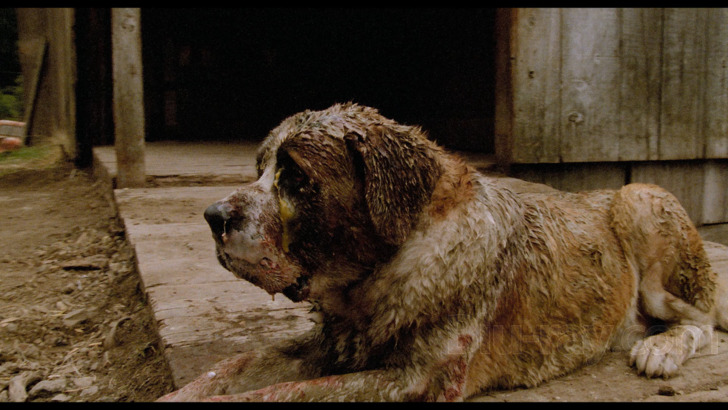
Cujo might have worked better had the terror arrived a lot sooner. As it is, there is so much dysfunctional turmoil to work through to get to the scary bits that the film seems weighed down in “kitchen sink drama” to the point of absolute lethargy. A perhaps more important issue, albeit one that may work more subliminally than the lack of up front scares, is the fact that Cujo is an innocent victim himself. A lot of King’s work has Evil (with a capital “E”) afflicting various people who really don’t deserve to be afflicted (think Carrie), but there’s something almost tragic about a sweet dog coming down with rabies and attacking various people (some of whom, like the mechanic and his assistant, seem to warrant some kind of attack).
All of this said, once the “attack dog” scenario finally begins unfolding, there’s little question that Cujo does work up some considerably frightening sequences, but there’s a certain air of desperation as the film continues trundling down its seemingly interminable path. As Donna and Tad continue to try to exist within the increasingly untenable confines of their Ford Pinto (which actually holds up admirably well under Cujo’s ferocious assaults), the film does become almost anger provoking, simply because it’s all built on so many patently ridiculous conceits. There’s also a rather troubling final showdown between Donna and Cujo that may have ASPCA and PETA members up in arms, though Teague makes it quite clear in his commentary that he purposefully staged the goings on so as not to show anything too graphic or in fact to endanger the dog playing Cujo.
Cujo never really fully integrates its roiling subtext of family dysfunction within the overall genre conventions of a horror thriller, but it’s laudable that the film at least tries. What works best in this film is the relationship between Donna and Tad. Cujo may be a “mad dog”, but he’s no match for a “Mama Grizzly”.
Cujo 4K Blu-ray Movie, Video Quality
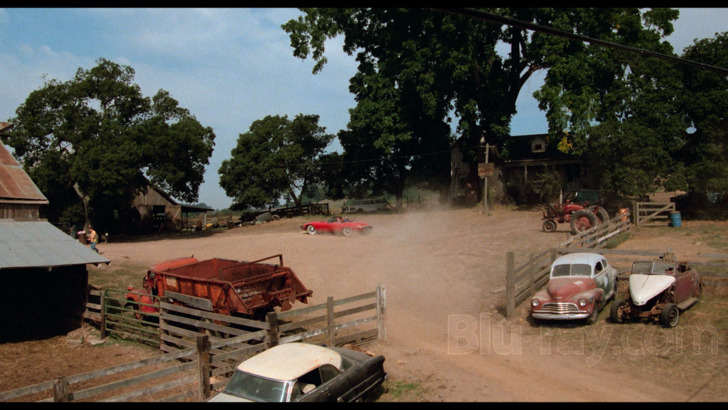
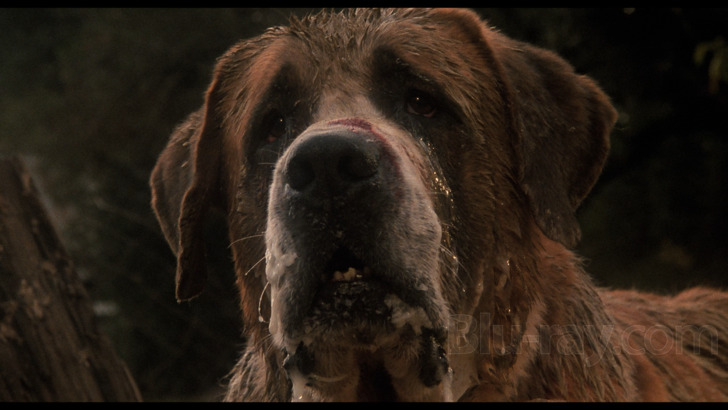
Note: Screenshots are from the 1080 disc in this package.
Cujo is presented in 4K UHD courtesy of Arrow Video with an HEVC / H.265 encoded 2160p transfer in 1.85:1. A 1080 disc with an AVC
encoded presentation of the International Cut is also included. Arrow's insert booklet contains the following information on the presentations:
Cujo is presented in its original aspect ratio of 1.85:1 with it original monoaural soundtrack and a 5.1 surround remix. The film was restored in 4K from the original camera negative and made available to Paramount Pictures.Both Casey Broadwater in his review of Lionsgate's 1080 release and I in my review of Olive Films' 1080 release mentioned how gauzy a lot of this film looks, and in fact Casey even suggested a diffusion filter may have been used, and so comments about a "filtered" appearance may be misleading, at least in terms of any aggressive DNR allegedly applied in some kind of ostensible "upgrade". There is a clearly visible grain field throughout both the 4K and 1080 presentations offered in this set, though that said, when the "exhibition print" material in the International Cut shows up, there is an undeniable uptick in the grittiness of the grain field. There are some rather interesting differences between the 1080 SDR and 4K HDR versions in terms of palette reproduction, and this is the rare case where to my eyes the SDR version actually can look a bit more vibrant than Arrow's 4K presentation. Some of the outdoor material on the 1080 disc pops quite authoritatively, especially with regard to primaries like blues and reds, whereas the 4K's Dolby Vision and HDR grades seem to kind of tamp down some of the vividness of the palette, leaving things looking slightly wan and less well suffused at times. The HDR grades probably marginally improve some of the shadow detail in the darkest scenes. Detail levels are typically quite expressive throughout, even given some of the seemingly intentionally soft shooting style.
The shorter International Cut, which re-orders several scenes in the first half of the film and features some unique footage, was reconstructed in high definition by Arrow Films using the 4K remaster as well as material scanned from a 35mm exhibition print by Indeed Film.
Cujo 4K Blu-ray Movie, Audio Quality
Cujo features LPCM Mono and DTS-HD Master Audio 5.1 options. As mentioned in Arrow's verbiage reprinted above, the mono mix is the original theatrical version and may well suffice for many listeners, especially "audio purists". It's obviously narrow, but it's well mixed, with those growling sound effects often very ominous, and with music and dialogue always well prioritized. The 5.1 mix does significantly open up all of the outdoor material, and adds some low end punch to some of the late attack scenes. Optional English subtitles are available.
Cujo 4K Blu-ray Movie, Special Features and Extras
Disc One (4K UHD) - Theatrical Cut (1:32:47)
- Audio Commentaries
- Commentary by Lewis Teague (2007)
- Commentary by Lewis Teague & Jeff McKay (2012)
- Commentary by Lee Gambin (2019)
- Cujo Revisited (HD; 21:40) is a 2014 roundtable with Dee Wallace, Danny Pintauro, Daniel Hugh Kelly and Lewis Teague.
- Dog Days: The Making of Cujo (HD; 42:49) is from 2007.
- Cast and Crew Interviews are from Eureka's 2019 Region B release:
- Dee Wallace (HD; 41:35)
- Charles Bernstein (HD; 35:38)
- Gary Morgan (HD; 26:11)
- Jean Coulter (HD; 21:10)
- Marcia Ross (HD; 20:04)
- Kathie Clark Lawrence (HD; 13:56)
- Robert Clark (HD; 12:51)
- Teresa Miller (HD; 28:15)
- Trailer Gallery
- Theatrical Trailer 1 (HD; 1:50)
- Theatrical Trailer 2 (HD; 1:50)
- 3 TV Spots (HD; 2:18)
- 3 Radio Spots (HD; 1:36)
- Stills Gallery (HD; 00:51)
- Kim Newman on Cujo (HD; 27:04) is from 2019.
- Q & A with Dee Wallace (HD; 40:54) is from 2015 and is moderated by the late, great Lee Gambin. We miss you, darlst (IYKYK).
Cujo 4K Blu-ray Movie, Overall Score and Recommendation
Cujo takes its own sweet time setting up its various plot dynamics, and as such it's an awfully slow genre film. It's also problematic that the "evil" in this film is something as real as a rabid dog, especially a dog that seems as sweet as Cujo does in the film's early scenes. That means that some in the audience aren't going to know whom to root for, especially when Cujo's first two victims are kind of reprehensible to begin with. So what we have is a sweet dog that's horribly afflicted with a hideous disease, and a mother and son in a car, trying to survive long enough to perhaps patch their faltering family back together again. For some, that will add up to at least a fitfully entertaining thriller. For others, a little winter vacation in an isolated lodge or an unforgettable high school prom may be more enticing. One way or the other, as I joked in the deck of my review of the Olive edition, it may be time to rethink our criticism of the Ford Pinto's safety record. Technical merits are generally solid, though the palette is a bit drab on the 4K edition. Arrow has aggregated its usual supply of outstanding supplements. With caveats noted, Recommended.


Similar titles
Similar titles you might also like

Children of the Corn III: Urban Harvest
Slasher Classics Collection #15
1995

The Void
2016

Splinter
2008

Sleepwalkers
Stephen King's Sleepwalkers / Eureka Classics
1992

Poltergeist II: The Other Side
Poltergeist 2
1986

Cat's Eye
Stephen King's Cat's Eye
1985

Feast
2005

The Texas Chain Saw Massacre
Seriously Ultimate Edition | The Texas Chainsaw Massacre
1974

The Relic
1997

We Are Still Here
2015

Hellraiser
Remastered
1987

Night of the Living Dead 4K
1968

The Hole in the Ground
2019

Don't Be Afraid of the Dark
2010

Grabbers
2012

Mama
2013

Pumpkinhead II: Blood Wings
1994

The Bye Bye Man
2017

Rawhead Rex
1986

The Descent 4K
2005