Cry, the Beloved Country Blu-ray Movie
HomeCry, the Beloved Country Blu-ray Movie 
Kino Lorber | 1951 | 95 min | Not rated | Mar 11, 2025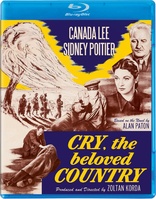
Price
List price:Amazon: $14.99 (Save 20%)
Third party: $14.99 (Save 20%)
Only 7 left in stock (more on the way).

Movie rating
6.9 | / 10 |
Blu-ray rating
| Users |  | 0.0 |
| Reviewer |  | 3.5 |
| Overall | | 3.5 |
Overview
Cry, the Beloved Country (1951)
Set in a little village in the scorched valley of Ixopo, the story revolves around the family of Reverend Stephen Kumalo. The Reverend's son, Absalom, has disappeared and his sister, Gertrude, is ill in Johannesburg. Kumalo leaves his poor village with his life savings in order to go to Johannesburg to try to persuade his sister and son to come home but while there he finds his son has been accused of the murder of the son of a farmer. As both fathers suffer, they slowly become friends.
Starring: Canada Lee, Charles Carson, Sidney Poitier, Joyce Carey, Geoffrey KeenDirector: Zoltan Korda
| Drama | 100% |
Specifications
Video
Video codec: MPEG-4 AVC
Video resolution: 1080p
Aspect ratio: 1.37:1
Original aspect ratio: 1.37:1
Audio
English: DTS-HD Master Audio 2.0 Mono (48kHz, 24-bit)
Subtitles
English SDH
Discs
Blu-ray Disc
Single disc (1 BD)
Playback
Region A (locked)
Review
Rating summary
| Movie | | 3.5 |
| Video |  | 5.0 |
| Audio | | 5.0 |
| Extras |  | 2.0 |
| Overall | | 3.5 |
Cry, the Beloved Country Blu-ray Movie Review
Reviewed by Dr. Svet Atanasov March 16, 2025Zoltan Korda's "Cry, the Beloved Country" (1951) arrives on Blu-ray courtesy of Kino Lorber. The supplemental features on the release include new audio commentary by critic Daniel Kremer and archival program with author Mona Z. Smith. In English, with optional English SDH subtitles for the main feature. Region-A "locked".
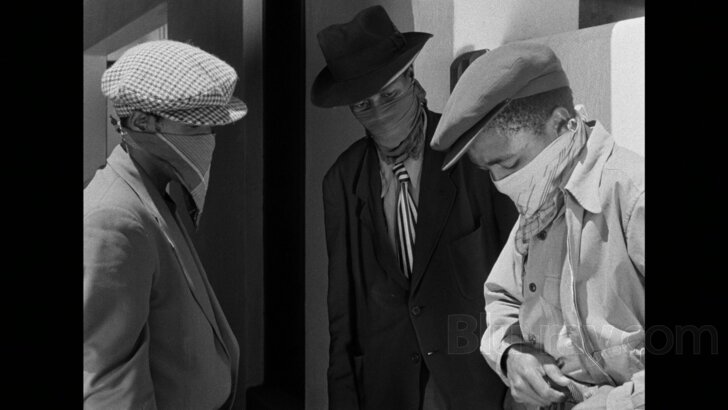
Alan Paton’s novel has inspired two completely different films that share its name. Zolan Korda’s film is the earlier of the two and was the more difficult one to track down and see. It was not a lost film, but if one wanted to see it, one had to search hard for it. It looked rough, too. Darrell Roodt’s film, which was made more than four decades later, has always been easy to see. Miramax handled its distribution, so this helped a lot.
Comparing Korda and Roodt’s films to determine which does a better job with the original material from Paton’s novel is a tricky business. Korda shot his film in 1951 on location in South Africa, which is quite an accomplishment considering that at the time the country was still heavily segregated. In 1995, Roodt went to South Africa too, but the country had already dramatically transformed itself, so the working conditions were drastically different. Also, for obvious reasons, these films not only choose different angles to see South Africa, but they choose a different tone for their storytelling as well. The drama that flourishes in them is defined by it, but only one film had the complete freedom to adjust it as needed.
The aging preacher Stephen Kumalo (Canada Lee) receives a letter urging him to travel to Johannesburg and look for his missing son. Sensing that something might have gone terribly wrong, Kumalo grabs his bible and gets on the first train heading to the big city. Immediately after he reaches his destination, Kumalo is robbed by a supposedly friendly young man, but welcomed with open arms by the reverend Msimangu (Sidney Poitier) who promises to help him locate his son.
A day later, Kumalo discovers that his son has made a very young woman pregnant but abandoned her, quite possibly so that he can make ends meet as a hoodlum. Around the same time, news breaks that several hoodlums have attempted to rob the home of a white family and killed a man whose father is a wealthy rancher from the same area Kumalo comes from. After a very short hunt, the police then arrest the hoodlums and identify the killer as Kumalo’s son. As everyone awaits a high-profile trial to begin, Kumalo attempts to understand why he failed to raise a good son but makes some most unusual discoveries about his closest relatives and the parents of the killed man.
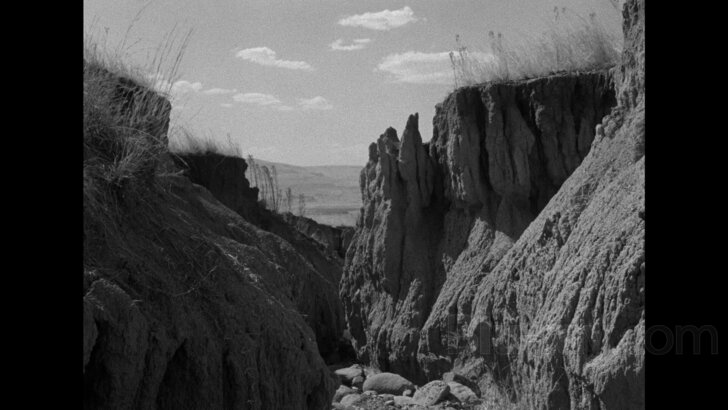
In certain areas, the authentic locations and the large number of non-professional actors give the film a quasi-documentary appearance that feels most appropriate. However, it is very easy to tell that Korda and his crew were extremely careful with their movement and the management of the drama. In fact, once the action moves to Johannesburg, which happens very early in the film, there isn’t any illuminating footage that makes it easy to see the film as an invaluable time capsule. While understandable, this is unfortunate because it would have given Kumalo’s journey a very different resonance.
While Lee and Poitier are supposed to lead with equal authority, the former is unquestionably a lot more impressive. Yes, it is true that the screenplay provides Lee’s character with better material to impress, but there are several sequences where Poitier has the opportunity to match the quality of his performance and fails.
Charles Carson and Joyce Carey are both very good as the devastated parents of the killed man. Arguably the most memorable sequence in the entire film comes toward the end where Carson meets Lee and reveals that he wants him to stay because he intends to build a brand new church.
Korda’s director of photography was Robert Krasker, whose credits include such iconic films as Brief Encounter, The Third Man, and The Quiet American.
Cry, the Beloved Country Blu-ray Movie, Video Quality
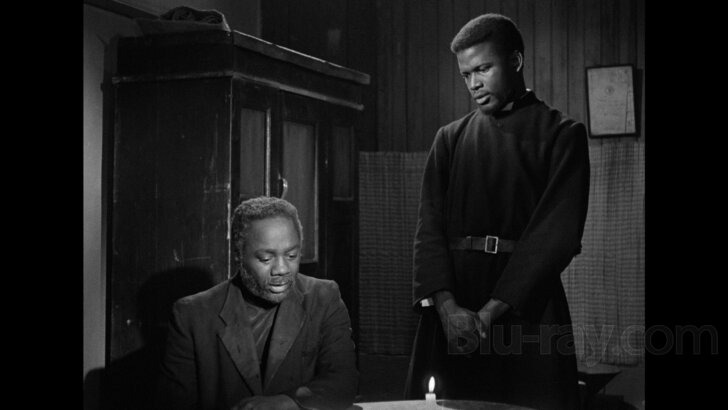
Presented in its original aspect ratio of 1.37:1, encoded with MPEG-4 AVC and granted a 1080p transfer, Cry, the Beloved Country arrives on Blu-ray courtesy of Kino Lorber.
In 2023, we reviewed this Region-B release of Cry, the Beloved County, which introduced an exclusive 4K restoration of the film, completed by the British Film Institute. Kino Lorber's release brings the same 4K restoration to America.
I revisited Cry, the Beloved Country earlier tonight and do not have anything new to add. This film looks quite spectacular now. While there are a few areas with small density fluctuations, all introduced by the original cinematography, not digital corrections, the quality of the visuals ranges from excellent to outstanding. (The fluctuations appear before or after transitions, only one of which reveals some traces of aging). The grayscale is fantastic. Blacks are very lush but do not appear boosted, while grays and whites are wonderfully balanced. Grain exposure is very good. I did not notice any mushy spots or similar anomalies. The entire film looks rather strikingly clean as well. (Note: This is a Region-A "locked" Blu-ray release. Therefore, you must have a native Region-A or Region-Free player in order to access its content).
Cry, the Beloved Country Blu-ray Movie, Audio Quality
There is only one standard audio track on this Blu-ray release: English DTS-HD Master Audio 2.0. Optional English SDH subtitles are provided for the main feature.
The audio has been fully restored. However, while the dialog is clear, in some areas there is noticeable light hiss. I suspect that it is inherited because there is quite a bit of outdoor footage that was clearly not shot under optimal conditions. For the same reason, dynamic intensity is underwhelming, or if one ignores the fact that Cry, the Beloved Country was completed in 1951. So, I think that the lossless audio reproduces the native qualities of the original soundtrack very well.
Cry, the Beloved Country Blu-ray Movie, Special Features and Extras
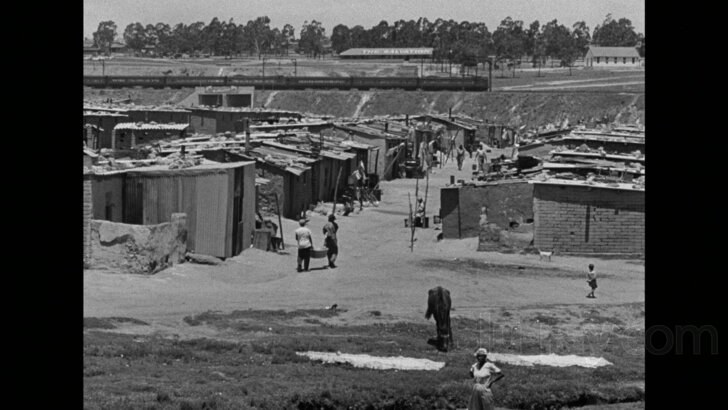
- Canada Lee: An Interview with Mona Z. Smith - in this archival program, Mona Z. Smith, author of Becoming Something: The Story of Canada Lee, discusses the life and career of Canada Lee. In English, not subtitled. (36 min).
- Commentary - this exclusive new audio commentary was recorded by critic Daniel Kremer.
Cry, the Beloved Country Blu-ray Movie, Overall Score and Recommendation
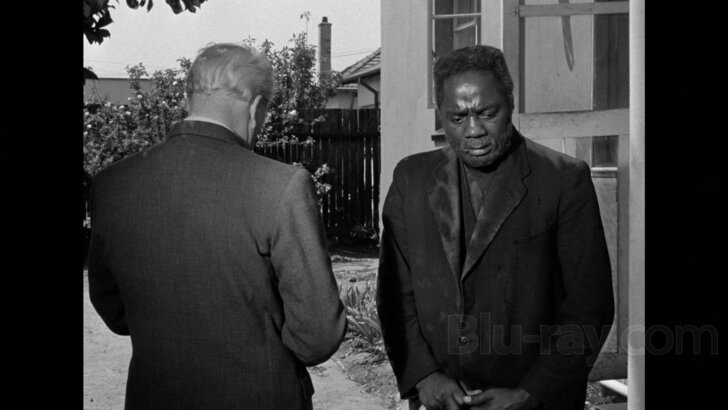
The historical value of Cry, the Beloved Country is undeniable because it is the first big film to be made in South Africa during the Apartheid. However, it is a very difficult film to evaluate because it was made with a tremendous awareness of what was safe to say and reveal in it. It is certainly worth seeing, but anyone expecting a fascinating time capsule will almost certainly be underwhelmed by it. Kino Lorber's release brings to America the recent 4K restoration of Cry, the Beloved Country that was completed by the British Film Institute on behalf of StudioCanal. RECOMMENDED.
Similar titles
Similar titles you might also like
(Still not reliable for this title)

Hamilton
2020
The Dresser
1983

Nell
1994

Spoiler Alert
2022

Mrs. Harris Goes to Paris
2022

The Son
2022

A Delicate Balance
1973

Black Nativity
2013
Nuts
1987

Song Sung Blue
Collector's Edition
2025

Kiss of the Spider Woman 4K
2025

The Color Purple
2023

Cyrano
2021

Jesus Christ Superstar
1973

Sorrowful Jones
1949

Carousel
1956

The President's Lady
Limited Edition
1953

God's Not Dead: A Light in Darkness
2018

The Normal Heart
2014

Follow That Dream
Limited Edition - SOLD OUT
1962