Crucible of Horror Blu-ray Movie
HomeCrucible of Horror Blu-ray Movie 
The Corpse | Limited Collector's EditionHammer Films | 1971 | 91 min | Rated BBFC: 15 | Apr 20, 2026
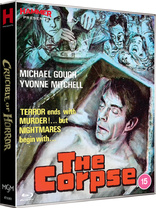

Movie rating
6.1 | / 10 |
Blu-ray rating
| Users |  | 0.0 |
| Reviewer |  | 4.0 |
| Overall | | 4.0 |
Overview
Crucible of Horror (1971)
A mother and daughter hatch a scheme to murder their family's domineering and sadistic patriarch.
Starring: Michael Gough, Yvonne Mitchell, Sharon Gurney, David Butler (II), Olaf PooleyDirector: Viktors Ritelis
| Horror | Uncertain |
| Thriller | Uncertain |
Specifications
Video
Video codec: MPEG-4 AVC
Video resolution: 1080p
Aspect ratio: 1.66:1, 1.85:1
Original aspect ratio: 1.85:1
Audio
English: DTS-HD Master Audio 2.0 Mono
Subtitles
English
Discs
Blu-ray Disc
Single disc (1 BD)
Packaging
Slipcover in original pressing
Playback
Region B (A, C untested)
Review
Rating summary
| Movie |  | 3.5 |
| Video |  | 4.5 |
| Audio | | 4.5 |
| Extras | | 3.5 |
| Overall | | 4.0 |
Crucible of Horror Blu-ray Movie Review
Reviewed by Justin Dekker June 3, 2026Primarily known for his television work, Viktors Ritelis' ('A Country Practice') first feature film 'Crucible if Horror' (also known in the UK as 'The
Corpse') arrives on Blu-ray in this Limited Collector's Edition courtesy of Hammer Films. The nasty slice of psychological terror stars Michael Gough
('The Boys From Brazil', 'Batman') and Yvonne Mitchell ('Demons of the Mind') in this tense tale with a small cast and a limited number of sets. The
film has been given a lovely 4K restoration from the original 35mm camera negatives, comes outfitted with a decent assortment of on-disc extras, and
the film is presented in both the 1.66:1 and 1.85:1 aspect ratios. The Limited Collector's Edition comes with a slipcover, but a Digital Code is not
included. This release is Region B "locked", therefore viewers wishing to enjoy this disc outside of that territory will require a region-free player to do
so.
The middle-aged Walter Eastwood (Michael Gough) rules over his family with brutal iron first. Verbally and physically abusive, he is cruel to his long-
suffering wife (Yvonne Mitchell) and his teenaged daughter (Sharon Gurney), and only his eldest son Rupert (Simon Gough) escapes his terroristic
attentions. After Walter administers an especially brutal beating, the two women devise a plan to end their torment. Is Walter the corpse he seems to
be, or is something more sinister transpiring?
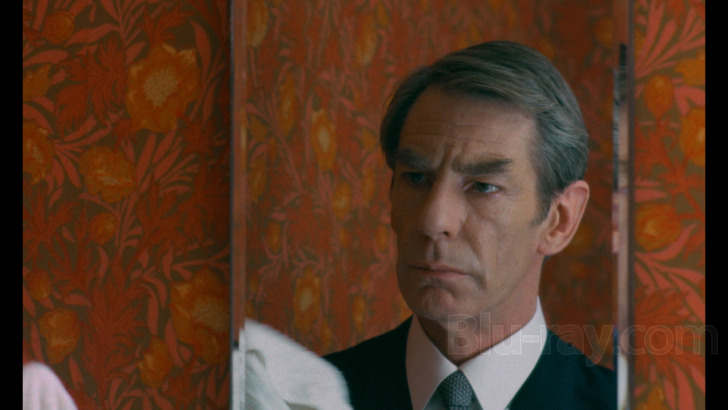
Made for a purported £75,000 and completed in 1969 before being unceremoniously shelved for several years, Crucible of Horror first appeared cinematically in the US in 1971 before making its way to UK screens. The film is quite a small and almost family affair. Rupert Eastwood, played by Simon Gough, is star Michael Gough's son. Simon, for his part, has also been married to co-star Sharon Gurney, who plays his sister Jane, since 1970 and the pair share a number of children. Olaf Pooley, who wrote the screenplay, also stars as Reid, an architect and Walter's hunting companion. Given the era, as one would expect, several of those involved with this film had experience with Hammer Films as well. Composer John Hotchkis was originally tapped to provide the score for the studio's pivotal The Quatermass Experiment, with the job ultimately going to James Bernard, the composer who would contribute scores to several key films from the studio and would be linked with the sound of Hammer for many fans. His haunting work shines here. Michael Gough, in 1962, would appear in Hammer's take on The Phantom of the Opera, and Yvonne Mitchell who plays his wife Edith, would appear in their 1972 feature Demons of the Mind, a spooky film with nary a golem, a mummy, nor a vampire on hand. And in a small but important role as the Eastwood family's much derided servant (by Walter, anyway), Mary Hignett appeared in the 1967 feature Prehistoric Women which starred the incomparable Martine Beswick. It's fitting, in its way, that there should be so much overlap with Hammer, as this small feature with it's tiny cast and but a few shooting locations feels, in many respects, like a Hammer film. Velvet House, which serves as the Eastwood family home, along with the remote hunting lodge help provide some of the same production values that made Hammer's best seem rich beyond their cost. The same holds for the cast, with Michael Gough, Yvonne Mitchell, and Olaf Pooley greatly elevating the film with their nuanced and powerful performances.
However, it's truly the elder Gough upon whom the success of the film primarily depends. With a great economy of word and deed he provides a steady diet of Walter's cruelty, both verbal and physical for the first third of the film. Within the first few minutes, it's more than evident that it's he who is the problem. His particular brand of tyranny and the endless well of hate which fuels his every interaction with the female members of the Eastwood family and their servant generates an equally endless reserve of sympathy for them. Strangely, though, while he doesn't always agree with his son Rupert, toward him he behaves in as nurturing a fashion as he is able, helping him learn how it is women should be treated via his example, and offering guidance for the betterment of his still young career. It's an unsettling juxtaposition. After consistently demeaning and diminishing the three women in his orbit, the most horrifically physically abusive scene occurs when Walter whips Jane in her room over a situation regarding the theft of a relatively trivial amount of money. While this beating transpires, in his own room, young Rupert, wearing head phones and using similar motions to those of his father, aggressively pantomimes conducting along to the classical music to which he is listening. His baton visually mirrors the implement Walter uses to whip Jane until she's bloody and whimpering. When it's over, Rupert emerges from his room and meets his father in the hall. Smiling and contented, he seems pleased to understand that due to his father's efforts Jane will have learned her lesson and has been put in her place. That Edith would soon thereafter speak of her desire to kill Walter should come as no surprise.
To think of Crucible of Horror, a film whose British title was The Corpse, as purely a thrilling tale of some much deserved revenge meted out with all due viciousness would be to miss a great deal that is bubbling away just under the surface. With a bit of thought it's clear to see the societal commentary with regard to the era's rigidly defined gender roles being not only critiqued but skewered. Walter essentially holds Jane hostage in the house, forbidding her to see a local suitor. Further, by denying her access to money he inhibits her ability to have and make friends, as she at one point laments that they all eventually abandon her when they tire of paying her way. She is isolated, alone, and under his thumb. Edith has but one outlet and purpose for her time; painting. Though she is allowed this trivial pursuit that will never lead to anything greater than a door to shut for protection in the bleak room that serves as her studio, she is still dependent on a man, her son in this case, to bring her the canvases she needs. She either hasn't access to money or the authority to use a car and get them on her own. Rupert, demonstrating that he is learning all too well from his father's demonic example intones one morning over breakfast that he believes there should be a national conscription for young women to work as domestic servants for two years so that they may then "be of some use". Women have almost no value. Not only is Walter ruining their presents but, by poisoning Rupert's mind, their futures as well. Women are viewed here as doing nothing of import, neither the housemaid, nor the mother who paints, nor the 16-year old daughter who isn't allowed to have any money of her own. Their stations will never improve under this model. Not so for the men, though. Their place is in the world, where they are able to to influence, control, or dominate everything as they so choose. (Warning: the following discussion contains spoilers.)
Aside from the gripping work of the leads and the rest of the cast, another element that aids the immense re-watchability of the film is the uncertain and intentionally undefined nature of its ending. While the first of the film's three acts clearly and definitively establishes Walter (and therefore the patriarchy) as a tyrannical force that must be destroyed, everything becomes unclear and almost dreamlike once Edith's plan is put in motion. After repeated viewings, in my estimation there are no less than three ways to interpret the film's gut-wrenching ending. First, one could simply take it at face value. Edith and Jane carried out their plan perfectly but the evil that brings Walter life is too powerful to be extinguished by such pedestrian and mortal means. Plausible, but it seems unlikely that he would allow their audacity to pass without a brutal retaliatory beating. Or, would he? Considering Michael Gough's impressively measured performance he just might, as he knows his survival has disintegrated whatever hope of a life without him that the two women had left. Secondly, one could look at the final scene as metaphorical, and given the film's small budget that it was simply the most poetic method Pooley and Ritelis could leverage to demonstrate that isolated action (in this case, murder) is insufficient to bring about the needed broader change. Even without her cruelly controlling husband, the wider society would never allow her the opportunities she seeks for herself and her daughter. After Walter's death, his tyranny would simply be replaced by that of someone else and continue unabated, without her life or situation improving one whit. "Meet the new boss, same as the old boss", as the saying goes.
But perhaps the film's original British title of The Corpse provides the best clue in the final analysis. The lifeless body that drives the title isn't Gough's Walter as the cover art would suggest, though. No, the corpse is instead Mitchell's Edith, whose spirit has been methodically and slowly exterminated by a husband who is a condensed version of the patriarchal and outmoded ideals of the time that still not only held sway but a significant level of dominance. Her own son has dutifully fallen into line espousing rhetoric startlingly similar to that of his father and even going a step or two further. As she watches, Jane's hopes and dreams for a meaningful future are literally being beaten out of her and condemn her to a future not unlike her own. Her fantasy of killing her husband and starting anew was just that; a fantasy. And it has come to a crushing end. She saw the action of it in her mind's eye, and witnessed the havoc it would visit upon her as a good person who has done the unthinkable. But she has done nothing. How could she? It is Edith who symbolically becomes the corpse at the film's end, with the single tear that trails down her withered and sunken cheek marking her passing before she fades from our view forever. But not so for Walter whose life was never in any real danger. For him, things are completely unchanged, and the film ends much as it began to prove just that point.
Crucible of Horror Blu-ray Movie, Video Quality
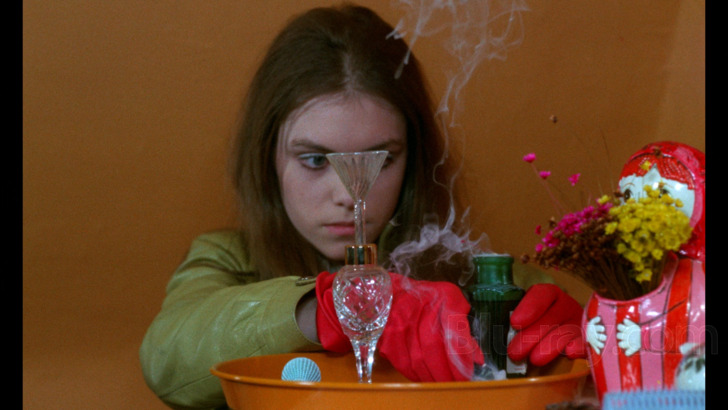
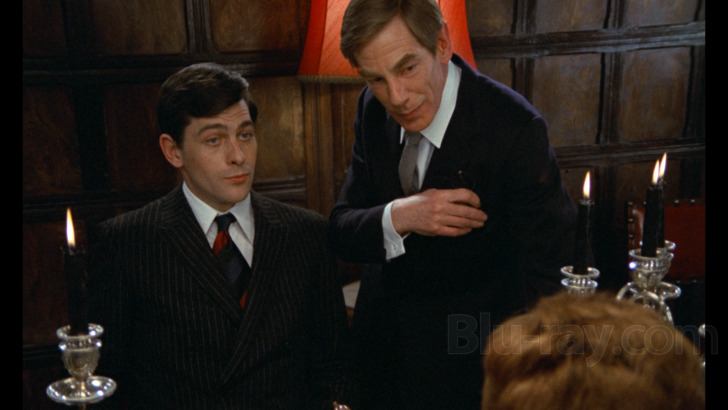
For their new 1080p presentation, Hammer went back to the original 35mm negatives which were held at the Pro-Tek Vaults in Burbank for MGM. After a 4K scan and 2K restoration, the end result is rather impressive for the overwhelming majority of the film's runtime. The main title sequence is a bit soft and slightly grainier than the rest of the film, however, while the grain here is noticeable it's not what I would refer to as noisy or distracting. As the credits end and Gough makes it into the house and moves into the bathroom to wash his hands, the quality of the image on display improves dramatically and stays at that level for the remainder. The image sharpens to a point that meets the standards of Hammer's other restoration work. Grain, while still present, is managed and resolves well, and colors become healthier across the board. Mind you, some softness does occasionally creep back in from time to time, though this is the exception and not the rule and such moments are brief. Based on the era of the film and the camera's subject, some of these may have been intentional or stylistic choices. There are also a few brief moments where Gough's complexion veers more toward the tan than the healthier hues we typically see, though these moments, too, are brief. Fine detail levels are typically high. The individual brush strokes and thicker layers of paint are clearly visible on the canvases with which Edith (Yvonne Mitchell) spends her time. Lines and wrinkles are visible on Mitchell and Gough's faces, with his in particular being an especially impressive and deep collection that add richer layers to his emotions and expressions. Flyaway hairs are visible on the styles of the ladies. Environmental details such as fringe on lamps, chipped and worn paint on door jambs, and wood grains are precisely defined. The late 60s color palette tends toward darker and earthier tones, though reds, such as those present in the drapes of the Eastwood family dining room pop nicely and make the viewer wish that more such elements of decor were to be found around the rather dour and drab home. Overall, it's and impressive and enjoyable transfer that meets the high standards that viewers have quickly come to expect from a Hammer release.
Crucible of Horror Blu-ray Movie, Audio Quality
The restored mono track that accompanies the film is tastefully done. Much of what it needs to handle is dialogue; the nervous warbles of Edith, the panicked utterances from Jane (Sharon Gurney), the dunderheaded comments from Rupert (Simon Gough), and the constant bullying and cruelty of Walter (Michael Gough). The dialogue is consistently clean and free from any distortion or defect, and intelligible in all situations. Mundane contemporary sound effects such as car engines, breaking dishes, needles skipping over records, and slamming doors are all reproduced well, though gunshots, as one would expect, are a bit thin. Music is also handled well, with the string elements of the film's score sounding especially pleasing.
Crucible of Horror Blu-ray Movie, Special Features and Extras
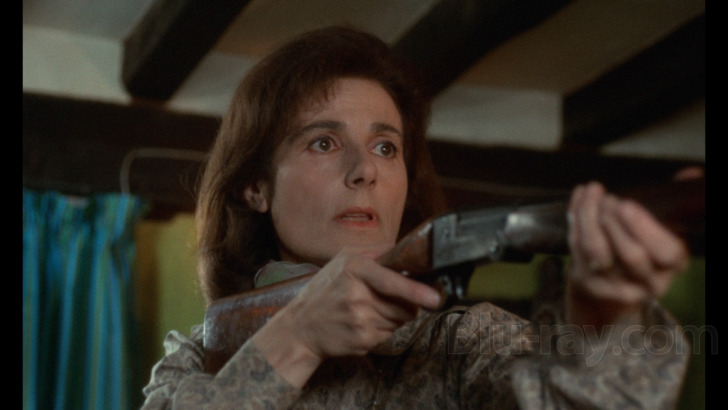
Hammer's Crucible of Horror arrives with a solid assortment of on-disc extras as below.
- 2025 Commentary with Vic Pratt and William Fowler - The authors begin by commenting on the score and the images that accompany the opening credits. The house itself garners some attention before they discuss Edith's artwork and the associated symbolism. The pair then spend time setting the scene of London and England in the late 60s and early 1970s, as they share information about the societal roles and expectations, and censorship attitudes as well. The commentary is quite conversational and feels natural and free-flowing, and the pair are obviously comfortable with each other. It's relaxed and thoughtful.
- US Theatrical Trailer (2.11) - Spoilers about so watch with caution.
- Textless US Theatrical Trailer (2.12)
- The Persistence of Patriarchy (31.47) - In this 2026 interview with author and film historian Jonathan Rigby, he provides a great deal of context for the film's creation, the careers of the director and the producer before moving on to the cast. Eventually, he turns his attention to the the film and its structure.
- Image Gallery (2.39) - Playing in silence, a collection of posters, lobby cards and stills auto-advance.
Crucible of Horror Blu-ray Movie, Overall Score and Recommendation
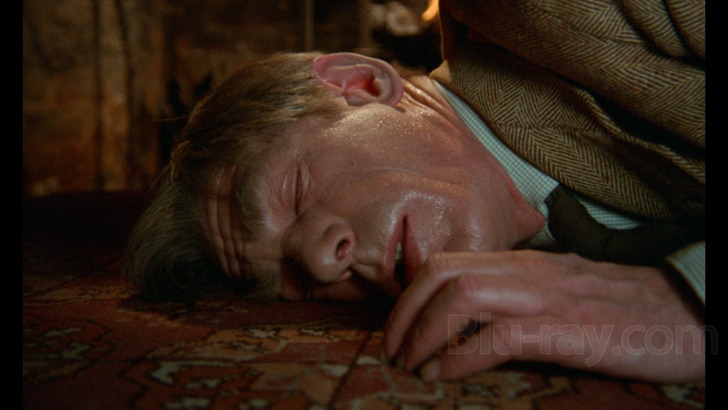
Preparation for this review marked my first times viewing Crucible of Horror though I will most certainly revisit it again in the future. After my initial viewing, I immediately started the film over to watch it again, looking for clues as to the events that transpire in the film's second and third acts and also relishing the cold, controlled cruelty of Gough's performance. In lesser hands the role of Walter could devolved into something almost cartoonish, but his staid and calculating performance renders him all the more frightening. Chilling, even. Taken on its face, the film entertains, but looking below the surface reveals a subtext that is all the more rewarding and thought-provoking. Crucible of Horror looks stunning and the film all but demands repeat viewings. Highly recommended.
Similar titles
Similar titles you might also like

Pet Sematary 4K
2019

Demons of the Mind 4K
Hammer | Collector's Edition | Limited Edition
1971

The Boy
2016

Fanatic
Die! Die! My Darling! / Indicator Series
1965

American Mary
2012

Dead of Night 4K
Vintage Classics
1945

The Incubus
Slasher Classics Collection #55
1982

The Raven
Masters of Cinema
1935

Intruders
2011

The Skull
Eureka Classics
1965

Dementia 13
Director's Cut | Vestron Collector's Series
1963

Possessor 4K
Limited Edition
2019

Brahms: The Boy II
2020

Incident in a Ghostland
2018

Winchester
2018
The Climax
Eureka Classics
1944

Shock
Schock / Beyond the Door II
1977

Frightmare
1974

Thirst 4K
Indicator Series | Limited Edition
1979

Nightmare
1964