Come Back, Africa / The Films of Lionel Rogosin, Vol. II Blu-ray Movie
HomeCome Back, Africa / The Films of Lionel Rogosin, Vol. II Blu-ray Movie 
Milestone | 1959-1970 | 147 min | Not rated | Feb 25, 2014

Movie rating
Movie has not been rated yetBlu-ray rating
| Users |  | 0.0 |
| Reviewer |  | 4.5 |
| Overall | | 4.5 |
Overview
Come Back, Africa / The Films of Lionel Rogosin, Vol. II (1959-1970)
See individual titles for their synopses.
| Documentary | 100% |
Specifications
Video
Video codec: MPEG-4 AVC
Video resolution: 1080p
Aspect ratio: 1.31:1
Original aspect ratio: 1.37:1
Audio
See individual releases
Subtitles
None
Discs
50GB Blu-ray Disc
Two-disc set (2 BDs)
Playback
Region free
Review
Rating summary
| Movie | | 4.5 |
| Video |  | 4.0 |
| Audio |  | 3.5 |
| Extras | | 4.0 |
| Overall | | 4.5 |
Come Back, Africa / The Films of Lionel Rogosin, Vol. II Blu-ray Movie Review
The Agitator Abroad and at Home
Reviewed by Michael Reuben February 24, 2014It has taken two years, but Milestone Films is releasing the second volume in their series of The Films of Lionel Rogosin, the trail-blazing documentarian whose first film, On the Bowery, supplied the title for Volume 1. The new volume is called Come Back, Africa, the title of Rogosin's second documentary feature, which he shot covertly on location in Johannesburg, once he felt that he had mastered his craft sufficiently to explore the subject that had first caught his attention during his travels after World War II. (For a brief overview of Rogosin's background, please see the review of On the Bowery.) A separate disc offers Rogosin's fourth documentary, Black Roots. His third film, Good Times, Wonderful Times, was included in Volume 1. Rogosin arrived in Johannesburg in 1959 with a new wife and a successful first film under his belt, but no script, no plan and no contacts. His lack of a clear design may have served him well in at least one regard; when he had to tell various South African authorities why he was there, he was able to spin them all manner of phony stories, from a yarn about airline advertising to a fiction about making an indigenous musical. Gradually, though, and sometimes by sheer luck, Rogosin made the acquaintance of writers, intellectuals and anti-apartheid sympathizers who helped him develop a story outline (much as he had done for On the Bowery), recruit non-professional actors, identify locations and organize a covert shooting schedule. As each days' shots were checked and developed, they were immediately transported to New York, where editor Carl Lerner, a veteran of On the Bowery, was waiting. After four months, Rogosin and most of his team left Johannesburg, where the regime would never allow them to return, once they learned what Come Back, Africa was really about. Rogosin's brief notoriety for On the Bowery may have helped him get Come Back, Africa made, but his long struggle to obtain financing for the anti-war film Good Times, Wonderful Times, along with that film's association with movements perceived to be naive at best and pro-communist at worst, closed most doors to him. It would be four years before Rogosin could raise funds for another feature documentary, and it had to be a concept stripped to the bare minimum. Having chronicled apartheid in South Africa, Rogosin now chose to make his contribution to the civil rights movement in his own country. Rogosin didn't have the money for a story, multiple locations or even a lengthy shoot, but he did have the gift he had first deployed in On the Bowery, which was an uncanny ability to engender trust in people with whom, on the surface, he had nothing in common. In Black Roots, he did little more than persuade a group of African-Americans to tell stories about themselves and their experiences to the camera and each other, but Rogosin was able to get them to speak in a way they normally would not in the presence of a white man, at least in that era. This may be difficult for anyone who wasn't alive then to imagine, but such conversations simply did not occur in such a polarized and tense age--or if they did, they quickly turned ugly. Through careful editing with faces in crowds, set to the rhythm of blues and African music, Rogosin created both a cultural collage and a window into what had previously been a world invisible to mainstream America.
For a discussion of Come Back, Africa, please see the Come Back, Africa Blu-ray review. For a discussion of Black Roots, please see the Black Roots Blu-ray review.
Come Back, Africa / The Films of Lionel Rogosin, Vol. II Blu-ray Movie, Video Quality
Come Back, Africa 4.5/5 A note preceding the Blu-ray presentation states, in part, as follows:
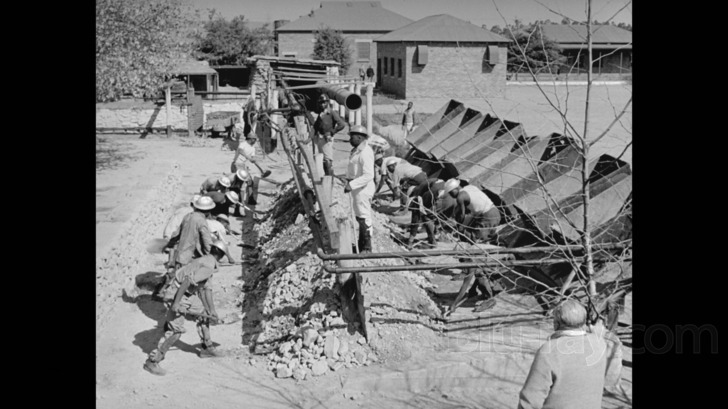
The restoration is based on the original negatives, a fine grain and a dupe negative preserved at the Anthology Film Archives in New York and at the British Film Institute-National Film and Television Archive in London.The Cineteca di Bologna has produced a restoration of Come Back, Africa that can easily stand comparison with its impressive work displayed in On the Bowery. This is not to say that every frame is perfect. Evidence of repaired scratches remains, a few frames are missing here and there, and some frames display the kind of pulsing that indicates damage from stretching, which is impossible to address. But the depth, clarity and detail of the black-and-white images captured by cinematographers Ernest Artaria and Emil Knebel are astonishing. For an idea of just how much has been revealed by the restoration, simply compare the excerpts of the film included in the documentary, An American in Sophiatown, which was made before the restoration and where much of the film's detail is swallowed up in darkness. On Milestone's 1080p, AVC-encoded Blu-ray, by contrast, the frame is black only where it should be, and the shadow detail is delineated in fine shades of gray. Much of the impact of Come Back, Africa rests on the implicit contrast between the modern (for its time) city of Johannesburg and the rubble of Sophiatown, which was being leveled by the authorities even as Rogosin was filming. Once home to a thriving local culture, some of which Rogosin was able to capture before it was crushed, Sophiatown was in the process of being eliminated and its population forcibly relocated. Although this is never explained in the film, the visual contrast itself tells the viewer that the African population is being separated from the white minority rulers by force. Milestone has encoded Come Back, Africa at the high bitrate of 33.99 Mbps, which is excellent, because the images are complex and the irregularities that remain even after the restoration require adequate bandwidth to ensure that no compression anomalies appear. None did. Black Roots 3.5/5 A note preceding the Blu-ray presentation states as follows:
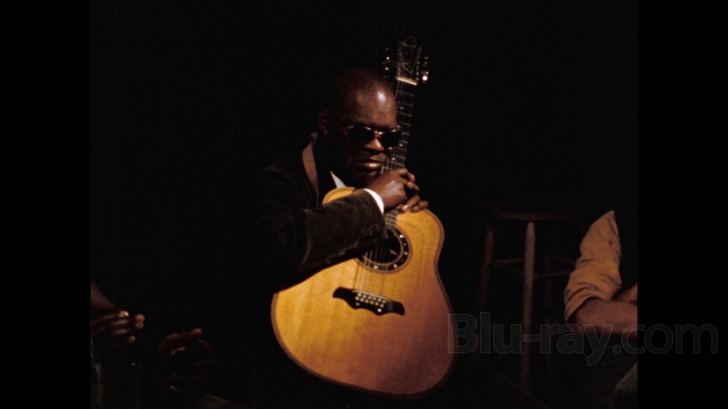
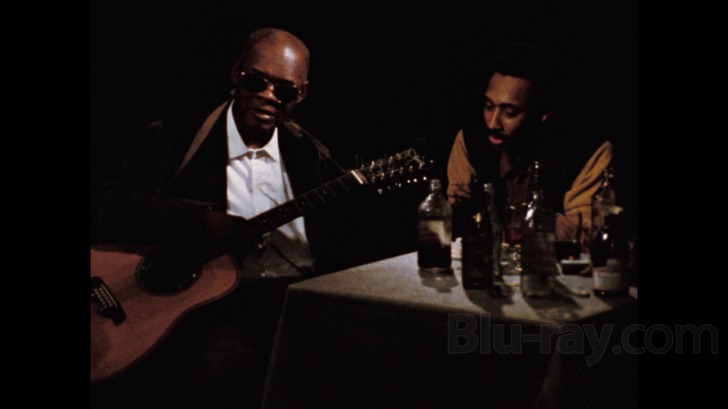
The restoration of Black Roots has been supported by Rogosin Heritage Inc. and carried out by Fondazione Cineteca di Bologna. The restoration is based on the original negatives preserved at the Anthology Film Archives in New York. The restoration was carried out at L'Immagine Ritrovata laboratory in 2012.By all appearances, Black Roots was shot on 16mm film. The cinematographer was J. Robert Waggoner, who would reunite with Rogosin two years later for Black Fantasy, his film on interracial marriage. Given the excellent work achieved by the Cineteca di Bologna on the two Rogosin films included on Milestone's Vol. 1 set, one can only assume that the negative for Black Roots was in poor shape before restoration. Although obvious dirt, speckles and spots have been largely removed, the locations of the many repaired vertical scratches ("gashes" might be a better word) are still evident, although the scratches themselves have been filled in. I can happily report that the film's natural grain pattern has been preserved intact, without filtering or artificial sharpening. However, portions of the image on Milestone Film's 1080p, AVC-encoded Blu-ray will strike some Blu-ray viewers as excessively grainy, which is not a fault in the transfer but a function of low-light conditions. The grainiest portions are consistently those shot on the makeshift soundstage housing the bar/coffee house set. The outdoor shots and the Florence Kennedy interviews have far less noticeable grain. Blacks are solid and deep. Colors are decently saturated, but they do not leap off the screen. Rogosin wanted to capture the everyday world, and he did not boost color for additional glossiness. Milestone has achieved a relatively high average bitrate of 29.07 Mbps, which is certainly desirable given the grainy nature of the image in large portions of the film. No compression artifacts were in evidence. The video grade assigned to this presentation will undoubtedly provoke complaints, but I believe that video grades should be based, at least in large part, on accuracy rather than eye appeal.
Come Back, Africa / The Films of Lionel Rogosin, Vol. II Blu-ray Movie, Audio Quality
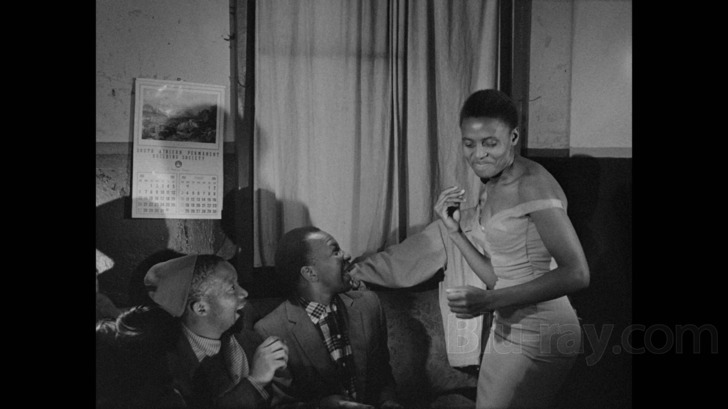
Come Back, Africa 3/5 The film's original mono soundtrack has been encoded as PCM 2.0, and it has good fidelity and dynamic range for its vintage. The sound editing is as sophisticated as the film editing, with sudden alternations between noise and silence and unexpected sound effects that convey the strangeness of the environment. The dialogue is partly in English, partly in Zulu (Zachariah's native language) and occasionally in Afrikaans (the language of the police); the latter two are subtitled. The English dialogue is often difficult to understand, because, as Rogosin later explained, many of the non-professional African actors did not speak good English. They found it difficult enough to improvise their dialogue, let alone improvise in a foreign tongue. Optional English subtitles are available for viewers who want them, but my own experience watching the film was that one didn't need to understand much of the dialogue, because Rogosin's visuals conveyed his story so clearly. (The sole exception might be the intense political discussion that occurs near the end of the film.) Black Roots 3.5/5 The film's original mono soundtrack is presented as PCM 2.0, and it probably sounds about as good as it can, which isn't great. Florence Kennedy's interviews were well-miked, but the conversations on the bar/coffee house set sound like they were recorded from a distance. As a result, the voices are flat and muddy. Speakers can be understood, but one must strain to hear them. Fortunately, there are optional subtitles. The musical selections, both pop recordings and live performance, are also just adequate. They sound better than AM radio of the era but are nothing compared to what a contemporary mono recording might offer in terms of fidelity and dynamic range. Here again, this is probably as good as they can sound.
Come Back, Africa / The Films of Lionel Rogosin, Vol. II Blu-ray Movie, Special Features and Extras
For the various extras included with both films, please see the Come Back, Africa Blu-ray review and the Black Roots Blu-ray review.
Come Back, Africa / The Films of Lionel Rogosin, Vol. II Blu-ray Movie, Overall Score and Recommendation
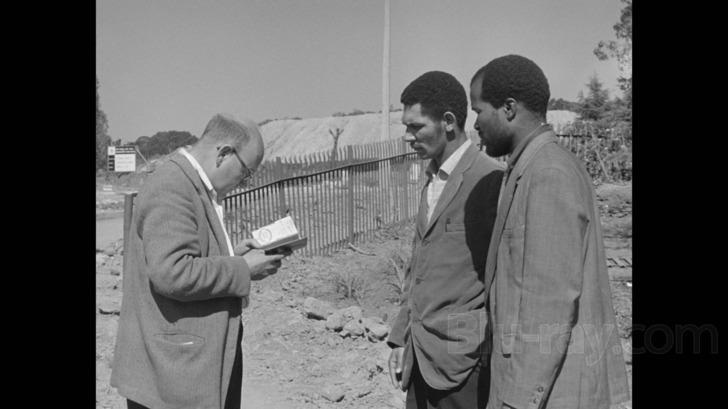
Black Roots is very much a film of its time, both in cinematic style and in subject matter. With today's technology, a budding filmmaker could do far more logistically on Rogosin's limited budget, but few would have Rogosin's eye or his ability to get people to speak openly. Besides, Rogosin captured a socio-psychological landscape that has changed dramatically, just as New York's Bowery has evolved since the filmmaker spent weeks in its back alleys making friends with the regulars. Black Roots captures an essential perspective on America at the height of the civil rights movement. For that alone, it is worth seeing. Come Back, Africa is an undisputed masterpiece, a landmark in documentary filmmaking. If it didn't have the immediate impact for which Rogosin hoped (naively, as he would later say), it has been hailed as an essential record of South Africa's cultural history during the Fifties, and it certainly played a part in the many decades of struggle against apartheid. Milestone and the Rogosin Foundation are to be commended for their continued effort in restoring, preserving and distributing Lionel Rogosin's work to a new audience in the best quality possible. Highly recommended.