Come Back, Africa Blu-ray Movie
HomeCome Back, Africa Blu-ray Movie 
Milestone | 1959 | 85 min | Not rated | No Release Date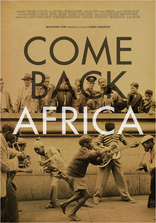
Price
Movie rating
7.1 | / 10 |
Blu-ray rating
| Users |  | 0.0 |
| Reviewer |  | 4.5 |
| Overall | | 4.5 |
Overview
Come Back, Africa (1959)
Come Back, Africa chronicles the life of Zachariah, a black South African living under the rule of the harsh apartheid government in 1959.
Director: Lionel Rogosin| Documentary | 100% |
Specifications
Video
Video codec: MPEG-4 AVC
Video resolution: 1080p
Aspect ratio: 1.31:1
Original aspect ratio: 1.37:1
Audio
English: LPCM 2.0 Mono (48kHz, 16-bit)
Subtitles
English SDH
Discs
50GB Blu-ray Disc
Single disc (1 BD)
Playback
Region free
Review
Rating summary
| Movie | | 4.5 |
| Video | | 4.5 |
| Audio |  | 3.0 |
| Extras | | 4.5 |
| Overall | | 4.5 |
Come Back, Africa Blu-ray Movie Review
Guerilla Filmmaking—for Real
Reviewed by Michael Reuben February 24, 2014After learning how to make a documentary with On the Bowery (and, in the process, reinventing the form), Lionel Rogosin set off for South Africa to make the film that was dearest to his heart: an account of the apartheid regime of which he had observed the the early stages on his first visit to the country in 1948. Rogosin arrived in Johannesburg with his new wife and a successful first film under his belt, but no script, no plan and no contacts. His lack of a clear design may have served him well in at least one regard; when he had to tell various South African authorities why he was there, he was able to spin them all manner of phony stories, from a yarn about airline advertising to a fiction about making an indigenous musical. Gradually, though, and sometimes by sheer luck, Rogosin made the acquaintance of writers, intellectuals and anti-apartheid sympathizers who helped him develop a story outline (much as he had done for On the Bowery), recruit non-professional actors, identify locations and organize a covert shooting schedule. As each days' shots were checked and developed, they were immediately transported to New York, where editor Carl Lerner, a veteran of On the Bowery, was waiting. After four months, Rogosin and most of his team left Johannesburg, where the regime would never allow them to return. Rogosin himself made arrangements for several of his principal actors to leave the country. Others made their own arrangements, but many stayed behind and, as noted in the documentary, An American in Sophiatown, died of drink, heartbroken over the merciless and deadly course that the campaign against their community was shortly to take.
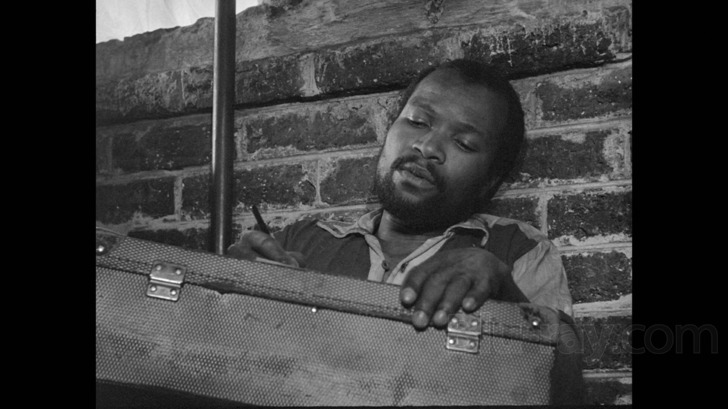
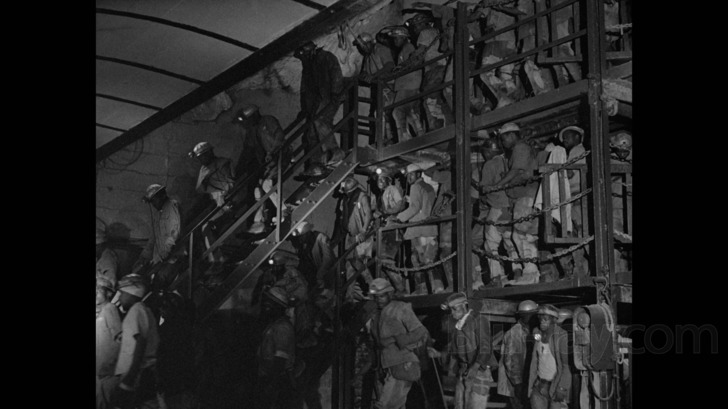
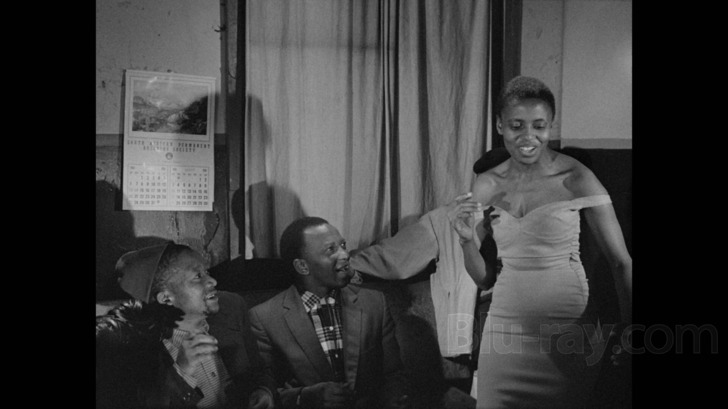
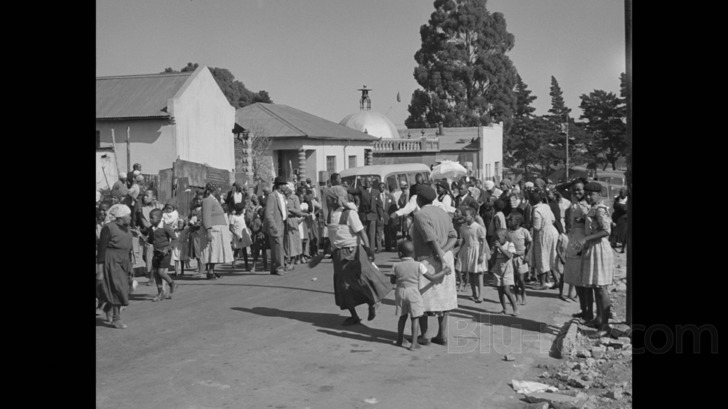
As he did in On the Bowery, Rogosin focuses on a representative character. His name is Zachariah (Zacharia Mgabi), and he arrives in Johannesburg from the outer provinces seeking work so that he can send money home to his wife and children. Travel and work permits are strictly regulated. Although Johannesburg is a modern city (by the standards of the 1950s), opportunities for Africans are limited. Most end up working in the gold mines, which is where Zachariah begins but immediately tries to escape for better options. As Zachariah bounces from one job to another—houseboy, auto mechanic, hotel waiter—he encounters the full array of prejudice by whites against Africans, and he also experiences the clandestine and often petty forms of rebellion in which many of his fellow Africans engage to let off steam. More often than not, their behavior lands them in more trouble and confirms their white employers' view that they are ignorant "savages". One day, Zachariah returns to his room to find that his wife, Vinah (Vinah Makeba), has brought their children to join him. She explains that conditions at home have deteriorated to the point where she could no longer cope without him. The family finds rooms in nearby Sophiatown, a lively environment where the streets are always bustling with activity, penny whistle bands, children playing, even the occasional wedding, but the houses look like they're about to fall down (and many already have). Zachariah continues to look for work, hampered by the fact that his pass to visit Johannesburg has expired. At the height of his frustrations, Zachariah has a run-in with a well-known local hoodlum (known as a "tsotsi"), from which he escapes with minor injuries. Friends bring him to a local social gathering where he listens to a lengthy and articulate political debate of the kind that co-screenwriter Lewis Nkosi (who plays one of the participants) has described as typical for the era. It is interrupted by the arrival of a pretty local singer, Miriam (Miriam Makeba), who entertains the assembled group. It is a moment of beauty and transcendence that only serves to distract from the sense of impending doom that has been gathering for a long time. The regime has imposed so many rules and regulations that it is only a matter of time before Zachariah or a member of his family trips over one of them and is caught up by the security forces. When that happens, a chain of events is unleashed that cannot end well. As in all of his best work, Rogosin lets the imagery do the talking. The film's climactic montage requires no dialogue or explanation.
Come Back, Africa Blu-ray Movie, Video Quality
A note preceding the Blu-ray presentation states, in part, as follows:
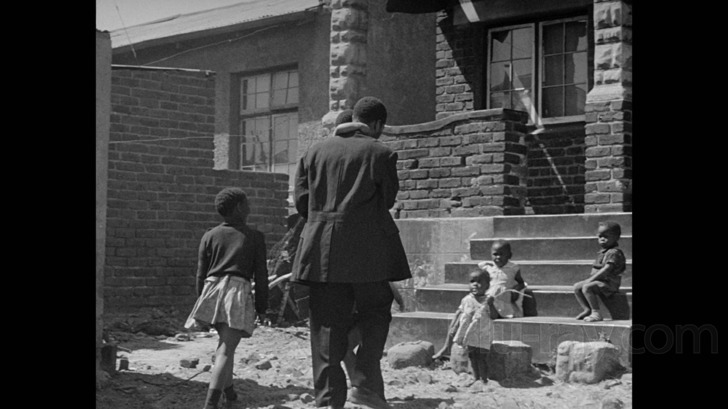
The restoration is based on the original negatives, a fine grain and a dupe negative preserved at the Anthology Film Archives in New York and at the British Film Institute-National Film and Television Archive in London.The Cineteca di Bologna has produced a restoration of Come Back, Africa that can easily stand comparison with its impressive work displayed in On the Bowery. This is not to say that every frame is perfect. Evidence of repaired scratches remains, a few frames are missing here and there, and some frames display the kind of pulsing that indicates damage from stretching, which is impossible to address. But the depth, clarity and detail of the black-and-white images captured by cinematographers Ernest Artaria and Emil Knebel are astonishing. For an idea of just how much has been revealed by the restoration, simply compare the excerpts of the film included in the documentary, An American in Sophiatown, which was made before the restoration and where much of the film's detail is swallowed up in darkness. On Milestone's 1080p, AVC-encoded Blu-ray, by contrast, the frame is black only where it should be, and the shadow detail is delineated in fine shades of gray. Much of the impact of Come Back, Africa rests on the implicit contrast between the modern (for its time) city of Johannesburg and the rubble of Sophiatown, which was being leveled by the authorities even as Rogosin was filming. Once home to a thriving local culture, some of which Rogosin was able to capture before it was crushed, Sophiatown was in the process of being eliminated and its population forcibly relocated. Although this is never explained in the film, the visual contrast itself tells the viewer that the African population is being separated from the white minority rulers by force. Milestone has encoded Come Back, Africa at the high bitrate of 33.99 Mbps, which is excellent, because the images are complex and the irregularities that remain even after the restoration require adequate bandwidth to ensure that no compression anomalies appear. None did.
Come Back, Africa Blu-ray Movie, Audio Quality
The film's original mono soundtrack has been encoded as PCM 2.0, and it has good fidelity and dynamic range for its vintage. The sound editing is as sophisticated as the film editing, with sudden alternations between noise and silence and unexpected sound effects that convey the strangeness of the environment. The dialogue is partly in English, partly in Zulu (Zachariah's native language) and occasionally in Afrikaans (the language of the police); the latter two are subtitled. The English dialogue is often difficult to understand, because, as Rogosin later explained, many of the non-professional African actors did not speak good English. They found it difficult enough to improvise their dialogue, let alone improvise in a foreign tongue. Optional English subtitles are available for viewers who want them, but my own experience watching the film was that one didn't need to understand much of the dialogue, because Rogosin's visuals conveyed his story so clearly. (The sole exception might be the intense political discussion that occurs near the end of the film.)
Come Back, Africa Blu-ray Movie, Special Features and Extras
- Martin Scorsese Introduction (1080p; 1.78:1; 2:15): Optionally playable before the film, Scorsese's introduction situates Come Back, Africa in Rogosin's career and acknowledges the film's influence on his own work.
- An American in Sophiatown (1080i; 1.78:1; 51:54): This informative 2007 documentary was produced and edited by Michael Rogosin and directed by Earl Lloyd Ross. It is an essential resource on the making of Come Back, Africa, as well as a retrospective on the film's place in history. Among the important interview subjects are Rogosin's widow, who served as continuity advisor and general helpmate during production; Myrtle Berman, who appears as a viciously racist housewife in the film but was, in fact, part of an underground movement of white anti-apartheid activists, who, with her husband, helped Rogosin recruit other white non-professional actors; and Lewis Nkosi, a journalist who helped Rogosin develop the screenplay and also appears in the film. Nkosi is seen introducing the restored film at a gala screening in Bologna, and he is also seen returning to Johannesburg after a forty-five-year absence from South Africa to revisit some of the locations, which are now much changed. Nkosi's sadness as he walks the paved-over streets where Sophiatown used to exist is palpable. Also providing valuable accounts of the film's technical challenges is Emil Knebel, one of the two cinematographers whom Rogosin recruited from Switzerland. Rogosin himself appears in vintage interviews from the Seventies.
- Lionel Rogosin Interview (1080p; various; 19:44): Rogosin was interviewed for United Nations radio in 1979. The interview plays over a montage of still and moving images from and relating to Come Back, Africa.
- Come Back, Africa Trailer (1080p; 1.37:1; 2:21).
Come Back, Africa Blu-ray Movie, Overall Score and Recommendation
In later years, Rogosin would say that he had been naive when he made Come Back, Africa. He thought it would be enough to show the world what apartheid was doing to the black population of South Africa, but he discovered that no one cared. He may have been overstating the case. It would take more than a film to build the kind of international pressure on the apartheid regime that would lead to its voluntary surrender of power in 1993. Still, Come Back, Africa, which was critically acclaimed and shown all over Europe, was part of the process. Today, it has been hailed as an essential record of South Africa's cultural history during the Fifties. It is, in addition, a landmark in documentary filmmaking.
Similar titles
Similar titles you might also like
(Still not reliable for this title)

When We Were Kings
1996

Powaqqatsi
1988

The Salt of the Earth
Le Sel de la Terre
2014

Heartworn Highways
1976

Adventures on the New Frontier
1961

Nudist Life
10 Days in a Nudist Camp / Shangri-La Forbidden Fruit: The Golden Age of the Exploitation Picture, Vol. 14
1961

Rivers & Tides
2001

Cameraperson
2016

On the Bowery
1956
My Generation
2017

Soul Power
2008

Streetwise
1984

The Maestro: King of the Cowboy Artists
1994
The Beales of Grey Gardens
included with "Grey Gardens" release
2006

Tiny: The Life of Erin Blackwell
2016

Vernon, Florida
1981
Regrouping
included with "Born in Flames" release
1976

F for Fake
1973

Color Adjustment
1992

Minding the Gap
2018