City on Fire 4K Blu-ray Movie
HomeCity on Fire 4K Blu-ray Movie 
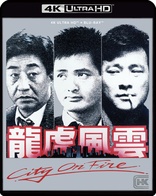
Lung foo fung wan / Lóng hǔ fēng yún / 龍虎風雲 / Hong Kong Cinema Classics #6 / 4K Ultra HD + Blu-rayShout Factory | 1987 | 105 min | Rated R | Aug 26, 2025

Movie rating
7.6 | / 10 |
Blu-ray rating
| Users |  | 4.5 |
| Reviewer | | 4.5 |
| Overall | | 4.5 |
Overview
City on Fire 4K (1987)
Ko Chow, a police undercover agent who is torn between his duty as a police officer and his loyalty to his friends on the wrong side of the law. He wants out and his commander officer Inspector Lau reluctantly approves his resignation but gives him his last assignment - supplying guns to a gang at criminals suspected of armed robbery. Tiger the head honcho of the gang of robbers. He has built a relationship with Ko Chow based on mutual trust and respect. During a shoot out with the police, Ko Chow must decide which side he is on.
Starring: Chow Yun-Fat, Danny Lee, Roy Cheung, Yueh Sun, Carrie NgDirector: Ringo Lam
| Foreign | Uncertain |
| Drama | Uncertain |
| Crime | Uncertain |
| Action | Uncertain |
| Thriller | Uncertain |
Specifications
Video
Video codec: HEVC / H.265
Video resolution: 4K (2160p)
Aspect ratio: 1.85:1
Original aspect ratio: 1.85:1
Audio
Cantonese: DTS-HD Master Audio 2.0 Mono (48kHz, 24-bit)
English: DTS-HD Master Audio 2.0 Mono (48kHz, 24-bit)
Subtitles
English
Discs
Blu-ray Disc
Two-disc set (2 BDs)
4K Ultra HD
Packaging
Slipcover in original pressing
Playback
Region A (B, C untested)
Review
Rating summary
| Movie |  | 4.0 |
| Video | | 4.5 |
| Audio | | 4.5 |
| Extras |  | 5.0 |
| Overall | | 4.5 |
City on Fire 4K Blu-ray Movie Review
Reviewed by Dr. Stephen Larson August 29, 2025In their book, Sex and Zen & A Bullet in the Head: The Essential Guide to Hong Kong's Mind-bending Films (Touchstone, 1996), Stefan Hammond and Mike Wilkins argue that director Ringo Lam's career essentially took with City on Fire (1987), which collected multiple Hong Kong Film Awards, including Best Director for Lam. This movie represented a big departure for Cinema City & Films Co. As film historian David Bordwell explains in his book Planet Hong Kong: Popular Cinema and the Art of Entertainment (Harvard University Press, first published: 2000), the studio was formed by the comedians Raymond Wong, Karl Maka, and Dean Shek. Cinema City was known for producing comedies such as the Aces Go Places series. But there was an emerging trend of "gun-fu" pictures highlighted by John Woo's A Better Tomorrow (1986). City on Fire is not really gun-fu, but it demonstrates a wave of more action-oriented films coming out of Hong Kong.
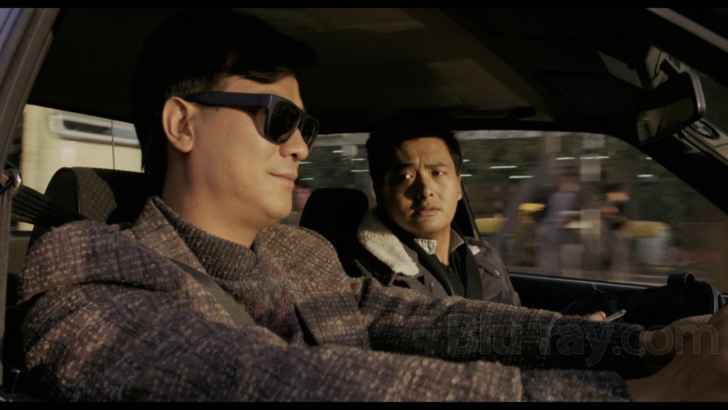
As the film opens in the streets of Kowloon, an undercover cop is killed while infiltrating a gang he is attempting to prevent from committing a robbery. Hangdog Inspector Lau (Sun Yeuh) of the Royal Hong Kong Police (RHKP) is most concerned about the frequent heists and bloodshed occurring in the city. He wants his nephew, Ko Chow (Chow Yun Fat), to go under cover so the police force can catch a small group of jewel thieves. But Ko Chow has a lot on his plate distracting him from police business. He has strained romantic relations with his fiancée Hung (Carrie Ng), who is also attracted to an affluent businessman whom Ko Chow despises. Ko Chow becomes more important to Inspector Lau and RHKP following a messy standoff with a notorious gang pillaging the Forever Jewelry store. After Ko Chow is embedded in the gang and accepted as one of its members, he finds his loyalty in conflict with RHKP. He becomes friends with thief Lee Fu (Danny Lee). Complicating matters is Lau's demotion and the ascension of officer John Chan (Roy Cheung) in the police force. John is young, cocky, and brash. He believes that Chow is dealing arms with Lee Fu's gang. Inspector Lau and John Chan are in bitter disagreement over whether Chow should go under cover for a big heist about to go down in the city.
Partners?
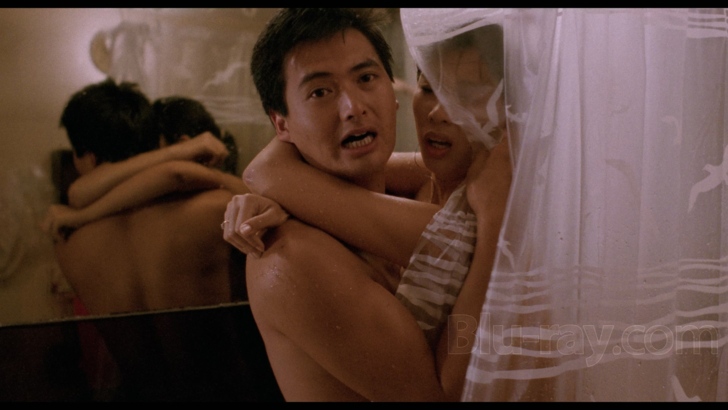
Chow Yun Fat demonstrates a wide range of impressive character-acting skills, which are on full display here. He is shown as playful and insolent towards Hung and other women. (He also may be a philanderer.) But he also demonstrates genuine concern to Hung that flying to Hawaii with the shady businessman would not be in her best interest. Chow is also portrayed as sensitive when he is dealing with Lau. In addition, City on Fire demonstrates Chow as an athletic specimen who had to do a lot of running for the chase scenes. The picture's other strength lies in its editing. For example, when the thieves have Forever Jewelry's employees at gunpoint while they try to crack a safe, Lam crosscuts to the escalating chaos outside. The editing has a rhythmic bent that's part of its style. City on Fire is a fast-moving crime drama and one of Hong Kong's bona fide action classics of the '80s.
City on Fire 4K Blu-ray Movie, Video Quality
City on Fire is part of Shout! Studios' new Hong Kong Cinema Classics line. The boutique label's 4K Ultra HD Blu-ray + regular Blu-ray combo is housed with a slipcover featuring vintage theatrical poster art. The 1.85:1 presentation is encoded with Dolby Vision (HDR10 compatible). A 4K scan was done of the original camera negative. This is also a complete 4K restoration of the film. Traces of infinitesimal dust and specks are only evident in a couple places. There's a small tramline over the yellow marquee in Screenshot #29.
When I watched the UHD, the opening nighttime aerial shot of Kowloon (frame grab #31) displays a wide field of heavy grain. This may appear like mosquito noise from my downsampled 1080p capture but I can confirm that this is natural grain when displayed in full 2160p. I compared an identical shot on the standard 1080p Blu-ray, which I upscaled to 4K on my Panasonic player, and the grain doesn't spike as much (see #30). Later in the film when Ko Chow is having a phone conversation with Hung, grain thickened over his black sweater (see #34 on the UHD). (Note: black levels on the downscaled image may look crushed when you click on the screenshot, but I can assure you that there is no crush when playing the video at full resolution.) I then played the standard Blu-ray and the level of grain is about the same as it is on the UHD. There's a nice smattering of grain on both discs along yellow walls in the interior scenes. Grain is more coarse along the white tiles in the morgue where Lau is about to show Ko Chow a body (see capture #13). While grain is resolved better at times on the 1080p disc, the UHD definitely offers the superior visual presentation.
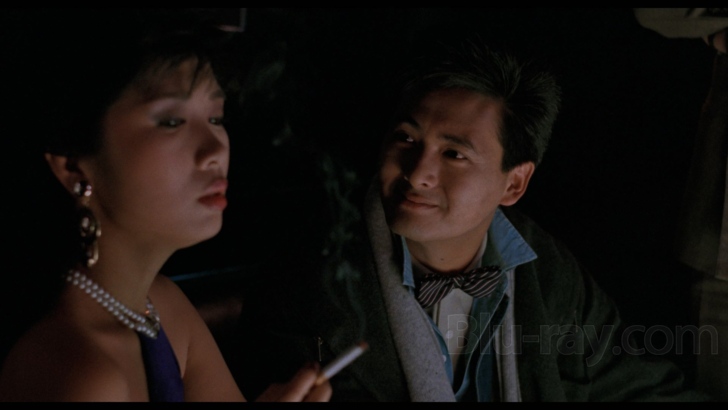
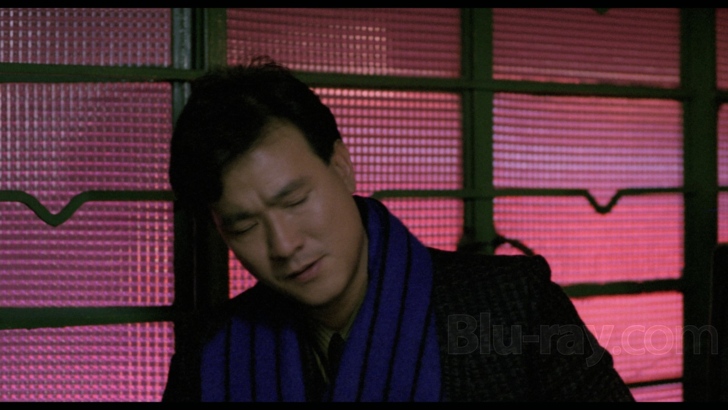
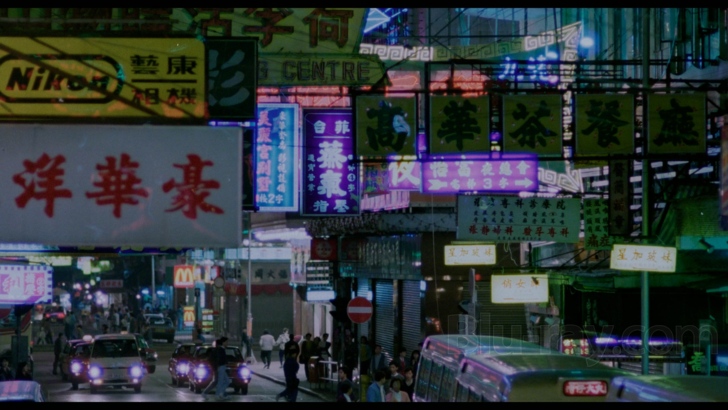
Both transfers do a splendid job of bringing out the fluorescent and neon lights of night life in Kowloon as you'll see in the screenshots I retrieved. In addition, this applies to special light fixtures used for the interiors. Look at the performance lights above and behind Maria Cordero as she sings in #11. Cinematographer Andrew Lau employs hot pink behind Danny Lee in #4. DP Lau reportedly sought a blue tone for much of the shoot. I could see the blue amidst the atmospheric lighting seen in a different room adjacent to where Cordero performs (which even has blue carpet). Also, check out the beautiful semi-dark blue sky behind John Chan in #9. Moreover, Lau employs classic noir lighting techniques. For example, notice the shafts of light entering from between the blinds and onto Ko Chow's face in #25. Black levels are very deep.
Shout! has placed the UHD on a 66.2 GB disc. The feature sports a mean video bitrate of 80.3 Mbps and an overall bitrate of 89.6 Mbps for the whole disc. The standard Blu-ray employs an MPEG-4 AVC codec and carries an average video bitrate of 32000 kbps.
Screenshot #s 1-30, 32, 34, 36, 38, & 40 = Shout! Studios 2025 4K Ultra HD (downscaled to 1080p)
Screenshot #s 31, 33, 35, 37, & 39 = Shout! Studios 2025 Blu-ray BD-50 (from a 4K restoration)
Shout! has given the 105-minute feature ten chapter stops, which you can only skip to on your remote control.
City on Fire 4K Blu-ray Movie, Audio Quality
Shout! has supplied the original Cantonese track, which is encoded as a DTS-HD Master Audio Dual Mono (1621 kbps, 24-bit). It has also provided an English dubbed track with the same audio codec, a DTS-HD MA 2.0 Mono (1578 kbps, 24-bit). The Cantonese track is often quite loud when there is an explosion and when gunshots ring out. Fortunately, it apparently hasn't undergone any EQing. I found all spoken words audible and intelligible. I did hear a reverb in the morgue scene where Inspector Lau and Ko Chow talk to each other. Footsteps sound crisp and finely accented. The saxophone reaches a high pitch during the opening scene and other moments in the film. It is performed on both the diegetic and non-diegetic tracks. According to co-authors Hammond and Wilkins from the book I cited, the "Cantorocking themes" are by Maria Cordero. I also heard percussion, a rock guitar, and synths performed on the underscore. They sound pretty dynamic. There are no pops, crackles, or scratchy sounds on the native mix. I also sampled the English dub and it does not feature an alternate score. The ADR that was later added for the English track follows lip movements alright, but the Cantonese monaural mix is undoubtedly the preferred version.
New English subtitles were translated especially for this release. They are clear and legible (e.g., see Screenshot #30.) I didn't spot any egregious grammatical errors.
City on Fire 4K Blu-ray Movie, Special Features and Extras
DISC ONE: 4K Ultra HD
- NEW Audio Commentary with Film Historians Frank Djeng and F.J. Desanto - this feature-length track with Djeng and Desanto contains very few gaps and delivers a pretty enlivening discussion of City on Fire. Djeng remembers seeing it in a theater and his recollections of the audience's reactions to certain moments are pure gems. He's overly familiar with all the filming locales, which he points out to the viewer. Djeng also demonstrates wide knowledge of the movie's principals and supporting players. He met Ringo Lam and shares a few personal anecdotes about the director. In addition, Djeng discusses City on Fire in relation to several of Lam's other works. He compares and contrasts his films with those of John Woo. Djeng proves a superb guide to Hong Kong cinema of the '80s. Desanto makes some fine observations if his own, but Djeng talks for a majority of the commentary. Both Djeng and Desanto speak in English. Track isn't subtitled.
DISC TWO: Blu-ray
- NEW Audio Commentary with Film Historians Frank Djeng and F.J. Desanto - this feature-length track with Djeng and Desanto contains very few gaps and delivers a pretty enlivening discussion of City on Fire. Djeng remembers seeing it in a theater and his recollections of the audience's reactions to certain moments are pure gems. He's overly familiar with all the filming locales, which he points out to the viewer. Djeng also demonstrates wide knowledge of the movie's principals and supporting players. He met Ringo Lam and shares a few personal anecdotes about the director. In addition, Djeng discusses City on Fire in relation to several of Lam's other works. He compares and contrasts his films with those of John Woo. Djeng proves a superb guide to Hong Kong cinema of the '80s. Desanto makes some fine observations if his own, but Djeng talks for a majority of the commentary. Both Djeng and Desanto speak in English. Track isn't subtitled.
- NEW Burn It Down! – An Interview with Screenwriter Tommy Sham (18:21, 1080p) - an appreciative Tommy Sham (aka Sai-Shing Shum) tells what it means to finally have City on Fire available in a respectable edition on home media. He begins by recounting the writing he did for magazines and newspapers and working with the Shaw Brothers. Sham spends a considerable amount of the interview focusing on City on Fire and Chow Yun Fat's acting career in Hong Kong. Sham recalls the cameo he made in the film and makes reminiscences of his experiences on location. He explains whether or not there were any safety measures taken, particularly when it came to explosions and shattered glass. The most fascinating section in the interview is when Sham distinguishes between the different levels of value accorded to American screenwriters versus scriptwriters working in Hong Kong. Sham draws contrasts between how writers in each country's industry are treated financially and by their peers. In Chinese, with optional English subtitles.
- NEW Hong Kong Confidential – Inside CITY ON FIRE with Author Grady Hendrix (11:30, 1080p) - in this recently produced program by Ballyhoo, Grady Hendrix looks at Ringo Lam's early career as a comedy director, Tsui Hark luring Lam to Cinema City, and how Lam came up with the concept for City on Fire. More, Hendrix discusses actors Chow Yun Fat, Danny Lee, and Carrie Ng. He also explains how the original casting choices were changed. We also learn the risks Lam took of filming City on Fire on location. In English, not subtitled.
- NEW Some Like It Hot: The Cult of Chow Yun Fat and the Hong Kong Kinetic Action Film – An Interview with Film Historian Ric Meyers (33:29, 1080p) - a video essay by author/critic Ric Meyers. He covers the career of Chow Yun Fat in both TV and film through City on Fire. Meyers views Chow's performance as a reflection of the Hong Kong populace and what was going to occur in the region, particularly when the Sino-British Joint Declaration went into full effect in 1997 with Hong Kong's handover to the People's Republic. Meyers discusses the geopolitics happening between China and Hong Kong during this period. Meyers then segues into kung-fu and the actors who have practiced it. He also spends a section of the program on Danny Lee and Ringo Lam. In addition, he has a wide-ranging talk on both vintage and contemporary Hong Kong and Japanese films, including The Tale of Zatoichi (1962). He explains how national cinemas have influenced each other. Meyers also broaches Reservoir Dogs and the cinema-cultural references Quentin Tarantino brought to his debut feature as well as his other films. In English, not subtitled.
- NEW Burning Rivalries: The Influence of Ringo Lam on RESERVOIR DOGS – An Interview with Film Historian Kim Newman (14:03, 1080p) - author, film critic and historian Newman gives a comparative analysis of City on Fire and Reservoir Dogs. He takes out a 1993 issue from Empire magazine and summarizes a short article that draws similarities between the Lam and Tarantino films. Conversely, Newman argues that Reservoir Dogs is quite different in several ways from the picture Lam made five years earlier. Newman opens the subject up to a broader discussion of undercover cop and bundled heist genre films that were produced through various decades in Hollywood, some of which he believes influenced Lam on City on Fire. This is a well-produced piece. In English, not subtitled.
- Theatrical Trailer (3:30, 1080p) - the official Cinema City Productions trailer for City on Fire presented in 1.85:1 anamorphic widescreen. The trailer hasn't been restored as it displays various source-related artifacts. All of the written Cantonese titles are subtitled in English.
- NEW Image Gallery (3:20, 1080p) - a slide show depicting the production and release of City on Fire. The first eight lobby cards, which were promoted for the Asian market, are cool because each one has a large horizontal photograph that's accompanied by a different photo in the inset. The next several images are color snapshots from filming that appear in very good condition (some hairs are present). This is followed by original theatrical poster artwork stills and covers from various DVD editions.
City on Fire 4K Blu-ray Movie, Overall Score and Recommendation
It has been said by film critics that parts of City on Fire (1987) served as a direct model for Quentin Tarantino and his Reservoir Dogs (1992). While Tarantino was influenced by this Ringo Lam film, the two works have stylistic differences that make them distinct in several ways from the other. City on Fire probably anticipates and more resembles cinematographer Andrew Lau's co-directing feature Infernal Affairs (2002). Shout! Studios has delivered excellent picture and sound transfers to go with several in-depth bonus features. It is great to see Tommy Sham give a recent interview! I am hopeful and confident that this will be a harbinger for more great releases from the Hong Kong Cinema Classics imprint. VERY HIGHLY RECOMMENDED and a MUST OWN for fans of Chow Yun Fat.
Similar titles
Similar titles you might also like
Hard Boiled 4K
Lat sau san taam / La shou shen tan / 辣手神探 / Hong Kong Cinema Classics #17 / Includes Bonus BD
1992

Headhunters
Hodejegerne
2011

Shock Wave
拆彈專家 / Caak daan jyun ga
2017

Three
Saam yan hang / 三人行
2016

Firestorm
風暴
2013

The Stool Pigeon
綫人 / Sin yan
2010

A Better Tomorrow II 4K
Ying hung boon sik II / Ying xiong ben se II / 英雄本色II / Hong Kong Cinema Classics #20
1987

Infernal Affairs II
無間道II
2003

Drug War
毒戰
2012

A Company Man
2012

The Tough Ones
Rome Armed to the Teeth / Roma a Mano Armata
1976

Un flic
Dirty Money
1972

Infernal Affairs
無間道 / Mou gaan dou
2002

My Father is a Hero
The Enforcer / 給爸爸的信
1995

Kill Zone 2
殺破狼2 / SPL II: A Time for Consequence / Saat Po Long 2
2015

Infernal Affairs III
無間道III:終極無間
2003

A Better Tomorrow 4K
Ying hung boon sik / Ying xiong ben se / 英雄本色 / Hong Kong Cinema Classics #19
1986

Kill Zone
殺破狼 | SPL: Kill Zone | Saat po long | Ultimate Edition
2005
Dobermann
1997

Zero Woman: Red Handcuffs
0課の女 赤い手錠 / Zeroka no onna: Akai wappa | Standard Edition
1974