Chopin: Piano Concertos Warsaw 2010 Blu-ray Movie
HomeChopin: Piano Concertos Warsaw 2010 Blu-ray Movie 
Accentus | 2010 | 97 min | Not rated | Jan 25, 2011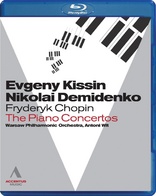

Movie rating
6.8 | / 10 |
Blu-ray rating
| Users |  | 0.0 |
| Reviewer |  | 4.0 |
| Overall | | 4.0 |
Overview
Chopin: Piano Concertos Warsaw 2010 (2010)
An internationally celebrated concert featuring two Russian pianists performing in Warsaw on the 200th anniversary of Chopin's birth.
| Music | 100% |
Specifications
Video
Video codec: MPEG-4 AVC
Video resolution: 1080i
Aspect ratio: 1.78:1
Audio
Music: DTS-HD Master Audio 5.1
Music: LPCM 2.0
Subtitles
None
Discs
25GB Blu-ray Disc
Single disc (1 BD)
Playback
Region free
Review
Rating summary
| Movie | | 4.0 |
| Video | | 4.0 |
| Audio |  | 4.5 |
| Extras | | 0.0 |
| Overall | | 4.0 |
Chopin: Piano Concertos Warsaw 2010 Blu-ray Movie Review
Warsaw celebrates Poland's national composer on the 200th anniversary of his birth.
Reviewed by Jeffrey Kauffman April 12, 2011Chopin often gets pegged, rightly or wrongly, as a composer who was really only at home on smaller canvasses. The common “wisdom” is that Chopin never was really comfortable in the orchestral idiom, and in fact the dearth of large scale material in his oeuvre may indeed support that position. But in terms of competence and facility, his two piano concerti are ample proof that orchestrally speaking he certainly had the compositional goods. While no one would accuse either of his large scale piano works of being overly innovative or even flashy in the orchestration department, they are both completely solid, commanding pieces that have rightly assumed their place in the piano concerto repertoire. Of course the piano solos are daunting and at times incredibly florid, full of the filigreed brilliance for which Chopin became rightly famous in his many smaller pieces for solo piano, but there’s also fine attention paid, albeit often times in a relatively subtle way, to the interaction between the soloist and the accompanying orchestral elements. But as it should be, the piano is front and center in both of these pieces, and each concerto requires a pianist of formidable expertise, not just to handle the technical aspects, but to cull every last drop of emotion from Chopin’s heart on his sleeve writing. Two radically different approaches are taken in this interesting Gala Concert celebrating the bicentenary of Chopin’s birth in 1810.
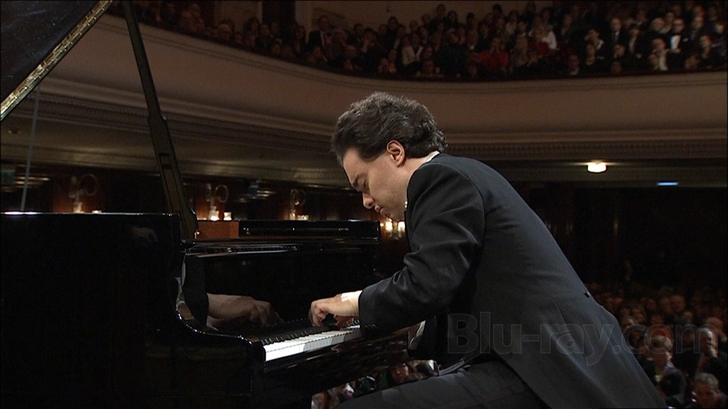
Are two heads better than one? Are four hands more able to handle the intricacies of Chopin’s incredibly difficult writing better than two? That may be the question some listeners may be asking themselves about this Warsaw Philharmonic Orchestra concert which took place on February 27, 2010. Two Russian-born pianists were on hand to tackle the two Chopin concerti. International superstar Evgeny Kissin handled (some would say manhandled) the Second, while his compatriot, though perhaps less spectacularly renowned, elder Nikolai Demidenko took a decidedly more introspective approach to the First. Demidenko may have felt like the ugly stepsister (or brother, as the case may be) in this concert venue. Kissin is such a force of nature and brings with him such an incredible charisma and reputation, that virtually anyone daring to share billing with him is bound to come off as second best.
And in fact the Demidenko performance seems oddly reserved, even restrained, with conductor Antoni Wit seeming almost tentative at times. Demidenko offers none of the fiery flash of Kissin, but that’s not necessarily a bad thing. This is an older man (at least compared to the still baby-faced Kissin), and one who obviously has thought a lot about each note, each phrase, of Chopin’s masterpiece. That inquiring spirit rings through a series of incredible displays of virtuosity, but with none of Kissin’s inherent showiness. But this interpretation of the First comes off as perhaps too introspective for its own good. It’s certainly lovingly approached, and there is fine attention paid to phrasing and detail, with wonderful nuances coaxed out of virtually each and every ornamentation which Chopin offers at seemingly every turn. It’s only too apparent the Warsaw audience feels the same way; reaction at the end is polite, but not enthusiastic, especially when compared to the accolades Kissin receives, which brings him back for not one, but two, encores. (Demidenko provides a quick accounting of the Mazurka in A minor as his only extra performance).
What can one say about Evgeny Kissin? This is a wunderkind who simply blasts his way through material as if nothing is going to stop him. Utterly and undeniably commanding at the keyboard, his placid demeanor cloaks a fierce pianism which is perfectly suited to Chopin’s nonstop demands. This formidable approach might lead some to believe there’s a lack of nuance in Kissin’s interpretations, but that is more often than not decidedly not the case. Kissin doesn’t linger and dote the way Demidenko does, make no mistake. But at the same time there is an impeccable intelligence behind his playing which, while still full of the vigor and gloss of youth, still manages to dig beneath the surface sheen of this unbelievable onslaught of notes to deliver some real musical meaning.
The crowd simply erupts in approval at Kissin’s account of the Second, and one has to wonder what Demidenko was wondering back in the Green Room. Nonetheless, the audience won’t let Kissin go, even after a positively blistering account of the Etude in C minor (Revolutionary). It’s unclear from the viewpoint given on this Blu-ray whether Kissin was riding the pedal a bit too enthusiastically or if the concert Steinway’s sound simply bled a bit too much, but that ferocious left hand which has been the figurative death of many a pianist devolves into some pretty serious murkiness at times, perhaps also due to Kissin’s totally insane speed through the piece. One way or the other, the audience is enthralled and calls him back for yet another encore, this time the posthumous Waltz in E minor.
This fascinating study in contrasts actually only proves how elastic Chopin's music really is. Both approaches seem suitable when taken on their own; it's really only in having them slam up against each other in one evening that may cause some consternation in some listeners. Antoni Wit keeps a firm grasp on the Warsaw Philharmonic Orchestra throughout both of these pieces, though for my money, the playing is much more robust in the Second, perhaps simply due to the excitement generated by Kissin himself.
Chopin: Piano Concertos Warsaw 2010 Blu-ray Movie, Video Quality
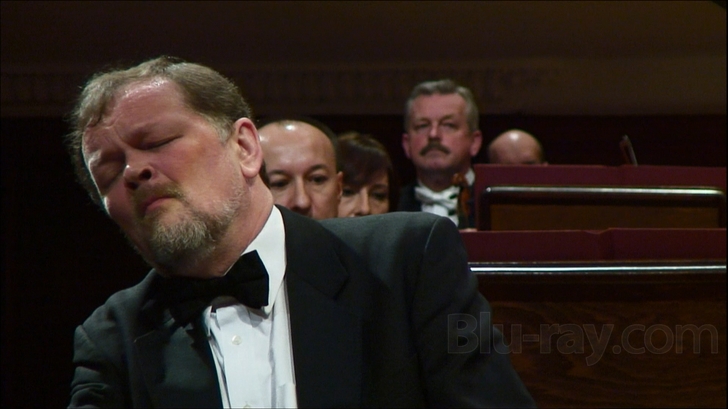
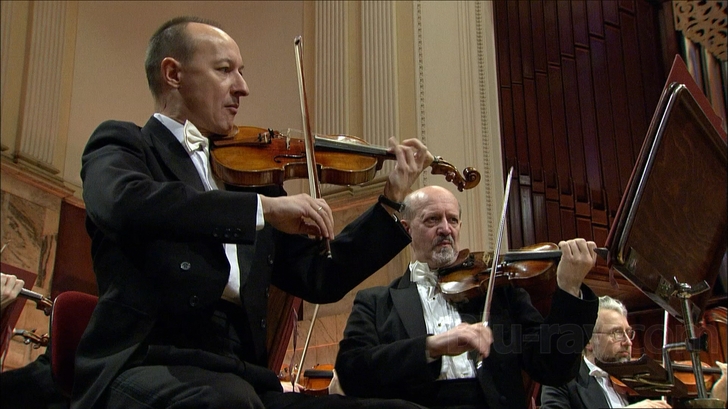
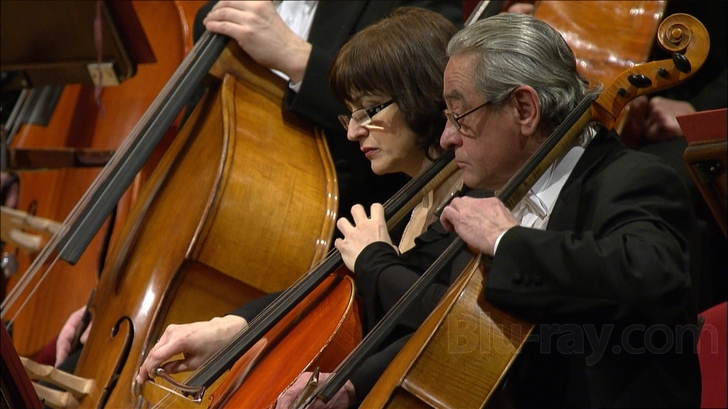
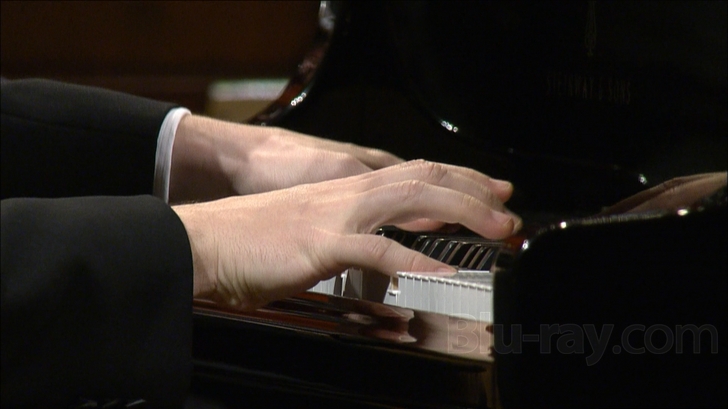
Fryderyk Chopin: The Piano Concertos debuts on Blu-ray courtesy of Accentus Music, with an AVC encoded 1080i transfer in 1.78:1. This is a nicely detailed and beautifully saturated presentation that offers excellent coverage of the orchestra and artists, with a couple of kind of funny exceptions. The multi-camera setup captures a wealth of detail all over the place, from stray dust mites flying out from Wit's tuxedo when he waves his arms, to what appears to be a missing pixel on one of the high definition cameras. What's odd is that evidently one of the cameras is placed with the first violins in order to capture an upstage view of the piano soloists. Unfortunately whoever is sitting next to this camera positions their violin repeatedly so that the scroll intrudes on the image. It's a momentary annoyance but argues to some perhaps unclear planning. Overall, however, this is a very sharp looking Blu-ray, one which offers some spectacular close-ups of fingers flying over the ivories, as well as solid and well edited accounts of the various sections of the orchestra.
Chopin: Piano Concertos Warsaw 2010 Blu-ray Movie, Audio Quality
Fryderyk Chopin: The Piano Concertos is offered with two generally excellent sounding lossless tracks, a DTS-HD Master Audio 5.1 mix and an LPCM 2.0 stereo fold down. It's hard to separate what may be interpretive issues from the actual sound of the recordings at time. The First Concerto sounds almost muffled at times, with a quieter and strangely subdued orchestra. Fidelity is fine, but dynamic range is notably more narrow than on the Second. Things change rather spectacularly for the better with the advent of the Second and the arrival of Kissin. Suddenly the orchestra is on fire, and the whole sound of the DTS-HD Master Audio 5.1 mix comes fully alive. The piano sounds excellent for about 99.9% of these performance, with a brilliantly ringing tone that never devolves into brittleness or an overly tinny sound. The one big problem was the murkiness revealed in Kissin's performance of The Revolutionary Etude. As mentioned above, it's not clear from the camera coverage whether he's simply using the pedal too much, his speed is simply too fast for the sound to waft properly, allowing each note to be heard, or if in fact the hall ambience simply can't handle the concert Steinway grand, but the left hand becomes a muddle in this piece, which is a bit sad considering the fact that Kissin gives the piece such an amazing performance.
Chopin: Piano Concertos Warsaw 2010 Blu-ray Movie, Special Features and Extras
No supplements other than Trailers for other Accentus Blu-rays are included on the disc itself. The insert booklet offers background on each Concerto as well as biographies of the two pianists, conductor Wit and the Warsaw Philharmonic Orchestra.
Chopin: Piano Concertos Warsaw 2010 Blu-ray Movie, Overall Score and Recommendation
Musicologists have come to the conclusion that the two Chopin Piano Concertos were written at more or less the same time, and that in fact the one we call the Second was probably written first. The two share a certain emotional similarity and both utilize elements of Polish folkmusic. What becomes fascinatingly clear in this Blu-ray is how different the two concerti can sound when played by pianists of radically different temperaments. The First here sounds like a deliberately meditative journey on a decidedly inner pathway, while the Second is all fireworks and the exuberance of youth and outward displays of emotion. You may in fact not like one of these approaches, depending on your personal preferences, but the contrasts here are part of what make this such an enjoyable concert. Recommended.