Chinese Portrait Blu-ray Movie
HomeChinese Portrait Blu-ray Movie 
我的镜头Cinema Guild | 2018 | 79 min | Not rated | Sep 29, 2020
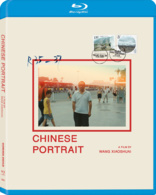
Price
List price:Listed on Amazon marketplace

Movie rating
Movie has not been rated yetBlu-ray rating
| Users |  | 0.0 |
| Reviewer |  | 3.5 |
| Overall | | 3.5 |
Overview
Chinese Portrait (2018)
Factory and construction workers, farmers, commuters, miners, students. The director captures the state of his nation, by static filming one or more people in more or less motionless poses. No narrative, just portraits.
Starring: Xiaoshuai WangDirector: Xiaoshuai Wang
| Foreign | 100% |
| Documentary | Insignificant |
Specifications
Video
Video codec: MPEG-4 AVC
Video resolution: 1080p
Aspect ratio: 1.78:1, 1.33:1
Original aspect ratio: 1.78:1, 1.33:1
Audio
Mandarin: DTS-HD Master Audio 5.1
Mandarin: LPCM 2.0
Subtitles
None
Discs
Blu-ray Disc
Single disc (1 BD)
Playback
Region free
Review
Rating summary
| Movie |  | 4.0 |
| Video | | 4.0 |
| Audio | | 4.0 |
| Extras |  | 2.0 |
| Overall | | 3.5 |
Chinese Portrait Blu-ray Movie Review
Reviewed by Dr. Stephen Larson February 22, 2022Wang Xiaoshuai is one of the leading directors of China’s Sixth Generation (born 1961-1970) along with Jia Zhangke, Jiang Wen, Wang Chao, Wang Guangli, and several others. Like his contemporaries and predecessors, Wang has faced strict censorship guidelines producing and distributing his films at home. That hasn't prevented his films from enjoying significant success along the international film festival circuit where they've won many prizes. I've only seen his Shanghai Dreams (2005) prior to watching Chinese Portrait (2018). The latter is his first solo documentary and eleventh feature overall.
The movie's Chinese title translates as "My Lens." Wang and four cinematographers spent nearly a decade traveling across mainland China to film as many people and locations as they could. In her Variety review of Chinese Portrait, Berenice Reynaud noted that Wang and his camera crew filmed in the eastern cities (Beijing and Shanghai), the northwestern areas (including the Qinhai province populated by Tibetans), and the Ningxia Hui Autonomous Region (home of Muslim people of the Hui minority). The movie deftly contrasts agrarian with urban life to show how lifestyles have changed in the last ten years.
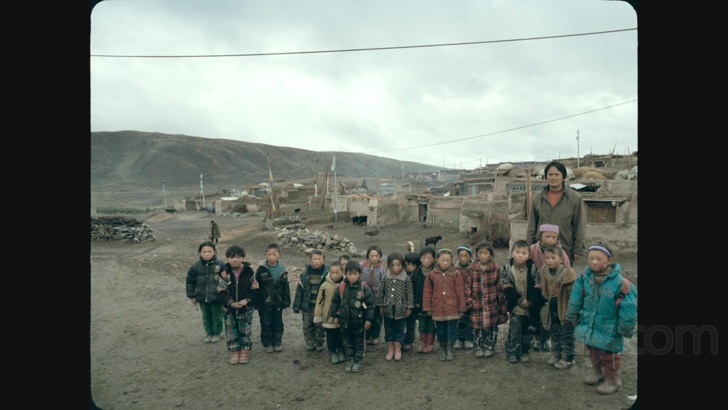
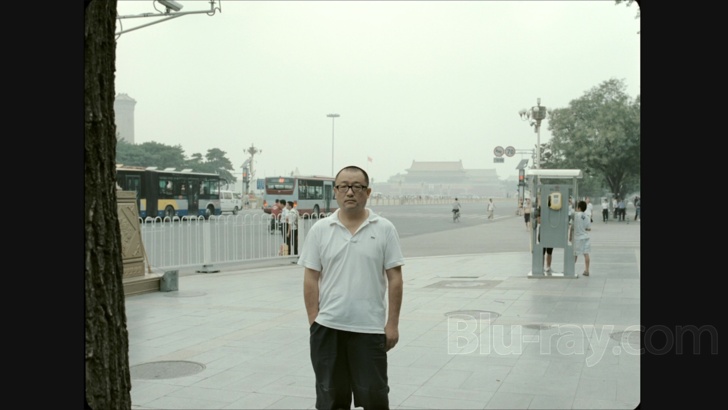
Chinese Portrait doesn't have a narrative or central story. It's comprised of seventy-some shots of stand-alone "scenes" that stick out as tableau vivants in motion. Wang has described his documentary as a "moving painting." He was trained as a painter (thanks to his father's urging) and hired contemporary artist Liu Xiaodong as a visual consultant for this doc and several of his features. Screenshot #8 shows Liu painting by a group of girls in a province that suffered an earthquake. Wang later graduated from the Beijing Film Academy in 1989, the same year the student protests and tumult occurred in Tiananmen Square where Wang poses in front of for this doc (capture #4).
Wang combines techniques from cinema, painting, and photography. Wang often asked persons who agreed to be filmed to hold still while others, such as passersby, go about their daily lives. Wang is said to be influenced by Andrei Tarkovsky and this is certainly the case with the way he holds the takes for extended periods. This compels the viewer to study and contemplate the filmed subjects, landscapes, and other details in the frame. The one shot that best emblematizes the dialectic between stasis and movement is a long shot of Wang standing in the back of a train where he poses for the camera while holding a cigarette. Wang hardly budges from his position while the viewer sees the train moving along the track. Wang seems to be saying that certain inhabitants remain frozen in time and space because they will continue to perform the same job and do what they'll always been doing.
Chinese Portrait Blu-ray Movie, Video Quality
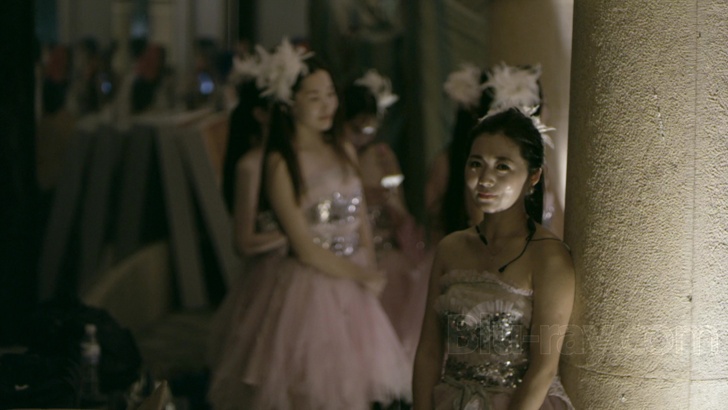
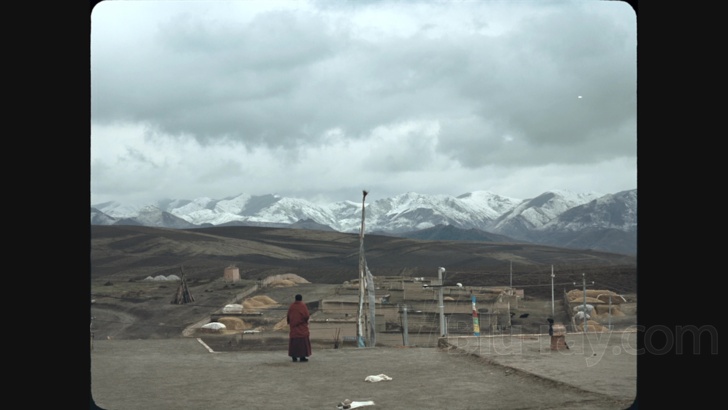
The Cinema Guild has brought Chinese Portrait to US Blu-ray on this MPEG-4 AVC-encoded BD-25. The picture was shot on both 16mm and DV. The celluloid shots are composed in 1.33:1 while the HD compositions are displayed in 1.78:1. The 4:3 shots have rounded corners giving it an old-fashioned look. They're also fuzzier. This was done on purpose since Wang wanted to reference cinema's origins and its pro-filmic qualities. When a take concludes, there's a flash and the image goes black. The 16:9 shots appear clearer and sharper. C.G. has encoded the documentary at a mean video bitrate of 29316 kbps.
The Cinema Guild has divided the 79-minute feature into twelve scenes, which are accessible via the thumbnails on the menu.
Chinese Portrait Blu-ray Movie, Audio Quality
Cinema Guild has supplied a DTS-HD Master Audio 5.1 Surround track (3667 kbps, 24-bit) and an LPCM Audio 2.0 Stereo (2304 kbps, 24-bit). There's little to no dialogue, only background chatter. The doc also lacks a non-diegetic score, although some music plays in individual shots. French editor Valérie Loiseleux also served as a sound designer. She skillfully layers the sound track with car horns, traffic noise, and cars passing by for scenes in urban spaces. Rural scenes are appropriately more tranquil.
There are no subtitles or closed captions.
Chinese Portrait Blu-ray Movie, Special Features and Extras
- Interview with Director Wang Xiaoshuai (26:59, 1080i) - this exclusive Cinema Guild interview with Wang is divided into the following sections: "Genesis," "Portraiture," "Portrait as a Mirror," "Pure Film," and "Chinese Portrait 2?" The questions are delivered in Mandarin as are Wang's answers. They've been subtitled into English. Tom Sveen composed the questions. Liu Xuan conducted the interview.
- Theatrical Trailer (2:10, 1080p) - Cinema Guild's official trailer for Chinese Portrait narrated by Wang Xiaoshuai. Wang asks questions to viewers who will presumably see his documentary. Unlike the film, the trailer contains musical underscore. Wang speaks in Mandarin, which is subtitled in English.
- Bonus Previews - When users click on "Also From Cinema Guild," they'll find posters (thumbnail size) for (from left to right):I Was at Home, But..., Liberté, Sunless Shadows, End of the Century, Milford Graves Full Mantis, El Mar La Mar, Hale County This Morning, and The Wild Pear Tree. When selected, a white border is highlighted in white and the trailer can be played for each respective title.
- Essay by Film Scholar Bérénice Reynaud - enclosed in the keep case is a four-page leaflet with some stills from Chinese Portrait and a highly detailed analysis of this documentary, Wang Xiaoshuai's career, and frequent collaborator Liu Xiaodong. Bérénice Reynaud's essay is an expanded version of her Variety review. The text is printed in a small font but it's readable (at least to my eyes).
Chinese Portrait Blu-ray Movie, Overall Score and Recommendation
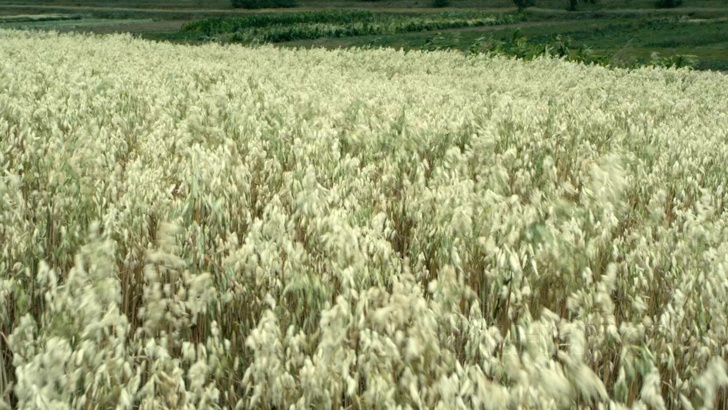
Chinese Portrait is a fascinating capsule of cultural life in China from 2009-2018. Wang Xiaoshuai subtly advances the art of documentary by combining painting and photographic techniques with mostly static film images. The movie doesn't contain any narration or a main story. Watching the immobile camera capture around seventy single-take "scenes" requires patience, endurance, and reflection. The Cinema Guild has delivered a fine transfer faithful to Wang's carefully composed images to go with a mostly quiet sound track. The interview with Wang is deeply informative as is Bérénice Reynaud's essay printed in the leaflet (it's also especially insightful). A SOLID RECOMMENDATION for fans of Asian cinema.