Children of the Night Blu-ray Movie
HomeChildren of the Night Blu-ray Movie 
LimboArtsploitation Films | 2014 | 105 min | Not rated | Sep 29, 2015
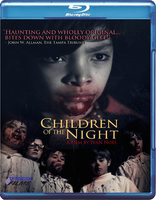
Price
List price:Listed on Amazon marketplace

Movie rating
6.4 | / 10 |
Blu-ray rating
| Users |  | 0.0 |
| Reviewer |  | 3.0 |
| Overall | | 3.0 |
Overview
Children of the Night (2014)
A secluded colony of child vampires come under attack from vengeful villagers in this darkly funny horror tale by Argentinean filmmaker Ivan Noel. A journalist visits a secluded orphanage where children suffer from an unknown skin disease. She soon learns that they are in fact not children, but vampires aging from 4 to 120 years old and who have been bitten at an early age and forever remain in that physical state. They are led and protected by a strange and deeply religious ex-nurse whose destiny in life is to find these ‘lost souls’ and raise them in her sanctuary. Through religious teachings, nocturnal rituals and the occasional visit to local towns for fresh human blood, she keeps them safe - that is until a cultish band of men from a nearby village plot to destroy the refuge. Now the children, headed by the 90-year-old grandson of Count Dracula, must defend their way of life.
Starring: Ana María Giunta, Toto Muñoz, Sabrina Ramos, Lauro VeronDirector: Iván Noel
| Horror | 100% |
| Foreign | Insignificant |
Specifications
Video
Video codec: MPEG-4 AVC
Video resolution: 1080i
Aspect ratio: 1.78:1
Original aspect ratio: 1.85:1
Audio
Spanish: Dolby Digital 2.0
192 kbps
Subtitles
English, English SDH, French
Discs
Blu-ray Disc
Single disc (1 BD)
Playback
Region free
Review
Rating summary
| Movie | | 3.0 |
| Video |  | 3.5 |
| Audio |  | 2.5 |
| Extras | | 2.5 |
| Overall | | 3.0 |
Children of the Night Blu-ray Movie Review
Reviewed by Dr. Stephen Larson December 23, 2016Since the Twilight series, vampire films have undergone a resurgence, which has not only been limited to primarily teen characters. Other
genre entries have been populated with young children such as Tomas Alfredson's Let the Right One In (2008) and Argentinian filmmaker Iván Noel's far lesser known Children of the
Night (2014). In his fifth feature, Noel attempts to peel away and de-mythologize the historical lore of vampirism as well as comment self-
reflexively about the found footage film. Newspaper reporter Alicia (Sabrina Ramos) receives an anonymous e-mail from a woman inviting her to a
secluded orphanage in rural Córdoba in order to do a feature on kids afflicted with a rare blood disorder. She takes the assignment and upon
arriving in the bucolic town, she encounters Siegfried (Toto Muñoz), a mysteriously familiar boy, who takes her to the private school. There she
meets the proprietress Erda (Ana María Giunta), a matronly ex-nurse who has joviality and charm beneath her eccentricities. Erda informs Alicia
that the colony of children have a condition known as Transylvirus, along with hemophilia. Alicia conducts a video ethnography of the schoolmates,
filming their recess activities at night with a mini-DV cam. Gradually, Alicia gets to know more about the kids and how adult vampires killed them
at an early age, which stunted their physical growth and infested their bodies and souls. Alicia learns that while they don't change in appearance,
they are really much older than they look. The Count (Lauro Veron) is not only the leader of the pack but also the central guardian of his species as
well as for Erda.
The orphanage is a protective fortress for the children from the forest's vampire slayers, a ragtag group of older men clad in black who resort to
hunter-gatherer methods to stalk their prey. The adult hunters are led by an Indian chief who wages a philosophical battle with the Count. There
are also two literal battle sequences between the two oppositions that anchor the second and third act. Their main problem is that they suffer from
inconsistencies in tone, partially due to Noel's choice of music cues. Early in his commentary, Noel explains that he composed a theme for the
children tinged with nostalgia, which has qualities of melancholic beauty connected to their lost innocence. When the kids retaliate by fighting back
on their nemesis in the first battle, Noel incorporates some other thematic material that is more ethereal and lighthearted than it is elegiac and
serious. Perhaps Noel was aiming for didactic counterpoint but tonally it backfires. While Noel leaves plenty of room for ambiguity in most of the
characters, the seemingly eternal conflict between the kids and adults is too manichean. I actually felt something for the hunters but the scene's
staging and sound design reflected the wrong mood. In the prelude to the final battle, Noel employs the haunting main theme but inexplicably
brings in a kids' pop song when the schoolmates encircle their aggressors. Noel layers the ballad with dance beats that carry a techno vibe. He
produces a musical anachronism that comes across as fake and anti-climatic.
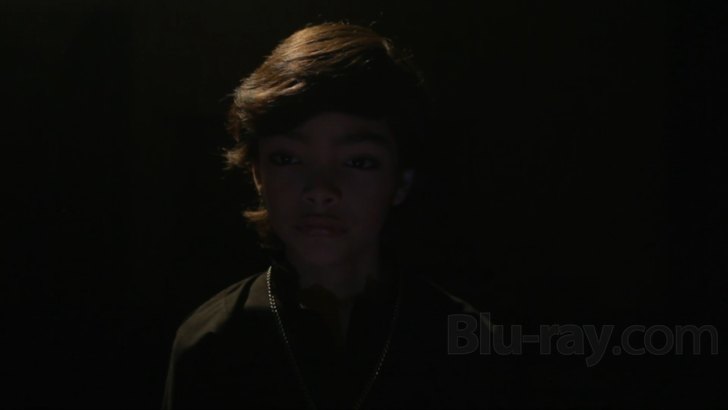
The Count.
Originally, Noel stated that his screenplay and rough cut amounted to two hours and forty minutes, an hour longer than his final cut. He said that characters were sacrificed and subplots shortened in the editing process. Actually, the titular Children of the Night are reasonably well-developed (not all forty-two of them, but Siegfried, the Count, the girl with acne, and some of their friends.) Alicia's boyfriend, however, is disposable and could have been left out altogether. There are also glaring plot holes such as Alicia not checking in with her editor about deadlines and staying with the kids for an uncommonly extended period. It would have been fascinating to see all three endings that Noel originally shot or read excerpts from his script containing scenes that hit the cutting room floor. Overall, the movie has a number of pleasing visuals and is meticulously harshly lit with chiaroscuro and shadows. But it is also unevenly paced and scored which throw it off balance at times.
Children of the Night Blu-ray Movie, Video Quality

Children of the Night appears in an aspect ratio of about 1.78:1 on this AVC-encoded BD-25. The movie was shot on the classic Canon 5D
digital SLR camera and its aesthetics reflect a very low budget. (In his commentary track, Noel divulges that the budget was so tight that they could
not break a coffee cup so instead, they added foley effects in post.) There is considerable hand-held work done by Ramos's character as Noel sought to
capture a Blair Witch-like feel to the roving movements coming from a subjective point-of-view. The transfer is presented at a video frame rate
of 60 fps and the result is moving pictures that progress like an episode from a soap opera in motion. The images can have a smooth look to them
but in other moments they appear like they are derived from an interlaced source. Indeed, the resolution is only 1080i which can explain why
whip/swish pans and quick tilts produce a combing effect. I also noticed some shimmering on the Count's head. (Be sure to watch Screenshot #1 in
motion.)
Despite these drawbacks, this is still a very good transfer for a 1080i presentation. Blacks are particularly deep and boldly rendered in the evening
scenes. Brown water along the river and verdant colors amidst the countryside look stunning (see #s 18, 19, and 20). The faux grain during the
nighttime scenes is not as pronounced on a large tube as it is watching it fairly close on a 19" monitor. The found footage shots (see #11) are meant to
stand out as an amateur videographer's work as they retain stock-like characteristics in their granularity. Noel actually shot most of the movie himself.
Noel also uses a different filter for a flashback scene (see the sideways shot in #10).
Artsploitation has broken up the feature into a dozen chapter stops.
Children of the Night Blu-ray Movie, Audio Quality
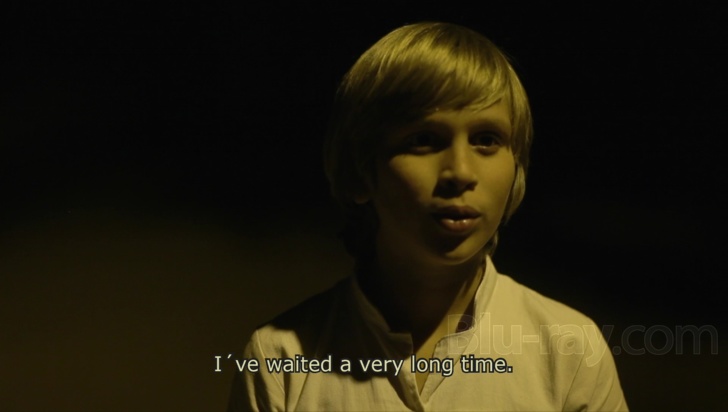
Children of the Night only comes with a Dolby Digital 2.0 Stereo track for the main feature. Encoded at 192 kbps, the lossy mix shows
surprising clarity and precision at the moments the instruments play from Noel's musical score. This is not a heavily active track but the Spanish
dialogue is usually decipherable for native speakers. The fronts show some separation for the action scenes but they would have benefited from a DTS-
HD Master Audio 2.0, at minimum. Given that this is a recent production, there are no source flaws or distortions in the recording to report.
Artsploitation has provided optional English subtitles, English SDH, and French subs.
Children of the Night Blu-ray Movie, Special Features and Extras

- Director's Commentary - a feature-length commentary track by director/writer/producer/composer/cinematographer Iván Noel. The Argentine speaks very fluent English and delivers nice insights into the choice of instruments for his score and working with the late Ana María Giunta. There are periodic gaps in his talk but it seems that Noel occasionally watches a given scene in retrospective contemplation before offering his remarks (he is not scripted). During the first ten minutes or so, his voice appears to fade in and out so this may have been a technicality on Artsploitation's part. In English, not subtitled.
- Making of Featurette (22:30, 480i) - a behind-the-scenes mini-doc comprised of audition reels, B-roll footage, production stills, and interview snippets. In Spanish, with some English subtitles and captions to guide the viewer through each segment.
- Trailer (1:25, 1080i) - a subtitled original trailer for Children of the Night.
- Bonus Trailers - Trailers for the Artsploitation titles Der Samurai, Horsehead, House with 100 Eyes, and Reckless. These load after inserting the disc and can be played from the extras menu.
- Easter Egg (2:30, 1080i) - this hidden extra is an extended scene from the communion scene in the film. There is no dialogue or subtitles.
Children of the Night Blu-ray Movie, Overall Score and Recommendation
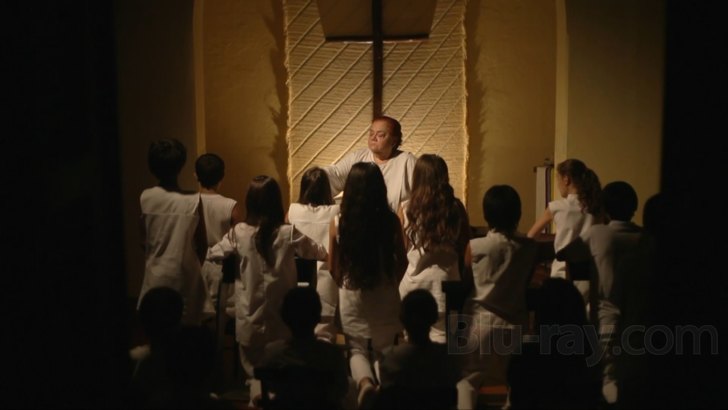
Children of the Night is a beautifully shot and well-lit film but its story loopholes are hampered by an ultra-low budget and inconsistencies in tone. The video presentation is sadly not 1080p but the transfer's primary colors come across very well in this print. The lossy sound track is adequate but leaves room for improvement. The extras contain a fairly informative commentary by Noel and the making-of-doc gives a solid overview of the production. Though stylistically quite different, Noel's movie will appeal to the fan base of Joel Schumacher's The Lost Boys (1987). Its sumptuous visuals help earn it a MILD RECOMMENDATION with qualifiers.
Similar titles
Similar titles you might also like
(Still not reliable for this title)
From Ear to Ear
Les Cousines
1970

Ghost Ambulance
Hantu Ambulance
2008
Kliwon Friday Night
The Night of Kliwon Friday / Malam Jumat Kliwon
1986
Malam Satu Suro
Satu Suro Night
1988
White Crocodile Queen
Ratu Buaya Putih
1988
Obscene Desire
L'osceno desiderio
1978

School of Fear
Il gioko
1993

The Prince of Terror
Il maestro del terrore
1996

The Man Who Wouldn't Die
L'uomo che non voleva morire
1993

Maya
1989

Pandemonium
Limited Edition
2023

Herencia Diabólica
Slipcover in Original Pressing
1993
When Evil Lurks 4K
2023

Cross of the Devil
La Cruz del Diablo
1975
Supernatural
Sobrenatural
1981
Beatriz
1976

The Seventh Grave
1965

Blood Delirium
Delirio di sangue / Slipcover in Original Pressing
1988
F*** the Devil 2: Return of the F***er
1991
F*** the Devil
1990