Charles Mingus: Mingus Moves Blu-ray Movie
HomeCharles Mingus: Mingus Moves Blu-ray Movie 
Quadio Blu-ray AudioRhino Music | 1973 | 50 min | Not rated | Dec 08, 2023

Movie rating
Movie has not been rated yetBlu-ray rating
| Users |  | 0.0 |
| Reviewer |  | 4.0 |
| Overall | | 4.0 |
Overview
Charles Mingus: Mingus Moves (1973)
| Music | 100% |
Specifications
Video
Video codec: MPEG-4 AVC
Video resolution: 1080p
Aspect ratio: 1.78:1
Original aspect ratio: 1.78:1
Audio
English: DTS-HD Master Audio 4.0 (192kHz, 24-bit)
English: DTS-HD Master Audio 2.0 (192kHz, 24-bit)
Subtitles
None
Discs
Blu-ray Disc
Single disc (1 BD)
Playback
Region A (B, C untested)
Review
Rating summary
| Movie | | 4.0 |
| Video | | 0.0 |
| Audio |  | 5.0 |
| Extras | | 0.0 |
| Overall | | 4.0 |
Charles Mingus: Mingus Moves Blu-ray Movie Review
Reviewed by Jeffrey Kauffman December 1, 2023Charles Mingus is one of those names that just resides almost like the black monolith in 2001: A Space Odyssey, an intimidating presence sent to "instruct", at least for those "evolved" enough to
hear. Many jazz fans who justly celebrate Mingus still may tend to think of his heyday as somewhat earlier than this 1973 album, and it's true that
Mingus' own health issues would soon start to weigh heavily on his performance acumen, but for me personally this has always been a hugely
enjoyable album that is both sober and ebullient by turn. This Quadio release also has some of the most enjoyable four channel separation that I've
heard with this recent spate of Rhino releases.
Note: I've been meaning to mention that these Rhino Quadio releases of Warner Music Group offerings reproduce the original look of the LP
labels, so this release for example has the tri-color Atlantic branding. It's a nice little touch for audiophiles.
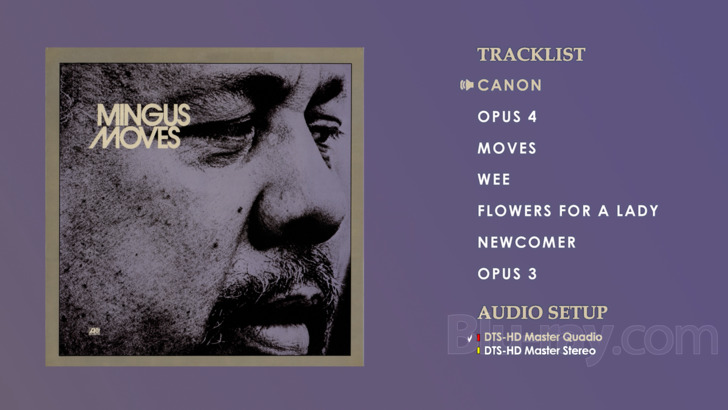
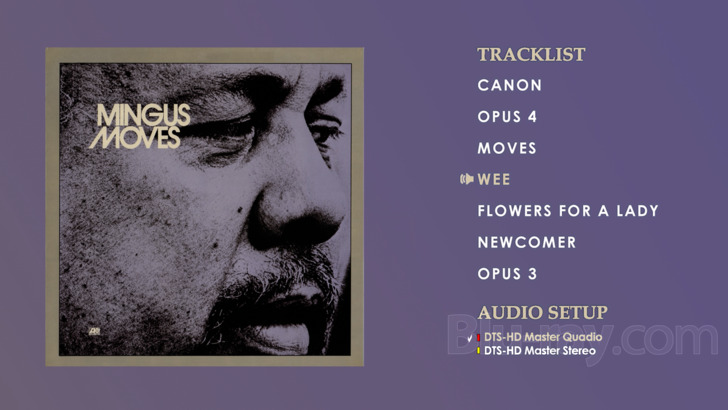
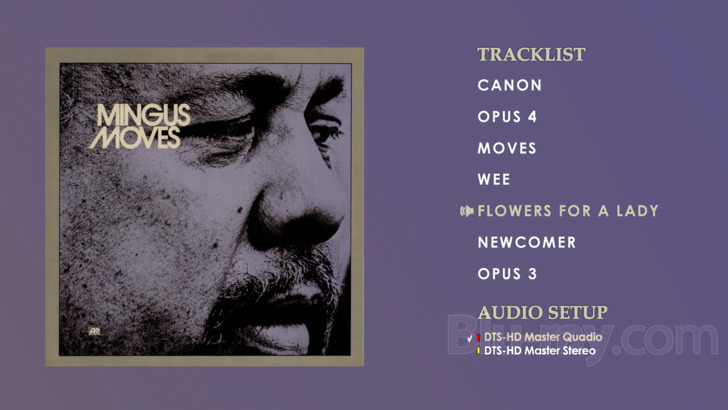
The track list for this album is:
- Canon
- Opus 4
- Moves
- Wee
- Flowers for a Lady
- Newcomer
- Opus 3
Charles Mingus: Mingus Moves Blu-ray Movie, Video Quality
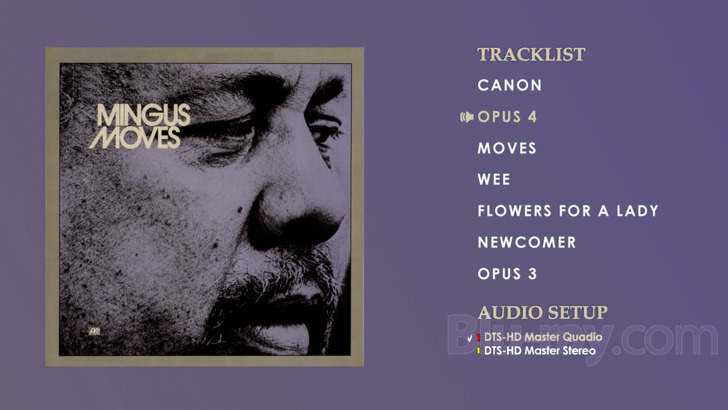
While there is video content here, like most hi-res audio Blu-rays, it's simply a menu, and because this release allows you to use the color buttons on your remote to choose which audio codec (red for DTS-HD Master Audio 4.0, yellow for DTS-HD Master Audio 2.0), you really don't even have to have your display on to enjoy this release. I've heard from several regular readers of my long running hi-res audio Blu-ray reviews that they'd actually prefer (repeated) screenshots of the menu rather than photos of the band, etc., on reviews, so you get seven screenshots of the menu here.
Charles Mingus: Mingus Moves Blu-ray Movie, Audio Quality
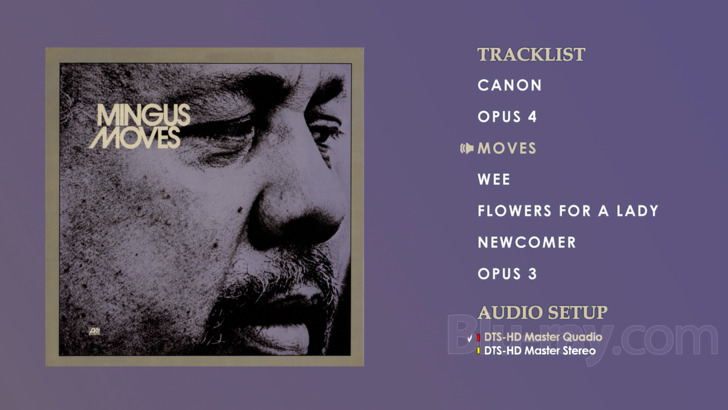
Mingus Moves offers DTS-HD Master Audio 4.0 and DTS-HD Master Audio 2.0 options, and I'm assuming anyone interested in this release is going to want to listen to the quadrophonic version, so the bulk of my comments will focus on that. This has some very noticeable four channel separation, as in the opening of "Canon" where George Adams' tenor sax is relegated to the right rear channel, soon joined by Ronald Hampton's trumpet in the rear left, and then the rest of the band creeping into the front channels. Other moments, like Don Pullen's amazing piano solo in "Opus 4" are splayed between channels. There is some verbiage in the insert booklet that mimics similar information in other 4.0 audio Blu-rays about how to utilize bass management, but I'd say whatever choice your particular system offers, don't expect a surplus of low end emanating from the subwoofer (per design), which is not to suggest that there's any real lack in either the lower midrange or actual lowest frequencies, and Mingus' bass is actually quite prominent throughout.
Charles Mingus: Mingus Moves Blu-ray Movie, Special Features and Extras
Unfortunately there's no bonus content offered here, which includes the omission of the bonus tracks offered on the CD reissue.
Charles Mingus: Mingus Moves Blu-ray Movie, Overall Score and Recommendation
This is an admittedly older and maybe just slightly less athletic sounding Mingus, but the musical content is hugely enjoyable in my estimation. This Rhino quadio release offers some thoughtful four channel separation and excellent fidelity. Recommended.