Carandiru Blu-ray Movie
HomeCarandiru Blu-ray Movie 
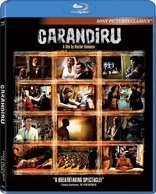
CarandirúSony Pictures | 2003 | 145 min | Rated R | Sep 26, 2023

Movie rating
7.2 | / 10 |
Blu-ray rating
| Users |  | 0.0 |
| Reviewer |  | 3.5 |
| Overall | | 3.5 |
Overview
Carandiru (2003)
Brazilian MD Drauzio Varella starts AIDS prevention in Brazil's largest prison, Carandiru, in São Paulo, where the population is nearly double its 4,000 maximum. Doc learns from experience and mainly stories the tragic stories of hideous crimes which landed scum there and passionate dramas adding otherwise decent people. Just when he believes to leave the prisoners happy with a soccer tournament, a silly clothing line argument kick-starts a politically opportune revolt repression.
Starring: Enrique Diaz, Wagner Moura, Rodrigo Santoro, Milton GonçalvesDirector: Hector Babenco
| Foreign | Uncertain |
| Drama | Uncertain |
| Crime | Uncertain |
Specifications
Video
Video codec: MPEG-4 AVC
Video resolution: 1080p
Aspect ratio: 1.85:1
Original aspect ratio: 1.85:1
Audio
Portuguese: DTS-HD Master Audio 5.1
French: DTS-HD Master Audio 5.1
Spanish: DTS-HD Master Audio 2.0
Subtitles
English SDH, French, Spanish
Discs
Blu-ray Disc
Single disc (1 BD)
Playback
Region A (B, C untested)
Review
Rating summary
| Movie |  | 2.5 |
| Video |  | 4.0 |
| Audio |  | 4.5 |
| Extras | | 2.5 |
| Overall | | 3.5 |
Carandiru Blu-ray Movie Review
Reviewed by Kenneth Brown July 3, 2025Writer/director Héctor Babenco's overly earnest Carandiru is a sticky but disjointed slice of historical melodrama that fails to capture the full scope and tragedy of the 1992 Carandiru Prison massacre in Sao Paulo, Brazil, in which 111 prisoners were killed by 300 police officers raiding an inhumanely overcrowded detention facility. Rather than telling a cohesive story, the film is divided into two parts; the first, the bulk of the film, an episodic introduction to several inmates and the lives they led prior to their imprisonment, and the second, relegated to the third act, a startling recreation of the massacre, interspersed with out-of-place narration and testimonials. It's a tale of two films ironically crammed into too small a space, one that's too limited and restricting to capture the trials of the Carandiru prisoners and the totality of their ordeal, a feat that would have been better served with a multi-season television series.
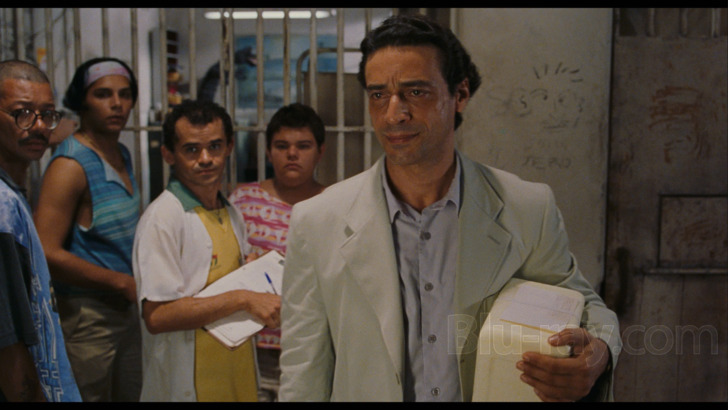
In São Paulo's most infamous of detention centers, Carandiru, the prison population welcomes Dr. Drauzio Varella (Luiz Carlos Vasconcelos), a specialist who comes to the overcrowded facility -- though built for 3,000 inmates, it houses over 7,000 people -- to implement an AIDS-prevention program. But Dr. Varella's enthusiasm is greeted with the stark reality of the conditions within the prison. Cells packed with eight times the men they were built to house, decrepit bathrooms and primitive sleeping areas, a complete lack of medical care, rampant disease and illnesses, zero access to attorneys, terrible mental health, widespread despair and depression, and looming death around every corner and down every hallway. What he's more surprised to discover, though, is a strangely functional community of men, complete with self-imposed law and order, some of whom begin to trust Dr. Varella, opening up about their tragic backstories and telling tales of colorful lives once lived.
-
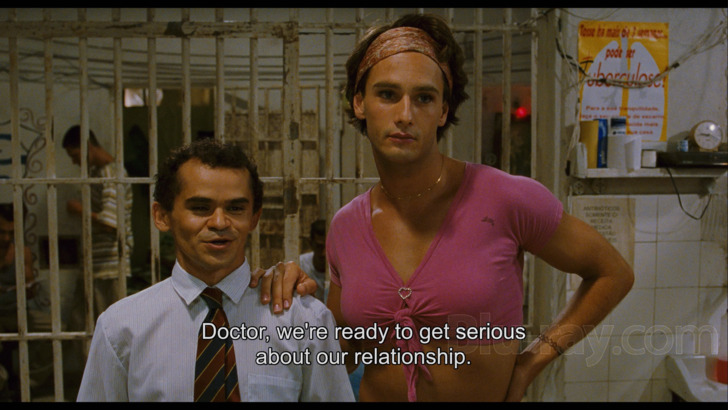
Lady Di: I've come to take the test.
Dr. Varella: Please, take a seat. First, I'd like to ask you a few questions.
Lady Di: I've seen this movie before, doctor. I've never needed a blood transfusion, and I never pierce my
veins. The only drug I use is a joint now and then, when I watch TV... or for a little romance.
Dr. Varella: And partners, how many?
Lady Di: Oh, about 2000.
Despite filling the first two hours of Carandiru with the prisoners' episodic stories (presented via flashback vignettes), Babenco struggles to balance the needs of the few with the demands of the many. Information comes fast and fleetingly, attainable one second then gone the next, bounding between past and present with a ferocity that devotes insufficient time to each character. The result is almost cartoonish in its grandiosity, grasping at straws when a more narrow, human-focused story might have been far more effective. Dr. Varella, meanwhile, is relegated to almost silent observer, soaking up the tales without much insight, context or judgement; begging us to question whether the storytellers are reliable narrators of their own crimes, particularly when they're given so much relativistic absolution. The result is the tale of more than 7,000 prisoners crammed into the life experiences of a dozen, which somehow feels both inadequate and overindulgent. Worse still, the tragedy of the inevitable massacre is (again, somehow) both undermined and over-lit; undermined because it feels like such an after-thought for nearly two hours, over-lit because suddenly it floods into full focus without much to connect it to anything that's come before.
The final half-hour (or so) is dedicated to the police raid and massacre, with Dr. Varella suddenly narrating the events and key prisoners, facing the camera and breaking the fourth wall, to describe the horrors. Though the abrupt switch to docudrama isn't entirely unsuccessful, it is a jarring track-switch that comes with little warning and offers little justification for its inclusion. Rather than allowing the injustice to speak for itself -- a picture is worth a thousand words -- Babenco instead chooses to hammer the obvious, and hammer us over the head as a result. The tragedy is shot with sincere abandon, and the style works wonders, or would, were it not for the constant interruptions from the dear doctor and his new friends. Ah well. What can't be taken away from Carandiru, whatever its faults, is the light it shines on an event that might otherwise disappear into history, forgotten and untold. I can only imagine how much more powerful it might have been had the filmmakers turned their eye to the dangers of a police state, how the cruelty inflicted on those deemed "lesser" reflects on a government's treatment of its larger populous, and the pressure cooker of prison life.
Carandiru Blu-ray Movie, Video Quality
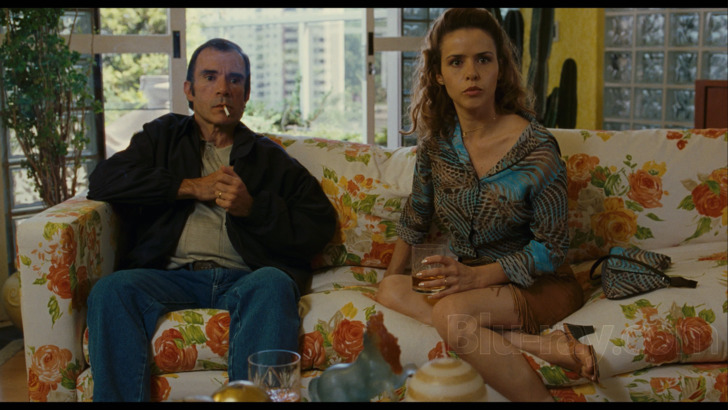
Sony's Blu-ray release of Carandiru features a solid 1080p/AVC-encoded video transfer. Though minted from an older master, the elements hold up quite well, with lovely colors piercing through the decay of the prison, nicely saturated and lifelike skintones, satisfying black levels, and decidedly decent shadow delineation. Detail is revealing as well, with clean, neatly defined edges and exacting fine textures. Grain is present and unobtrusive, though it spikes throughout the third act of the film (a product of the stylized shift in cinematography), and the movie retains a lived-in, filmic appearance that bolsters its tone. I also didn't notice any sign of banding, significant compression artifacts or other anomalies that might interfere with the integrity of the image. Crush occasionally creeps in but rarely, if ever, distracts.
Carandiru Blu-ray Movie, Audio Quality
The highlight of the presentation is Sony's Portuguese-language DTS-HD Master Audio 5.1 surround track. Engaging rear speaker activity creates a convincing space of the prison, with spatial acoustics and environmental ambience enveloping the listener in a dank, believably crowded facility. LFE output is reserved but effective, lending weight when called upon, and dynamics are excellent, with little to nothing left to the imagination. Dialogue is always crisp, intelligible and grounded in the soundscape, and prioritization is spot on, even when things reach a chaotic pitch in the third act, when the fateful massacre comes to fruition.
Carandiru Blu-ray Movie, Special Features and Extras

- Audio Commentary - Writer/director Hector Babenco offers a comprehensive rundown of the production, detailing everything from his and his co-writers' adaptation of Dr. Drauzio Varella's memoir to casting, shooting on location prior to the demolition of the prison, the themes at play throughout the story, and more. He's a bit subdued but it hardly matters. There's a lot of good information to be gleaned.
- Deleted Scenes (SD, 15 minutes) - Seven scenes cut to improve pacing.
- Historical Footage (SD, 9 minutes) - Two videos featuring historical footage of the real prison.
- The Making of Carandiru (SD, 32 minutes) - A decent production documentary.
- Theatrical Trailer
Carandiru Blu-ray Movie, Overall Score and Recommendation
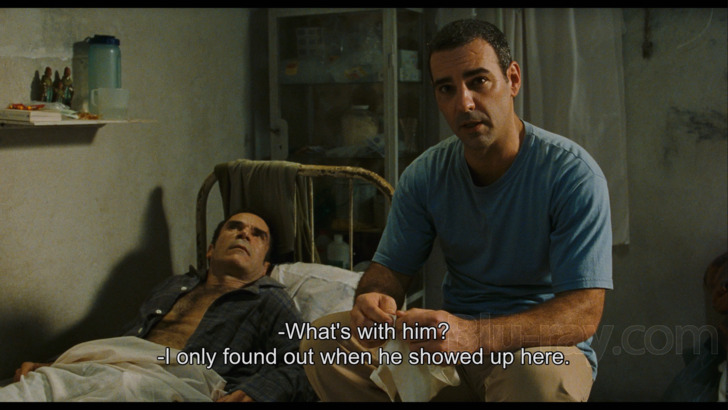
Carandiru offers a startling tragedy wrapped in maudlin melodrama. A shame, considering how powerful the story at the core of the film actually is. Unfortunately, director Hector Babenco tries to bite off more than he can chew, and chew he does, with too many characters, side stories, subplots and tonal incongruities to create a cohesive experience. The final half-hour works and works quite well, but too much baggage weighs it down in stylistic indulgence. Thankfully, Sony's Blu-ray release is much more consistent, with an exceedingly solid video transfer, a strong DTS-HD Master Audio 5.1 surround track, and a number of welcome supplements.
Similar titles
Similar titles you might also like
(Still not reliable for this title)

Scum
1979

A Prophet
Un prophète
2009

Kiss of the Spider Woman
Collector's Edition
1985

Le Trou
1960

Lady Vengeance
Sympathy for Lady Vengeance | Ultimate Revenge Edition | 친절한 금자씨
2005

Corpus Christi
Boże Ciało
2019

The Traitor
Il traditore
2019

In the Fade
Aus dem Nichts
2017
Tsotsi
2005

Female Prisoner Scorpion: Beast Stable
1973

Two Men in Town
Deux hommes dans la ville
1973

Pixote
Pixote: A Lei do Mais Fraco
1980

Berlin Alexanderplatz
1980

L' argent
1983

Pickpocket
1959

Mustang
2015

Capernaum
Capharnaüm
2018
Shoeshine 4K
Sciuscià
1946

Female Prisoner #701: Scorpion
1972

On the Job
2013