Bye Bye Brazil Blu-ray Movie
HomeBye Bye Brazil Blu-ray Movie 
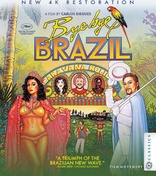
Slipcover in Original PressingFilm Movement | 1980 | 100 min | Not rated | Mar 24, 2026

Movie rating
Movie has not been rated yetBlu-ray rating
| Users |  | 0.0 |
| Reviewer |  | 4.0 |
| Overall | | 4.0 |
Overview
Bye Bye Brazil (1980)
The Caravana Rolidei rolls into town with the Gypsy Lord at the mike: he does magic tricks, the erotic Salomé dances, and the mute Swallow performs feats of strength. A young accordion player is completely enamored of Salomé, and he begs to come along. The Gypsy Lord shrugs, and the accordionist and his pregnant wife, Dasdô, join the troupe. Television is their enemy as they go from the coast deep into the Amazon. Salomé lets the accordion player sleep with her once, with Dasdô's knowledge. He's moon-struck. Then, after Dasdô's baby is born and financial disaster hits the troupe, and the accordionist must choose between seeing his wife a prostitute and leaving the caravan.
Starring: José Wilker, Betty FariaDirector: Carlos Diegues
| Foreign | Uncertain |
| Drama | Uncertain |
Specifications
Video
Video codec: MPEG-4 AVC
Video resolution: 1080p
Aspect ratio: 1.67:1
Original aspect ratio: 1.66:1
Audio
Portuguese: LPCM 2.0 Mono
Subtitles
English
Discs
Blu-ray Disc
Single disc (1 BD)
Playback
Region A (B, C untested)
Review
Rating summary
| Movie | | 4.0 |
| Video |  | 3.5 |
| Audio | | 4.0 |
| Extras |  | 2.0 |
| Overall | | 4.0 |
Bye Bye Brazil Blu-ray Movie Review
Reviewed by Jeffrey Kauffman February 28, 2026The ebullient rhythms of Forró music erupt from the soundtrack of Bye Bye Brasil* virtually from the get go and then continue
to suffuse the film for the rest of its running time, perhaps subliminally suggesting that this is not going to be a Bossa Nova / Samba retread of sounds
heard
in, say, Black Orpheus. And in fact the whole ethos of
Northeastern Brasil, as opposed to the favelas of Rio de Janeiro, are part and parcel of this charming opus which contended for the
Palme d'Or at Cannes in 1980. Bye Bye Brasil is rather Fellini-esque in its emphasis on a traveling troupe of carnival performers, and in fact
it also kind of weirdly may bring to mind Ingmar Bergman's great The
Magician, with head honcho Lord Gypsy (José Wilker) kind of resembling a combo platter of Max Von Sydow from that 1958 classic with
arguably a liberal dose of Coffin Joe.
*Longtime readers of my reviews know I'm a huge fan of Brasilian music, and I honor that nation's own orthography for its preferred spelling, which is
in fact the way it's rendered in the film itself.

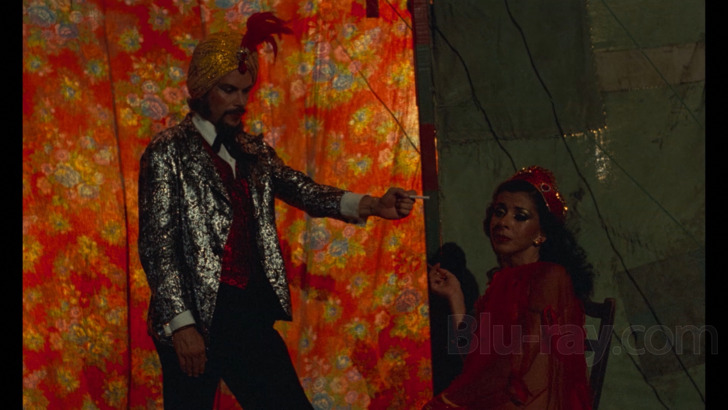
Forró might reasonably be compared to Zydeco in terms of a "regional" music, and as such it's as energetic as Bossa Nova and/or Samba, but perhaps a bit more manic and less suavely sinuous in how it "reaches out and touches" listeners. There's a similarly engagingly loose, ragtag feeling to the tale, with Lord Gypsy and his featured player Salomé (Betty Faria) arriving for their annual performance in a quaint Brasilian village, where their antics catch the eye of local accordion playing busker Ciço (Fábio Jr.), who plays on street corners along with his very pregnant wife Dasdô (Zaira Zambelli) to earn whatever little money they have. (Fábio Jr. is a superbly engaging presence in the film, but he is almost hilariously bad at "finger synching" his supposed accordion playing.) Ciço decides he'd be better off attempting to "run away and join the circus", so to speak, and rather incredibly gives Dasdô the choice of whether or not she wishes to come with him. She does, and the two join the carnival after a bit of initial haggling.
What ensues is a highly distinctive "road trip" as the four focal characters (and soon enough a newborn), along with both carnival "supporting acts" and various natives providing color. There's a bit of a "coming of age" angle to the stories of Dasdô and Ciço, but this is really more of a vignette driven enterprise that centers more on the interrelationships between the performers, and in a way between the performers and their audiences. There are a number of potent socioeconomic critiques offered throughout the story courtesy of the "backwoods" locations where indigenous types are finding the encroachment of "civilization" not redounding to their benefit.
Bye Bye Brazil Blu-ray Movie, Video Quality

Bye Bye Brasil is presented on Blu-ray courtesy of Film Movement's Film Movement Classics imprint with an AVC encoded 1080p transfer in 1.67:1. The front cover announces a "new 4K restoration" with the insert booklet further clarifying the original camera negative was utilized. There's both good news and bad news with regard to this presentation. Detailing is typically great looking, and the palette, while arguably a bit on the brown side at times, is generally very healthy looking and helps to give the film considerable visual interest. Unfortunately it does not look like the negative was especially well curated, and this presentation is liberally littered with (admittedly typically pretty small) nicks, scratches and especially flecks and white specks, all blemishes which are especially noticeable given the prevalence of outdoor material with (supposedly) clear (daytime or nighttime) skies in the background. Grain resolves naturally throughout.
Bye Bye Brazil Blu-ray Movie, Audio Quality
Bye Bye Brasil features a vibrant LPCM 2.0 Mono audio track which supports the film's hugely winning score along with occasional sound effects, ambient environmental background noise, and dialogue. The film's score features a host of fantastic performers, along with a theme co-written by both the great Roberto Menescal and Chico Buarque. Fans of Brasilian music may recognize the charming theme for the film, which became a minor hit. While Menescal's reputation seems to have filtered north pretty well, some may not be that familiar with Chico. Buarque is a fascinating musician in any case and deserves attention from those who might not be that well acquainted with him. Perhaps a bit like the venerable Caymmi clan, Buarque is also related to a host of notables, including his sister Miúcha, who was Joao Gilberto's second wife (after Astrid) and is the mother of the fantastic Bebel Gilberto. This disc features optional English subtitles.
Bye Bye Brazil Blu-ray Movie, Special Features and Extras
- Lucy Barreto (HD; 6:47) is a sweet piece with one of the founders of Barreto Films.
- Making Of (HD; 6:24) has some fun candid footage. This was sourced from what looks like an older interlaced video. Subtitled in English.
- Trailer (HD; 1:24)
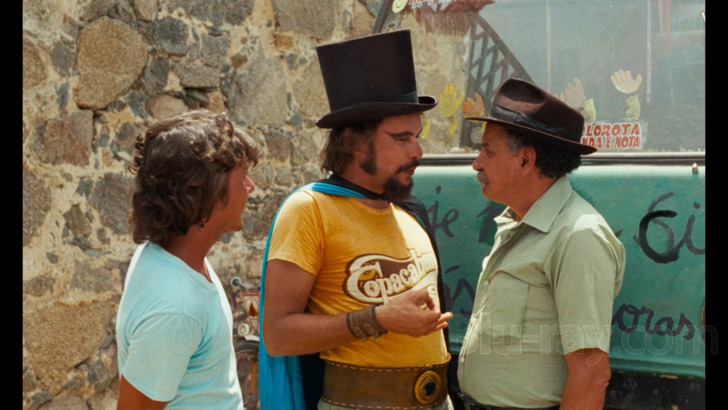
A nicely appointed insert booklet contains an interesting essay by Rafa Sales Ross. The insert sleeve has an inner print that is similar to screenshot 2 accompanying this review. The Vinegar Syndrome exclusive release reportedly has a slipcover, though the review copy sent to me did not.
Bye Bye Brazil Blu-ray Movie, Overall Score and Recommendation

Bye Bye Brasil is perhaps intentionally ironic with its title, one which suggests that the nation was indeed bidding adieu to old ways of life, especially in the interior of the Northeast. Even without any socioeconomic subtext, though, this film provides some genuine emotion and a really viscerally effective look at the life of supposedly "simple" people in an exotic if hardcrabble rural location. Colorful and inventive, and with one of the most enjoyable soundtracks of its era, Bye Bye Brasil is a genuine delight. The restoration here has really not addressed what is surprisingly recurrent (if mostly minor) damage to the element, and may be the one niggling qualm some may have with this release. Otherwise, though, Bye Bye Brasil comes Recommended.