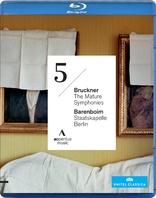
Bruckner: Symphony No. 5 Blu-ray Movie
HomeBruckner: Symphony No. 5 Blu-ray Movie 
The Mature SymphoniesAccentus | 2010 | 77 min | Unrated | Jun 25, 2013
Price
List price:Listed on Amazon marketplace

Movie rating
7.2 | / 10 |
Blu-ray rating
| Users |  | 3.5 |
| Reviewer |  | 4.0 |
| Overall | | 3.6 |
Overview
Bruckner: Symphony No. 5 (2010)
| Music | 100% |
Specifications
Video
Video codec: MPEG-4 AVC
Video resolution: 1080i
Aspect ratio: 1.78:1
Original aspect ratio: 1.78:1
Audio
German: DTS-HD Master Audio 5.1
German: LPCM 2.0
Subtitles
None
Discs
25GB Blu-ray Disc
Single disc (1 BD)
Playback
Region A (B, C untested)
Review
Rating summary
| Movie | | 4.0 |
| Video | | 4.0 |
| Audio |  | 4.5 |
| Extras |  | 0.0 |
| Overall | | 4.0 |
Bruckner: Symphony No. 5 Blu-ray Movie Review
Reviewed by Jeffrey Kauffman June 29, 2013"The structure of Bruckner is classical, almost baroque. Its musical language is late romantic and the ambience and psychology takes you back to the Middle Ages."Years ago when I was being introduced to the sonic world of Anton Bruckner, one of my classical music mentors said, “Bruckner composed with a t-square and slide rule”. It was a perhaps glib recognition of the architectural aspect to Bruckner’s usually rather immense compositional outings, but in another way, it kind of missed the point. For all that supreme planning and execution, Bruckner’s writing often seems inchoate, a mass of competing ideas that seem to exhibit a sonic entropy at times, with motives unspooling and then tending to die on the vine, with moments of bombast suddenly supplanted by long sequences of idyllic languor. I must admit that while I admire Bruckner, I rarely if ever love him in the way I do some of his contemporaries or near contemporaries. Perhaps one of the reasons I have a somewhat “distant” reaction to Bruckner is because of the very aspects alluded to above in that quote by Daniel Barenboim. Take Mahler as a contrasting example. For all of his emotional sturm und drang, sudden shifts of musical intent and innovative structures, you know where you stand with him: he is relentlessly forward looking, to the point that during his lifetime, he was assaulted with critical brickbats by those who couldn’t figure out what the hell he was doing with established musical norms. Bruckner, on the other hand, is a musical Janus—he’s certainly as forward looking in his own way as Mahler, and yet there’s an undeniably “retro” aspect to much of his work. It’s an odd, sometimes discomfiting, dialectic that at the very least takes a little getting used to. Add to this element Bruckner’s sometimes meandering melodic sense, where sequences seem to replace actual flights of song, and there’s a decidedly peculiar aspect to this composer’s oeuvre that can make for very challenging listening.
Case in point: think of any iconic Fifth Symphony in the classical repertoire. Probably the first one that comes to mind is Beethoven’s immortal effort. How does that piece start off? With a stirring pronouncement of one of the most famous motives in the entire history of music, one which Beethoven continues to ply for the rest of the movement, wresting about as much musical content out of it as could possibly be achieved. Mahler himself did much the same thing in his fifth, though perhaps bit more discursively, owing to his less rigorous adherence to traditional sonata form. Perhaps surprisingly, Tchaikovsky takes a somewhat round robin approach, with traditional motives used in sequences that turn things back upon themselves repeatedly. Even a “lesser” known Fifth like Prokofiev’s has a strong opening motivic statement followed by a rigorous development. But Bruckner? Here we get a frankly meandering opening gambit given largely to strings before the first real statement of the unifying major triad motive is finally announced by the brass after about a minute.
This sort of internal tension is indicative of both Bruckner’s questioning spirit as well as more mundane issues the composer was going through as he wrote the piece. Professionally things were not especially lucrative during this period of Bruckner’s often troubled career, and personally he was also encountering difficulties that may have splayed his focus. But here’s where his Fifth Symphony completely defies any expectation that a consciousness fraught with worries might not be able to muster enough concentration to achieve mediocrity, let alone greatness, for Bruckner engages in some of the most insanely baroque counterpoint ever conceived in 19th century musical literature.
Bruckner’s fugal approach is quite different from, say, Bach’s. Bruckner in fact tends to work at times rather like Tchaikovsky, unspooling sequences which float in and out of each other as well as working as a sort of warp and weft where individually presented sequences than interweave with each other in surprising ways. Bruckner does not build melodies in traditional ways throughout this symphony (and in fact in many of his others). Instead we have discrete building blocks which suddenly reveal interconnectedness, as if they’ve magically transformed into Legos (this is a very clumsy analogy, but hopefully imparts some of what makes Bruckner both maddeningly opaque as well as brilliantly compelling).
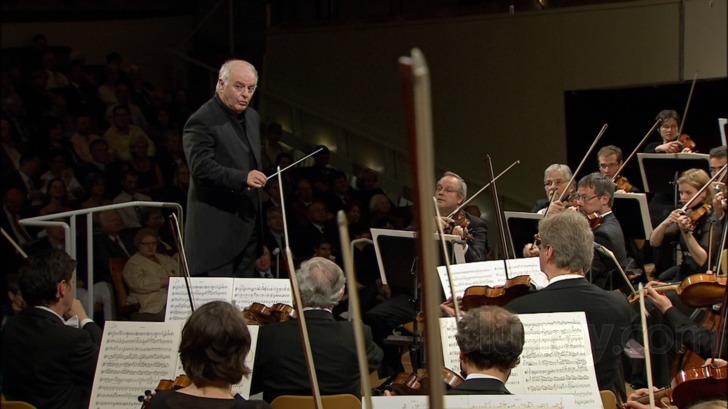
Daniel Barenboim is one of the most experienced Bruckner conductors currently working, with recordings of various Bruckner symphonies dating back decades. He brings a magisterial dimension to this gargantuan piece, carving out huge chunks of sound that collide like slabs of earth being disrupted by seismic movements of the tectonic plates (should that be tec-diatonic plates?). Against these gigantic moments (many of which involve brass), Barenboim also coaxes surprisingly agile sounds out of the strings and especially the winds. In fact some of Bruckner’s astringent wind writing in this symphony is oddly prescient of the so-called “critics’ section” in Richard Strauss’ Ein Heldenleben. Bruckner may well have been a bit depressed when he wrote this symphony, but he wasn’t above taking out the nay sayers before they had even heard this piece.
Bruckner: Symphony No. 5 Blu-ray Movie, Video Quality
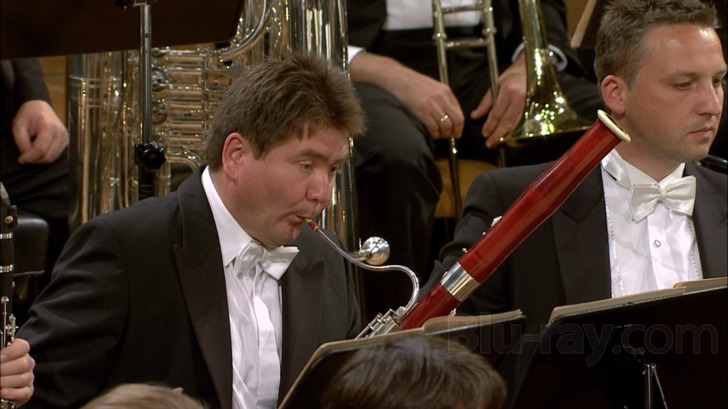
Bruckner; Symphony 5 is presented on Blu-ray courtesy of Unitel Classica and Accentus Music with an AVC encoded 1080i transfer in 1.78:1. This is a rather appealing high definition presentation with admirable fine detail that pops quite vividly in the many close-ups. Colors are fairly well saturated, though skin tones seem just a bit pallid some of the time. The second balcony wide shots appear to be somewhat softer than the bulk of this outing, perhaps due to an inferior camera. Very few if any combing artifacts were noticed, despite the interlaced presentation.
Bruckner: Symphony No. 5 Blu-ray Movie, Audio Quality
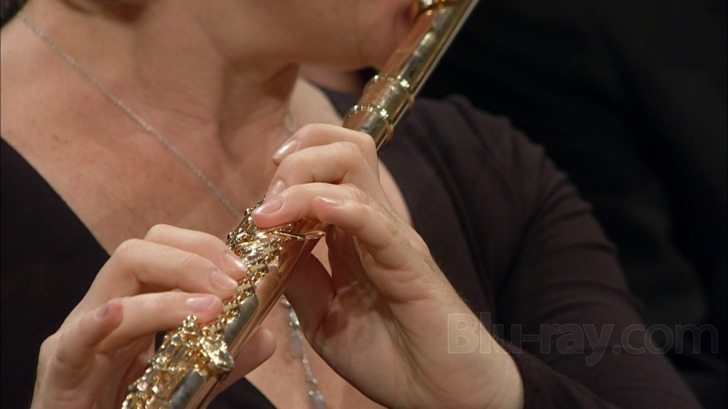
Bruckner; Symphony 5 features both a lossless DTS-HD Master Audio 5.1 mix as well as an uncompressed LPCM 2.0 stereo fold down. Both of these tracks offer exemplary fidelity, though the 5.1 choice obviously provides much greater resonance in the low end that Bruckner exploits so vividly throughout this symphony. The Staatskapelle Berlin sections sound magnificent throughout this performance. Bruckner pits section against section at times like players on opposing teams, and the 5.1 further increases that aspect by widely splaying the soundfield, offering clear separation between instruments on one side of the podium or the other. Dynamic range is extremely wide, capturing everything from the barest orchestral whisper to the thundering tutti that Bruckner employs repeatedly for climaxes.
Bruckner: Symphony No. 5 Blu-ray Movie, Special Features and Extras
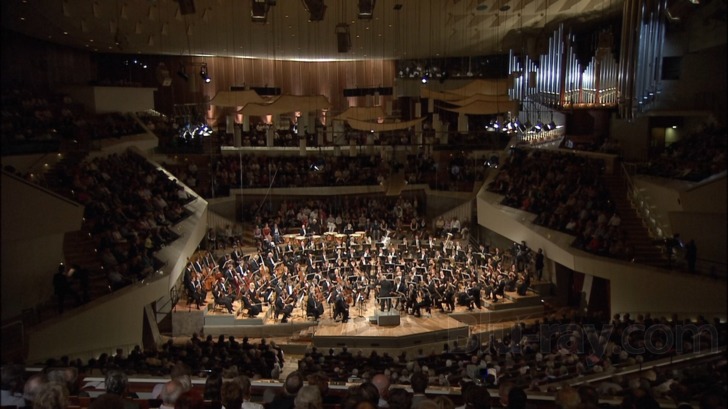
Trailers for other Unitel Classica and Accentus Music releases are the only supplements offered on this Blu-ray disc. I never consider such extras worthy of scoring.
Bruckner: Symphony No. 5 Blu-ray Movie, Overall Score and Recommendation
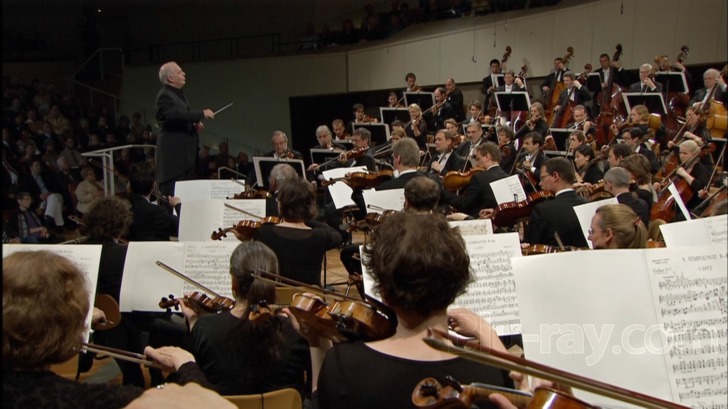
None of Bruckner's symphonies are as instantly inviting as, say, Beethoven's or in fact Mahler's. There's not the immediate melodic imprint that makes those two composers' works viscerally accessible (even if at least one of them might not be particularly to your individual taste). Bruckner's writing is introspective almost to the point of navel gazing, and that means that it often affords no easy entrée into any compelling emotional content. In fact Bruckner is a rather intellectual composer, as my long ago mentor's comments about the mathematical quality of his writing sought to explicate. But hidden within the fifth are veritable thesauruses of meaning, with motives played against each other like metaphors struggling to describe some ineffable aspect of reality. This performance captures the majesty of Bruckner while not shirking from the fact that the composer is an awfully thorny territory to wade in to unprepared. Recommended.