Broken Mile Blu-ray Movie
HomeBroken Mile Blu-ray Movie 
Gravitas Ventures | 2016 | 82 min | Unrated | Aug 15, 2017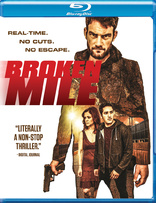
Price
List price:Listed on Amazon marketplace

Movie rating
7 | / 10 |
Blu-ray rating
| Users |  | 0.0 |
| Reviewer |  | 4.0 |
| Overall | | 4.0 |
Overview
Broken Mile (2016)
A man awakens in a woman's apartment, only to find her dead on the sofa. Panicked and desperate, he seeks the aid of a former girlfriend, while the dead woman's boyfriend pursues him seeking answers.
Starring: Francesco Filice, Caleigh Le Grand, Patrick McFadden, Lea LawrynowiczDirector: Justin McConnell
| Drama | Uncertain |
| Crime | Uncertain |
| Thriller | Uncertain |
Specifications
Video
Video codec: MPEG-4 AVC
Video resolution: 1080p
Aspect ratio: 2.34:1
Original aspect ratio: 2.39:1
Audio
English: DTS-HD Master Audio 5.1 (48kHz, 24-bit)
English: Dolby Digital 5.1 (640 kbps)
English: Dolby Digital 2.0 (448 kbps)
Subtitles
English SDH
Discs
Blu-ray Disc
Single disc (1 BD)
Playback
Region A (B, C untested)
Review
Rating summary
| Movie |  | 3.0 |
| Video | | 4.0 |
| Audio |  | 4.5 |
| Extras |  | 5.0 |
| Overall | | 4.0 |
Broken Mile Blu-ray Movie Review
Trauma
Reviewed by Michael Reuben August 17, 2017Toronto-based Justin McConnell is a one-man filmmaking factory. When he's not creating
unique documentaries (Skull World) or
curating his monthly "Little Terrors" festival of horror
shorts from around the world (Minutes Past
Midnight), McConnell writes, produces, directs,
photographs and edits his own shorts and feature films. In his spare time, he does authoring for
DVDs and Blu-rays of both his own work and that of others. Indeed, it would be hard to identify
a role in the creation of filmed entertainment that McConnell hasn't undertaken, with the notable
exception of appearing in front of the camera. That part he leaves to actors, although he does
make a cameo as the voice of a 911 operator in his latest feature, Broken Mile.
Originally titled "One Shot Kills", Broken Mile grew out of McConnell's frustration with stalled
efforts to raise funds for other projects. Instead, he conceived a script that could be shot on a
micro-budget using a minimal cast, a small crew and locations in and around his own Toronto
neighborhood. The film's "high concept" is that it plays out in real time in what appears to be a
single take lasting 80 minutes. In fact, Broken Mile has been stitched together from individual
scenes separately rehearsed and shot (and sometimes reshot), with the edits neatly concealed.
Still, even split into small segments, the film was a logistical nightmare, with takes lasting as
long as 19 minutes that required extensive rehearsal to choreograph the movements of cast and
crew. The film was shot in true guerilla style, with the company braving uncontrolled traffic,
locations open to the public and inclement weather—and it all creates a sense of immediacy that
recalls such bold experiments as Mike Figgis' Timecode.
McConnell has created a terrific Blu-ray for Broken Mile, loaded with a wealth of extras that puts
many studio releases to shame. Unfortunately, too many collectors are likely to pass on the
disc, because it is being released as a burned BD-R. When I asked McConnell about his selection
of media, he responded with a detailed analysis of the economic constraints that make such
choices necessary. With the filmmaker's permission, I have reproduced his informative
presentation in the Video section below.
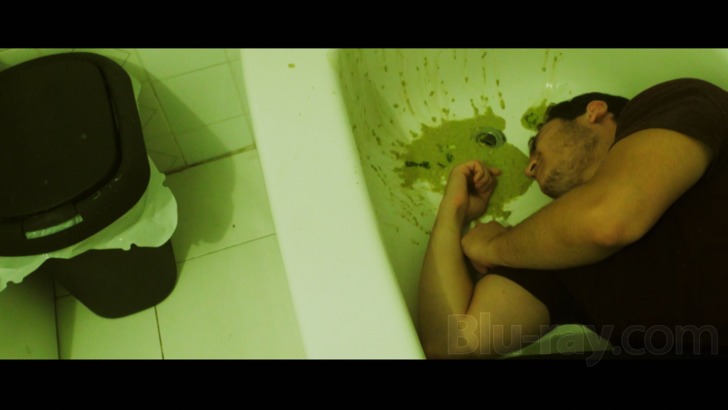
As Broken Mile opens, Shaun (Francesco Filice) awakens in an apartment bathtub from what is presumably a drug- or alcohol-induced stupor, only to find the apartment's occupant, Sarah (Lea Lawrynowicz), dead on her sofa. She appears to have committed suicide, and Shaun panics for reasons (other than the obvious) that are not fully explained until later in the film. After dialing 911 and hanging up without reporting the death, Sean calls his former girlfriend, Amy (Caleigh Le Grand), and she reluctantly agrees to see him. As he departs Sarah's apartment for Amy's place, Shaun unexpectedly encounters his friend, Kenny (Patrick McFadden), from whom he flees like someone guilty of a crime. Shaun spends the rest of the evening alternately begging for Amy's help and evading pursuit by Kenny, who is shortly revealed to be armed with a pistol.
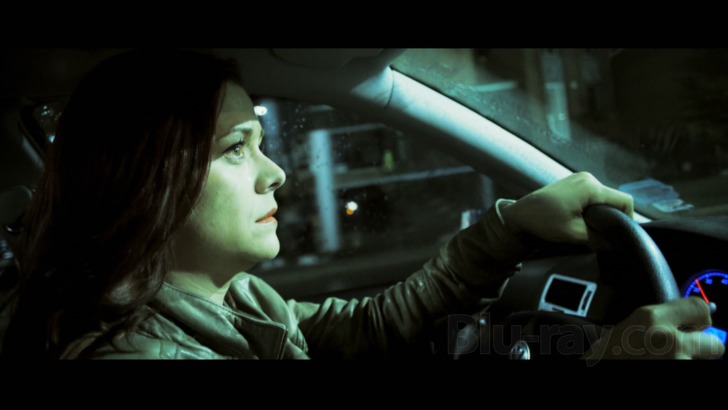
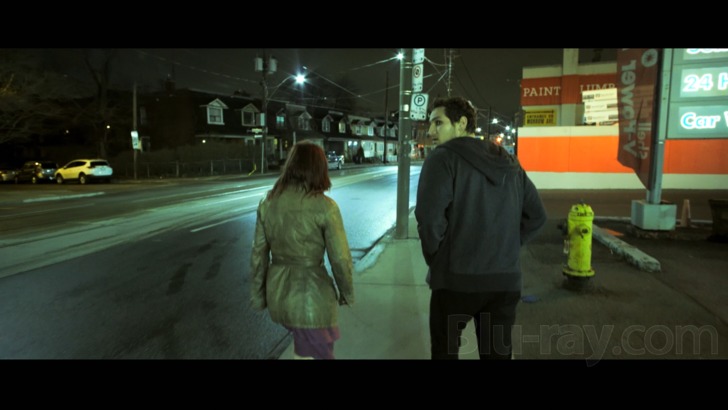
Little more can be said about these characters without spoiling McConnell's narrative strategy, which is to stick closely to first one person, then another, then two, then eventually all three, as relationships are clarified and the facts of Sarah's death emerge. Characters stride through the lobbies and corridors of apartment buildings, wander down rainy city streets, stop in a café for a drink and ride in cars listening to an ominous radio broadcast. All the while, McConnell's camera scrutinizes them intensely against a dark and spooky background.
By its very nature, Broken Mile is filled with lengthy passages in which someone is traveling from point A to point B, and the director's greatest challenge is to inject visual interest and narrative intrigue into these sequences, as each builds to the next encounter. Some of McConnell's strategies work better than others. When Shaun's garrulous Uber driver prattles on about a youthful encounter with the police, the camera remains fixed on Shaun's stricken face as the driver's innocent tale intensifies his dread. It's a device worthy of Hitchcock. The repeated return calls from 911 are unnerving, as is the honking car that trails Amy as she drives to her meeting with Shaun. Other tricks are less effective, such as the repeated climbs up the flights of stairs to Amy's apartment, which aren't sufficiently differentiated by the fact that it's different people making the trip each time. Of course, when characters do meet and converse (or, more often, argue), there's inherent drama in their exchanges, especially as the possibility of violence looms.
As far back as Hitchcock's Rope, single-take films have always felt like a gimmick, but the gimmick becomes part of the entertainment. With the advent of lightweight digital cameras and miniaturized portable tripods, filmmakers can take their real-time stories to places that were previously unthinkable, and they can achieve a voyeuristic intimacy that Hitchcock could only imagine. Broken Mile isn't a perfect film, but it's engaging and provocative. Above all, it's a shining example of just how much can be accomplished with minimal expenditure but a lot of imagination and hard work.
Broken Mile Blu-ray Movie, Video Quality
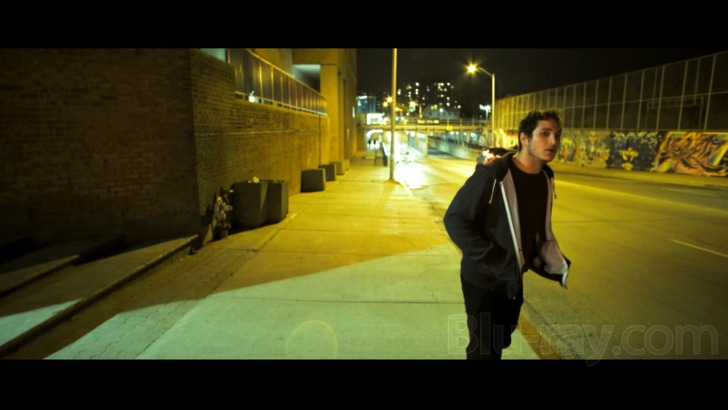
Broken Mile was photographed by director Justin McConnell on a Sony A7S II, which delivers
impressive performance for a camera that can be purchased for less than the rental on an Arri
Alexa. Post-production was completed at 4K to fulfill the technical requirements of an overseas
distributor, and the image on the 1080p, AVC-encoded BD-R being released through Gravitas
Ventures in the U.S. and IndieCan Entertainment in Canada has been downconverted from the
4K source. The Blu-ray image retains the documentary feel and indie aesthetic that results from
shooting with available light from nighttime sources. McConnell effectively exploits a dull
palette and flaring illumination to sustain an unsettling and often nightmarish mood. Sharpness
and detail are better than screen captures may convey, because it's difficult to capture a tightly
focused frame when the camera is always in motion (though it remains steady; no "shaky cam"
here). Broken Mile has been mastered on BD-R with an average bitrate of 25.78 Mbps, which is
more than respectable for a digitally originated project. The encode is capable, and the only
apparent artifacts are lens flares, which are both intentional and unavoidable.
As regards the decision to release Broken Mile on burned BD-R, the film's creator (who also
mastered and authored the Blu-ray) sent me the following statement, which is reprinted below
with his kind permission:
I'm fully aware of the stigma when using BD-Rs, especially since I do authoring as a part of my career and have seen distributors get flack for choosing to go the burned route. The sad fact of the current market is a problem of economics, unfortunately. It means that films the size of Broken Mile (or an older film of mine, Skull World, for that matter), mostly never even make it to Blu-ray, as the cost is simply too much. They will either get DVD only (and in most cases DVD-5 only with next to no bonus features due to the cost difference DVD-9 causes and Redbox only taking DVD-5s), or they go to VOD only.
The minimum order to press a Blu-Ray, from anyone, is 1000 units. The cheapest I've found for that (and I've done tons of searching) is about $2900 US with shipping to Canada ($3600 CDN approx.). Now, lets say you sell most BD units via Amazon at 19.99 each. Amazon takes $8.50 of that sale for their fulfillment, leaving you with a wholesale price of about $11.50 per unit returning to the distributor. Which means 250 units would need to be sold to cover the cost of just the replication. But then most distributors also have to factor in the cost of authoring, QC, shipping, etc. This reduces the margin even more, and means somewhere around 400-500 units need to be sold to break even, or more. If the title were more in demand, and more units were run, then the economics would become simpler. But these smaller films don't have anywhere near that kind of demand.
On a title like Broken Mile, where one company has US (Gravitas) and another has Canada (Indiecan), and Gravitas does Amazon-disc-on-demand as a mandate for 90% of their releases, that would mean two entirely separate releases, one for each territory. So if I pressed for just the Canadian release, at just needing to recoup replication cost (because I do authoring so there is no cost there for me), that means we'd have to sell 250 units just in Canada alone, which is unlikely. The most I'll move is 100-150. And then if I pressed, I'd have 850 units unsold, sitting in boxes in a garage somewhere, and would only make about half my replication money back.
* * * *
The point I'm trying to make is I'm with the fans; I would love to offer pressed discs for these small films, but it wouldn't be a smart financial decision. So I clearly label the burns, make sure they are burned and verified, do them with full artwork, and put the best special edition together I can. They do sell, but it's unfortunate that the die-hard collectors won't touch them. Short of not playing in Xbox One, they have a very low failure rate.
Justin McConnell
Broken Mile Blu-ray Movie, Audio Quality
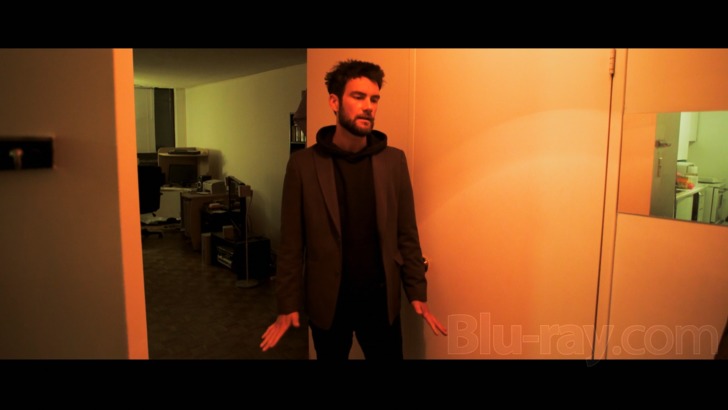
Broken Mile's Blu-ray presentation offers a choice of audio between a 5.1 mix (in either lossless DTS-HD MA or lossy Dolby Digital) and a 2.0 option (Dolby Digital only). Unless one is listening through headphones, I can't imagine why anyone would choose the 2.0 track, because the 5.1 mix is essential to the film's impact. The audio matches the prevailing "point of view" aesthetic, rapidly shuttling voices to left and right and forward and backward to match the camera's shifting perspective. The effect can be disconcerting, deliberately so, and especially when someone approaches from off-camera and abruptly begins speaking. Key environmental sounds are also shifted into the rear speakers to create a sense of the characters' space being encroached upon. For example, when Shaun and Amy sit in a café at a table near the door, the establishment's sounds remain firmly anchored behind Amy in the left rear channel, fighting for the viewer's attention as the pair engages in a tense conversation. (Ironically, despite the apparent realism of the effect, the mix had to be created in post-production, because the actual sounds in the location drowned out the dialogue.) The score by Sean Motley, who worked with McConnell on both Skull World and Minutes Past Midnight, has echoes (no doubt unintentional) of Elliot Goldenthal's electronic instrumentals for Michael Mann's Heat.
Broken Mile Blu-ray Movie, Special Features and Extras
- Director's Commentary: McConnell provides a wealth of technical detail about the shoot and post-production, including the logistics of maneuvering the cast and crew through the various locations and the editing tricks that create the illusion of a single unbroken take for the film's entire running time.
- Actor's Commentary: While the title suggests a single actor, this is a group commentary featuring stars Francesco Filice, Caleigh Le Grand and Patrick McFadden.
- Behind the Scenes Featurette (480p; 1.78:1; 1:06:01): More than a "featurette", this is a full-length documentary entitled "One Shot Kills" about the making of Broken Mile. Both McConnell and his cast participate. An opening title card provides a link for an HD version available through Vimeo.
- Q&A at Canadian Film Fest 2017 (480p; 1.78:1; 11:28).
- Full Rehearsal Take (480p; 1.78:1; 12:54): This rehearsal encompasses the initial conversation between Shaun and Amy, and it's interesting to observe both the actors and the director/cameraman perfecting their intricate choreography.
- Official Trailer (1080p; 1.78:1; 1:16).
- Early Sales Trailer (480p; 1.78:1; 0:51): At this point, the film was still called "Red Mile", which was changed to "Broken Mile" for reasons explained in McConnell's commentary.
- Short Film—Damned Selfie (480p; 2.35:1; 6:12): Starring Caleigh Le Grand.
- Short Film—Open Invitation (480i; 1.78:1; 12:24): Thematically aligned with Broken Mile, for reasons that cannot be explained without spoilers.
- Song—Drifting Souls (6:48): Used in the film.
- Stills Gallery (1080p): Posters, production stills, behind-the-scenes and festival photos.
Broken Mile Blu-ray Movie, Overall Score and Recommendation
No one would ever mistake Broken Mile for a studio production, and that's an essential part of its
appeal. Compared to predictable Hollywood fare, it's a breath of fresh air. McConnell's wealth
of extras is a valuable resource for anyone interested in the nuts and bolts of do-it-yourself
filmmaking. Prospective purchasers shouldn't let the fact that this intriguing creation arrives on
BD-R deter them. Recommended.