Brahms: Piano Concerto No.2 Blu-ray Movie
HomeBrahms: Piano Concerto No.2 Blu-ray Movie 
Piano Concerto No.2 Live at Jerwood Hall St Luke's LondonOpus Arte | 2009 | 53 min | Not rated | Mar 30, 2010

Movie rating
6.6 | / 10 |
Blu-ray rating
| Users |  | 0.0 |
| Reviewer |  | 4.0 |
| Overall | | 4.0 |
Overview
Brahms: Piano Concerto No.2 (2009)
Joaquín Achúcarro, piano. Colin Davis, conductor.
| Music | 100% |
Specifications
Video
Video codec: MPEG-4 AVC
Video resolution: 1080i
Aspect ratio: 1.78:1
Original aspect ratio: 1.78:1
Audio
English: LPCM 5.1
English: LPCM 2.0
Subtitles
None
Discs
25GB Blu-ray Disc
Single disc (1 BD)
Playback
Region A (B, C untested)
Review
Rating summary
| Movie |  | 3.5 |
| Video |  | 4.5 |
| Audio |  | 5.0 |
| Extras | | 3.5 |
| Overall | | 4.0 |
Brahms: Piano Concerto No.2 Blu-ray Movie Review
A trifle too restrained to completely capture Brahms' often cloudly temperament, this is still a lovely interpretation of the master's beautiful second piano concerto.
Reviewed by Jeffrey Kauffman April 13, 2010The music of Johannes Brahms holds a very, very special place in my heart, as I had what I refer to as one of my first “cosmic” listening experiences when I was a teenager and was quite simply bowled over by the old Columbia recording of Bruno Walter conducting the Symphony No. 4. About two or three minutes into the first movement, after the first subject has been announced and Brahms starts dissecting it with those incredible downward winds seeming to melt over every phrase, I turned to a much more classically schooled acquaintance and gasped, “It’s so. . .ordered!” He merely nodded in agreement, a sly smile on his face, as if he were initiating me into some super secret occult society of music appreciation.
Every new piece of Brahms’ I then consumed repeatedly reminded me of that appreciation of the master’s architecture which quite readily reached out and touched me all those decades ago. Brahms’ two piano concerti are certainly no exception to this rule, with elegant themes and perfectly balanced arcs building gigantic statements from sometimes very simple foundations. The second concerto (in Bb major) came some 22 years after Brahms’ titanic first essay in the idiom. If the first concerto is a lively work full of the vigor and innovations of youth, this is certainly the more mature piece, much like the difference between Brahms’ first and fourth symphonies. There’s an autumnal feel to many of the elegiac themes Brahms brings to bear in this piece, starting with the famously nostalgic horn call which begins the first movement.
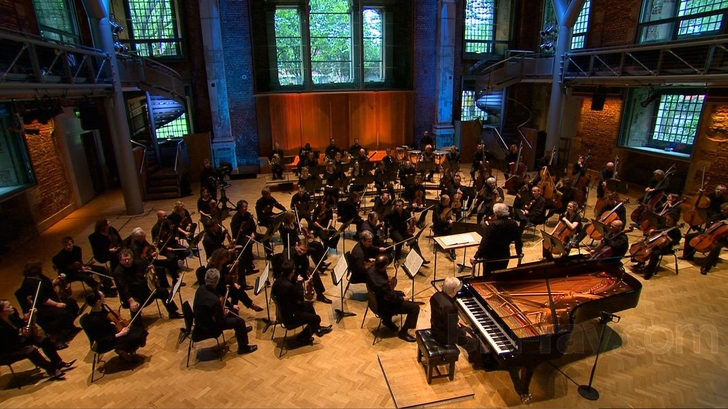
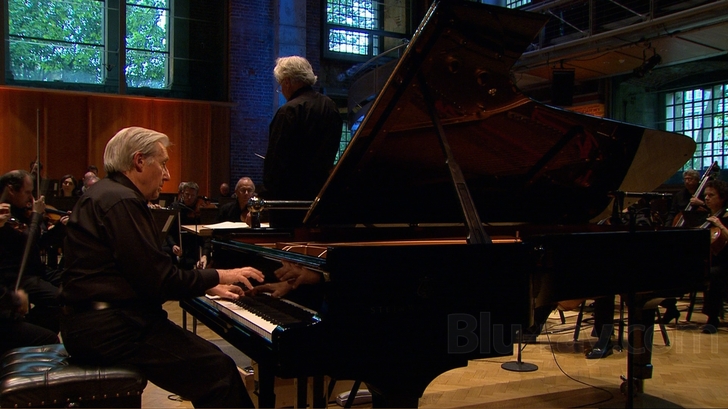
Achúcarro and the London Symphony.
This is not to say that this concerto does not in and of itself present some innovations, because it most certainly does, starting with its unusual four movement structure. The first movement, marked Allegro no Troppo, is a beautifully heroic piece which Spanish pianist Joaqquin Achúcarro attacks with some deliberate phrasing, if odd pauses at times, especially in the distinctively placed opening cadenza. I in fact wondered if he were incorrectly seated on his bench so odd was one of his pauses in this opening flurry of solo activity, which was followed by a quick readjustment of his position on the bench. Once the movement takes off into its more deliberative moments, Achúcarro shows his intelligence and clarity throughout this premier movement, revealing that he’s lost none of the luster and finesse which first brought him to international fame in 1959 when he won the Liverpool International Competition, which indeed resulted in his debut with the London Symphony Orchestra, the 50th anniversary of which is celebrated with that same vaunted organization on this performance in the lovely confines of Jerwood Hall, St. Luke’s, London, with Colin Davis conducting. If Achúcarro isn’t the most fiery pianist around, he’s certainly one of the most appealingly precise, bringing a great deal of grace and excellent overall phrasing to the grand themes of Brahms’ opening movement.
Things are decidedly more passionate in Brahms’ second movement (which is in fact marked Allegro appassionatto), which journeys into the related key of D minor and shows Brahms’ more stormy, less classically restrained, side. Again, Achúcarro is perhaps a bit too reserved for his own good in this movement, which is often played by other pianists as if they’re storming the battlements. Achúcarro takes a slightly more detached approach, offering a certain rational clarity where some listeners might prefer more emotion.
The gorgeously lyrical third movment begins with a lovely conversation between cello and oboe, showing off Brahms’ mastery of orchestral color, especially in the wintry lower registers. This is achingly beautiful music, and presents Achúcarro at his finest, with filigreed work which lovingly reveals the haunting aspect of Brahms’ sometimes quite forward thinking chromaticism, albeit a chromaticism delivered via a rigorously tonal and diatonic system of composition.
The fourth and final movement is a frolicsome affair that presents the playful side of both Brahms the composer and Achúcarro the pianist. In fact, the pizzicato delicacies melting into ravishing waltz themes remind me, as strange as it may sound, of some of Prokofiev’s piano writing which would come some fifty years after this work. Achúcarro and Davis easily traverse the many stylistic changes in this extremely diverse movement, one of the most widely variant Brahms ever wrote.
My one major complaint about this performance, which is by and large wonderful and a rewarding listening experience, is that the tempi, to my ears anyway, are uniformly too slow. While this allows a lot of the nuance of Brahms’ writing to shine through, the mercurial aspects of the composer are left largely by the wayside. This tends to be an issue mostly with the second and parts of the fourth movement, where I really would have like Davis and Achúcarro to put the pedal to the metal, so to speak, and up the intensity of the playing a level or two. What remains, though, is a beautifully played performance of one of Brahms’ most breathtaking pieces. If my particular breath was taken quite enough to my personal taste, this is still a performance I’m happy to return to for its purity and above all its clarity.
Brahms: Piano Concerto No.2 Blu-ray Movie, Video Quality
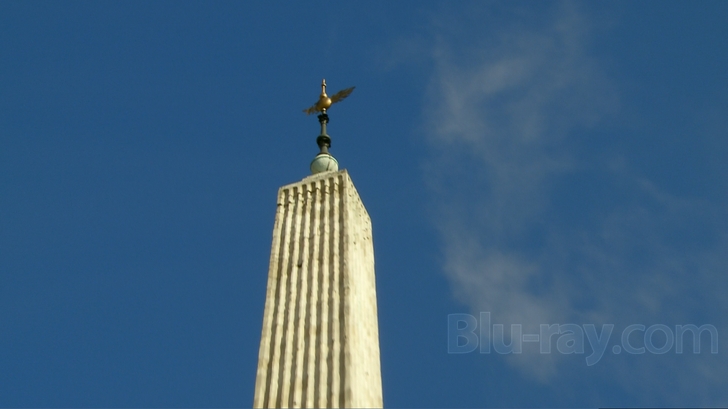
This live performance is offered with an AVC encoded 1080i image in a 1.78:1 aspect ratio. Unlike virtually every other Opus Arte classical title I've reviewed, there is no audience in attendance here, and in fact it's not completely clear if there are even seats for an audience in this space (though the final shot of Davis and Achúcarro seem to hint that there are). Therefore this is an unusally filmic presentation, with the camera moving in and about the players with a huge variety of shots in a very unusual, almost warehouse like hall. Detail is exceptional throughout, with fantastic depth of field. Even longshots will reveal clearly passing cars through the windows outside, and the close-ups clearly show every smudge on the satin finish of the Steinway piano Achúcarro plays. Flesh tones and other colors are uniformly lifelike, though this is not an explosion of color by any means. The artists are all dressed in black and the only real color comes from the appealing life beyond the windows of the hall, as well as some of the stage lighting of the space itself.
Brahms: Piano Concerto No.2 Blu-ray Movie, Audio Quality
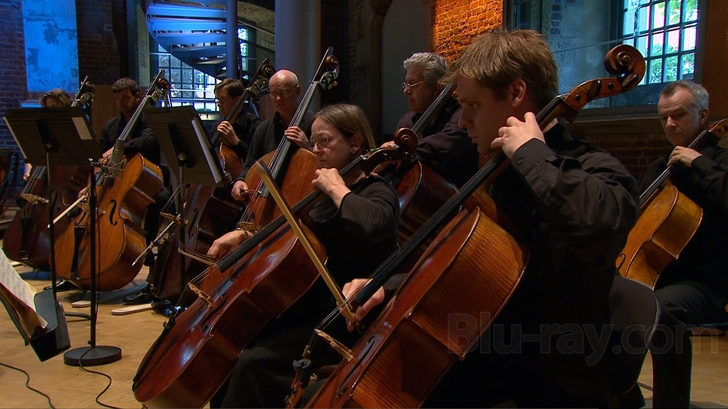
Two beautiful uncompressed, lossless tracks are presented on this Blu-ray, an LPCM 5.1 and an LPCM 2.0. I spot checked the 2.0 and found it fine as far as it went, though its narrowness and lack of hall ambience bothered me enough that I didn't want to spend too much time with it. On the other hand, the 5.1 is not only clear as a bell but offers that hall ambience to a tee, with lovely reverberent sound and gorgeously saturated channels offering extremely clear and beautifully balanced sound between the piano and orchestra. The piano sounds wonderfully warm, with no brittle ringing or distortion, and Davis' London Symphony is simply marvelous, with every color perfectly reproduced on this recording.
Brahms: Piano Concerto No.2 Blu-ray Movie, Special Features and Extras

Two excellent HD supplements are included on this Blu-ray:
Joaquín Achúcarro: Fifty Years On (41:43) offers a career retrospective on a master pianist whose career may not be as widely known as some of his contemporaries.
Achúcarro at the Prado (35:55) offers live performances of solo piano works, including Brahms' Three Intermezzi, Op. 117, Chopin's 24 Preludes, Op. 28, Nos. 15-16, Scriabin's Two Pieces for the Left Hand, Op. 9, and Albéniz's Suite Iberia, Op. 47, Book 1, No. 2.
Brahms: Piano Concerto No.2 Blu-ray Movie, Overall Score and Recommendation
Brahms played a tad too slow is still Brahms, and that should be enough for most audiophiles. Add in some excellently precise playing by both soloist and orchestra, and a simply top notch recording, and this concert, as brief as it is, has a lot to recommend it.