Brahms: Complete Symphonies / Discovering Brahms Blu-ray Movie
HomeBrahms: Complete Symphonies / Discovering Brahms Blu-ray Movie 
Christian ThielemannC MAJOR | 2013 | 193 min | Not rated | Jan 28, 2014
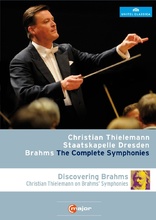

Movie rating
7.2 | / 10 |
Blu-ray rating
| Users |  | 0.0 |
| Reviewer |  | 4.5 |
| Overall | | 4.5 |
Overview
Brahms: Complete Symphonies / Discovering Brahms (2013)
| Music | 100% |
Specifications
Video
Video codec: MPEG-4 AVC
Video resolution: 1080i
Aspect ratio: 1.78:1
Original aspect ratio: 1.78:1
Audio
Music: DTS-HD Master Audio 5.0
Music: DTS-HD Master Audio 5.1
Music: LPCM 2.0
Subtitles
None
Discs
50GB Blu-ray Disc
Two-disc set (2 BDs)
Playback
Region A (B, C untested)
Review
Rating summary
| Movie | | 4.5 |
| Video |  | 4.0 |
| Audio | | 4.5 |
| Extras |  | 2.5 |
| Overall | | 4.5 |
Brahms: Complete Symphonies / Discovering Brahms Blu-ray Movie Review
A different kind of final four.
Reviewed by Jeffrey Kauffman January 18, 2014The term “religious experience” gets bandied about so much these days that it’s become virtually meaningless, but I had something I personally considered a religious experience the first time I heard Brahms’ Fourth Symphony. At around score marking A in the first movement (measure 19, to be exact), suddenly the sheer magnitude of the intersecting wind and reed lines with the antiphonal string underpinnings seemed to reveal to me a kind of divine honeycomb, a brief glimmer of intelligent design, an ordered universe, every good boy doing extremely fine. Others may experience this phenomenon Mozart—I understand the allure, and I of course find the ineluctable facility of his music incredible, but it frankly leaves me emotionally cold. Many champion Beethoven as having provided their own personal “come to Jehovah moment”—again, I respect the ferocity, the brooding genius and the titanic waves of energy that just as suddenly relax into sylvan calm, but aside from the occasional odd piece (for me, perhaps unusually it’s the Seventh rather than his more iconic Symphonies), I can take him or leave him. No, for some unknown reason, Brahms’ music spoke directly to my soul when I was a young kid, still trekking to theory lessons where slightly impatient teachers tried to get me to finally understand the “importance” of the augmented sixth chord. When Christian Thielemann released his fantastic Beethoven cycle a couple of years ago (Beethoven: Symphonies 1-3, Beethoven: Symphonies 4-6, and Beethoven: Symphonies 7-9 ), the eminent conductor and scholar had me “taking” Ludwig much more than “leaving” him for the first time in many years. Furthermore, all three of those releases contained fascinating and illumination bonus documentaries that played like the old annotated orchestral scores that music students may remember from bygone days (great teaching aids that typically had things like arrows pointing out first and second subjects, modulations, developments and recapitulations). In what was only the latest in my long line of geeky responses, I secretly hoped that Thielemann would undertake a similar slate of releases with the Brahms symphonic output, and now here it is. While some might have wished that this set featured the Vienna Philharmonic (as the Beethoven cycle did), the Staatskapelle Dresden Orchestra is certainly no slouch and delivers some startlingly visceral performances under Thielemann's always excellent baton.

Some “outsiders” may look at Brahms’ symphonic output, compare it to Beethoven’s, and wonder why Brahms was a relative slouch. Of course, nothing could be further from the truth, and part of what kept Brahms from writing more in the idiom was his own self-critical nature, something that led to, for example, his First Symphony taking literally decades to be shaped into a form its composer felt was finally worthy of being presented to the public. Brahms’ First is often given the soubriquet “Beethoven’s Tenth”, which provides some estimation of the esteem in which it is held. Brahms himself was rather humorously dismissive of this comparison, basically indicating that any idiot (Brahms used a somewhat more colorful term) could see the similarities. The first movement is almost funereal in its epic poco sostenuto opening, but becomes more relatively celebratory as the Allegro kicks in. Brahms writes a typically calm and gorgeous second movement, but in the completely unexpected (and unrelated) key of E major (the symphony is ostensibly in C minor). The third movement may remind some listeners of the sylvan ambience of Beethoven’s Sixth (a comparison that is more often utilized with regard to the Second Symphony as a whole), while the fourth movement undergoes some rather startling changes in mood and tempo, especially when one considers how “formal” many critics have accused Brahms of being.
It may be a little disconcerting (no pun intended) to hear Christian Thielemann “accuse” (for want of a better term) Brahms’ Second Symphony of not having much depth. His comment actually resurrected a long dormant memory from my childhood. Back in the late seventies, several record labels started reissuing their older classical releases on their then contemporary budget imprints, and ABC Records was shall we say “inventive” in repackaging these products. The covers for their reissued albums were often humorous, and if I’m remembering correctly, their reissue of the William Steinberg and The Pittsburgh Symphon Orchestra’s recording of Brahms’ Second featured a cover showing a page of the score being used to wrap a dead fish. Taken in tandem, these two “commentaries” might suggest that Brahms’ Second is a disposable piece in the symphonic repertory, but nothing could be further from the truth, for the symphony is fairly bursting with melodic and harmonic invention. Rather ironically, for such an at least occasionally dismissed piece, the Second contains what is arguably Brahms’ best known melody (at least the public at large), his iconic “Lullaby” (formally Wiegenlied), which Brahms uses as the basis for the first movement of the Symphony.
Brahms’ Third and Fourth Symphonies exist in a somewhat separate world than even his first two. Both of these pieces are unquestionably among the greatest works in this idiom, let alone in the 19th century formulation of the symphony. Many have suggested that the “subtext” of the Third is Brahms’ middle-aged bachelorhood, for he utilizes a three note motive in all of the movements which is an acronym for Frei aber froh, which means “free but happy”. There are contrasting emotional resonances in the Third, however, with a certain ebullience contrasting with a more melancholy flavor, as can clearly be heard in the first movement’s subtle shifts between major and minor tonalities. The Third’s third movement is an absolutely gorgeous poco allegretto which has always reminded me of the second movement of Beethoven’s Seventh Symphony. (Rock fans may recognize it, as none other than Carlos Santana lifted the main theme to become part of the guitar solo from his song “Love of My Life”, albeit in a completely different overall setting, obviously. Older music lovers may recognize the theme, which is kept a bit more intact, as the basis for Frank Sinatra's hit "Take My Love". Brahms is even credited as the composer on that tune, which begs the question of where the royalty checks were sent.)
The Third’s occasionally stormy final movement clearly presages the overall moody ambience of Brahms’ Fourth, which I’ve already stated is one of the most epochal pieces of my personal listening history. It’s actually a bit hard to put into words what this music means to me, but I will simply state that the Fourth reigns supreme among Brahms’ accomplishments, a piece that seems to reflect in an autumnal way on both the triumphs and tragedies of a long life well lived. There’s a heroic subtext to the piece (as evidenced by those triplet horn calls in the first movement, or the towering passacaglia of the Fourth. If Brahms’ First is Beethoven’s Tenth, I’d argue the Fourth is Beethoven’s Eleventh through Fourteenth (I joke, of course, but only slightly).
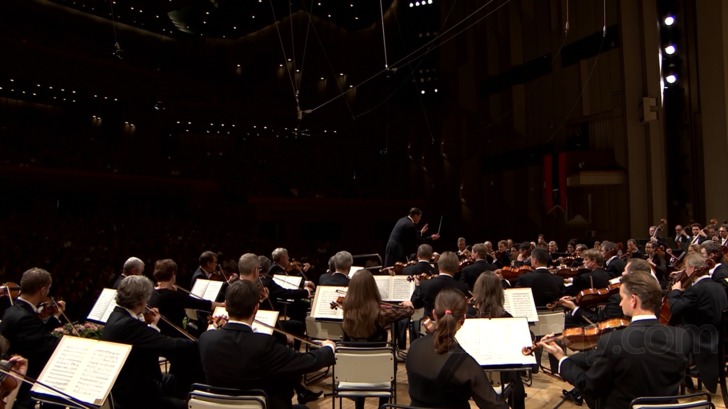
Thielemann doesn't radically reinvent the wheel here, offering solid, and sometimes spectacularly energetic, performances of all four symphonies. As is his wont, he tends to focus on sudden extremes in dynamic and equally abrupt changes in tempi, but he knits together everything into a fully coherent and cohesive whole. Interestingly, at various points he actually pretty much stops conducting and just lets the orchestra play (he almost "relaxes" during the first movement of the Fourth, for example, just kind of leaning back and taking it all in before rejoining the fray.) The Dresden Staatskapelle may frankly not have quite the sonic luster of the Vienna Philharmonic (which after all sets an awfully high bar to reach), but it plays with a great deal of grace and nuance here.
Brahms: Complete Symphonies / Discovering Brahms Blu-ray Movie, Video Quality
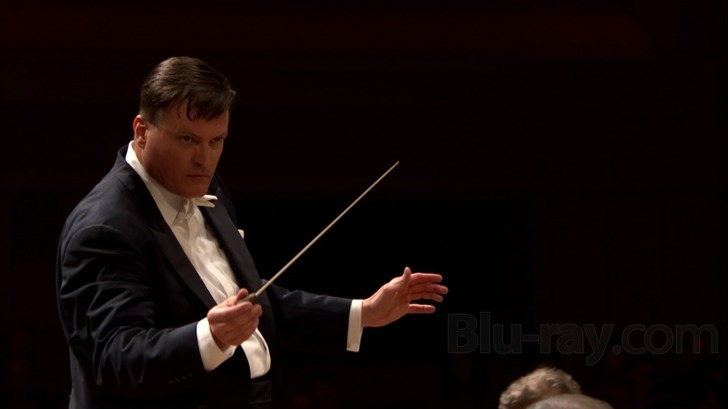
Brahms: The Complete Symphonies and Discovering Brahms (Christian Thielemann on Brahms' Symphonies is presented on Blu-ray courtesy of C Major with an AVC encoded 1080i transfer in 1.78:1. This is a really sharp and appealing set of performances. Black levels are especially strong—I was pleasantly surprised by the differentiation between Thielemann's black tails, for example, and the shrouded background he conducts in front of. There's virtually no crush here, with clear delineation between very slight differences in tone. The orchestra is covered from a variety of angles (by a variety of directors, it should be stated), with color looking accurate and fine detail revealing little things like fingerprints on the bells of some of the horns. Despite the interlaced presentation, aside from some very slight combing on Thielemann's baton when he waves it manically, there are no egregious artifacts to mention.
Brahms: Complete Symphonies / Discovering Brahms Blu-ray Movie, Audio Quality
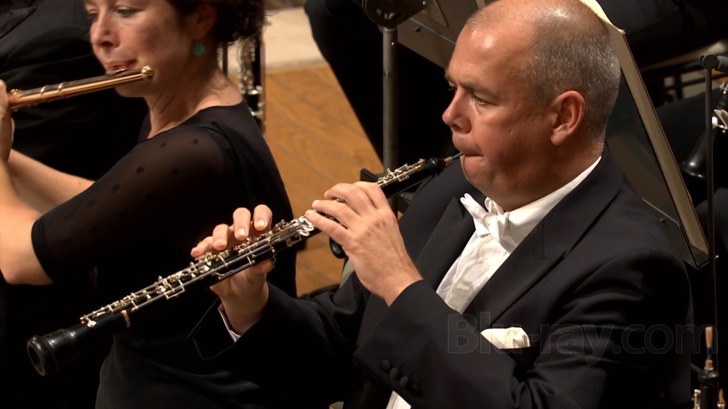
In a somewhat perplexing concatenation of audio codecs on this release, the First and Third Symphonies are offered in DTS- HD Master Audio 5.0, while the Second and Fourth rate a DTS-HD Master Audio 5.1 mix (all four symphonies also have an LPCM 2.0 option available). Truth be told, there's not a whale of a lot of difference between the 5.0 and 5.1 mixes, though curmudgeons might have wished for the extra discrete low end on the Third rather than the relatively more placid Second. Fidelity is excellent on all of these symphonies, though I personally had some passing issues with actual mix. Those redolent horn calls in the first movement of the Fourth, for example, are almost completely buried and are barely heard, despite obviously being the focal element at that point (as well as the visual one—the video director captures the horn players blowing into their instruments, with virtually no sound emitting on the track). My sense is this must have been a microphone issue, for overall, the balance and precision of these tracks is extremely laudatory. There is one other extraneous issue to be aware of—why is it that audience members who need to loudly cough or clear their throats always choose the quietest moments of any given piece to do their dirty work? You'll hear occasional examples of this tendency, which obviously can't be blamed on anything other than some people's bad manners.
Brahms: Complete Symphonies / Discovering Brahms Blu-ray Movie, Special Features and Extras
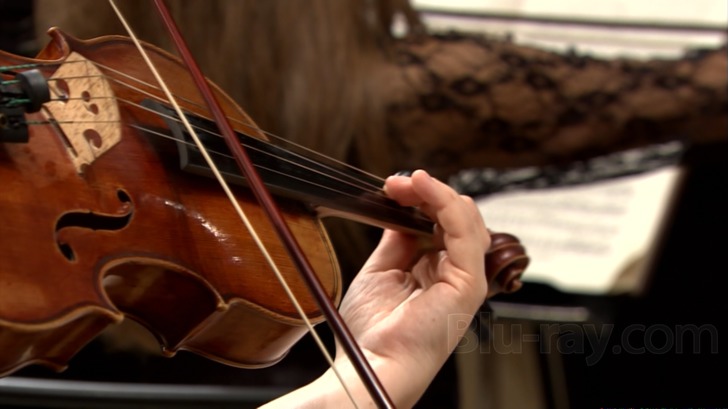
- Discovering Brahms (1080i; 51:17) is a good, if not quite as exhaustive, companion piece to the documentaries that graced Thielemann's Beethoven Cycle. Thielemann talks about his background with the composer, and gives some salient biographical details about Brahms as he discusses the symphonies. Thielemann tends to concentrate more on mood than actual technical information here, but his comments are extremely worthwhile and interesting.
Brahms: Complete Symphonies / Discovering Brahms Blu-ray Movie, Overall Score and Recommendation
Brahms: The Complete Symphonies and Discovering Brahms (Christian Thielemann on Brahms' Symphonies is a worthy follow up to Thielemann's incredibly exciting Beethoven cycle. The performances here are top notch, even if occasional mix issues deprive the listener of hearing important elements in Brahms' musical thinking. The bonus documentary is another splendid peek inside Thielemann's approach to these iconic works. So, now we've had two out of the three big "B"'s in classical music. Bach, anyone? Highly recommended.