Blood Done Sign My Name Blu-ray Movie
HomeBlood Done Sign My Name Blu-ray Movie 
Image Entertainment | 2010 | 128 min | Rated PG-13 | Aug 03, 2010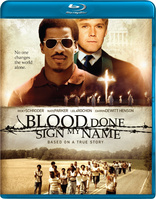

Movie rating
6.9 | / 10 |
Blu-ray rating
| Users |  | 0.0 |
| Reviewer |  | 4.0 |
| Overall | | 4.0 |
Overview
Blood Done Sign My Name (2010)
When a black Vietnam War vet is murdered by whites in small-town North Carolina, it sparks a firestorm of violent protest. Amid the rising chaos, a local teacher and a newly arrived preacher will risk everything to see justice done and change the brutal legacy of the past.
Starring: Nate Parker, Ricky Schroder, Lela Rochon, Nick Searcy, Afemo OmilamiDirector: Jeb Stuart
| History | Uncertain |
| Other | Uncertain |
| Drama | Uncertain |
Specifications
Video
Video codec: MPEG-4 AVC
Video resolution: 1080p
Aspect ratio: 2.35:1
Original aspect ratio: 2.39:1
Audio
English: DTS-HD Master Audio 5.1
Subtitles
English SDH, Spanish
Discs
25GB Blu-ray Disc
Single disc (1 BD)
Playback
Region A (B, C untested)
Review
Rating summary
| Movie | | 4.0 |
| Video |  | 4.5 |
| Audio |  | 3.5 |
| Extras |  | 2.0 |
| Overall | | 4.0 |
Blood Done Sign My Name Blu-ray Movie Review
This, Too, Is History
Reviewed by Michael Reuben December 23, 2011Writer Jeb Stuart has a solid track record with popular entertainment. He scripted two of the most successful and enduring action films of the modern era, the original Die Hard and the film adaptation of The Fugitive. He also wrote and directed the unpredictably creepy (and underrated) Switchback, with Dennis Quaid as an FBI agent searching for the serial killer who kidnapped his son. In 2008, Stuart turned his talents in a completely new direction, writing and directing an adaptation of a best-selling work of history by Timothy Tyson, a professor at the University of Wisconsin. Tyson's book was also part autobiography, because Tyson's father, Vernon, was the pastor of the First Methodist Church in Oxford, North Carolina, in 1970, and Tyson witnessed many of the book's key events as a small boy. Oxford was a small town that the civil rights movement had passed by, before so much of that movement was subsumed (or maybe it would be fairer to say "drowned out") by the anti-Vietnam protests that swelled to a crescendo during the 1968 presidential election and the first Nixon administration. When Vernon Tyson arrived in Oxford to take over as pastor of First Methodist, he found a town where race relations had changed very little in the past hundred years and where his sermons about equality made many members of his uniformly white congregation uncomfortable. Rev. Tyson's invitation to a distinguished black pastor to give a guest sermon provoked an open revolt from the church's board of directors, which threatened to remove him (though they didn't actually have the power). In vain did Tyson warn them that they were sitting beneath a dam holding back "300 years of wrong" that was ready to burst. The dam cracked on May 11, 1970, when a recently returned Vietnam vet named Henry "Dickie" Marrow was shot, beaten, stomped and finally executed with a rifle bullet by a local storeowner named Robert Teel and his son Larry. Dickie Marrow was black; the Teels were white. Even before the Teels were acquitted of the murder by an all-white jury, Oxford exploded. After the trial, a march began to the state capital at Raleigh. The number of marchers eventually swelled to 45,000. One of the organizers of the march was a young teacher named Ben Chavis, who, twenty-five years later, would help organize the Million Man March on Washington. It was as if, in the space of less than a year, a single small town was replaying the history of the civil rights movement, in microcosm and on fast foward. Such stories are tailor-made for dramatization, because they arrive at the writer's desk "pre-condensed", so to speak, with "types" and representative characters already populating the narrative. It may be difficult for some contemporary viewers to accept, but just forty years ago in large parts of America (and not just the South), there really were people who acted and spoke like the persons depicted in Blood Done Sign My Name. And while forty years may be a long time in the life of an individual, it's barely a stroll around the block in the life of a nation.
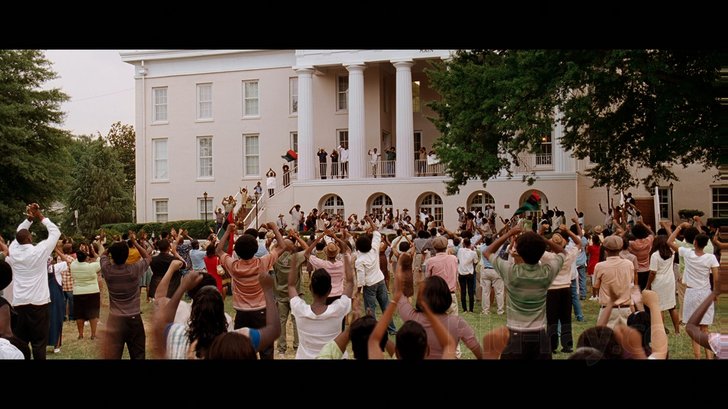
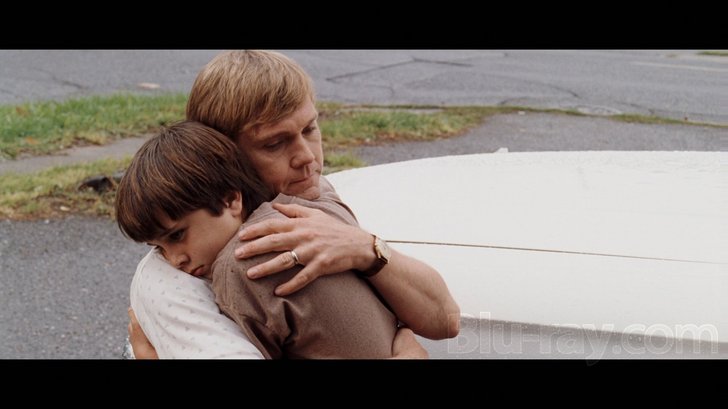
Stuart opens the film in the current era, with elderly people reflecting on the events of 1970, including an older white North Carolina state trooper recalling how odd it was to return from Vietnam, where he was used to serving with soldiers of all races, then joining a police force that was almost entirely white. Stuart returns to this framing device at the end of the film, because, among other things, it will provide a perspective on how differently past events are perceived by different generations. After this prologue, the film catches up with the Tyson family just as they are relocating to Oxford in early 1970. The family consists of Pastor Vernon (Rick Schroder, who hasn't been seen much since he left NYPD Blue), his loyal wife, Martha (Susan Walter), and their four children, Julie and Boo (Emily and Natalie Alyn Lind), future author Tim (Gattlin Griffith) and his older brother Vern (Colin Stuart, no relation to the director). Stuart then spends almost a third of the film showing the audience around Oxford, acquainting us with the town much like the Tysons are getting to know it. This leisurely approach has become rare in moviemaking (and unthinkable in a studio film), but Stuart handles it elegantly and it pays off later, when the deceptively peaceful surface shatters. Stuart keeps his "tour" of Oxford interesting by following the first rule of storytelling, which is "show don't tell". Ben Chavis (Nate Parker) has returned home from a northern education, but his first day teaching at the local black high school reveals unexpected layers in both Chavis and the town, when his students are less interested in the lesson than in learning whether it's really true that he knows the activist Stokely Carmichael. Chavis hesitates but then answers their questions in detail, because he can see that his students are hungry for first-hand information of what they've heard is happening in the world outside the city limits. Even more revealing is Chavis' decision to reopen the drive-in restaurant owned by his grandfather, to the surprise and pleasure of his mother, Elizabeth (Donna Briscoe). Renovated and rechristened "Soul Kitchen", the establishment quickly becomes a roaring success, thereby providing a preview of the combined economic muscle of Oxford's black community. That financial clout will play a decisive role in the battle to come. It's certainly more powerful than the rigged political process, as Chavis learns when he tries to get basketball hoops restored in city parks. The resulting runaround is worthy of the most sophisticated big city machine. There are even more sinister elements of Oxford, as exemplified by the Klan rally that the Reverend Tyson lets his sons observe clandestinely. And then there's the Teel family. The patriarch is Robert Teel (Nick Searcy), a bilious barber, who also owns a general store in the black section of town, where he marks up all the prices and tells his customers to walk another mile and half to the supermarket if they don't like it. A sarcastic tyrant to his two sons, Larry and Gerald (Cullen Moss and Michael May), Teel Sr. is known for his hot temper, and we see the town's local lawyer, Billy Watkins (Michael Rooker), caution Teel on that score when he turns a black man away from his barbershop. (The man, Herman Cozart (Omar Benson Williams), will later become a prominent member of the protest movement.) As portrayed in the film, the murder of "Dickie" Morrow (A.C. Sanford), who is Ben Chavis' cousin, by Robert Teel and one or both of his sons begins as a misunderstanding that quickly escalates into a fight. But the Teels continue the violence long past the point where Morrow can possibly pose a threat (not that he ever did), and that's how the witnesses at their trial describe it. Consistent with the conflicting testimony, which was key to the defense strategy, Stuart doesn't let us see who fired the final, fatal rifle shot. But the shot is loud, and it echoes through the rest of the film. Riots ensue in the downtown business district, which is all-white and Stuart doesn't stint on showing the senseless destruction and greedy looting. (Both Martin Luther King and his supporters and successors were known to protest that the civil rights movement was not a gift certificate for a free color TV.) More focused and destructive attacks are organized by a small, cohesive unit (in real life, Vietnam vets like Morrow) on the huge tobacco warehouses that were essential to the town's major industry. But the reaction takes a decidedly different turn at Morrow's funeral with the appearance of Golden "Goldie" Frinks (Afemo Omilami), a flamboyant personality and powerful speaker sent by the Southern Christian Leadership Conference as a "stoker" (Goldie's word). It's Goldie's idea to organize the march to the state capitol, with Dickie's widow and her two children riding atop a mock coffin drawn by a mule to meet with the governor. And it's Goldie who teaches the young Ben Chavis some valuable (one might even say cynical) lessons about the use of publicity and perception in the fight for justice and equal rights. The Teel trial ends in an acquittal, which was the historical outcome. But as suggested by the film's title (which comes from one of Goldie Frinks's speeches), the blood of Dickie Morrow did not go unavenged. An entire way of life in Oxford was convicted for it and killed off within a few years. There were other casualties (Vernon Tyson lost his pastorship at First Methodist), but so thorough was the eventual eradication that, when the film returns to the present, the state trooper in the diner is now revealed to be sitting with two black colleagues on the force—a grouping that would have been almost unthinkable forty years earlier. In a final touch of irony, though, the film reminds us how quickly memories fade. As the older man reminisces about once hearing Golden Frinks speak and what a powerful presence he was, the younger man next to him (Chaz Amo'n McNeil) looks up and asks: "Who's Golden Frinks?" The older man repeats the question in disbelief, and the film fades to end titles.
Blood Done Sign My Name Blu-ray Movie, Video Quality
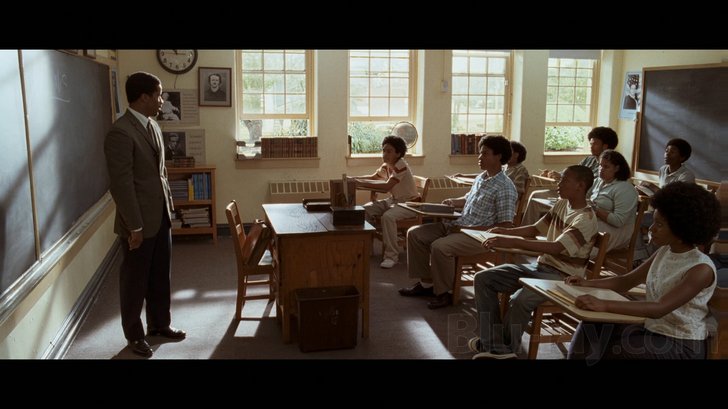
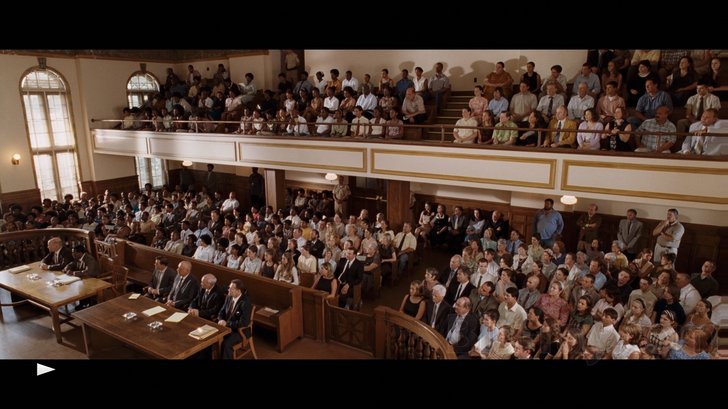
Although Blood Done Sign My Name was shot on film, it has been heavily processed in post-production to give it an almost digital sheen. The image is grainless, clear, sharp and remarkably detailed, whether in wide shots of large crowds or in interiors like the courthouse where the Teels are tried for murder. Colors are strong, but not overly vibrant or saturated; while the garish Sixties may dictate style and fashion elsewhere in the country, they have yet to catch up with Oxford. Black levels and contrast are so well handled that in scenes where fire suddenly blazes at night (e.g., the Klan rally or the fires at the tobacco warehouses), both the intense flames and the surrounding blackness retain their visual integrity. Image continues to be addicted to BD-25s. However, with only one audio track and light extras, the space appears to be adequate, and I saw no signs of compression errors or high frequency filtering. Nor did I observe any other transfer-induced anomalies.
Blood Done Sign My Name Blu-ray Movie, Audio Quality
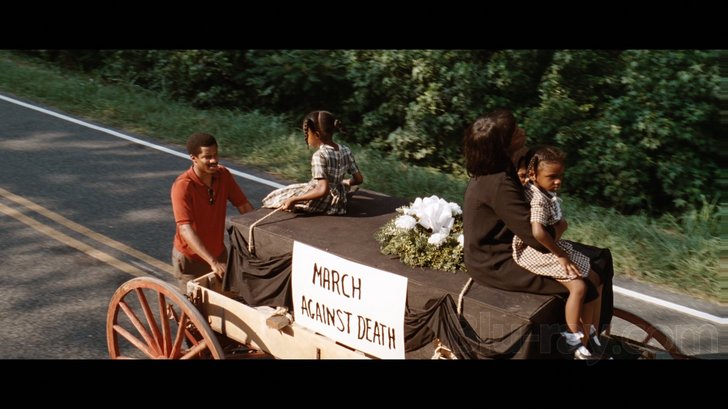
The DTS lossless track is relatively restrained in terms of surround activity. It provides a generalized sense of ambiance for such environments as crowds, Ben Chavis' Soul Kitchen diner, the march to the capital, Reverend Tyson's church during services and the courtroom. Voices are always clear and centered. The soundtrack features a number of well-chosen period songs by bands such as the Allman Brothers, which are delivered with appropriate punch, and an original score by John Leftwich, whose principal credits are as a bass player and arranger. His score for Blood Done Sign My Name often recalls the style of film composer Thomas Newman (which is meant as a compliment).
Blood Done Sign My Name Blu-ray Movie, Special Features and Extras
- TV One Special (HD, 1080i; 1.78:1; 22:39): TV One is a network jointly owned by Radio One and Comcast with headquarters in Silver Springs, Maryland. This special was timed to the film's release, is hosted by star Nate Parker and features interviews with Stuart, Tyson and Chavis. In the latter half of the documentary, Parker visits Morehouse College and meets with students in an African-American Studies class. It's an interesting idea, although there's little sense of spontaneity with a camera crew present. A sound mixing glitch at about the 8:40 time mark causes the voiceover narration to drop to nearly inaudible volume, but the problem is of brief duration.
- Theatrical Trailer (SD; 2.35:1, enhanced; 2:32): Like the film's marketing in general, the trailer focuses on the murder of Dickie Morrow, but it also suggests the larger context in which that crime occurred.
Blood Done Sign My Name Blu-ray Movie, Overall Score and Recommendation
In a dismissive "review" submitted to one of the major unmoderated sites (I don't recall whether it was Amazon, Netflix or IMDb), a poster summed up his reaction to Blood Done Sign My Name with the phrase: "Get over it!" That's a bizarre reaction to a historical film, especially one that so clearly tries to take a "warts and all" view of a microcosm of the civil rights movement (as Timothy Tyson's book did). It started me thinking about how many history-based movies could be tossed out with the same phrase. Saving Private Ryan: "The Allies won the war. Get over it!" Braveheart: "England and Scotland are unified now. Get over it!" 1776, the miniseries John Adams, The Patriot or, for that matter, July 4th celebrations in general: "You won your independence. Get over it!" Gone with the Wind: "The South lost. Get over it!" I could go on, but why belabor the point? One doesn't study history or revitalize it through storytelling in order to nurse wounds. (Well, some people do, but they're doing it wrong.) Stories like Blood Done Sign My Name are a way of understanding how we became who we are, and of honoring—and sometimes judging—those who preceded us. It's unfortunate that studios rarely make such films anymore, but premium cable and independent film companies have stepped in to fill the gap. When a filmmaker of Jeb Stuart's caliber takes on material with the potential of Timothy Tyson's book, one hopes for a good result, and Stuart has delivered. The vagaries of the marketplace limited theatrical distribution, but the Blu-ray is exemplary and highly recommended.
Similar titles
Similar titles you might also like
(Still not reliable for this title)

The Conspirator
2010

Journey's End
2017

Beneath Hill 60
2010

The Killing Fields
1984

Judgment at Nuremberg
Limited Edition to 3000 - SOLD OUT
1961

9th Company
9 rota | Collector's Edition
2005

Breaker Morant
1980

Roots: The Next Generations - Complete Mini-Series
1979

Julius Caesar
1970

The Captain
Der Hauptmann
2017

The Dam Busters 4K
Slipcover in Original Pressing
1955

The Outpost
2020

The Barbarian and the Geisha
1958

The War Lord
1965

The Heroes of Telemark
1965

The Siege of Firebase Gloria
1989

The Book of Clarence
2023
Fat Man and Little Boy
1989

Alexander the Great
Limited Edition to 3000
1956

Emperor
2012