Bill Cunningham New York Blu-ray Movie
HomeBill Cunningham New York Blu-ray Movie 
Zeitgeist Films | 2010 | 84 min | Not rated | Dec 11, 2012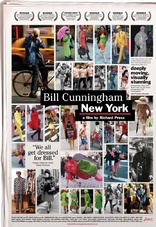
Price
List price:Amazon: $26.75 (Save 23%)
Third party: $26.75 (Save 23%)
Only 1 left in stock (more on the way).

Movie rating
6.3 | / 10 |
Blu-ray rating
| Users |  | 0.0 |
| Reviewer |  | 4.0 |
| Overall | | 4.0 |
Overview
Bill Cunningham New York (2010)
A profile of 80+ New York Times photographer Bill Cunningham who, for decades, has been obsessively and inventively chronicling fashion trends for his Style section columns “On The Street” and “Evening Hours.”
Starring: Bill Cunningham (X)Director: Richard Press
| Documentary | 100% |
Specifications
Video
Video codec: MPEG-4 AVC
Video resolution: 1080p
Aspect ratio: 1.78:1
Original aspect ratio: 1.85:1
Audio
English: DTS-HD Master Audio 5.1
Subtitles
English
Discs
25GB Blu-ray Disc
Single disc (1 BD)
Playback
Region A (C untested)
Review
Rating summary
| Movie | | 4.0 |
| Video | | 4.0 |
| Audio |  | 3.5 |
| Extras |  | 2.5 |
| Overall | | 4.0 |
Bill Cunningham New York Blu-ray Movie Review
A Different Kind of Street Poet
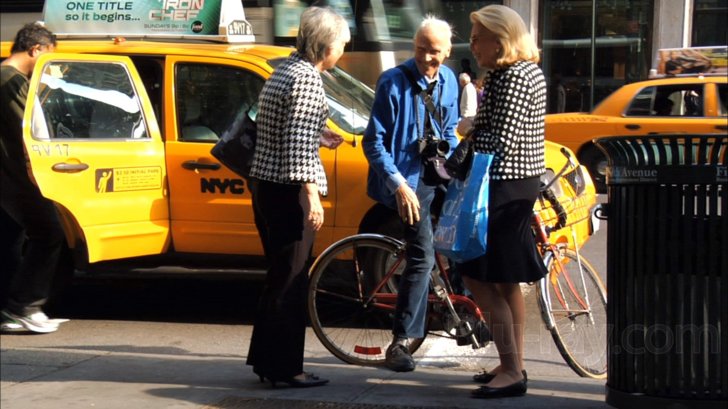
Reviewed by Michael Reuben December 15, 2012On any given day on the streets of New York City, an unobtrusive white-haired man in a trademark blue painter's smock (concealed under a coat or a taped-up poncho, if the weather is bad) can be spotted with cameras slung around his neck, perching and hopping with an agility that belies his octogenarian status, snapping photos of any passerby that catches his attention. Bill Cunningham has been doing this since 1978, and his collection, much of which has never been seen, represents the most complete photographic record of an American city's street life known to exist. A small selection appears weekly in the New York Times Sunday "Styles" section in a feature called "On the Street", a collage of photos painstakingly selected and arranged by Bill—everyone calls him "Bill"—to illustrate some trend he observes in people's attire. It might be a particular fabric (denim used in a dress); a specific color (bright orange); one item in the overall ensemble (an unusual type of collar); a distinctive print (leopard); or a way of wearing something (low-slung pants, early rap style). Bill sees these things as they happen, because he doesn't wait in an office for someone to tell him about them. His prescience in spotting fashion trends before the so-called experts has become legendary. Now, before anyone is tempted to dismiss fashion as trivial—and members of a forum where people fret over aspect ratios, color timing, sound codecs and Blu-ray cover art should think twice about the glass houses in which they live—let me stress that Bill isn't strictly part of the fashion industry. The fashion world didn't create him, and it won't be able to replace him. His formal association with that world, as a photographer for Women's Wear Daily, was brief and unhappy. Bill never accepts money, other than his salary from the Times, and he routinely declines honors and awards, although the film Bill Cunningham New York (hereafter "BCNY") does record a rare occasion when he departed from his usual practice by accepting the appointment of Officier de l'ordre des Arts et des Lettres from the French Ministry of Culture. Bill is a true original: an artist with a singular passion for recording images of clothing as it's worn by real people. Knowledgeable fashion professionals have learned to depend on his instincts. In the axiom of Anna Wintour, Vogue's editor-in-chief and supposedly the model for Miranda Priestly in The Devil Wears Prada: "We all get dressed for Bill." Bill also shoots a feature for the Times called "Evening Hours", which documents the social whirl at major charitable events. It's almost a celebrity gig, but not quite, becase Bill is notorious for overlooking famous people in favor of a nobody wearing an outfit that intrigues him. I'd make a terrible papparazzi, he observes at one event late in the film, where he passes up an opportunity to photograph Catherine Deneuve. His reason? She wasn't wearing anything interesting.
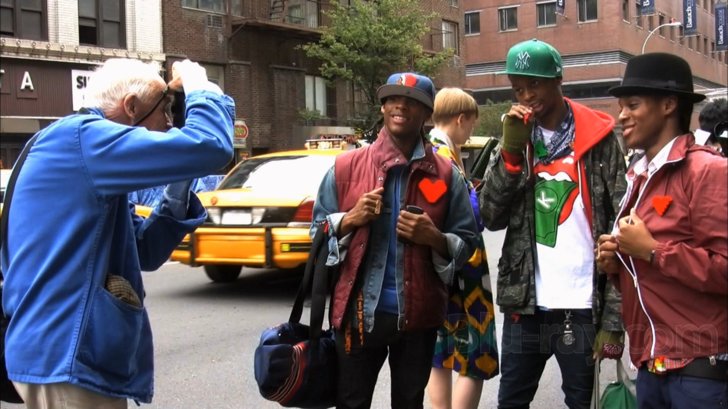
By his own reckoning, it took filmmaker Richard Press ten years to make BCNY, of which the first eight were spent persuading the publicity-shy Bill to do the film. It took two more years to get the footage, because Bill only slowly warmed to Press and his producer, Philip Gefter, and even then he shooed them away if he thought their presence interfered with his work. Press has said he did not want to make a bio-pic, which would have been hard to do, because Bill is intensely private and little is known of his life. The friends and colleagues interviewed for BCNY all remark on how little they know about him, and Bill himself considers his background unremarkable. In one of the deleted scenes, he describes his family as ordinary Americans, in the clipped tones of his working class Boston upbringing. It's one of the few times in any of Press's footage that one glimpses pride in Bill's bearing, as if he were upholding a family tradition. His own life may have been spent in an unusual pursuit, but Bill has brought to it all of the traditional Yankee values of a disciplined work ethic, penny-pinching thrift and self-effacing modesty. "He doesn't want to be honored", says President Didier Grumbach of the French Federation of Couture. "He doesn't want anything." What keeps Bill motivated and vital is the intense, almost child-like joy he takes in what sees and photographs. Nothing else matters to him, and that was the spirit Press wanted to capture on film (or, in this case, digital video). Press has characterized BCNY as "a narrative with a strong protagonist surrounded by a menagerie of characters", but it can also be described as variations on a single theme: the irrepressible Bill. The film zigzags across New York, following Bill on his daily quest for interesting sights, starting at eight in the morning when people are coming to work. Until recently, Bill lived in one of the artist studios at Carnegie Hall. (His forced decamping from that long-time home forms an entire subplot, which, like most New York stories, involves the intersection of real estate and politics.) His rounds begin nearby at Fifth Avenue and 57th Street. From there he might proceed downtown or wherever else his instincts lead him. Eventually he ends up back at the offices of the Times, where a succession of staffers from the art department have worked closely with him over the years to select shots for his exacting layouts. At the time of BCNY, the point man is John Kurdewan, who treats his esteemed co-worker with equal measures of frustration and affection, as Bill keeps fiddling with the photo array while the deadline looms. Press and his camera are there for a surprise birthday party at which a dozen former Times assistants serenade Bill with a tribute to his perfectionism, sung to the tune of "Kids!", while the guest of honor giggles with delight. Intercut with Bill's rounds are interviews with frequent subjects such as Wintour and Annette de la Renta, who is a Trustee at the Metropolitan Museum of Art and thus a fixture at many of the charity events featured in "Evening Hours"; former co-workers at smaller publications (notably Details and Paper) where Bill expanded his range by night while working at the Times by day; and one-of-a-kind characters like Editta Sherman, Bill's neighbor at Carnegie Hall, age 96 at the time BCNY was made (and still going strong as of this writing), who is best known for her celebrity portraits and her association with Andy Warhol. And there are interviews with Bill himself as a younger man, speaking to local journalists with the same sparkle and enthusiasm still evident in the man that Press is recording in 2008. Press even includes photographs from the days before Bill became a photographer, when, for a brief time, he operated an upscale ladies hat shop offering one-of-a-kind creations for high society. (As he is with most things in his past, Bill is casually dismissive of this phase in his life.) Even though no one knows him well, what emerges from Press's collage of voices is a clear portrait of an individual whose life has been governed by a laser-like focus on doing what he loves and an almost monastic discipline on eliminating everything else. "Money is the cheapest thing", says Bill at one point. "Liberty is the most expensive." He should know, since he's turned down every opportunity for a payday simply to retain his sense of feeling beholden to no one. When Condé Nast Publications bought the magazine Details, Bill famously refused to accept any payout, to the point where Condé Nast's owner, S.I. Newhouse, sent him a check and begged his friends to persuade Bill to cash it. He never did. At the charitable events he photographs, he won't accept food or drink. Bill's "code", if you will, is almost comical in its extremism, but then again, in an era when too many people want quick fame and easy money in exchange for little effort, it's refreshing to encounter someone who cares only about their work. Shortly before awarding Bill his honor as Officier from the French Ministry of Culture, Didier Grumbach tells Press: "Very deeply, I think, he doesn't believe he deserves it." He pauses and adds: "That's why he deserves it even more."
Bill Cunningham New York Blu-ray Movie, Video Quality

Director Press shared cinematography duties with Tony Cenicola, a staff photographer at the New York Times, who had the advantage of being someone Bill knew and liked, so that his presence wasn't a distraction. In order not to disturb Bill or interfere with his work, they had to use consumer-grade handheld digital cameras, which were smaller and more discreet. As a result, Bill Cunningham New York isn't as sharp and crisp as a feature film captured on a professional system like the Red or the Alexa. Still, even consumer gear has advanced to the point where the image on Zeitgeist Films's 1080p, AVC-encoded Blu-ray is impressive. Black levels, detail and sharpness are almost as good as film, and colors are distinct and well-saturated (with, presumably, some help from a digital colorist in post-processing). The single biggest giveaway that the photographic equipment was less than the best is the frequent appearance of video noise in all or part of the frame, depending on light, shooting conditions and the nature of the subject. At no point is the noise so severe or pervasive as to obscure the image or compromise viewing enjoyment, but one is routinely reminded of the "run and gun" nature of BCNY as a documentary.
Bill Cunningham New York Blu-ray Movie, Audio Quality
The DTS-HD MA 5.1 track gets the job done, but it's nothing special. The soundtrack is almost entirely production sound consisting of Bill's comments and interactions with others, as well as the remarks of interview subjects. The quality of the sound recording is superior, especially in contrast to some of the archival footage, although it too is always intelligible. Director Press has said that he originally envisioned more music on the track than the little that he ended up including, but he discovered that music "cluttered" the scene. What's now there is an occasional contribution by John Lurie and the Lounge Lizards, which Press decided was the right sound for Bill Cunningham.
Bill Cunningham New York Blu-ray Movie, Special Features and Extras
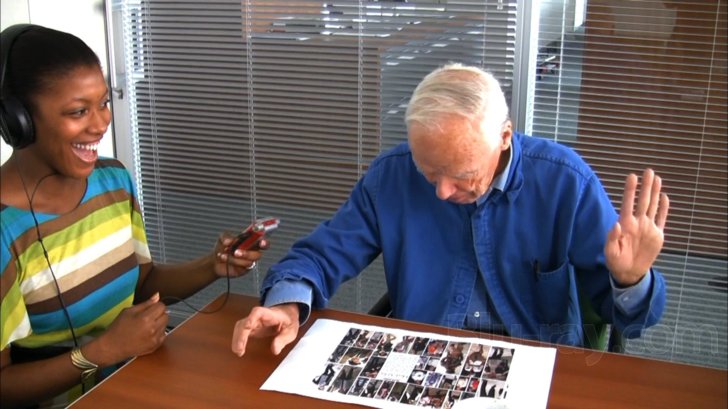
- Extra Footage (1080p; 1.78:1; 18:24): Twelve additional scenes are included. Any of them would have been worthy of inclusion. The titles provided by the disc's producers are largely self-explanatory:
- Bill Moving
- Bill and Paper Magazine
- Bill's Family
- Bill's Hat Salon
- Child (Bill's pet nickname for most people)
- Facades (excerpts from a now-rare book by Bill tracing the parallel histories of New York City architecture and fashion)
- Fashion Historian
- First "On the Street" (it featured Greta Garbo)
- For the Love of It
- Sneaky
- Spotting Trends
- Still Uses Film (the only photographer at the Times who hasn't gone digital)
- Trailer (1080p; 1.78:1; 2:05)
Bill Cunningham New York Blu-ray Movie, Overall Score and Recommendation
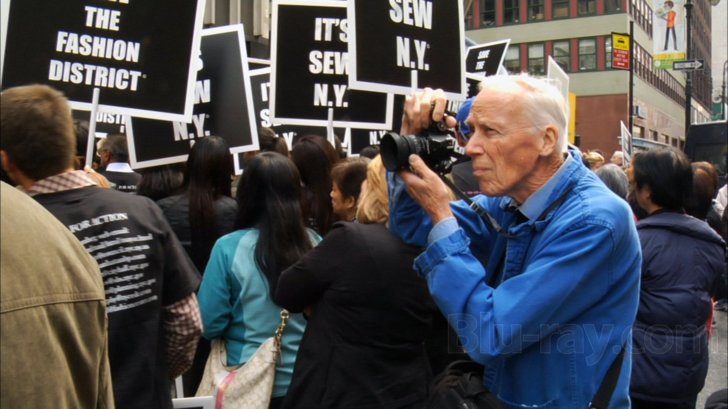
At first glance, BCNY might appear to be another navel-gazing New York story about a subject of little interest to the rest of the planet. But it's more accurate to view the film as a portrait of an adventurer who, as a young man seeking his place in the world, happened to visit his New York aunt and uncle for what was supposed to be a short visit and stumbled upon something that fascinated him. Having found his life's work, he pursued it with a single-minded devotion from which he never deviated, even when temptations abounded. It's intriguing to ponder the two occasions in BCNY when its protagonist displays obvious emotion. One is when he talks about his quest for beauty. The other is when he's asked why he goes to church every weekend. Highly recommended.
Similar titles
Similar titles you might also like
(Still not reliable for this title)

The Arrested Development Documentary Project
Limited Edition
2013
The Great Buster: A Celebration
2018

The Maestro: King of the Cowboy Artists
1994

Dear Zachary: A Letter to a Son About His Father
2008

The Devil at Your Heels
Slipcover in Original Pressing
1981

Hitchcock/Truffaut
2015

Jodorowsky's Dune
2013

The Ambassador
2011

When the Levees Broke: A Requiem In Four Acts
2006

The Queen
1968

Harlan County USA 4K
1976

All That Breathes
2022

GoldenEra
2022

Fire at Sea
Fuocoammare
2016

Salesman
1968
The Story of Film: An Odyssey
2011
La Soufrière
1977

Jiro Dreams of Sushi
2011
The Story of Film: A New Generation
2021

I Think We're Alone Now
Slipcover in Original Pressing
2008