Big History Blu-ray Movie
HomeBig History Blu-ray Movie 
Blu-ray + UV Digital CopyLionsgate Films | 2013 | 442 min | Rated TV-PG | Mar 11, 2014

Movie rating
7.1 | / 10 |
Blu-ray rating
| Users |  | 0.0 |
| Reviewer |  | 3.0 |
| Overall | | 3.0 |
Overview
Big History (2013)
Narrator: Bryan Cranston| Documentary | 100% |
| Nature | 65% |
| History | 23% |
Specifications
Video
Video codec: MPEG-4 AVC
Video resolution: 1080p
Aspect ratio: 1.78:1
Original aspect ratio: 1.78:1
Audio
English: DTS-HD Master Audio 5.1
Subtitles
English SDH, Spanish
Discs
50GB Blu-ray Disc
Three-disc set (3 BDs)
UV digital copy
Packaging
Slipcover in original pressing
Playback
Region A (B, C untested)
Review
Rating summary
| Movie |  | 2.5 |
| Video |  | 4.0 |
| Audio | | 4.0 |
| Extras |  | 1.5 |
| Overall | | 3.0 |
Big History Blu-ray Movie Review
Reviewed by Jeffrey Kauffman March 4, 2014While the stated goal of The Big History Project, namely “the attempt to understand, in a unified way, the history of Cosmos, Earth, Life and Humanity”, is certainly commendable, curmudgeons may be prone to wondering how this really differs from a traditional rigorous examination of the many interdisciplinary forces which have shaped things from (space)time immemorial. The term “Big History” was coined by historian David Christian in the late 1980s, and Christian’s approach to teaching history has slowly but surely spread to many of the world’s leading institutions. “Big History” got a massive shot in its burgeoning arm when none other than Bill Gates joined up with Christian to found the aforementioned Big History Project, which sought to introduce Christian’s concepts to younger students. Now even the layman is getting schooled in this new approach via History Channel’s Big History, a perhaps unexpectedly interesting series which takes “micro” topics, like salt, and develops them in a decidedly “meta” way. One of Big History’s signal achievements is how it spans various sciences and perspectives to try to knit together how various phenomena helped to make our world what it is today. In the case of salt, for example, it’s shown that beyond the physical need for sodium that virtually all life forms have, culturally every early metropolis wasn’t just built by waterways—they all were sited close to salt deposits. Could this be mere coincidence? Big History also treks across huge spans of time in its examination of some of these supposedly “little” elements. In the case of salt, we’re given brief overviews of everything from the building of The Erie Canal and the subsequent rise of early harbors like New York City to more atavistic presentations of ancient salt licks forged by animals which ultimately became the first paved roads. There’s even some passing information about etymology thrown in for good measure, when we’re informed that every burg in England which ends in “wich” (Greenwich, for example) actually points to a place built either on or near a salt deposit. It’s this somewhat arbitrary but nonetheless focused approach that ultimately gives Big History much of its abiding interest.

There’s little doubt that we live in an attention deficit disorder age, as evidenced by the quick cutting that has become de rigeur in both narrative dramatic films, musicals and even concert videos. Big History perhaps capitalizes upon this trend by delivering a high octane mélange of facts and figures, usually centered around one concept or element. What Big History is trying to do is to, in its own words (as voiced by narrator Bryan Cranston), get away from the “timeline” approach to examining the historical record and instead depicting a kind of three dimensional hologram that attempts to divine connections between events.
What that boils down to is a show that is comprised of quick flashes of information across broad epochs, with connective tissue that might be along the lines of the aforementioned salt, or man’s use of horses, the development of clothing, and precious metals like gold and silver. The series is commendable in how wide its reach is, but there’s a certain shallowness to its endeavors which seems to be an inherent part of how it’s structured. Any given moment in the series typically lasts only a second or two, until we’re careening off on a new “connection”, which itself will be as ephemeral as everything else in the show.
If you can make it past the hyperkinetic video style and equally busy (and noisy) audio mix, there are really fascinating factoids to be gleaned from the series. In the episode about silver, the series gets into a brief (of course) history of American money, revealing that the Peso was actually the first coin of the realm since the United States didn’t have its own mint. A picture on the Peso of a garland encircling a pillar actually morphed into the common symbol for the dollar: $. For those with the patience to wade through an often frenetic enterprise, Big History typically offers at least a few little glimmers of interest like this in any given episode.
The series does have a sleek visual style (if anything is on screen long enough to actually see it), and it also features a typically erudite slate of talking heads, including The Big History Project’s founder David Christian. But as with the main thrust of the series, even these interstitial elements only last for a sentence or two, and the series is rushing headlong into its next offering. Big History may be the “next big thing” in educational series, but this History project tends to revisit several problematic areas of other series on the network, including a too rushed and busy style and writing that often seems tailored to the lowest common denominator. While there is certainly enough here to entertain armchair historians in dribs and drabs, ironically Big History often feels decidedly small.
Big History Blu-ray Movie, Video Quality
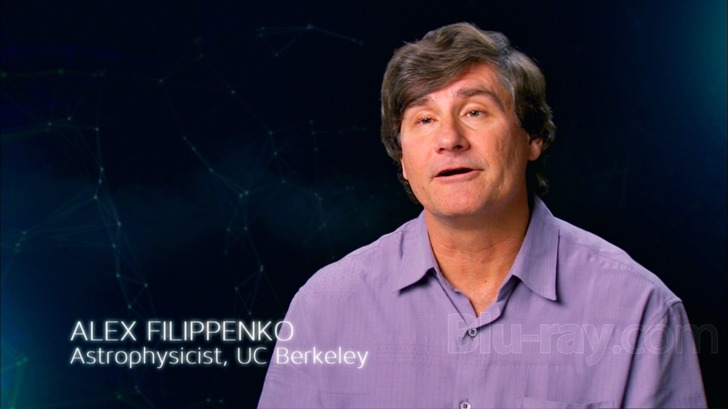
Big History is presented on Blu-ray courtesy of Lionsgate Films and A & E Networks Home Entertainment with an AVC encoded 1080p transfer in 1.78:1. Anyone who has seen a typical History series will know pretty much what to expect here. Big History features a glut of CGI, some of which is fairly soft and often not very well defined. Part of the problem here is that the majority of shots are so quick throughout this series that the eye can't ever become anchored on anything long enough to actually discern whether or not it's sharp, colorful or accurate looking. The talking heads segments at least feature a stationary camera, and as you can see from the screenshots of those moments, things do look nicely detailed, with well saturated and accurate looking color and solid contrast. The series plays with a number of video effects in a ubiquitous manner, intentionally distressing the image or introducing horizontal lines to make the image look like an old broadcast. These elements may add visual interest, but they also tend to make the image look that much softer.
Big History Blu-ray Movie, Audio Quality

History Channel seems to default to the concept that "more is better", and so this DTS-HD Master Audio 5.1 mix is relentlessly noisy, to the point that it actually becomes a bit bothersome after a while (I've mentioned this same proclivity with many other History series). The series is rife with panning effects, huge whooshes of sound that flow through the side and rear channels, and a perhaps unlikely ubiquity of LFE. Cranston's narration is always easy to hear, however, as are the talking heads segments. History would do well to dial their soundtracks down a little, at least occasionally.
Big History Blu-ray Movie, Special Features and Extras

In the "whom do they think they're kidding?" category, both Discs 1 and 2 have a menu option touting "Special Features", which include such incredible supplements as "Bookmarks" (both discs) and "Trailers" (Disc 1). Disc 3 therefore has the only "real" special features.
- Featurettes (1080p; 30:03) include the following 10 shorts:
- Big History
- Are We Alone?
- Common Man
- Complexity
- Connections
- Global History
- Moments
- Mysteries
- Questions
- Thresholds
Big History Blu-ray Movie, Overall Score and Recommendation

Big History is commendable insofar as it wants to invigorate the study of history, but it's so relentlessly manic in both its video and audio elements that it actually becomes off putting after a while. It's absolutely true that history shouldn't be a dry recitations of times, dates and events, and at least Big History attempts to get away from that admittedly boring approach. But shouldn't there be some passing attempt at depth, at least once in a while? Big History sifts through enormous amounts of data in a relatively short period of time, and it's probably unavoidable that in that maelstrom there's worthwhile material to be found. The problem here is that it's so fleeting as to be ultimately meaningless a lot of the time. For those who appreciated this series in its broadcast version, the technical merits of this Blu-ray are excellent.
Similar titles
Similar titles you might also like
(Still not reliable for this title)

Cave of Forgotten Dreams 3D
2010

Mummies: Secret of the Pharaohs 3D
IMAX
2007

In the Shadow of the Moon
2007

Yellowstone: Battle for Life
2009

The Universe: The Complete Series Megaset
2007-2009

The National Parks: America's Best Idea
A Film by Ken Burns
2009

Wings 3D
2014

Last Chance to See
2009

Wild Africa
2015

Tiny Giants 3D
2014

Hurricane on the Bayou
IMAX
2007

Life After People
2008

Asia
2024

Planet Ocean
2012

Wonders of the Universe
BBC
2011

Le monde du silence
The Silent World
1956
An Inconvenient Truth
2006

Journey Into Amazing Caves
IMAX
2001

Journey to the Edge of the Universe
2009

Atmospheres: Earth, Air & Water
2008