Berlioz: Les Troyens Blu-ray Movie
HomeBerlioz: Les Troyens Blu-ray Movie 
Opus Arte | 314 min | Apr 27, 2010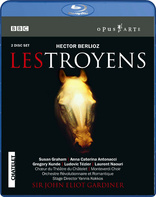
Price
List price:Listed on Amazon marketplace

Movie rating
Movie has not been rated yetBlu-ray rating
| Users |  | 0.0 |
| Reviewer |  | 4.0 |
| Overall | | 4.0 |
Overview
Berlioz: Les Troyens ()
Starring: Susan Graham (I), Anna Caterina Antonacci, Renata Pokupic, Gregory Kunde, Ludovic TézierDirector: Peter Maniura, Yannis Kokkos
| Music | 100% |
Specifications
Video
Video codec: MPEG-4 AVC
Video resolution: 1080i
Aspect ratio: 1.78:1
Audio
French: DTS-HD Master Audio 5.0
French: LPCM 2.0
Subtitles
English, French, Spanish, German
Discs
50GB Blu-ray Disc
Two-disc set (2 BDs)
Playback
Region A (B, C untested)
Review
Rating summary
| Movie | | 4.0 |
| Video | | 4.0 |
| Audio |  | 4.5 |
| Extras |  | 3.0 |
| Overall | | 4.0 |
Berlioz: Les Troyens Blu-ray Movie Review
Rome wasn't built in a day, though Berlioz' gargantuan 'Les Troyens' may seem to last that long.
Reviewed by Jeffrey Kauffman April 29, 2010Richard Wagner isn’t exactly known for his ebullient, vivacious wit. Therefore it was something of a surprise that the Baron of Bayreuth provided me not one, but two, hearty belly laughs as I was researching background information for this review of Hector Berlioz’ Les Troyens. The first laugh came with a sort of tangential Wagner connection, which I’ll phrase in the form of a question: when is a Wagner opera considered small scale? The somewhat hilarious answer: when it’s compared to the mammoth Berlioz piece, a work the composer himself never heard in its complete five act form during his own lifetime. The Paris Opera famously declined to produce Les Troyens because of its size and production requirements, opting instead for the intimate coziness of Tannhäuser. If that doesn’t set you off on at least minor giggles, you haven’t seen enough opera. The second laugh came from Wagner himself, in a rather Xenophobic, yet still uproarious quote to Liszt. Berlioz had long been on the international radar of both German composers, and Wagner confided, “We are three equals, but we must take care not to say so to him (i.e., Berlioz).” Now, that’s comedy.

Cassandra (Anna Caterina Antonacci) doesn't like what she sees coming.
For a composer as gifted and multifaceted as Berlioz, it’s rather odd that both during his lifetime and especially now in the light of posterity, he’s often seen as a second tier composer, certainly not one of the “Alpha Beta’s” (i.e., Bach, Beethoven and Brahms) I mentioned in my recent review of Fidelio. Berlioz seemed to be born under a dark cloud, as it were, with a life fraught with periods of bad luck in both career and romance. Unfortunately, that unlucky streak continued long after his death, where individual pieces like Symphone Fantastique or Harold en Italie were quite rightly proclaimed as masterpieces, and yet his overall oeuvre was somehow perceived to be second rate. That’s especially unfathomable considering the towering achievement that is Les Troyens, certainly one of the grandest of all grand operas, a sweeping piece that traverses myth and history while revealing Berlioz to be one of the most apt libretto setters (and it’s his own libretto, by the way) of his era. In fact, in a head to head contest between Berlioz’ settings for Les Troyens and those of the usually incomparable Beethoven for Fidelio, I personally would give the edge to our French friend. Berlioz seemed to possess the native intuition of how to capture drama in the human voice, something Beethoven came to naturally in his choral writing, but which seemed to elude him, at least partially, in his one and only opera.
This undeniably huge piece opens with the end of the siege of Troy. Outside of Troy’s gates, the Greeks have left a mysterious, large wooden horse, which the Trojans mistakenly believe is a sacrifice to Pallas Athene. Only Cassandra (Anna Caterian Antonacci), who has been gifted by Apollo with prophecy, is able to see the horse as the beginning of Troy’s downfall. Unfortunately, Cassandra rejected Apollo’s advances and so he simultaneously cursed her, causing her prophecies to inerrantly fall on unbelieving ears, including those of her lover Choreobus (Ludovic Tézier). Through a series of mishaps, King Priam (René Schirrer) misinterprets a mystical death at the hands of serpents which emerge from the horse, and has the horse brought inside of Troy’s walls to ultimately be taken to Pallas Athene’s temple. Of course, that leads to disaster, with the fall of Troy coming exactly as Cassandra had prophesied. Trojan commander Aeneas (Gregory Kunde) is visited by the ghost of Hector (Fernand Bernadi) and exhorted to escape to Italy and found a new empire there. Instead Aeneas and Choreobus decide to stay and defend Troy. Choreobus falls in battle, but Aeneas escapes. The death of her lover leads Cassandra to urge suicide for all the Trojan women so that they will not fall into Greek hands. This précis comprises the first two acts of Les Troyens, the acts Berlioz was fated to never hear or see performed live on stage.
Act III begins with more familiar territory, at least for those acquainted with Purcell’s Dido and Aeneas. Dido (Susan Graham) is ensconced as Queen of Carthage, but is facing an attack from Iarbas (Mark Padmore), a neighboring King who wants Dido’s hand in marriage. Enter Aeneas, who has washed up on Carthage’s shore with the surviving Trojans, and offers to help defend Dido from the unwanted advances. Iarbas is defeated, and Dido and Aeneas begin their romantic entanglement, as the Gods attempt to remind Aeneas that he’s really supposed to be heading off to Italy to found that new empire. Hylas (Topi Lehtipuu) pines for Troy, while other Trojan soldiers delight in the pleasures of Carthage. Aeneas finally heeds the call of the Gods, departing to found Rome while leaving Dido distraught and seeking revenge even as she contemplates suicide, revenge which she attempts to cull from the forces of evil, an attempt she sees in her dying moments as ultimately being successful, though it also means the destruction of Carthage. Not exactly a happily ever after moment, is it?
As should be abundantly clear in this summation, Les Troyens is a mammoth piece of writing and, as the liner notes to this excellent release call it, remains the “sum total” of Berlioz’ writing. Here the composer repeatedly reveals his gift for orchestral magnificence, exploiting the three dimensional space of a theater hall in gloriously antiphonal ways, while also crafting both solo vocal pieces and unusually strong ensemble moments that show him to be one of the most assured composers of voice in the operatic firmament. This is a spare but often moving production helmed by director Yannis Kokkos (who better for a Greek tragedy?) that puts the emphasis squarely on the music, with brilliant interpretations by Graham and Antonacci especially. The orchestra and chorus are under the direction of the redoubtable Sir John Eliot Gardiner, who brings scintillating clarity to Berlioz’ often overwhelming lines. While it’s obviously a long production, there’s enough momentum here delivered by an able cast and wonderfully nuanced orchestra to keep most audience members from repeatedly checking their watches.
Les Troyens suffered perhaps more than most from Berlioz’ oddly unappreciated reputation. The entire opera only very recently has begun to enter the repertoire of the larger companies worldwide. This excellent Blu-ray should help to ameliorate that situation. Especially for opera houses who have done Tannhäuser recently.
Berlioz: Les Troyens Blu-ray Movie, Video Quality
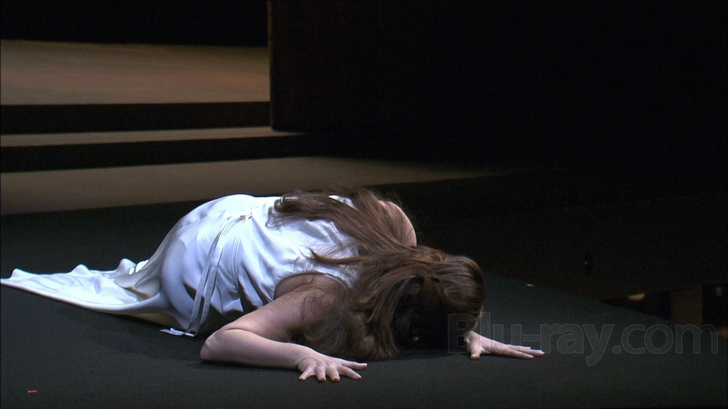
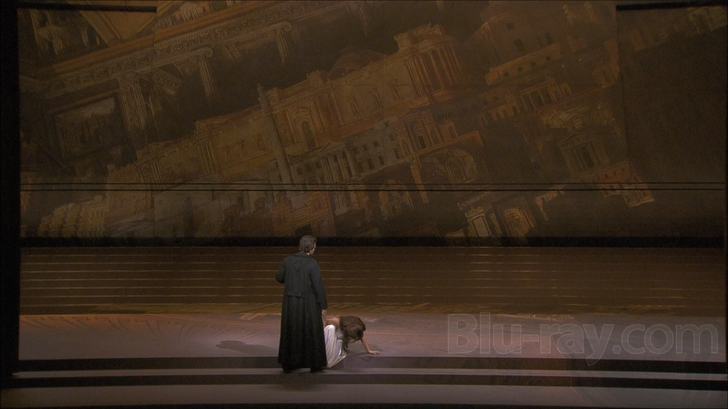
Les Troyens arrives on Blu-ray from Opus Arte with that label's typically excellent, AVC encoded image, with a live 1080i transfer in a 1.78:1 aspect ratio. This is an interesting, often very spare, staging, that relies on a subdued palette for at least its first two acts. Whites, blacks and the occasional blue or red are clearly represented here, with good detail and decent, if not eye popping, saturation. Once we get to the final three acts, colors perk up noticeably, with a very pleasing amount of saturation and nicely varied hues. Flesh tones are accurate, and close-ups reveal a wealth of detail, including everything from makeup to perspiration. Contrast is generally very good, though occasionally the darker moments are a bit hard to completely make out due to some stage lighting issues.
Berlioz: Les Troyens Blu-ray Movie, Audio Quality
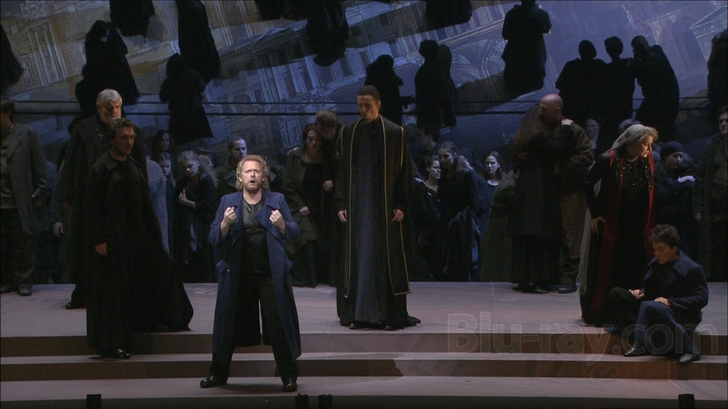
Berlioz was one of the first composers to really think in three dimensions when he wrote his larger pieces, and there's certainly no larger piece in his oeuvre than Les Troyens. That size provides the DTS-HD MA 5.0 mix ample opportunities to exploit surround activity, with a really thrilling spatial separation of orchestral elements, something that Gardiner addresses in the excellent liner notes to this production. Unfortunately, there are occasional balance issues which result from this very same spatial approach, notably with Tézier in Act I, who occasionally just gets swallowed up by the orchestral forces. Toggling between the 5.0 and LPCM 2.0 fold down clearly exhibits this problem. While the 2.0 is obviously much narrower, with none of the ambience or surround activity of the 5.0, suddenly voices which are buried in the 5.0 mix are nicely in the foreground, easily heard. Aside from this perhaps minor quibble, this is really a gorgeously recorded piece. The ensemble choral numbers are literally breathtaking, and Gardiner leads the orchestra and choruses (yes, more than one, including his vaunted Monteverdi Choir) in a brilliantly clear interpretation.
Berlioz: Les Troyens Blu-ray Movie, Special Features and Extras
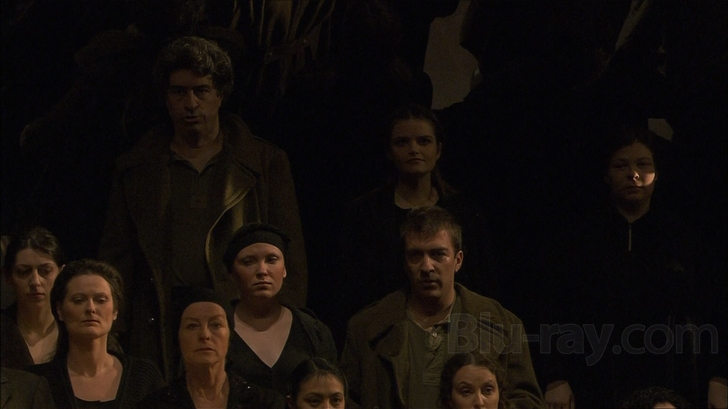
Les Troyens' five acts are spread over two Blu-rays on this impressive set. Disc One features the expected illustrated synopsis, which runs a whopping 9:30. The typical cast gallery is also included. What really elevates the extras is the superb 59:36 feature, The Trojans, or A Masterpiece Revived, full of really insightful commentary by Gardiner and the cast.
Berlioz: Les Troyens Blu-ray Movie, Overall Score and Recommendation
For a composer who contributed so much to theories of orchestration and who himself provided so much brilliant music in a variety of genres, why is it that Berlioz is so often relegated to second class musical citizenship? Hopefully this stellar production of Les Troyens helps rehabilitate Berlioz' reputation. There's rarely been a bigger opera which still provides such intimacy and nuance.