Berlioz: Benvenuto Cellini Blu-ray Movie
HomeBerlioz: Benvenuto Cellini Blu-ray Movie 
Naxos | 2007 | 164 min | Not rated | Apr 26, 2011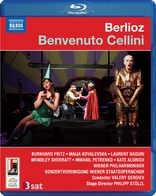
Price
List price:Listed on Amazon marketplace

Movie rating
Movie has not been rated yetBlu-ray rating
| Users |  | 0.0 |
| Reviewer |  | 3.5 |
| Overall | | 3.5 |
Overview
Berlioz: Benvenuto Cellini (2007)
Hector Berlioz's infrequently performed opera is offered in a production from the 2007 Salzburg Festival.
Starring: Laurent Naouri, Kate Aldrich, Burkhard Fritz, Maija Kovalevska, Brindley SherrattDirector: Philipp Stölzl, Andreas Morell
| Music | 100% |
Specifications
Video
Video codec: MPEG-2
Video resolution: 1080i
Aspect ratio: 1.78:1
Original aspect ratio: 1.78:1
Audio
French: DTS-HD Master Audio 5.1
French: LPCM 2.0
Subtitles
English, French, Spanish, German
Discs
25GB Blu-ray Disc
Single disc (1 BD)
Playback
Region A (B, C untested)
Review
Rating summary
| Movie | | 3.5 |
| Video | | 3.5 |
| Audio | | 3.5 |
| Extras | | 0.0 |
| Overall | | 3.5 |
Berlioz: Benvenuto Cellini Blu-ray Movie Review
Is it time to take out or take in the Eurotrash?
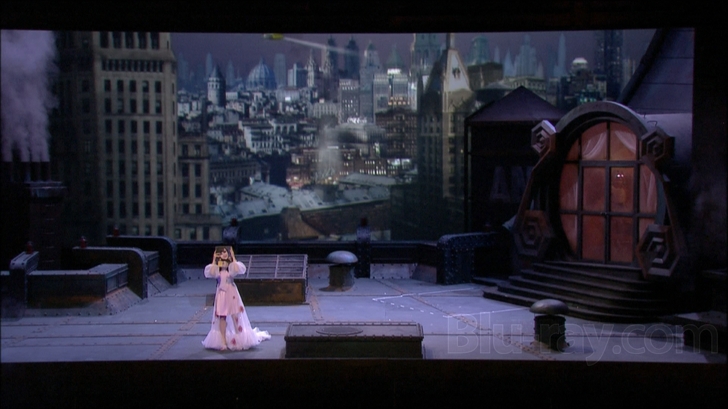
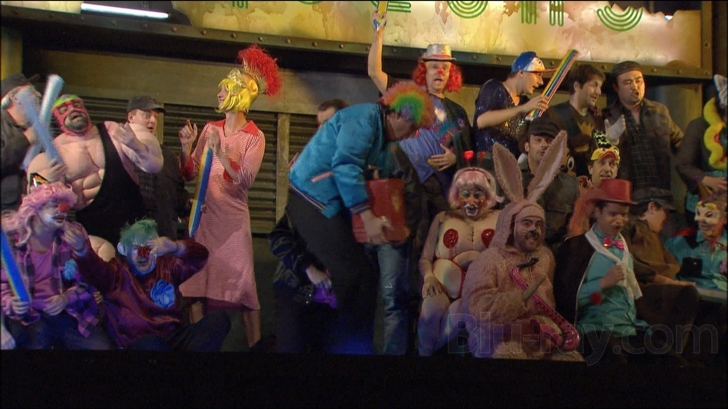
Reviewed by Jeffrey Kauffman May 24, 2011Hector Berlioz seems to be oddly underappreciated a lot of the time. While his massive tone poem Symphonie fantastique, still one of the icons of program music, is solidly in the repertory, and his Requiem and Harold in Italy get trotted out with a fair amount of regularity, his operas are rarely produces. Les Troyens may not be considered very often simply due to its size and scale, but neither Béatrice et Bénédict or Benvenuto Cellini have managed to gain much traction, and in fact it’s for his “dramatic legend” vocal pieces like La damnation de Faust that Berlioz may be best remembered, rightly or wrongly, by opera fans. In fact there has been an absolute dearth of home video offerings of Benvenuto Cellini, despite the opera having been broadcast on television around the world at least a few times since the advent of the videotape, and then the DVD, era. Whether or not this rather odd new mounting, first performed at the Salzburg Festival in 2007, will help to grant Benvenuto Cellini new life, or will in fact scare potential appreciators away, is probably going to a function of how tolerant audiences are for a mounting which comes dangerously close at times to that much derided genre now known as “Eurotrash.” Director and designer Philipp Stölzl has reinvented Berlioz’s buffa in a sort of Hollywood meets Berlin style that melds elements of everything from Fritz Lang’s Metropolis to George Lucas’ Star Wars, with a smattering of Batman thrown in just for good measure. It’s obviously “out there,” intentionally provocative, and probably meant to addle people who want their 19th century operas about Renaissance sculptors to be time-appropriate. But does it work beyond merely pushing people’s buttons?
Either because of or in spite of Benvenuto Cellini being Berlioz’s first attempt at an opera, it is a notoriously difficult piece, technically challenging (some would say well-nigh impossible) for the singers, and tonally a rather odd choice of subject matter for a traditional opera buffa. The first performances of the piece were rather lackluster, something Berlioz attributed to the then prevailing custom of not letting composers conduct their own pieces. Many years after the premiere, Franz Liszt became fascinated with the opera and recommended several changes to the score, which Berlioz undertook. Even then, though, the opera met with less than universal acclaim. Amazingly, the first performance in the United States didn’t take place until 1975 (in Boston), and the Met didn’t deign to produce Benvenuto Cellini until 2003.
The main plot of Benvenuto Cellini is really rather simple, perhaps helping to ameliorate the inherent difficulties of the score and the demands of the physical production. Cellini (Burkhard Fritz), famous Florentine sculptor, is trying to court Teresa (Maija Kovalevska), the daughter of the Papal Treasurer Balducci (Brindley Sherratt). Balducci wants Teresa to marry Cellini’s nemesis, the milquetoast Fieramosca (Laurent Naouri). A planned kidnapping, a failed assassination, and an unexpected killing all come into play, hardly the stuff of your typical “comic” opera, which may indeed be part and parcel of Benvenuto Cellini’s less than glorious history in terms of finding audience approval, not to mention houses willing to actually produce it.
Philipp Stölzl has a rather interestingly diverse background, all of which helps to shed some light on this bizarre recasting of Berlioz’s opera. After working as a design assistant at various German theaters, he became a director of Music Videos for a number of German pop and rock artists. He then went on to direct television commercials, and has also helmed two feature films, Baby and Nordwand. Obviously this is a director enamored of pop culture and he brings that sensibility to full flower (and then some) throughout Benvenuto Cellini. The clash of ideas is actually rather invigorating at times, though cynics may decry that lack of balance and discipline which is evidence onstage throughout a lot of this production. It’s as if Stölzl knew he had been given free reign and was going to throw as many disparate elements at the proscenium to see which, if any, stuck.
Unlike a lot of these completely odd revisionist attempts which I just unabashedly loathe, I’m willing to give credit where credit’s due with this Benvenuto Cellini, albeit with some significant caveats. First of all, this has few of the outright smarmy elements that often populate Eurotrash productions, and that's a decidedly good thing. Stölzl has also taken the “lunatic fringe” elements of the opera and wisely incorporated them into a bizarre, literally carnival-like atmosphere that is perfectly suited to the opera’s ambience, no matter what period the dress and settings may be. That in and of itself lifts this enterprise above most if not all typical “Eurotrash” productions. But at the same time, Stölzl is just plain weird at times, and for no real apparent reason. Two supporting roles are reimagined as operatic counterparts to R2D2 and C3PO, believe it or not, and while it gives the opera some visual whimsy, there’s still the reigning question of “Why?” And a giant bobble-headed Punch and Judy element seems like it was plucked out of Katharina Wagner’s similarly ill-conceived Die Meistersinger von Nürnberg.
This production is also hobbled by a critical piece of miscasting, or at least ill preparation. Burkhard Fritz was thrust into the titular role when the originally slated star withdrew unexpectedly and on short notice. Fritz had been understudying the role, but this is a part that is treacherous even under the best of circumstances, and he just seems vocally unsuited to handle Berlioz’s lines which are often frankly not all that easy to sing in the first place. Much better is Maija Kovalevska as Teresa, though her soprano can be just a tad brittle and grating in its uppermost register. The best thing overall in terms of the music element is without a doubt the precise conducting and playing of Valery Gergiev and the Vienna Philharmonic. That precision is in evidence from the first notes of the piece, that radical deconstruction of G major by Berlioz that seems to be like Rossini on some strange hallucinogenic drug. The difficult dotted rhythms and odd phrasings are handled expertly and crisply by Gergiev and his ensemble.
This is a fascinating production by any standard, and it at least gives opera lovers a chance to see and hear one of the rarest pieces by a major composer. Whether they’ll want to return to this production after a first gander is anyone’s guess, but as a wag once said (or at least should have), one person’s Eurotrash is another person’s Eurotreasure.
Caveat Emptor: There were two small anomalies on the review disc I received. Pressing Play at the Main Menu actually took me to the Audio Options. Also the Pop-up Menu did not function and neither did Top Menu once the feature had begun.
Berlioz: Benvenuto Cellini Blu-ray Movie, Video Quality
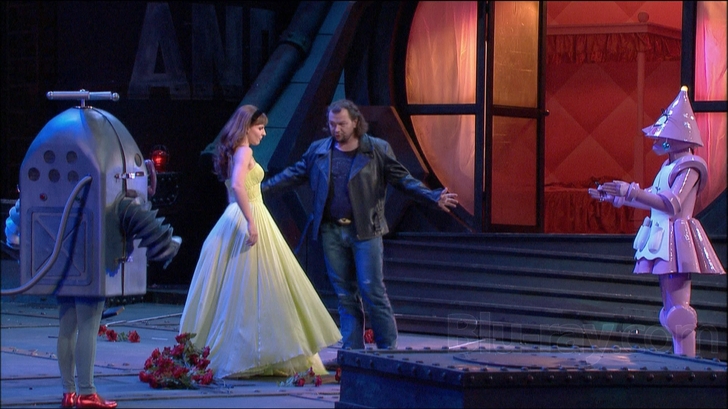
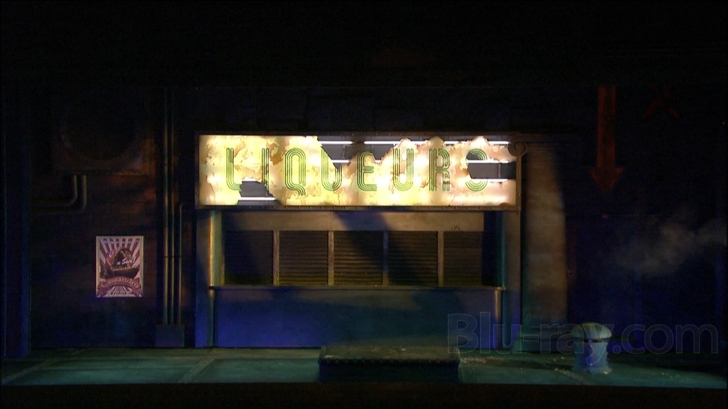
Benvenuto Cellini is presented on Blu-ray courtesy of Unitel Classica and 3Sat (along with distributor Naxos), with an MPEG-2 encoded 1080i image in 1.78:1. This is one of the softer looking opera Blu-rays in recent memory, with a fuzzy and gauzy image that is further hampered by some pretty severe crush, something made even worse by the fact that this opera plays out in darkness or near darkness a lot of the time. The best thing about this visual presentation is the bright color palette, which is alive with a lot of well saturated primary colors as well as some more subtle pastels. Unfortunately even some of these nice hues tend to bloom from time to time, especially toward the red and purple end of the spectrum. While there's nothing here that is probably going to make you want to tear your hair out, the overall look of this Blu-ray is nowhere near as crisp and sharp as we've come to expect from the usually excellent stable of Naxos distributed labels.
Berlioz: Benvenuto Cellini Blu-ray Movie, Audio Quality
Benvenuto Cellini features two lossless audio options, a DTS-HD Master Audio 5.1 mix and an LPCM 2.0 stereo mix. While there are excellent features to both of these tracks, I was immediately struck by how low the volume was mixed on both of these tracks. The difference was completely audible, especially as I had just been watching another Naxos title releasing this month. If you can get past that anomaly (which is after all surmountable by simply turning up the volume), there are some aural pleasures to be had here, chiefly in the orchestra. As mentioned above, Fritz is simply not in good voice here and strains mightily to reach the upper notes Berlioz has written. While Kovalevska is a good deal better, and handles the fleeter aspects of her part with appealing facility, she also sounds slightly brittle in her higher register. But the Vienna Philharmonic makes up for at least some of these problems with a really forceful performance of this score. Berlioz is a somewhat discursive composer, tooling about on tangents and never quite coming to the point, at least some of the time, but under Gergeiv's able baton there's a definite structure on display, and the DTS track supports that very well. I was a little disappointed with the overall balance between the orchestra and the singers, but it may have in fact been mixed that way (with the orchestra "winning" a lot of the time) in order to hide some of the vocal problems the cast was experiencing. Fidelity is strong throughout, though, and dynamic range is very impressive (be prepared for some perhaps unexpected LFE toward the opera's end).
Berlioz: Benvenuto Cellini Blu-ray Movie, Special Features and Extras
No supplements are offered on this Blu-ray, other than the insert booklet which contains some background and a plot synopsis.
Berlioz: Benvenuto Cellini Blu-ray Movie, Overall Score and Recommendation
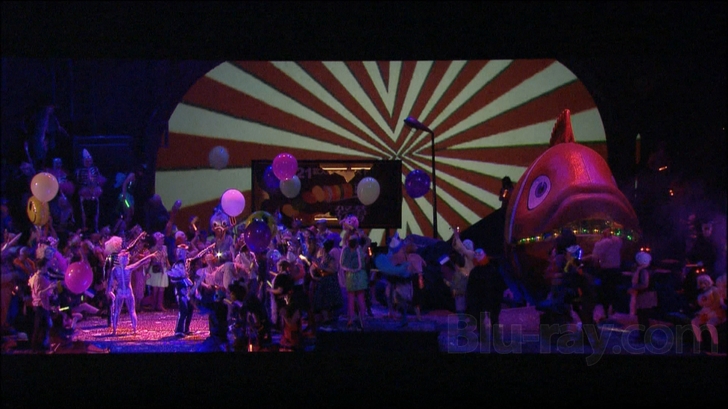
How adventurous are you? Perhaps the opportunity to see this largely forgotten and hardly ever performed opera is enough to get you past some of the decidedly odd directorial choices on display here. Those of you who have read some of my blistering reviews of what I at least deem Eurotrash know I do not suffer these attempts at modernization gladly. So the good news is I was at least able to tolerate if not outright love this Benvenuto Cellini, and you might therefore be able to judge your own reaction relative to mine. There's no denying that Stölzl has imbued this production with a fair amount of whimsy. Whether or not it's actually relevant to the piece itself can be argued. But if you are in the mood for something decidedly different, you may want to check out this odd production of a piece which is hard enough to see in any case.