Berg: Lulu Blu-ray Movie
HomeBerg: Lulu Blu-ray Movie 
Royal Opera House 2009Opus Arte | 2009 | 177 min | Jul 27, 2010

Price
List price:Amazon: $22.05 (Save 45%)
Third party: $22.05 (Save 45%)
Temporarily out of stock.

Movie rating
6.9 | / 10 |
Blu-ray rating
| Users |  | 0.0 |
| Reviewer |  | 4.5 |
| Overall | | 4.5 |
Overview
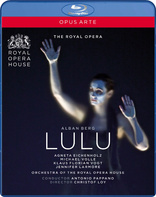
Berg: Lulu (2009)
Starring: Agneta Eichenholz, Michael Volle, Klaus Florian Vogt, Jennifer Larmore, Gwynne HowellDirector: Robin Lough, Christof Loy
| Music | 100% |
Specifications
Video
Video codec: MPEG-4 AVC
Video resolution: 1080i
Aspect ratio: 1.78:1
Audio
German: DTS-HD Master Audio 5.1
German: LPCM 2.0
Subtitles
English, French, Spanish, German
Discs
50GB Blu-ray Disc
Single disc (1 BD)
Playback
Region A (B, C untested)
Review
Rating summary
| Movie | | 4.5 |
| Video |  | 4.0 |
| Audio |  | 5.0 |
| Extras |  | 3.0 |
| Overall | | 4.5 |
Berg: Lulu Blu-ray Movie Review
"Someone told me it's all happening at the zoo. . ."
Reviewed by Jeffrey Kauffman July 25, 2010One of the funniest things I’ve ever received in an email was an outrageously funny audio file spoof of those old K-Tel commercials where you’d be assaulted by snippets of hundreds of various “greatest hits”, all assembled for your buying pleasure on two long playing albums, cassettes or 8 Track tapes. What made this parody so incredibly hilarious was that it was an ersatz commercial for the greatest hits of the 12 tone composers, including (in the dulcet tones of the side splittingly spot on narrator), “all of the most popular 12-tone rows that only this morning you were whistling in the shower.” Though a lot of the humor would probably be apparent even to those not particularly schooled in music history or theory, there was one fairly subtle moment which literally had me laughing out loud. “How many times have we been stunned by the virtuoso writing in [Alban Berg’s] violin concerto?” asks our trusty narrating pitchman, at which point we hear the unstopped open strings of the violin playing ascending fifths. In fact Berg comes in for several mentions in this perfect satiric piece including a wonderful example of a “catchy melody from. . .Altenberg Lieder.” Of course anyone who’s muddled through the often opaque depths of any dodecaphonic piece will probably tell you, at least if they’re being honest, that it can be tough slogging at times, hardly ever exactly “catchy”. That’s what may therefore come as a surprise for those unanointed into the mad world of Berg’s Lulu, though; this is a ravishingly lyrical piece at times which exploits a post-Romantic tonal vocabulary as much as it does anything exclusively “row” oriented.
"Dammit, I've killed another one!"
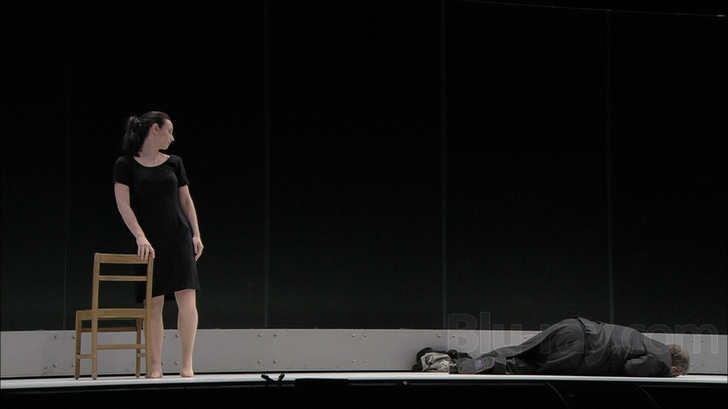
In an operatic world filled with seductive and destructive females, Lulu stands alone as one of the most complex and enigmatic characters ever to wreak havoc upon (several) poor men’s souls. Originally a character in two proto-Expressionist plays by Franz Wedekind (the same playwright who inspired the recent Duncan Sheik rock musical Spring Awakening), Lulu became a sensation both on stage and several years later when Louise Brooks embodied her in the iconic silent film Pandora’s Box by Georg Wilhelm Pabst. (In fact I highly recommend anyone unfamiliar with the background of this character to run—don’t walk—out and buy the Criterion Collection’s wonderful edition of Pandora’s Box). In the operatic version, Lulu (Agneta Eichenholz) is introduced as a “human snake” by the Animal Trainer (Peter Rose), who talks about his “charges” as part of a menagerie which will reveal the depths and degradations of the human condition and is not meant to be a bourgeosie entertainment. What enfolds over the ensuing three acts (in this reconstituted version by Friedrich Cerha which completes the final act which Berg left unorchestrated upon his death) is an anecdotal journey through a dark and tormented world where Lulu’s interaction with any given male more often than not spells certain death.
Lulu is no run of the mill femme fatale, however, and that mysterious quality is demonstrated both in the sometimes inexplicable effect she has on the various males who become ensnared by her serpentine allure, but also in the series of nicknames the various characters bestow upon her. As the Animal Trainer makes clear in the prologue, Lulu is a type, a symbol for all women, and she therefore assumes manifold identities as the opera proceeds. To Dr. Schön (Michael Volle), she is “Mignon”. To the Painter (Will Hartmann), she is “Eva”. On and on it goes, until the chilling denouement of Act III occurs, when Lulu has her own fated interaction with a man with a soubriquet—namely, Jack the Ripper.
The music of the serial school is so often unbearably dense as to be unlistenable at times. It’s intellectualism run amok, a system without a soul and often with the only emotional import one of angst and chaos, certainly redolent of the era from which this compositional technique sprang. How bracing it is, then, to hear this often cold and calculating approach given the lush treatment it receives from Alban Berg. Despite the jokes alluded to in my first paragraph, Lulu is a remarkably melodic opera, at least in the often arcane genre of dodecaphony. Berg doesn’t just mechanically repeat tone rows, though he introduces individual rows for each main character; instead he blends, transmogrifies and often lays rows side by side to create block chords that resemble the altered dominant seventh structures that Wagner and others began utilizing a compositional generation earlier.
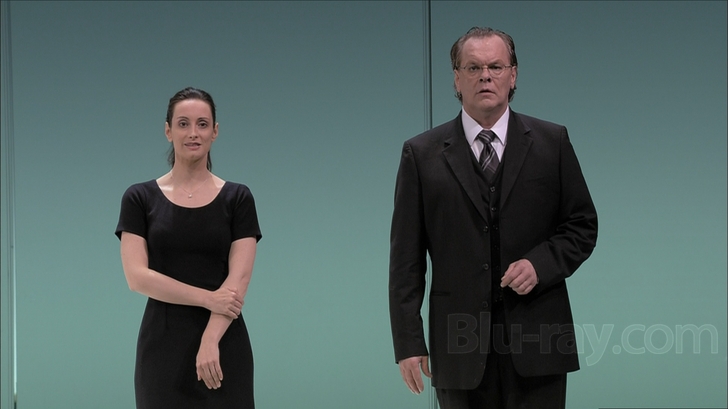
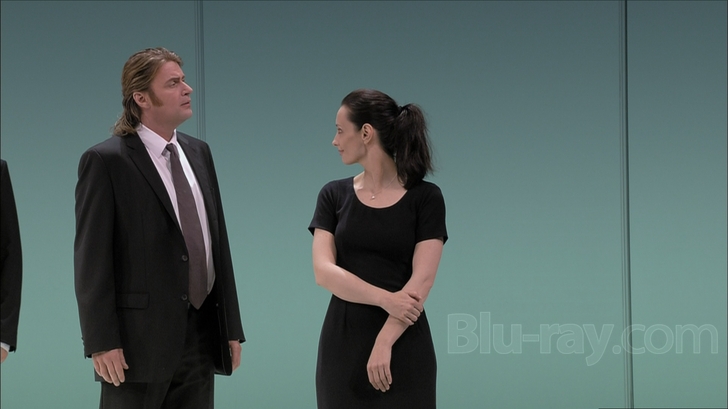
This Royal Opera House production is a study in minimalism, which is both inviting at troublesome, depending upon your history with Lulu. We have no painting, no film, nothing but a resolutely black and white stage with only the characters and Berg’s iconoclastic music as our guides. And yet that very black and white ethos hints at the filmlike qualities of this presentation, one which seeks to remind us constantly of the disconnect these characters are experiencing, much like an audience viewing a movie. There’s always a certain distance between the experience and the experiencer, nowhere in more stark relief than in the character of Lulu, who is such a cipher that she can be seen as both victim and conniving seductress, often simultaneously. And yet even she seems hypnotized by the awful tragedies she either witnesses or causes (depending on your point of view), an emotional zombie passing through the maelstrom without a hair out of place.
Because this production eschews virtually all stagecraft, it puts the emphasis squarely on Berg’s music, and though this is not the angular performance of, say, a Boulez, under Antonio Pappano’s excellent direction the Royal Opera House orchestra delivers a fierce, if somewhat muted, performance of Berg’s score. The performances of the singers are all incredible, with Eichenholz’ Lulu and especially Michael Volle’s titanic Dr. Schön the standouts.
This was a brave choice by the Royal Opera House and director Christof Loy. This company is just as apt to be doing their umpteenth rendition of Carmen while the sometimes edgier English National Opera takes the real chances. But this is a fine and fascinating exploration of one of the epochal scores of the 20th century, one which doesn't require a lot of bells and whistles to bring its devastating emotional lessons home. It may not be exactly "catchy," but this Lulu is unforgettable.
Berg: Lulu Blu-ray Movie, Video Quality
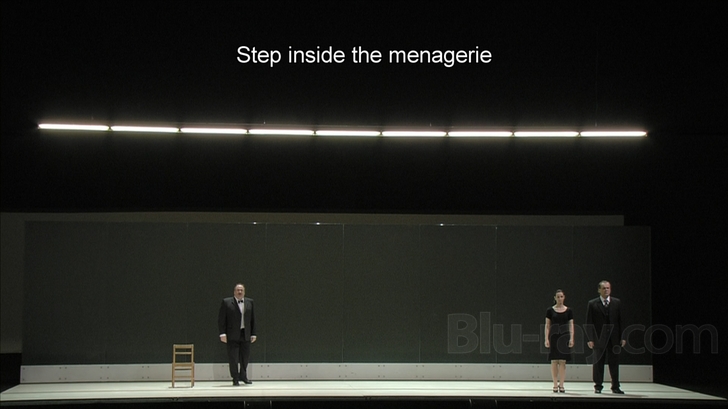
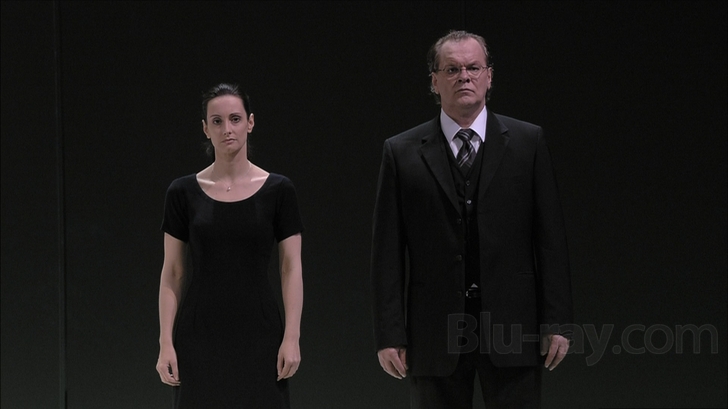
There is next to nothing to see in this Lulu, and that is a purposeful decision on the part of director Christof Loy. We have an empty stage, often flooded with darkness, upon which the actors, all in black and white, move about their isolated worlds, arguably like living shadows. About the only color that comes into play in this AVC encoded 1080i image (with a 1.78:1 aspect ratio) is the blood which dots various deceased people in the opera. All of this said, this is an accurate recreation of the live performance, with brilliantly evocative black levels and excellent contrast. Lulu's "little black dress" never crushes into the background, and the men's gray to black suits are also very well gradated. Flesh tones are accurate and detail overall is excellent, though it's limited often to lines on a face or fabrics of various costumes. The image does tend toward softness some of the time, which is the only real detriment here other than the fact that there's simply not a lot to look at.
Berg: Lulu Blu-ray Movie, Audio Quality
Lulu's dense and challenging music is given a ravishingly successful treatment on both of the lossless tracks offered on this Blu-ray, a DTS-HD Master Audio 5.1 and an LPCM 2.0 stereo fold down. Huge slabs of tone pour over the listener in the 5.1 mix, but the most amazing thing about this recording is the clarity of interior lines. At last the listener can really hear how Berg liked to line up rows side by side and deliver quasi-Romantic chord structures (which often are interpolated with actual traditional—an even triadic at times—structures that form like temporary islands in the otherwise chaotic seas). This is a very spacious and well separated recording which helps to clarify the lyrical aspects of Berg's writing. All of the singers sound marvelous, and the recording boasts an incredible level of dynamic differences. There's also some thrilling low end delivered by tympani tremolos and Berg's massed brass work. While this may not be the most "athletic" reading of Lulu ever delivered, it's a vibrant and measured account of the score that is really beautifully recorded and performed.
Berg: Lulu Blu-ray Movie, Special Features and Extras
Aside from a cast gallery, there are two excellent, albeit brief, HD interviews included on the disc, one with conductor Pappano (14:20) and another with star Eichenholz (14:18). The insert booklet contains a very good essay as well as a plot synopsis.
Berg: Lulu Blu-ray Movie, Overall Score and Recommendation
This may be too recondite a production with which to make your introduction to Berg's Lulu, a rather ironic fact given this offering's minimalism. However, it's that very minimalism that perhaps makes the opera less "comfortable" (if Lulu could ever be comfortable) for those who haven't yet plumbed the tumultuous emotional depths of the piece. That very lack of stagecraft, however, may indeed be an extra calling card for those who want to experience the music in an unadorned, completely visceral, way. Lulu is not an easy piece for any number of reasons, but this thrilling and often daring interpretation makes it abundantly clear that Berg wasn't hamstrung by the 12-tone system. Highly recommended.