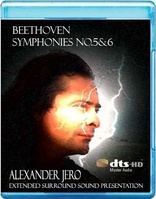
Beethoven: Symphonies No. 5 & 6 Blu-ray Movie
HomeBeethoven: Symphonies No. 5 & 6 Blu-ray Movie 
Arts and Music Expressions SeriesMediaInVision | 2010 | 67 min | Not rated | Oct 19, 2010
Price
List price:Listed on Amazon marketplace

Movie rating
Movie has not been rated yetBlu-ray rating
| Users |  | 0.0 |
| Reviewer |  | 3.5 |
| Overall | | 3.5 |
Overview
Beethoven: Symphonies No. 5 & 6 (2010)
| Music | 100% |
Specifications
Audio
Music: DTS-HD Master Audio 7.1
Discs
25GB Blu-ray Disc
Single disc (1 BD)
Playback
Region A (B, C untested)
Review
Rating summary
| Movie | | 3.5 |
| Video | | 0.0 |
| Audio |  | 4.5 |
| Extras | | 0.0 |
| Overall | | 3.5 |
Beethoven: Symphonies No. 5 & 6 Blu-ray Movie Review
Who's that knocking at the door?
Reviewed by Jeffrey Kauffman January 13, 2011Modern recording techniques have come alarmingly far in just a few short years. I’ve had the pleasure of having several commercial recordings released, and my earliest days in the recording studio were spent amid the flutter of reel to reel tapes. Later, exciting “improvements” like audio Betamax (yep, you read that right) and then digital media like ADATs came into play. Over the past couple of decades-plus, we’ve seen the advent of hard drive recording systems, with the ubiquitous use of bells and whistles like ProTools, which can make even amateurs (are you listening, Ashlee Simpson?) sound at least passable, what with pitch correction, WAV editing and the like. Casual listeners to modern day product might be quite surprised to see how a recording is assembled, and assembled is, for better or worse, the correct term. Even back in the days of analog recordings, it wasn’t unusual for rhythm tracks to be laid down first, often with “scratch” vocals, and then for the vocalist to come in to take their final version at a later date. While editing was certainly a more involved procedure back in the day, tape editors became so facile with their “archaic” medium that even syllables could be fairly seamlessly fixed for a final product. (Anyone wanting a good laugh should listen to John Barry’s commentary on You Only Live Twice, where he details the editing lengths they had to go to get a final take of Nancy Sinatra’s vocal on the title tune). However, as often as pop, rock and even Broadway cast recordings were “assembled” in the halcyon days of the 1950’s, 1960’s and 1970’s, even after the advent of hard drive recording, you could count on one genre to preserve at least a semblance of the “live” ensemble experience, and that was of course classical music. Not anymore. Choral composers like Eric Whitacre have pioneered the idea of a “virtual choir,” where people separated by continents are able to “join together” to sing via such media as YouTube. And now we are introduced to an “assembled” orchestra under the “virtual baton” of Alexander Jero, who releases audio Blu-rays under a variety of labels like Surround Records and Media in Vision.
Jero has been a pioneer in audio Blu-ray and has released several outstanding discs where he’s licensed previously recorded material and repurposed for hi-def audio in often rather striking surround versions. Jero now has a slew of new products out where there’s frightfully little information imparted in either (non-existent) insert notes or even Jero’s online presence. In exchanging some emails with Jero, some rather interesting information has been imparted. Jero is recording a glut of classical warhorses anew, hiring college students to come into his private studio to work under his own baton (hence the ubiquitous use of his image on the covers of all of these releases, something that has caused some comment here on Blu-ray.com). However, these are not live ensemble recordings in the traditional sense. Jero brings sections in separately, and records them, often utilizing previous recordings as reference material. He then assembles the final product in the mixing room. It’s an unusual approach for a genre as hopefully organic as classical music, and listeners’ reactions may be colored by the knowledge that high tech wizardry has at least helped to craft the architecture of any given performance.
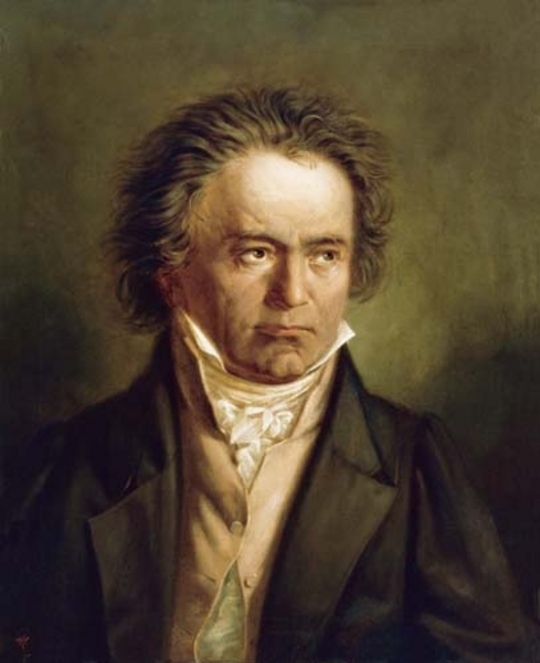
Beethoven sits so resolutely atop the mountain of late 18th and early 19th century music that he has assumed an iconic status that is at the same time unusual. His music has become so familiar to so many people that he is one of the few titans of classical music whose themes can easily be hummed by schoolchildren, and even those without even a passing interest in this idiom know at least a few salient facts about the composer’s life, notably his late career deafness. With the weird dual veneer of the familiar and unapproachable with which Beethoven seems to be covered, his music often is simply seen (and/or heard) as a “given,” something that’s just “there,” take it or leave it. The symphonies float by on your CD player or radio and often times little attention is paid, even as the strains of a frequently heard melody waft through the air.
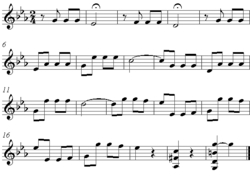
Jero’s approach to these two Beethoven Symphonies is, in the case of the Fifth at least, unusual. I have never in my life heard the opening movement of the Fifth taken at such a brisk tempo, and I had to wonder what reference recording Jero utilized to help him shape his take on this movement. This isn’t fate knocking at the door, it’s fate bursting through the door with a bulldozer. While it’s true that Beethoven is often treated with such extreme respect that interpretations of his pieces can come off as overly staid and stilted, the opening movement of Jero’s Fifth just left me breathless, and not necessarily in a good way. Luckily, things improved, albeit fitfully, through the rest of the Symphony. Tempi were still inexplicably fast a lot of the time, but there was some unusually fine playing, especially from the strings.
The Sixth is supposed to be a more relaxing, sylvan affair than the brusque Fifth, and Jero calms down at least a little bit in his approach to this “Pastoral” piece. I still would have preferred a calmer, more nuanced approach, but there is some exceptional attention to detail along the way here, with some nice tenuti and phrasing that help to give the listener at least the option of breathing (as it were) now and again. Jero is evidently about to embark on some Master’s level conducting studies, and it’s my hope that once he works repeatedly with a complete ensemble, under the tutelage of a “real” conductor (as opposed to simply utilizing reference recordings), he’ll be able to fully realize what is undoubtedly the real talent he already possesses.
Beethoven: Symphonies No. 5 & 6 Blu-ray Movie, Audio Quality
You may have qualms about Jero's interpretations of these classic scores, but few of you should have any issues with the sterling audio quality of this Blu-ray. Jero has always done an outstanding job with his audio Blu-rays, and these Beethoven Symphonies are certainly no exception. The DTS-HD Master Audio 7.1 mix is brilliantly effective, with excellent separation between sections and oustanding fidelity. The surround mix is about as immersive as one could hope for, and indeed in listening many people may think that they, not Jero, are the "virtual conductor." Jero has very smartly placed the orchestral masses according to their typical sectional positioning and the utilization of the rear surrounds also adds some decent (albeit "artificial") hall ambience. These are two "warm" recordings, with very nicely burnished string and brass sounds. Fidelity is top notch through all frequency ranges and the dynamic range is completely amazing, capturing everything from the bombastic opening of the Fifth and "storm" sequence of the Sixth to the quieter, more reflective and lyrical passages that both Symphonies contain.
Beethoven: Symphonies No. 5 & 6 Blu-ray Movie, Special Features and Extras
No supplements are offered, and I would encourage Jero to do a couple of things to increase the marketability of his efforts. First off, some sort of contextual information on the insert or even an insert booklet would be most appreciated. Also, an on-screen menu would be helpful. Jero's chapter stops are not always relegated to individual movements, as logically they should be.
Beethoven: Symphonies No. 5 & 6 Blu-ray Movie, Overall Score and Recommendation
Get ready for one of the briskest openings of the Fifth you'll probably ever hear. Jero will no doubt grow as a conductor as his studies continue. It's a bit difficult to assess the artistry of something like this which utilized reference recordings and most likely high tech editing. The playing is often quite excellent, despite these musicians being "only" at the college level, according to Jero. The recording itself is stellar and shows off Jero's engineering expertise in a very favorable light. Recommended.