Beethoven: Symphonies 4 & 7 / Coriolan Overture Blu-ray Movie
HomeBeethoven: Symphonies 4 & 7 / Coriolan Overture Blu-ray Movie 
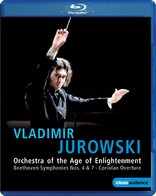
Vladimir JurowskiIdeale Audience | 2010 | 89 min | Not rated | May 31, 2011

Movie rating
7.2 | / 10 |
Blu-ray rating
| Users |  | 0.0 |
| Reviewer |  | 4.0 |
| Overall | | 4.0 |
Overview
Beethoven: Symphonies 4 & 7 / Coriolan Overture (2010)
This all Beethoven program brings together two lesser known symphonies and the Coriolan Overture, performed in Paris on period instruments by the Orchestra of the Age of Enlightenment.
| Music | 100% |
Specifications
Video
Video codec: MPEG-2
Video resolution: 1080i
Aspect ratio: 1.78:1
Original aspect ratio: 1.78:1
Audio
English: DTS-HD Master Audio 5.1
English: LPCM 2.0
Subtitles
None
Discs
25GB Blu-ray Disc
Single disc (1 BD)
Playback
Region free
Review
Rating summary
| Movie | | 4.0 |
| Video |  | 3.5 |
| Audio |  | 4.5 |
| Extras | | 0.0 |
| Overall | | 4.0 |
Beethoven: Symphonies 4 & 7 / Coriolan Overture Blu-ray Movie Review
Just close your eyes and enjoy the music.
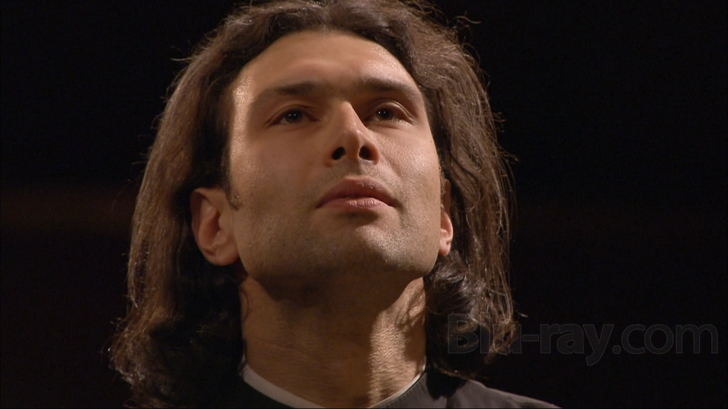
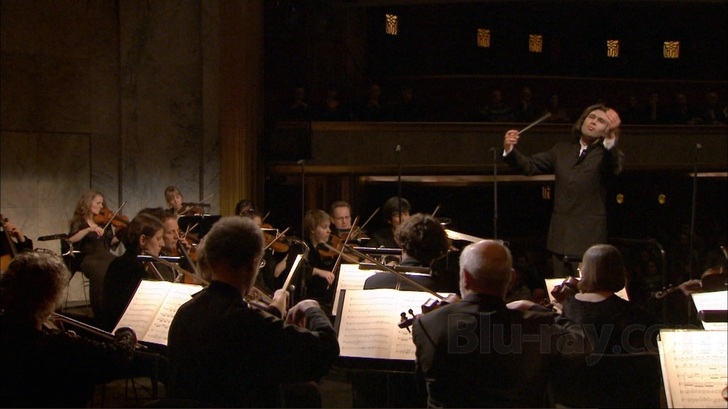
Reviewed by Jeffrey Kauffman May 20, 2011Conductors are a relatively recent phenomenon in the annals of classical music. In days of yore, ensembles would simply let the concertmaster or some other appointed putative leader give a head nod or two when movements were set to begin, and then the players were left to fend for themselves, establishing their own kind of communication and rapport. Those days are obviously past (though occasionally conductorless ensembles do arise), and for decades now we’ve been in an era of “star conductors.” Some of these people have no doubt warranted their public and professional acclaim. Their knowledge of the music they lead is phenomenal, they attend to every jot and tittle of the interpretation, and they wrest an unruly mob of musicians into a coherent whole, something one wag has compared to herding cats. But this “star conductor” phenomenon can also lead to some baton wielders getting a rather hubristic view of themselves, and I couldn’t help but wonder if that’s the case with Vladimir Jurowski, the Principal Artist of the wonderful Orchestra of the Age of Enlightenment. Jurowski is a younger man, and he is highly—as in highly—emotive on the podium. What’s rather odd about his conducting style is not just the fact that he’s obviously only too aware that multiple cameras are pointed in his direction, he eschews actually using his baton for long periods of time, simply leaving it hanging in mid-air while his left hand and arm go through a patently weird assortment of spasmodic motions. While Jurowski comes from a famous Russian musical family (his father Mikhail was a well known conductor), and has conducted to great acclaim all over the world, these sometimes bizarre histrionics are probably going to be off putting to some. They seem to at least temporarily draw attention away from the Orchestra of the Age of Enlightenment itself, and that may occasionally bother some viewers of this interesting period instrument performance of three Beethoven warhorses, as it did me.
The concert leads off with Beethoven’s Coriolan Overture, Op. 62, a rather interesting piece that rustles up a huge sonic storm and then seems to end in either quiet resignation or simply pure exhaustion. The Roman General Coriolanus is well known to Shakespeare lovers, but Beethoven’s Overture is actually for a much lesser known account of the life of the military legend by Heinrich Joseph von Collin, brother of the tutor of Napoleon’s son. This brief piece shows Beethoven in his full “sound and fury” mode, with tempestuous rhythms and dramatic sforzandi penetrating the ranks of the orchestra. It is a bit strange how quietly the piece ends, however, not with a bang but with a whimper of sorts. There’s a bit of a sloppy start here (not the only one, unfortunately), which I attribute to some tentative downbeat indications that Jurowski gives the players, but otherwise this is a solid reading, if not quite as nuanced as the excellent period performance conducted by Roger Norrington.
Both of the Symphonies performed on this disc have frequently been eclipsed by their better known siblings. The Fouth is especially underappreciated in this regard, having had the unfortunate fate to be sandwiched in between two of the most iconic pieces in all of symphonic literature, let alone Beethoven’s particular oeuvre. The Symphony’s relative lack of renown evidently started early, as Beethoven had a hard time even getting the thing published. But the Symphony itself is often seen as problematic, starting with a slow, tentative opening that has little of the immediacy of either the Third or Fifth. But the Fourth is a decidedly enjoyable affair, especially ebullient in its faster movements, where Beethoven is at the height of his creativity, throwing out one brilliant theme after another and playing with variations effortlessly. Jurowski is surprisingly restrained in his tempi here, especially in the Menuetto.
Most Beethoven fans have their favorite symphonies and really obsessive fans have their favorite movements within the entire symphonic output of Beethoven, and that’s the case with yours truly. I have always loved the gorgeous Allegretto of the Seventh. Its charming refusal to reveal itself as either major or minor, and that haunting main theme have always spoken to me as perhaps no other single movement in Beethoven’s output has. Jurowski does good work here throughout the Seventh, again seeming to err on the side of caution a bit too much, but finally letting loose with the bombastic Allegro con brio which forcefully closes the piece.
The Orchestra of the Age of Enlightenment is that rare classical ensemble without a full time conductor, with the orchestra itself deciding it could govern itself in the spirit of democracy and choose individual conductors on a project by project basis. Jurowski shares his “Principal Artist” status with Sir Simon Rattle and Iván Fischer. He is therefore certainly the youngest and at least temporally the least experienced of the three, and that inexperience shows in both his manner and occasionally the results he culls from the players. The good news is, the players themselves are in fact “self governing” and probably don’t need someone doing the figurative Hokey Pokey in front of them, and that is the saving grace of these performances. Period instruments are notoriously difficult to play, with an added precision of technique necessary to evince correct intonation, and in that regard the Orchestra of the Age of Enlightenment is unmatched. These are beautifully played performances that manage to rise above the theatrics of their young conductor. This may be one Blu-ray you’ll want to just listen to, ignoring the images.
Beethoven: Symphonies 4 & 7 / Coriolan Overture Blu-ray Movie, Video Quality
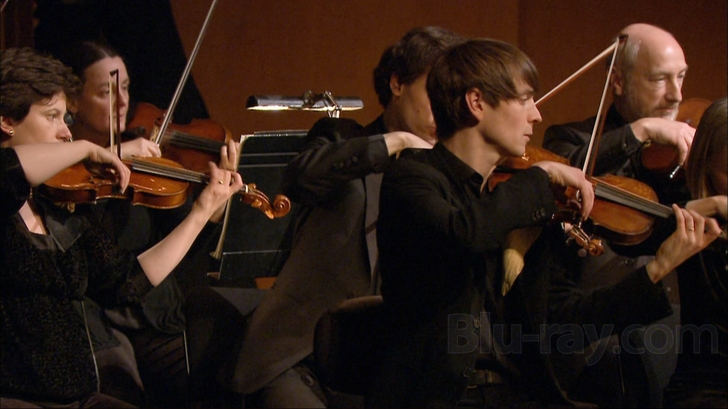
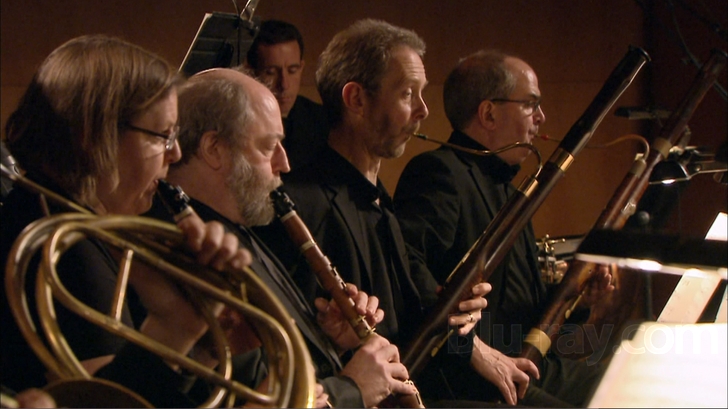
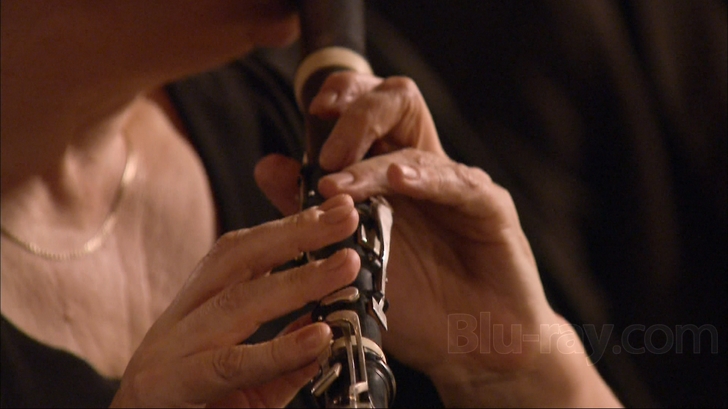
Vladimir Jurowski Conducts the Orchestra of the Age of Enlightenment: Beethoven Symphonies 4 & 7 and Coriolan Overture arrives on Blu-ray courtesy of Idéale Audience and EuroArts with a decent looking MPEG-2 encoded 1080i transfer in 1.78:1. This performance takes place at the opulent Théâtre des Champs-Elysées in Paris, a hall that is well lit and provides a good view of the orchestra and (for better or worse) Jurowski himself. It's fun to see some of these older instruments in action, and a variety of close-ups gives us very good to excellent fine detail as the players work through the challenges of these older, less technically refined instruments. Black levels are exceptional here (note how Jurowski's black Nehru jacket never crushes into the shadows of the black background), and contrast is generally strong. The entire image is just a tad on the soft side, but it's nothing too egregious.
Beethoven: Symphonies 4 & 7 / Coriolan Overture Blu-ray Movie, Audio Quality
These period instrument performances are delivered via two excellent lossless audio options, DTS-HD Master Audio 5.1 and LPCM 2.0. For the record, there was one weird anomaly I encountered when attempting to choose the DTS-HD Master Audio 5.1 mix by toggling between my audio options on my BD remote. For some reason everytime the BD moved to the next movement, it reverted to the LPCM 2.0 mix. Choosing the DTS-HD Master Audio 5.1 mix from the main menu under the Audio options seemed to keep the audio squarely on the surround mix. The 5.1 mix is extremely inviting and spacious, and the good news is that neither of these options belie any "dryness" of sound, frequently a bugaboo of period instrument readings. Balance is excellent throughout, and dynamic range is exceptional. Fidelity is also spot on. There is one unfortunate audience member who keeps coughing, but I suppose you could chalk that up to making this soundtrack even more realistic.
Beethoven: Symphonies 4 & 7 / Coriolan Overture Blu-ray Movie, Special Features and Extras
No supplements other than trailers are included on the disc. The insert booklet contains the requisite (albeit in this instance rather brief) essay.
Beethoven: Symphonies 4 & 7 / Coriolan Overture Blu-ray Movie, Overall Score and Recommendation
I no doubt suffer from my own classical music upbringing and training in both performance and conducting duties, having been taught a really competent interpreter doesn't need to be flouting anything on his or her face, or through exaggerated body movements. That training has stuck with me, for better or worse, and may color my less than impressed reaction with the over the top histrionics of Jurowski. The performances here, despite a couple of pretty sloppy starts, are overall excellent, revealing the always capable Orchestra of the Age of Enlightenment to be one of the leading period instrument ensembles in the world. While there's nothing really earth shatteringly different in these period instrument recastings of the Beethoven (unlike the amazing Mackerras period Brahms cycle of a few years ago), they're enjoyable and illuminating in their own quieter ways. Recommended.