Beethoven: Fidelio Blu-ray Movie
HomeBeethoven: Fidelio Blu-ray Movie 
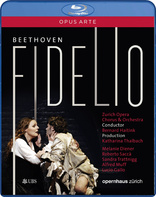
Featuring Gallo / Sacca / StrazanacOpus Arte | 2010 | 149 min | Rated G | Apr 27, 2010
Price
List price:Amazon: $36.76 (Save 8%)
Third party: $36.76 (Save 8%)
Temporarily out of stock.

Movie rating
Movie has not been rated yetBlu-ray rating
| Users |  | 0.0 |
| Reviewer |  | 4.0 |
| Overall | | 4.0 |
Overview
Beethoven: Fidelio (2010)
The Beethoven's opera remains a fascinating look inside his own creative process.
Starring: Roberto Saccà, Melanie Diener, Sandra Trattnigg, Alfred Muff, Lucio Gallo (I)Director: Felix Breisach, Katharina Thalbach
| Music | 100% |
Specifications
Video
Video codec: MPEG-4 AVC
Video resolution: 1080i
Aspect ratio: 1.78:1
Original aspect ratio: 1.78:1
Audio
German: DTS-HD Master Audio 5.1
German: LPCM 2.0
Subtitles
English, French, German, Spanish
Discs
50GB Blu-ray Disc
Single disc (1 BD)
Playback
Region A (B, C untested)
Review
Rating summary
| Movie | | 4.0 |
| Video | | 4.0 |
| Audio |  | 4.5 |
| Extras |  | 2.0 |
| Overall | | 4.0 |
Beethoven: Fidelio Blu-ray Movie Review
Beethoven's only opera gets a beautiful production in Zurich under the able baton of Bernard Haitink.
Reviewed by Jeffrey Kauffman April 26, 2010In the world of classical music there are what I’ve perhaps only half jokingly called the “Alpha Beta’s,” that is, the major composers whose surnames begin with B. Any music student can rattle them off without a second thought: Bach, Beethoven and Brahms. What’s rather fascinating about these three is that only one of them, Beethoven, ever wrote a traditional opera. Bach’s music theater offerings tend to be in the more static Oratorio format, a genre in which he obviously excelled, delivering unparalleled masterpieces built around the Lutheran liturgical year. Brahms most likely eschewed the operatic idiom for a couple of reasons. First, he was a stalwart proponent of “pure” music, that is music removed from any extra-musical meanings. Second, he was famously pitted in critical minds of his day against the theatrical excesses of Richard Wagner, and probably wanted to keep as much distance between Wagner’s theatrical ambitions as possible. And so we’re left with Beethoven, another “pure” music adherent who nonetheless wasn’t totally averse to at least dabbling in programmatic composition, as in his sylvan Sixth Symphony, which admirably recreated a bucolic sound world full of frolicking country folk and the occasional thunderstorm. For all his emphasis on music for music’s sake, Beethoven had a sub-textual through line underlying a fair number of his compositions, many of which were unapologetically political, or at least sociological, in nature. Caught up in the foment of his era, Beethoven certainly didn’t shrink from espousing the equality of men, and their inalienable right to freedom and liberty. Fidelio stands as one of his most explicit statements in this regard, fording a stream he would visit again in a purely choral and instrumental setting with his “call to arms” for uniting humanity in brotherly love, his Ode to Joy from the Ninth Symphony.
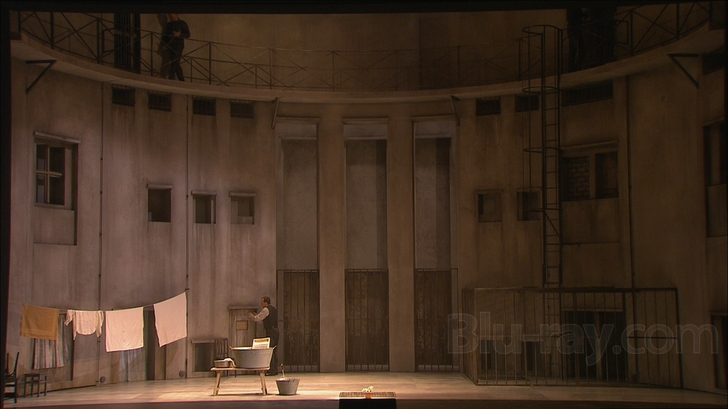
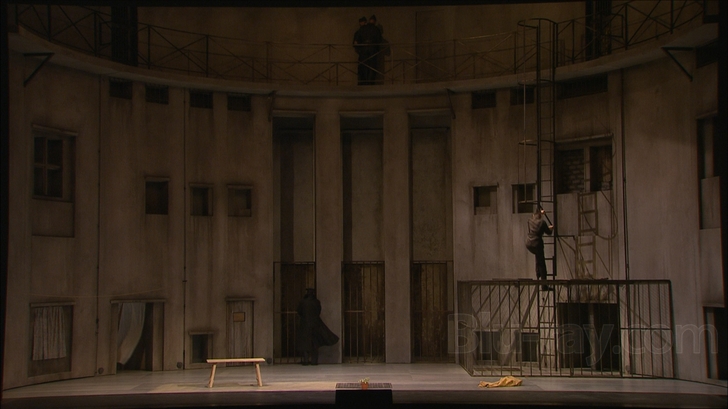
The minimal unit set which serves the bulk of the opera.
Fidelio was initially and intermittently after its premiere entitled Leonore (hence the interpolated “Leonore Overture No. 3,” which indeed is offered between the two scenes of Act II in this production). Beethoven abandoned his preferred titled in order to escape confusion with an identically named, and now largely forgotten, opera which had already made the rounds by the time his first version of Fidelio premiered in 1805. It wasn’t until a decade later, and numerous revisions which led Beethoven to claim, perhaps only partially in jest, that the opera would bestow a “martyr’s crown” on him due to the fits it gave him, that the opera settled down into the version it is usually performed in. Fidelio harkens back to more traditional singspiel, with spoken interludes, many of which have been jettisoned or themselves revised by modern directors and writers wishing to either contemporize or put their own brand on Beethoven’s original conception. Here director Katharine Thalbach walks a fine tightrope, subtly altering and redacting the original libretto by Joseph Ferdinand von Sonnleithner, Stephan von Breuning and Georg Friedrich Treitschke (the number of librettists points to the many revisions the piece underwent before Beethoven was satisfied with it). These changes, along with conductor Bernard Haitink’s decision to follow Mahler’s lead and interpolate the Leonore overture in Act II, are about the only diversions from Beethoven and company.
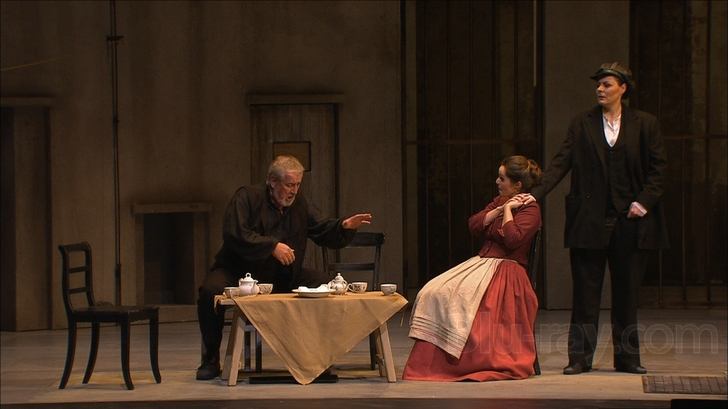
The opera itself concerns Leonore (Melanie Diener), who in true operatic fashion is disguised as errand boy Fidelio so that she can penetrate the bowels of a Spanish prison where she suspects her husband Florestan (Roberto Sacca) is being help captive. Unfortunately, the jailer Rocco (Alfred Muff) has a daughter, Marzelline (Sandra Trattnigg) who has her eye on Fidelio. Against this fairly traditional sounding set up of mixed identities and separated lovers, Beethoven, along with his unfairly decried librettists, explores ideas of freedom in general and personal liberty in particular that do in fact make Fidelio more of a screed than many operas, despite Haitink’s insistence that any political intent has been inferred after the fact by audiences more attuned to the liberty, equality and fraternity that roiled the Continental consciousness throughout the 18th and 19th centuries.
Haitink comes a bit closer to the mark with his assertion that the only three qualities a successful performance of Fidelio requires are “translucence, transparency and warmth,” and this production has all three in abundance. Staged minimally by Opernhaus Zürich, this is a gorgeously sung outing by Diener and Sacca, who bring all of the tragic weight of these lovers fully to bear, making their ultimate triumph at evening’s end all the more touching. Lucio Gallo also brings suitable menace to his interpretation of Don Pizarro, whose machinations may mean certain death for Florestan. Haitink’s conducting of the Zürich Opera Chorus and Orchestra is exceptionally clear and balanced, with the ensemble sounding especially resplendent in the famous Prisoners’ Chorus, a piece which foreshadows Beethoven’s iconic choral finale to his final symphony.
Fidelio remains a problematic work on a number of levels. The libretto is sometimes unjustly saddled with the bulk of these issues, but the fact is Beethoven himself was uncomfortable working in this idiom, as the many revisions he applied to the work amply demonstrate. The marriage between music and libretto is never as seamless as it might be, but the best of Fidelio offers Beethoven in full glory, if not always attuned to vocalists’ inherent limitations. This excellent production minimizes some of these qualms while never forsaking the composer’s very unique personal compositional language. While Beethoven will always be remembered more for his “pure,” non-programmatic, efforts, Fidelio, despite its inherent problems, shows that the composer had a nascent intuition about what comprises real dramatic content on the musical stage.
Beethoven: Fidelio Blu-ray Movie, Video Quality
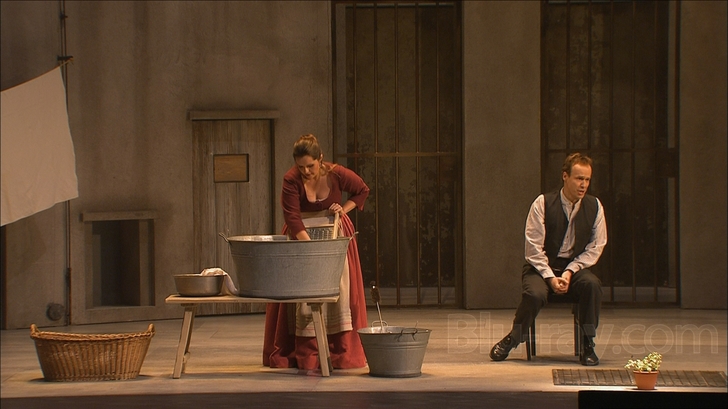
Fidelio arrives on Blu-ray from Opus Arte with a great looking live 1080i transfer via an AVC codec and with an aspect ratio of 1.78:1. Though large swaths of this production are (intentionally) dark and even claustrophobic, the Blu offers good if not outstanding contrast and black levels which keep the many blue-hued scenes from devolving into murkiness, though just the hint of crushing leaves some of the black clad characters melting into their shadowy backdrops. A lot of Act I plays out on the brown and beige side of the spectrum and the Blu reproduces those tones just as admirably. Detail is very good throughout the opera, with fleshtones accurate. Colors are rather muted throughout the piece, so don't expect a wealth of eye popping hues here.
Beethoven: Fidelio Blu-ray Movie, Audio Quality
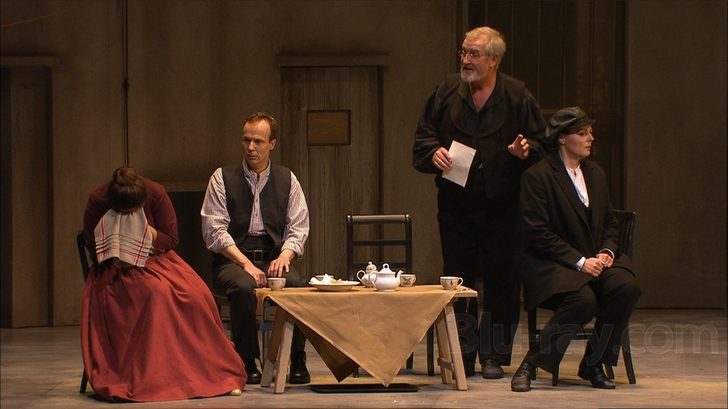
Fidelio is an infamously hard piece to sing, but for the most part this production's DTS-HD MA 5.1 mix offers wonderful clarity without too much stridency as the singers attempt to mount the peaks and valleys of Beethoven's intervallic extremities. The best part of this track is the gorgeously clear and balanced work of the orchestra under the direction of Haitink, certainly one of the best conductors to bring Beethoven's architecture fully into sonic relief. This is a wonderfully warm and deeply burnished sounding recording, with excellent dynamic range and top notch fidelity. There are some very minor and occasional balance issues between the orchestra and individual singers, though all of the ensemble moments are admirably balanced. There's not a wealth of surround activity with regard to the soloists, but the orchestra and hall ambience nicely fill the rear surrounds with just the right amount of ambience and reverb.
Beethoven: Fidelio Blu-ray Movie, Special Features and Extras
As is de rigeur with most of the Opus Arte opera Blu-rays, we get an illustrated synopsis (2:34) and cast gallery on the disc itself, and an informative essay in the insert booklet.
Beethoven: Fidelio Blu-ray Movie, Overall Score and Recommendation
Fidelio may not in fact be prime Beethoven, but even less than prime Ludwig is head and shoulders above most of what else is out there. The opera remains a fascinating look inside Beethoven's own creative process. The fact that someone so at home in the pure world of music removed from any extracurricular "meaning" could be so tormented by having to set a libretto and arrive at a dramatically coherent structure is in and of itself fascinating enough for any classical music lover to want to experience this piece. This is a solid, respectable production that features exceptional orchestral work from Haitink and crew.