Bart / Levaillant: La Petite Danseuse de Degas Blu-ray Movie
HomeBart / Levaillant: La Petite Danseuse de Degas Blu-ray Movie 
Arthaus Musik | 2010 | 112 min | Not rated | May 31, 2011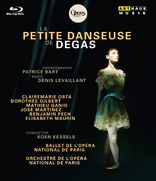

Movie rating
Movie has not been rated yetBlu-ray rating
| Users |  | 0.0 |
| Reviewer |  | 4.0 |
| Overall | | 4.0 |
Overview
Bart / Levaillant: La Petite Danseuse de Degas (2010)
Paris Opera Ballet Master and choreographer Patrice Bart plunges into the Opera‘s past and brings Degas‘ famous statuette to life. From the rehearsal rooms to the Cabaret du Chat Noir, the ballet conjures up a colourful era and the lively backstage world of a theatre.
Starring: Clairemarie Osta, Dorothée Gilbert, Mathieu GanioDirector: Patrice Bart
| Music | 100% |
Specifications
Video
Video codec: MPEG-4 AVC
Video resolution: 1080i
Aspect ratio: 1.78:1
Original aspect ratio: 1.78:1
Audio
French: DTS-HD Master Audio 5.1
French: LPCM 2.0
Subtitles
None
Discs
25GB Blu-ray Disc
Single disc (1 BD)
Playback
Region A (B, C untested)
Review
Rating summary
| Movie | | 4.0 |
| Video |  | 3.5 |
| Audio | | 4.0 |
| Extras |  | 2.5 |
| Overall | | 4.0 |
Bart / Levaillant: La Petite Danseuse de Degas Blu-ray Movie Review
An iconic statue comes to life in this ballet.
Reviewed by Jeffrey Kauffman June 11, 2011In the 1940’s there was a hit Broadway musical starring Mary Martin featuring a score by Kurt Weill and Ogden Nash called One Touch of Venus. (It was later made into a pretty lamentable motion picture starring Ava Gardner which jettisoned much of the charming score and inexplicably changed one phrase of the score’s biggest hit song, “Speak Low”). In the musical, Miss Martin played a statue of Venus which came to life, wreaking a little havoc in the life of a department store worker. There’s something passingly similar at work in La Petite Danseuse de Degas, for this charming and deliberately smaller scale ballet seeks to bring to life the iconic sculpture by Edgar Degas “La Petite Danseuse de quatorze ans.” Though the sculpture was not critically acclaimed in its day, it has become iconic in the intervening century-plus since it was created, in part due to the fact that it was one of the first sculptures which was semi-mass produced in a series of bronze casting reproductions which were then shipped worldwide, making the image one of the best known in the sculptural idiom. (Interestingly, Degas’ original was done in wax). The sculpture was of a young dance student named Marie van Goethem, and when it was debuted in 1881 there was more than a bit of critical approbation aimed at Degas. First of all, he placed the sculpture within a glass case, which some critics likened to seeing a “medical specimen.” Second, the sculpture was not particularly “pretty” in the traditional sense, and critics were disturbed by the almost primitive energy emanating from the piece. What few probably realized at the time was that there may have been a certain method to Degas’ madness. While the personal relationship between van Goethem, her mother and Degas hasn’t been fully unraveled, it’s at least possible that Degas was aware of the squalid conditions in which the van Goethems lived, and that due to poverty, Marie herself would soon be forced into a life of prostitution to help make ends meet (no irony intended). There’s therefore a very sad and pathetic subtext in this piece, one which is hinted at in this ballet, originally produced in 2003 and resurrected by the Opera National de Paris in 2010 for this World Premiere Recording. The backstory of this piece is in some ways as fascinating as the ballet itself, and spending a little time on research will pay enormous dividends in enjoying what the ballet is attempting to say as well as in how choreographer Patrice Bart chooses to depict various sequences.

The genesis for La Petite Danseuse de Degas actually began in 1997, when Martine Kahane, the General Curator and Director of the Paris Opera’s cultural service department, staged an exhibit about the tutu which had adorned the original version of Degas’ sculpture. That included some restoration of the outfit, which prompted Kahane to undertake some investigation about both the tutu and the sculpture’s history, and that in turn led to uncovering several salient facts about the van Goethem family in general and Marie in particular. It seemed that Mrs. Van Goethem realized that Marie and her two sisters were comely enough to attract the attention of well to do males, and in the best “stage mother” manner, Mrs. Van Goethem enrolled the three girls in the Opera’s ballet school while simultaneously hiring them out as models to pose for artists. Kahane published her findings in an article which drew the attention of Brigitte Lefèvre, the Paris Ballet’s dance director, who thought there was a kernel of an idea for a ballet there. Choregrapher Patrice Bart and composer Denis Lavaillent were brought in to fashion the piece, which became both a “recreation” of sorts of the sculpture as a living, breathing being, but also became an historical exegesis of what the Paris Opera Ballet itself was like in that era.
La Petite Danseuse de Degas is a strangely Dickensian piece, one which follows the plight of the low-born “little dancer” (Clairemarie Osta) as she seeks to escape a life of no opportunity and an overall suffocating ambience. She’s of course led on to perhaps unrealistic dreams by her ambitious zealot of a mother (Elisabeth Maurin), a woman who isn’t above encouraging the girl to seduce (and steal) her way up the social ladder. There’s a frankly appalling level of moral decrepitude at the heart of this ballet, one which plays rather ironically against the gilt-edged environment of the world of ballet itself. But that of course is part and parcel of what Degas was trying to portray, and something which critics of the time completely missed.
This is both a charming and slightly disturbing piece which is best thought of as a chamber ballet. Denis Levaillant’s score is quasi-minimalist, but not in the more typical Philip Glass or John Adams way. Levaillant takes phrases longer than the typical Glass motive and then subtly permutates them through slowly undulating harmonic changes. The score is largely string driven, with occasional flashes of percussive fury, and as strange as this may sound, I personally found it very redolent of some of jazz orchestrator and composer Claus Ogerman’s orchestral pieces with Michael Brecker, filtered through a sort of quasi-Ravelian intelligence. This is often very pretty, even ravishing, music, but music that is languid and not overly declamatory, something which perhaps keeps the ballet from reaching the emotional heights to which it aspires.
The production itself is a visual analog to Levaillant’s score, framing everything with very few scenic designs, and only a bare minimum of standing props and flats. This perhaps helps to highlight the fact that the little dancer exists in a world of dreams and fantasy where nothing is quite real, but at the same time it keeps the audience from ever experiencing the true majesty of the balletic world to which the little dancer is seeking admission. One problem that is quite evident, however, lies squarely on the shoulders of the television director Vincent Bataillon. Too often scenes are shot in medium framings and often without apparent reference to what is actually going on on stage. That means just the edges of some action is seen sometimes, which can get to be frustrating after a while.
The best thing about La Petite Danseuse de Degas is it relative lack of pretension. This is a modern ballet that doesn’t devolve into anything approaching Eurotrash in either its score or its presentation. It ably hints at the sociopolitical aspects of late 19th century France while never fully wallowing in anything squalid or fetid. Bart’s choreography is often very expressive and graceful and Levaillant’s score, while never really robust in any traditional sense, is appealing and often quite haunting. Coming into this ballet with some sort of background on the character of Marie Van Goethem, not to mention Degas himself, will no doubt help to increase appreciation for what Bart is going for in La Petite Danseuse de Degas. The dialectic between art and commerce is an age old struggle and one which is depicted here at its most brutal and desperate. The irony that it all takes place within the supposedly glamorous world of the ballet is not lost on this piece’s creators, and it no doubt won’t be lost on the audience either.
Bart / Levaillant: La Petite Danseuse de Degas Blu-ray Movie, Video Quality
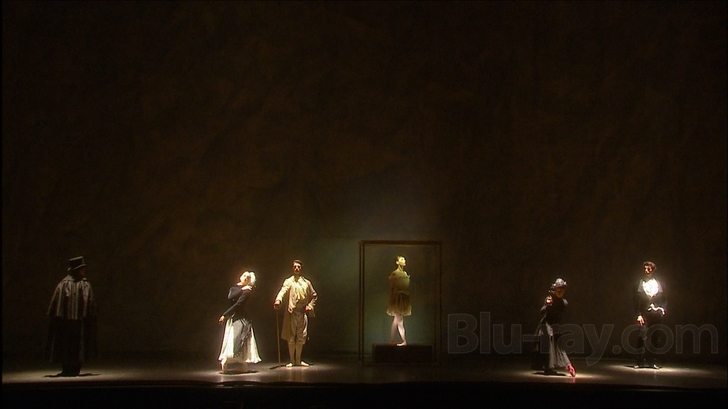
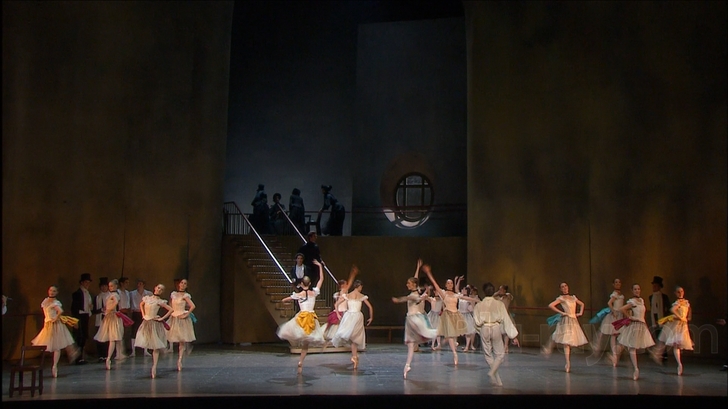
La Petite Danseuse de Degas is presented on Blu-ray courtesy of ArtHaus Musik, with an AVC encoded 1080i transfer in 1.78:1. This is one of the softer looking Blu-rays we've had from ArtHaus Musik, with a somewhat fuzzy image which never quite resolves into spectacular clarity or sharpness. Aside from the one huge ensemble number featuring a panoply of bright purples and reds, this is also a rather monochromatic offering, playing out mostly in beiges, blacks and rusts, which deprives the image of any chance to really pop with an impressive palette. Close-ups do reveal a decent amount of fine detail, but the bulk of this ballet has been shot in medium range shots. Blacks crush fairly consistently, and since a lot of this ballet plays in near darkness, that means a lot of detail is lost in the shadows. All of this said, there's nothing downright horrible here, there simply isn't the degree of sharpness, clarity and contrast that we've come to expect from the best Blu-ray ballet releases.
Bart / Levaillant: La Petite Danseuse de Degas Blu-ray Movie, Audio Quality
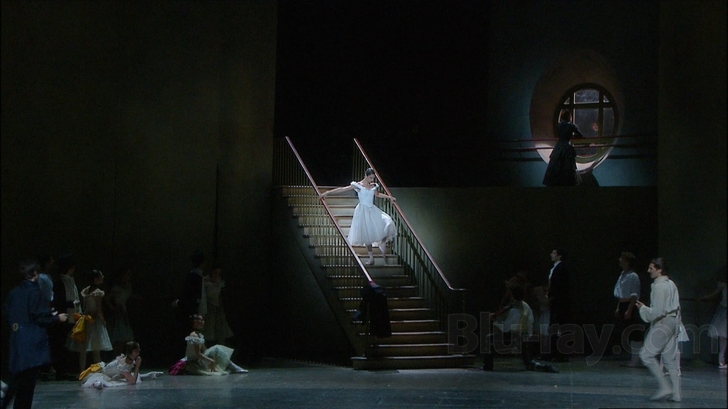
Much better are the two lossless audio offerings on the Blu-ray, a DTS-HD Master Audio 5.1 mix and and LPCM 2.0 stereo fold down. This is not bombastic music, and is really rather meditative much of the time, so much like the lack of bright color means no eye popping visuals, the lack of huge orchestral climaxes means that dynamic range is somewhat muted on this release. That said, fidelity is spot on, and the strings sound perfectly gorgeous. Some of the more unusual percussive elements as well as atypical classical orchestral sounds like muted trumpets also shine through with clarity and precision. The smaller scale ambitions of this score may prevent some from appreciating the excellence of the audio here, but for those with the patience to listen into the music, there's a lot of really gorgeous stuff going on here which the DTS track supports beautifully.
Bart / Levaillant: La Petite Danseuse de Degas Blu-ray Movie, Special Features and Extras
Interviews (1080i; 19:06) are offered with some of the principal crew, including Brigitte Lefevre, Martine Kahane, Patrice Bart and Denis Levaillant. This is an interesting set of interviews which provides a lot of background on the project as well as information on what the collaborators were hoping to achieve with this production.
Bart / Levaillant: La Petite Danseuse de Degas Blu-ray Movie, Overall Score and Recommendation
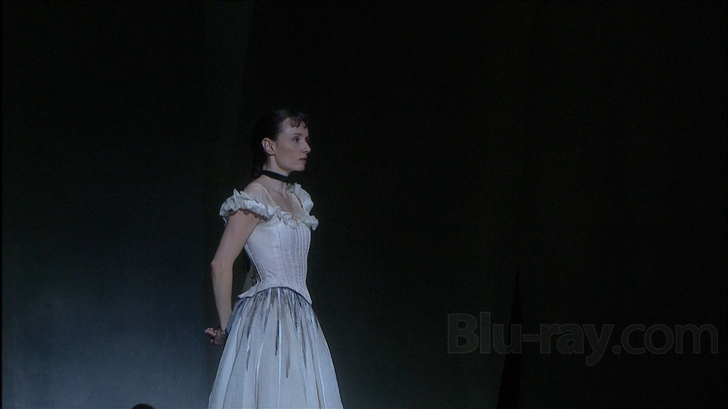
This is a piece that doesn't browbeat the audience into submission. If you're looking for extravagant production design and bombastic music, you're probably going to be sorely disappointed by La Petite Danseuse de Degas. This ballet won me over, though, with its quiet strength and meditative proclivities. Knowing the background of the story aids immeasurably in enjoying the onstage action, but being open to a somewhat unusual balletic score will also up your chances of "getting" what the creators of this piece were after. They say Art imitates Life, and that may be no truer than with La Petite Danseuse de Degas. The imitation here is both artful and lively, and this Blu-ray is Recommended.