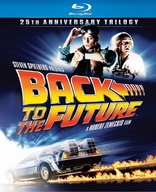
Back to the Future: 25th Anniversary Trilogy Blu-ray Movie
HomeBack to the Future: 25th Anniversary Trilogy Blu-ray Movie 
Back to the Future / Back to the Future Part II / Back to the Future Part III / Blu-ray + DVD + Digital CopyUniversal Studios | 1985-1990 | 3 Movies | 343 min | Rated PG | Oct 26, 2010

Movie rating
Movie has not been rated yetBlu-ray rating
| Users |  | 4.6 |
| Reviewer | | 4.5 |
| Overall | | 4.6 |
Overview
Back to the Future: 25th Anniversary Trilogy (1985-1990)
When teenager Marty McFly is blasted back to 1955 in the DeLorean time machine created by the eccentric Doc Brown, he finds himself in a time-shattering mess that could vaporize his future and his very existence! Then, Marty and Doc launch themselves to the year 2015 to fine-tune the future and inadvertently disrupt the space time continuum. Now, their only chance to fix it is by going back to 1955 all over again! Then, stranded in 1955 after a freak accident, McFly discovers he must travel back to 1885 to rescue Doc! It's up to Marty to keep Doc out of trouble, get the DeLorean running and put the past, present and future on track so they can all get.. back to the future!
| Adventure | 100% |
| Sci-Fi | 78% |
| Family | 44% |
| Teen | 30% |
| Period | 27% |
| Comedy | 22% |
| Coming of age | 10% |
| Western | 8% |
Specifications
Video
Video codec: VC-1
Video resolution: 1080p
Aspect ratio: 1.85:1
Original aspect ratio: 1.85:1
Audio
English: DTS-HD Master Audio 5.1 (48kHz, 24-bit)
French: DTS 5.1 (48kHz, 24-bit)
Spanish: DTS 5.1 (48kHz, 24-bit)
Subtitles
English SDH, French, Spanish
Discs
50GB Blu-ray Disc
Six-disc set (3 BDs, 3 DVDs)
Digital copy
DVD copy
Bonus View (PiP)
BD-Live
D-Box
Mobile features
Packaging
Slipcover in original pressing
Playback
Region free
Review
Rating summary
| Movie | | 4.5 |
| Video | | 4.5 |
| Audio | | 4.5 |
| Extras | | 4.5 |
| Overall | | 4.5 |
Back to the Future: 25th Anniversary Trilogy Blu-ray Movie Review
Let's go back to 'Back to the Future'.
Reviewed by Jeffrey Kauffman October 15, 2010Robert Zemeckis is arguably a close second behind Steven Spielberg as the contemporary American director who has most consistently gained critical acclaim while generating massive box office and popular appeal with a slew of iconic films. Even Zemeckis’ purported failures—and there indubitably are some—are often lionized for their breathtaking vision and utilization of modern special effects techniques like motion capture. But just a cursory review of the man’s contributions to film over the past 40 years reveals a staggering array of acclaimed and often insanely popular titles: Romancing the Stone, Who Framed Roger Rabbit, Forrest Gump, Contact, Cast Away. If Zemeckis’ post-Cast Away career has been lambasted for its emphasis on motion capture, with efforts like The Polar Express, Beowulf and A Christmas Carol, audiences have still flocked to see the movies, with Polar Express earning north of $300 million worldwide, Beowulf (which actually garnered stronger reviews than Polar) coming in close to $200 million, and A Christmas Carol doing even better than Polar, with at least the chance of repeated seasonal releases which will increase its massive third of a billion-plus take. And so it’s perhaps difficult to think of Zemeckis as anything other than a Hollywood insider who can pretty much call his own shots and get virtually anything greenlit with a simple phone call or two. ‘Twas not always the case, as Zemeckis himself makes clear in several of the documentaries and commentaries featured on this new three Blu-ray set celebrating the 25th anniversary of one of Zemeckis’ most beloved projects, Back to the Future.

When Zemeckis and his co-writer and frequent collaborator Bob Gale started pitching their idea for a time travel comedy where a boy would go back 30 years and attend high school with his own parents, there was little if any interest. Zemeckis and Gale had already had three strikes against them, with the box office failures of their own Used Cars, I Wanna Hold Your Hand and, probably most devastatingly, the Spielberg debacle 1941, for which they provided the script. In fact Gale asserts quite convincingly that they had become known as talented guys who could only get films made because of their association with Spielberg, and so they intentionally did not want the Back to the Future project to be linked to Steven, despite Spielberg’s enthusiasm for the project. But after months of being turned down by every major studio for a variety of reasons (my personal favorite being Disney’s shock that the film intimated incest between Marty McFly and his mother), Zemeckis decided he had to at least make some money directing, and he accepted Michael Douglas’ offer to helm Romancing the Stone. When that film became one of the biggest hits of the year, suddenly everything was forgiven, in typical Hollywood style, and Zemeckis and Gale found themselves “hot properties.” Feeling perhaps like they had achieved success on their own terms, they ultimately decided to partner with Spielberg for Back to the Future, and the project was quickly financed through Spielberg’s Amblin Productions. But that, to misquote Paul Harvey, was not the rest of the story.
The project underwent several casting woes, with first choice for Marty, Michael J. Fox, being unavailable for the role due to his commitment with the then top rated Family Ties. Zemeckis settled on Eric Stoltz, who was already making Hollywood waves for the as yet unreleased Mask. First choice for Doc Brown, the crazy genius who invents the time traveling DeLorean, had been John Lithgow, but the role ultimately went to Christopher Lloyd, who admits in one of the interviews on this set that he really wasn’t interested in the project and didn’t even read the script until prompted to by someone who told him that in Hollywood it was always wisest to “leave no stone unturned.” After the rest of the cast fell into place, five weeks of principal photography were actually completed with Stoltz before Zemeckis realized that comedy was perhaps not the young actor’s forte. The Future team went back to Family Ties’ executive producer Gary Goldberg and literally begged for Fox, and Goldberg relented as long as Fox always made the Top 10 sitcom his first priority. That led to a grueling schedule where Fox would be on the Ties lot during the day and then be shuttled to the Future lot for late afternoon and nighttime shootings. Somehow the insanity played well into the film’s overall ambience, and the first Back to the Future caught the public’s fancy as few other films released in 1985, becoming in fact the top grossing film of the year (close to $400 million—in 1985 dollars!).
Back to the Future is really a surprisingly dark film, despite its lighter than air ambience and gentle comedic touches. Marty McFly (Michael J. Fox) is a 1985 teenager from a pretty dysfunctional family, including a loser, nerdy father, George (Crispin Glover), an overweight and possibly alcoholic mother, Lorraine (Lea Thompson), and a whining and ineffectual brother and sister (Marc McClure, Wendie Jo Sperber). The only bright spots in Marty’s life are his girlfriend, Jennifer (Claudia Wells) and the neighborhood “mad scientist,” Doc Brown (Christopher Lloyd). Marty is a washout at school, the object of derision by his principal, Mr. Strickland (James Tolkan), who informs him there has never been a successful McFly and that Marty is destined to follow in those sad footsteps. When Doc Brown enlists Marty’s aid in a mysterious new scientific enterprise, Marty jumps at the chance, riding his ever present skateboard to a middle of the night rendezvous in a shopping mall parking lot. There Marty is introduced to Doc’s maddest ever invention, a time traveling DeLorean automobile. Through a haphazard and adrenaline pumping series of events, which includes Doc evidently getting shot by terrorists who have come to reclaim plutonium the scientist had stolen to complete his vehicle, Marty ends up traveling in the car back to 1955, when his parents were more or less the same age as he is in 1985. He quickly becomes the object of his mother’s romantic obsession and finds himself a stranger in a strange land, where his love of rock ‘n’ roll creates a new sensation, and his trusty skateboard becomes the latest fad for 1955 students.
This first outing with the Back to the Future gang plays brilliantly, with just a hint of discomfort lying steadily beneath the surface. That ill at ease feeling morphs gently from the dysfunctional early scenes of the McFly clan in all their sad glory, to Marty’s increasing anxiety over getting to know his parents when they were teens. Adding into the drama (and in fact the comedy) is Marty now being in the driver’s seat, literally and figuratively, and trying to recruit the younger Doc Brown to help Marty get back to the present. It’s made somewhat more tense due to the fact that Marty knows that in 1985 Doc had just been shot, before Marty catapulted back three decades. Oh, those time travel conundrums!
Back to the Future caught the public’s imagination for several very good reasons. The film is plotted elegantly and built around a formidable, yet easily accessible, concept. Most importantly, Zemeckis has a host of expert performers at his beck and call. Fox has probably never been more appealing than he was in this trilogy, and Thompson and Glover are also in fine form. While Lithgow probably would have been a perfectly adroit Doc Brown, it’s hard to imagine anyone other than Christopher Lloyd in the role, so nuttily commanding is the actor with this performance. While some of the then-amazing special effects have dated rather badly, Back to the Future, despite its sci-fi cred, was really always more of a character story, a classic fish out of water yarn that just happened to include time travel.
It’s a rare sequel that lives up to the original, but in some ways Back to the Future II is the best film of this triad, at least for those who love the paradoxes and complexities that time travel stories can provide. Four years after the world had fallen in love with Marty McFly, the gang was back (with Elisabeth Shue replacing Wells as present day love interest Jennifer and Jeffrey Weissman replacing Glover as Dad George McFly) on a new mad dash back to 1955 as well as forward to 2015. If the first Back to the Future never really dealt with the nuts and bolts of what time travel might entail, this film fairly relishes the hilarity of having not one, but two, Marty McFlys back in the era of ducktails and hot rods as well as in the spandex-laden 21st century, and there are similar pairings of most of the major characters (at various ages) in several different time streams. The fact that II is such a superior entertainment while Back to the Future III is at times a little less consistent in the fun quotient arena is at least a little odd, in that the second two films were filmed simultaneously. Be that as it may, Back to the Future II is a weird screwball time traveling version of Frank Capra’s inimitable It’s a Wonderful Life, with a series of alternate universes spinning around each other as Marty and Doc desperately attempt to “fix” both the future and the past, wreaking occasional havoc as they go.
The first film had ended with a cliffhanger, Doc Brown arriving at the McFly home to announce that Marty and Jennifer must travel to the future to help save their children, but Zemeckis and Gale had never really anticipated nor planned for a sequel. That four year interlude between the two films was needed, however, for the second iteration is by far the most complex, plotwise and just from a purely physical production standpoint, of the three films. Doc, Marty and Jennifer do travel forward thirty years to the then-distant sounding but now incomprehensibly close year of 2015 in order to prevent Marty’s son from getting mixed up in a robbery. Unfortunately as they depart they manage to reveal their time traveling propensities to longtime nemesis Biff Tannen (Thomas F. Wilson), and in the future older Biff realizes what’s going on and decides he can time travel, too. That sets a madcap series of events into motion where Doc, Marty and Jennifer return to 1985 to discover that time traveling Biff’s machinations back to 1955 have completely altered the happy universe they once knew. That means Marty needs to go back to 1955 himself (where he “is” already—from the first film—in true time conundrum magnificence) and try to put right Biff’s scheming. Confused? It’s actually brilliantly clear in Zemeckis and Gale’s superb screenplay, one which vaults over 60 years of various “realities” with nary a false step.
Like its precursor, Back to the Future II ends with a cliffhanger, with Marty stranded in 1955 and receiving a weathered letter from the late 1800s indicating that Doc Brown is stranded in that timeframe. That setup gets us prepared for the “wild, wild west” outing of the trilogy, Back to the Future III. With clues from the 1885 letter from Doc, Marty is able to find and repair the DeLorean, and he sets out to travel back in time to rescue Doc from imminent death, a nice mirroring of one of the sidebars to the main plot of Back to the Future. If the first two films were given over largely to Marty and his story (or stories, as the case may be), Back to the Future III is largely Doc’s tale, with Marty pretty much along for the ride. In this distant historical Hill Valley, there are still bullies (again played by Thomas F. Wilson), only this time they have guns and nooses.
This third film actually delighted a lot of fans with its whimsical reinvention of the comedy western genre, but the film really plays more like a slightly padded, and patently odd, love story between Doc and his newfound lady friend, Clara (Mary Steenburgen), while Marty runs around trying to get the infatuated inventor back to 1985. There are a lot of fun bits in Back to the Future III, to be sure, and it's undeniably fun and funny to see Lloyd in a romantic guise, but III, despite its brisk pace and especially its engaging climax and coda, often seems like warmed over fare. The film does have a number of great moments, like Marty meeting his grandparents and coming up with the pseudonym “Clint Eastwood” when they ask him who he is. There’s certainly nothing wrong in any major sense with III, and perhaps the film seems slightly stale by mere dint of the fact that it is, after all, the third outing with these characters. While III certainly maintains the madcap quality of the first film, it has neither that film’s pathos nor the second film’s time traveling complexities to give it momentum, and it simply seems to take too much. . .time to get to its expected denouement.
All three of these films were technical marvels in their day, and the second two films paved the way for Zemeckis’ ground breaking work with motion capture a couple of decades later. What really invests these films with lasting greatness, though, is their almost sanguine acceptance of the “fact” that all this rampant time traveling is possible. Science fiction films, even sci-fi comedies, too often focus on the gizmos rather than the humans. The Back to the Future trilogy wisely puts the humans and their stories out front, and lets the high tech wizardry (both on screen as part of the characters and the special effects themselves) support those stories. It’s an old fashioned idea, but one which has stood the test of time and which hopefully will continue to have a bright future.
A Note on the Packaging: Call me stupid (you'll have to get in line on that one), but I was having one heck of a time figuring out how to remove the BDs from the tri-fold case, until my brilliant wife pointed something out. These are not housed on traditional spindles. Open the case and you will notice there are small plastic "wings" at the bottom of each disc holder. You need to pull the disc down toward you, depressing those wings, and it will then snap out of the holder. Repeat that process in reverse to place the disc back in.
Back to the Future: 25th Anniversary Trilogy Blu-ray Movie, Video Quality
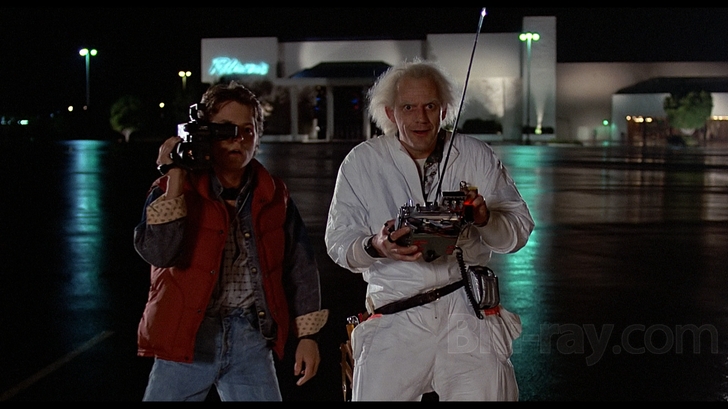
Hoo-boy, there may be some (unfounded) controversy with the image quality of these releases, so let the games begin! Let's state for the record that these new AVC encoded 1080p 1.85:1 Blu-rays present all three films with the best image quality they have ever had on home video. That probably still won't stop the brickbats from being thrown by some who either never saw these films theatrically, don't remember what films looked like in the 1980s, or who have unrealistic expectations of what restoration can achieve, especially in films this laden with optical effects. Let's discuss the basics first. All of these films were grainy and soft looking in their original theatrical releases; I know, because I saw them all. Special effects, even by the wizards of ILM, were still largely optically created back then, and that ups the softness quotient even more. Therefore, this Blu-ray's superior resolution only reveals some of the tricks of the trade to a lot of these effects sequences. Mattes show more clearly, green screen segments are more readily discernable, and the aging makeup utilized on most of the major players in the first two films especially shows its latex pretty demonstrably. Zemeckis and Gale have evidently been heavily involved in these new Blu-ray restorations, and it's good to note that there isn't egregious DNR applied to any of these releases, as seems to be Universal's wont a lot of the time. Some of the digital sharpening does occasionally lead to some aliasing and shimmer. Colors are noticeably more robust and better saturated in all three of the films than they ever have been before, and the infamous framing issues on the original DVD releases have been corrected. There is a rather surprising uptick in quality between the first and the second and third films, which were shot in tandem. Four years may not seem like a lot of time, but in the tech-heavy world of film, it can make a lot of difference, and the image quality is noticeably sharper, with better defined blacks and contrast, in the second two films than it is in the first. If you are expecting digitally pristine image quality from any of these films, you will probably be sorely disappointed. If you remember how these films looked theatrically (and they were frankly never "gorgeous" films even in their day), or realize that hi-def can only do so much depending on the source elements and the unique characteristics of any given film, you will most likely agree that this is the best looking the Back to the Future trilogy has ever been.
Back to the Future: 25th Anniversary Trilogy Blu-ray Movie, Audio Quality

The Back to the Future trilogy is presented with an excellent sounding lossless DTS-HD Master Audio 5.1 track. While this mix has spot on fidelity and often incredible dynamic range, some listeners may be at least a little disappointed that there isn't more consistent surround activity. While several standout sequences in all three films offer abundant immersion, with brilliant sound effects editing, overall this is a peculiarly front heavy mix for a film with at least a tangential sci-fi pedigree. Other than that passing qualm, this is an expertly realized mix, with dialogue, effects and score wonderfully balanced. When we do get some excellent surround activity, as in the great sequence in the first film where the terrorists show up to confront Doc Brown and Marty is madly trying to escape, or in the flying car sequences of the second film, or any of the great action sequences with horses (and trains) in the third, there is a beautifully natural ambience to the immersion and the soundfield is alive with activity. Audiophiles might just be wishing, though, that there were more of that activity in the overall scheme of things.
Back to the Future: 25th Anniversary Trilogy Blu-ray Movie, Special Features and Extras

Virtually all of the extras from the previously released SD-DVD trilogy boxed set have been ported over to this new BD set, plus several new to home video supplements are here as well. Get ready, because this is going to take some (ahem) time. First off, the new to video supplements as well as those exclusive to Blu-ray:
- U Control. Mostly text based bonuses this time around with Universal's "exclusive signature feature." You can access "Setups and Payoffs," which shows you how plot points are prepared and then referenced later down the line; "Storyboard Comparison," which shows the original conception of several sequences; and "Trivia Track," a host of factoids about various aspects of all three films.
- Tales From The Future is a phenomenal six part HD documentary that looks at all aspects of the film, from development through filming
and release. These are:
"In the Beginning" (27:24), which looks at pre-production and the original casting snafus;
"Time to Go" (29:54), covering the production of the original film.
"Keeping Time" (5:43), devoted to Alan Silvestri's score.
"Time Flies" (28:37), dealing with the second film and especially the convoluted effects sequences, as well as the decision to shoot the second and third films more or less in tandem.
"Third Time's the Charm" (17:07), which focuses on the production design of the third film, as well as Christopher Lloyd's Doc Brown as a romantic character.
"The Test of Time" (17:00) looks back at the cultural impact the trilogy has had. - The Physics of 'Back to the Future' (HD; 8:25), an interesting, if too short, discussion with physicist Michio Kaku about how the films mostly get the science part right.
- Nuclear Test Site Ending Storyboard Sequence (HD;4:12), a nice look at the original ending of the film, with an optional commentary by Gale.
- Back to the Future Night (SD; 27:10), an archival featurette hosted by Leslie Nielsen which aired on NBC prior to the first televised broadcast of the initial film.
- Deleted Scenes (HD; 17:57 over three discs), 16 excised moments, some with some pretty bad print damage, all with optional Gale commentary.
- Michael J. Fox Q & A (SD; 10:20), where the star reminisces about the films.
- Q & A Commentaries with Zemeckis and Gale, a kind of weird but interesting set of sessions at USC after the films had been screened for an audience, hosted by the ubiquitous (and sometimes hard to understand) Laurent Bouzerau.
- Feature Commentaries with Gale and co-producer Neil Canton, a more nuts and bolts style set of commentaries which are interesting and very informative.
- Archival Featurettes, a compendium of older documentaries on the films, which includes:
Making of the Trilogy: Chapters One (SD; 15:30), Two (SD; 15:30) and Three (SD; 16:30), a 2002 documentary released with the DVD version of the films.
The Making of 'Back to the Future' Parts I (SD; 14:28), II (SD; 6:40) and III (SD; 7:32), another vintage set of documentaries.
The Secrets of the 'Back to the Future' Trilogy (SD; 20:41) a Kirk Cameron hosted tv special which answers fan questions about the series. - Behind The Scenes, a series of archival material which includes:
Original Make-up Tests (SD; 2:17), where you can see Lloyd before his "Einstein-Stokowski" transformation;
Outtakes (SD; 5:23 over three discs), with gags and on set mishaps.
Production Design (SD; 2:55)
Storyboarding (SD; 1:29)
Designing the DeLorean (SD; 3:31)
Designing Time Travel (SD; 2:41)
Hoverboard Test (SD; :58)
Evolution of the Visual Effects Sequences (SD; 5:42)
Designing Hill Valley (SD; 1:08), more production design info.
Designing the Campaign (SD; 1:18), marketing info.
FAQs, text only questions about the series, with answers by Zemeckis and Gale.
Back to the Future: The Ride (SD; 31:06), with both the video components and actual ride footage from the theme park attraction. - Music Videos of Huey Lewis and the News performing "Power of Love" (SD; 6:27) and ZZ Top performing "DoubleBack" (SD; 4:09).
- Photo Galleries, which include production art, storyboards, photos, marketing materials and character portraits.
- Theatrical Trailers and Teasers for all of the films.
Back to the Future: 25th Anniversary Trilogy Blu-ray Movie, Overall Score and Recommendation

There has rarely been a franchise in the history of Hollywood which maintained its charm and luster over all of its entries as did the Back to the Future trilogy. Virtually everyone who has seen and loved this triad has their own favorite (mine is the second), and each of the films has their own special magic which enchants and effortlessly entertains. Some people may (mistakenly) take these BDs to task for what they perceive are image issues. The only real "issue" is occasional artifacting; otherwise these look splendid, better by far than any previous home video release. Filled with amazing supplemental content, this is a fantastic package which any lover of any of the three, let alone all of them, will want to have in their personal collection. Very highly recommended.