Augustine Blu-ray Movie
HomeAugustine Blu-ray Movie 
Music Box Films | 2012 | 102 min | Not rated | Sep 17, 2013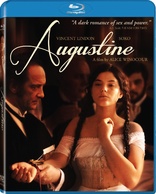
Price
List price:Amazon: $24.95 (Save 29%)
Third party: $24.95 (Save 29%)
Temporarily out of stock.

Movie rating
6.3 | / 10 |
Blu-ray rating
| Users |  | 0.0 |
| Reviewer |  | 4.0 |
| Overall | | 4.0 |
Overview
Augustine (2012)
A look at the relationship between pioneering 19th century French neurologist Dr. Jean-Martin Charcot and his star teenage patient, a kitchen maid who is left partially paralyzed after a seizure.
Starring: Vincent Lindon, Soko, Chiara Mastroianni, Olivier Rabourdin, Grégoire ColinDirector: Alice Winocour
| Drama | 100% |
Specifications
Video
Video codec: MPEG-4 AVC
Video resolution: 1080p
Aspect ratio: 1.85:1
Original aspect ratio: 1.85:1
Audio
French: DTS-HD Master Audio 5.1
French: Dolby Digital 2.0
Subtitles
English
Discs
50GB Blu-ray Disc
Single disc (1 BD)
Playback
Region A (B, C untested)
Review
Rating summary
| Movie | | 4.0 |
| Video | | 4.0 |
| Audio | | 4.0 |
| Extras |  | 3.0 |
| Overall | | 4.0 |
Augustine Blu-ray Movie Review
The method of treating madness.
Reviewed by Jeffrey Kauffman September 14, 2013There actually was a real life neurologist named Jean-Martin Charcot, who did in fact practice at the real life Parisian facility known as the Pitié-Salpêtrière Hospital, and he did evidently have a real life patient who became immortalized by her first name of Augustine in a series of photographs Charcot took of her experiencing her bouts of "hysteria", but the most salient question some may have after watching this fascinating if slightly erratic 2012 film will be: did Charcot really have a pet capuchin monkey and did he actually use the animal in a patently bizarre therapeutic “moment” with Augustine. The “monkey scene”, as I’m absolutely convinced Augustine’s weirdest few minutes will ultimately be known as to filmgoers far and wide, is one of the strangest depictions of what Freud and Jung called transference. The film has built up a slow and steady basis of trust if not outright affection between Dr. Charcot (Vincent Lindon) and seizure prone Augustine (Soko) when Dr. Charcot brings his pet monkey to the hospital and lets Augustine play with it. The monkey goes a little berserk in the good doctor’s opulent offices, and soon the doctor and Augustine are chasing the poor animal around trying to get it to calm down. When that finally occurs, the two humans find themselves almost embracing, face to face, with the monkey perched precariously on Charcot’s head, in a moment that seems like it’s about to lead to a really awkward ménage a trois (or in this case, perhaps a menagerie a trois). Augustine is but the latest in what seems to be a rather unexpected new subgenre dealing with 19th century attempts to cure so called “hysteria” in women, which many doctors (though not necessarily Charcot) felt was linked intimately with the sexual desires of the patients. 2011’s Hysteria took a decidedly whimsical approach to the subject, detailing the ultimate invention of the so-called “personal vibrator”. At the opposite end of the spectrum was another 2011 film, David Cronenberg’s A Dangerous Method, which actually featured Jung as a character and which was a much more dramatic depiction of the famed psychoanalyst’s attempts to peer beneath the covers of a disturbed patient’s mind to uncover the root of her problems. Augustine, despite that inarguably unusual “monkey scene”, is resolutely dramatic, though in some ways it hedges its bets with regard to both its patient and its doctor, leaving a couple of important facts open to interpretation, a gambit which in fact makes each audience member a therapist of sorts, attempting to divine what’s really going on.
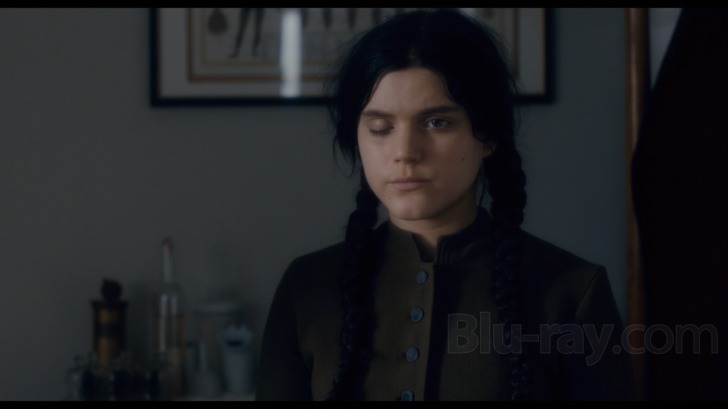
We first meet Augustine in her guise as a housemaid, where she is evidently having a hard time keeping it together as she prepares to serve food and drink to her upscale employers. It seems that Augustine is especially sensitive to noise and perhaps even light—could she be epileptic? Her hand begins shaking violently as she prepares to pour some liquid into a crystal glass, and then suddenly she collapses in a twitching, writhing morass on the floor, drawing gasps from the assembled dinner guests, at least one of whom crosses herself in an act of protection against any perceived evil spirits. Augustine is soon taken by her cousin to get a diagnosis at the Salpêtrière. By this time Augustine is demonstrating almost stroke like symptoms, with the right side of her body completely numb and lifeless and giving her the strange anomaly of a right eyelid which remains steadfastly closed.
Augustine believes she will be in and out of the facility in quick order, but once she starts to look around, she begins to notice what appear to be a lot of chronically mentally troubled women. The patients are regularly trotted before a review board, who then decide which few of them will be passed on to the hospital’s star neurologist, Dr. Charcot, a taciturn but groundbreaking physician who is developing a theory about the mental causes for what was then widely diagnosed as “hysteria”, meaning any number of emotional troubles which roiled various womens’ lives. Augustine, however, is passed over by this intermediary board and begins to wonder if she’ll ever be released—cured or not.
It’s at this point that writer-director Alice Winocour begins to slightly toy with the audience’s perception in a scene which hints that while Augustine is obviously a victim of sorts, she’s no mere shrinking violet. Suddenly as Dr. Charcot passes by one day, Augustine collapses into another seizure, one manifestly different from the first, and much more sexual in nature. Needless to say, Dr. Charcot’s interest is piqued, and Augustine is quickly moved to the head of the line of patients who receive some up close and personal time with Charcot.
Winocour begins examining the slowly shifting sands of power at this point. The all knowing doctor begins utilizing Augustine in his public displays of hysteria, which in those days passed for something of a high class entertainment for Paris’ ruling elite. Augustine seems to know she’s the “star” of these shows, and puts on a flagrant display of eroticism which actually gets her reviews in the Parisian press. But she’s also afflicted first by the stubborn numbness on her right side and, later (after a really chilling scene which graphically shows a chicken’s head being cut off), a severely twisted and restricted hand. Obviously, something is going on in Augustine’s mind, but there’s also a deliberate subtext here that Augustine may in fact be pulling a few strings herself to get some attention.
Augustine is a rather fascinating film where a slowly unfolding relationship is explored in a generally quiet, almost discursive, way. Like the character of Augustine herself, the film does not give up its secrets easily, but it is an unusually provocative piece which touches on a whole series of tangential issues surrounding Augustine’s “issues”, including gender roles, a certain voyeuristic quality on the part of the medical establishment of the day, and even a sort of “Stockholm Syndrome” on the part of patients who want to “perform” for their captors—in this case, the doctors who are ostensibly there to cure them of the very problems which has put them under care to begin with.
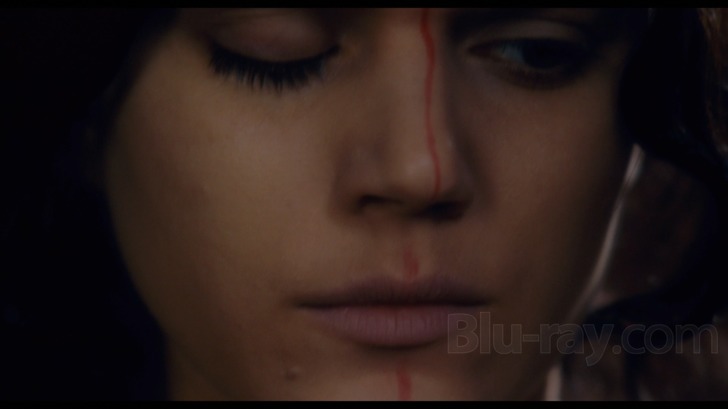
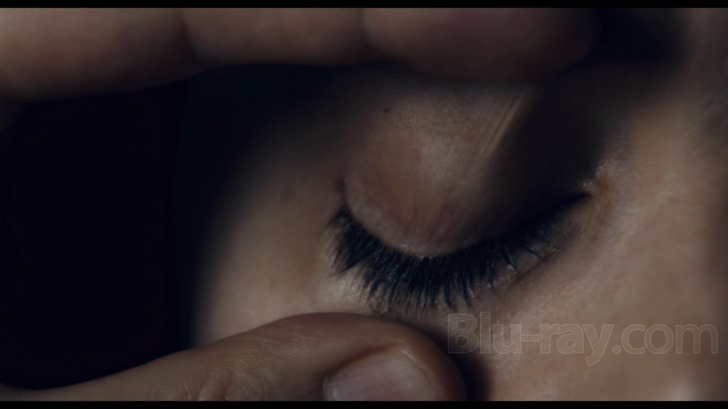
The film is bolstered by excellent performances by veteran Vincent Lindon and relative newcomer Soko (who is also a pop star in her native France and throughout Europe). The bizarrely tamped down intimacy which develops between these two is handled in a number of scenes where surprisingly few words are shared, but the deepening relationship between them is completely clear nonetheless. Winocour exploits extreme close-ups throughout the film, as if she were examining— perhaps even diagnosing—two characters whose symbiotic interaction needs some intervention itself.
Augustine Blu-ray Movie, Video Quality
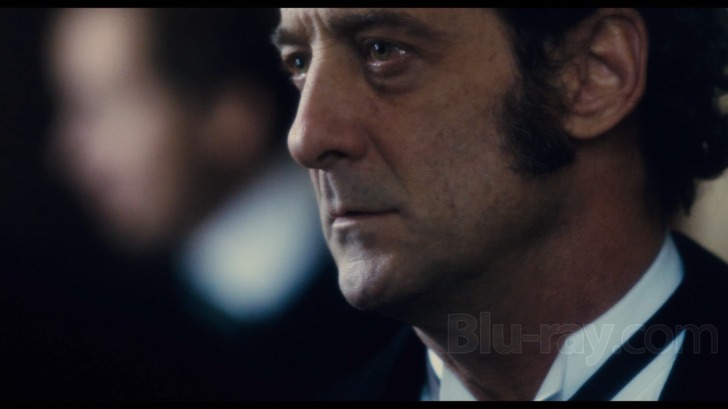
Augustine is presented on Blu-ray courtesy of Music Box Films with an AVC encoded 1080p transfer in 1.85:1. As Alice Winocour mentioned in our exclusive interview, Augustine was digitally shot (against Winocour's desires) in often very dark environments, something Winocour purposefully did in order to mask the fact that the budget did not allow for opulent sets. The result is a film with some shadow detail issues, as well as an overall fairly soft look for a native HD presentation, one which might have benefited from having the contrast boosted slightly. Those tendencies are balanced in part by Winocour's tendency to shoot in close-ups quite a bit of the time (sometimes in extreme close- ups, as the screenshots accompanying this review show), a choice which provides this presentation with well above average fine detail. The entire film has a diffuse, gauzy quality, something Winocour mentions as stemming from her choice to light the film as if it were taking place in a "sunny winter". That aesthetic also means that colors are slightly pallid looking quite a bit of the time, with a slightly dulled, monochromatic appearance.
Augustine Blu-ray Movie, Audio Quality
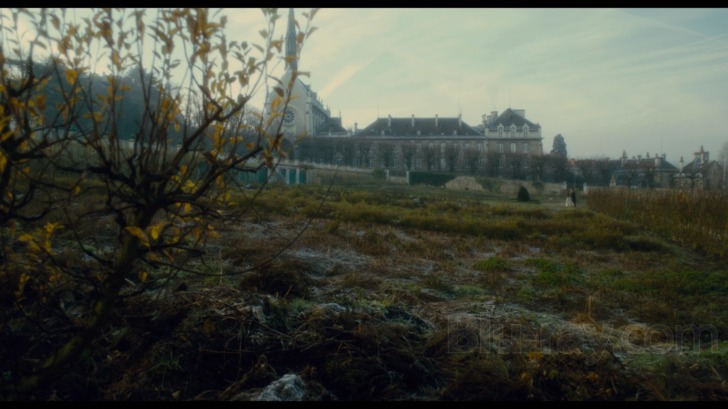
Augustine's lossless DTS-HD Master Audio 5.1 track (in the original French language) is a relatively small scale, but at times quite nuanced, affair. A lot of this film is actually almost like a silent movie, made up of stolen glances between various characters, and with only some subtle ambient environmental noises dotting the surrounds. Dialogue, when it occurs, is nicely rendered, and Soko's lullaby which begins and ends the film, as well as Jocelyn Pook's minimalist score, also spill throughout the channels. The film does tend to offer more immersion in scenes where Augustine is surrounded by the noisy environs of the hospital. Fidelity is excellent, though dynamic range is rather muted.
Augustine Blu-ray Movie, Special Features and Extras
- More from Director Alice Winocour Includes:
- Alice Winocour Bio is a text piece giving a brief overview of Winocour's life and career.
- Interview with Alice Winocour (1080p; 5:59) features Winocour speaking into a microphone labeled "NOW", which one assumes is not the National Organization for Women, although that might be appropriate, given the film's focus on power and gender roles.
- Short Films include Kitchen (1080p; 14:34) and Magic Paris (1080p; 19:52).
- More from Actor Soko includes:
- Soko Bio
- Q&A with Soko (1080i; 36:16) is a more in-depth piece hosted by Stephen Farber of Reel Talk, which was conducted during Augustine's special screening in Los Angeles in May of 2013.
- Music Videos include Destruction of the Disgusting Ugly Hate (1080i; 3:55) and We Might Be Dead by Tomorrow (1080p; 2:47).
- Forensic Photography from the Saltpetriere is a fascinating photo gallery culled from the documentary evidence assembled between 1876-78. There are several photos of the real life Augustine included.
- U.S. Theatrical Trailer (1080p; 2:14)
- French Theatrical Trailer (1080p; 1:31)
Augustine Blu-ray Movie, Overall Score and Recommendation
Augustine traffics in a number of highly provocative subjects while at the same time essaying an ostensibly "based on a true story" approach. The result may in fact be too low key for some, but for those with a taste for quiet, introspective fare with an unusual focus, the film repays its investment in some very thought provoking ways. Winocour is a significant talent who I predict will be making major waves in the next phase of her career. Recommended.
Similar titles
Similar titles you might also like
(Still not reliable for this title)

At Eternity's Gate
2018

Olive Kitteridge
2014

Plenty
1985

Colette
2018

Adore
Perfect Mothers
2013

Toys Are Not for Children
Virgin Dolls
1972

Sleeping Beauty
Slipcover in Original Pressing
2011

The Private Affairs of Bel Ami
1947

Bartleby
1970

Under the Sand
Sous le sable
2000

The Personal History of David Copperfield
2019

Great Expectations
2011

American Pastoral
2016

The Truth About Emanuel
2013

Perfect Sense
2011

Burning Palms
2010

Wild Orchid 2: Blue Movie Blue
Wild Orchid II: Two Shades of Blue
1991

Bloody Mama
1970

Drum
1976

Nymphomaniac: Volume I
Director's Cut
2013