Asafiev: Les Flammes de Paris Blu-ray Movie
HomeAsafiev: Les Flammes de Paris Blu-ray Movie 
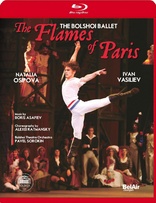
The Flames of Paris / Osipova/Savin/Yasilev/Bolshoi BalletBel Air Classiques | 2010 | 103 min | Not rated | Jan 25, 2011
Price
List price:Listed on Amazon marketplace

Movie rating
6.8 | / 10 |
Blu-ray rating
| Users |  | 0.0 |
| Reviewer |  | 3.0 |
| Overall | | 3.0 |
Overview
Asafiev: Les Flammes de Paris (2010)
The famous 1932 Stalinist ballet is given a revisionist production by the Bolshoi Ballet.
| Music | 100% |
Specifications
Video
Video codec: MPEG-4 AVC
Video resolution: 1080i
Aspect ratio: 1.78:1
Original aspect ratio: 1.78:1
Audio
Music: DTS-HD Master Audio 5.1
Music: LPCM 2.0
Subtitles
English, French, German
Discs
25GB Blu-ray Disc
Single disc (1 BD)
Playback
Region free
Review
Rating summary
| Movie | | 3.0 |
| Video |  | 4.0 |
| Audio |  | 4.5 |
| Extras |  | 2.5 |
| Overall | | 3.0 |
Asafiev: Les Flammes de Paris Blu-ray Movie Review
Vive la Revolution!
Reviewed by Jeffrey Kauffman April 3, 2011The Russian artistic temperament post-World War I seems especially astringent to outsiders, a world of brittle dissonances and anachronisms, flagrant disregard for tradition, and an adventurous spirit which sought to put the imprimatur of a “new” culture on every pursuit, whether that be music, dance or painting. How odd, then, that a famous Stalin-era ballet, The Flames of Paris, and one which in fact dealt overtly with Revolutionary themes, should be so staid and even musty. Boris Asafiev’s pastiche score, based on French tunes from the French Revolutionary period, is a model of Classical elegance and poise, with nary a whiff of anything even remotely Stravinskian or Prokofievian, even in terms of those two composers’ flirtations with neo-classicism. There’s barely even the hustle and bustle of Tchaikovsky here, and in fact the music of the original 1932 version of The Flames of Paris is, as bizarre as it may sound, oddly Handelian in that heraldic way that the great composer often exploited for his celebratory orchestral and religious masterpieces. Even more “old school” was The Flames of Paris’ original libretto and even choreography, which made the piece’s corps de ballet the real stars while pretty much ignoring, in the words of revisionist Alexei Ratmansky, any real human element. This was a big, almost proto-19th century piece of tableaux and pageantry that recalls anecdotal behemoths like La Bayadère or The Pharoah’s Daughter. The fact that this was one of Stalin’s personal favorites gives us a peek inside the mind of a tyrant who on the one hand could (at least temporarily) nurture the careers of such iconoclasts as Shostakovich, while not blinking for a moment when his aegis was violently withdrawn. One begins to understand the perhaps Stalin was a man of simple, dare we say proletarian, tastes who often foisted more forward thinking artists on the world if only to proclaim the Soviets’ supposed inherent superiority. Pieces like The Flames of Paris might argue persuasively otherwise. Be that as it may, The Flames of Paris fell out of the repertoire of the Bolshoi Ballet after decades of being one of its warhorses, and so when Ratmansky came along to invest new life into the then relatively moribund company, he went pawing through the archives to find works once associated with the troupe which had not been performed recently. Hence, this “new, improved” Flames, a ballet which under Ratmansky’s guidance does manage to eke out some human emotion now and again but which can’t ultimately escape its (dare we say?) bourgeois roots.
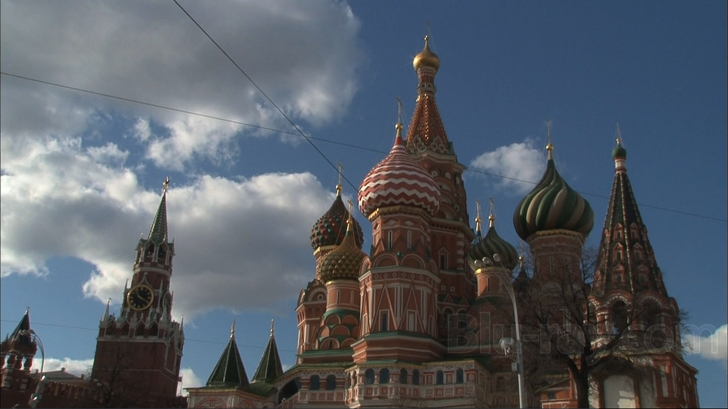
The Flames of Paris is a Revolutionary piece, by which we mean the French Revolution. Stalin wasn’t shy about wanting to find Marxist-Communist elements in all great societal upheavals throughout history, and the French Revolution certainly had enough of those elements to make it the perfect fodder for, as strange as it may sound, a balletic screed. The original version was really a panoply of set pieces with an underlying plot of the good, noble agrarian folk who managed to triumph over the unseemly and decadent upper class. Ratmansky has invested his new version with two sets of lovers, always a nice balletic trope, and he gives the ballet a more impactful emotional sweep by having the central tragedy of the ballet affect one of the main sets of lovers. This makes the Revolution, whether it be French or Soviet, not so much of an abstract principle as an actual event which drastically alters people’s lives.
Though Boris Asafiev’s music is completely competent, and at times incredibly colorful and propulsive, it too often has the slightly musty smell of something that’s been sitting on the shelf for a decade or two, gathering dust. How completely odd that this score should have come along in 1932, whether or not it’s based on older material. This could easily have been written in the 19th century, and it’s especially surprising that the orchestration, long the bulwark of Russian genius, should be so. . .well, expected. While there’s nothing wrong per se here, the traditionalist aspect of the score undercuts Ratmansky’s efforts to invest new life in a hoary older ballet. Imagine this same source material with a score by Stravinsky, Prokofiev or Shostakovich and the imagination reels with possibilities.
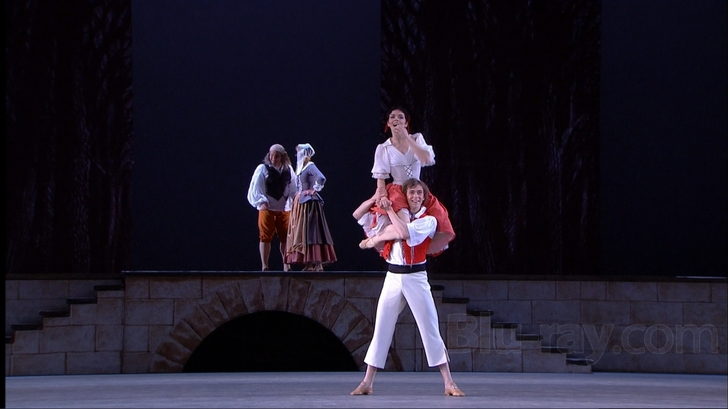
The dancers are uniformly magnetic and unusually athletic, especially leads Natalia Osipova and Ivan Vasilev who have one of the more commanding pas de deux in the contemporary ballet repertory. Best of all, the two actually are competent actors as well, and bring a sense of life and believability to their characters. While the first act of Ratmansky’s version is a little bottled up, things burst forth quite magnificently as the night goes on, and the sumptuous second act, though full of that very Russian tradition of the “specialty dance,” is gorgeous to look at and contains some of Asafiev’s best music. The production design is also quite effective, though it starts on the spare side. Costumes are incredibly elegant, especially after we move into the pampered world of the royal palace. There's also some very inventive lighting design utilized. The opening scene has what looks like "stationary" mist (for wont of a better term) that then magically disappears when the lighting changes, a very cool effect.
This production was beamed worldwide to theaters as part of the Bolshoi’s attempt to reinvigorate its reputation and show the world that it is still relevant in an increasingly modernist world. But part of the problem with reclaiming a reputation based on tradition is that one usually need to access at least elements of that selfsame tradition in order to not just cater to the existing audience base, but to establish what makes an individual company individual. The Bolshoi has such a long and vaunted history that it has literally an embarrassment of riches at its fingertips, or alternately, en pointe toes. Ratmansky has done exceptional job in adapting the original Vaynonen choreography, and the reworked Asafiev score certainly has some visceral moments, but too often this enterprise seems like a museum piece that’s been dusted off and been slapped with some shiny new colors. Unfortunately the old decrepit vase underneath is still visible.
Asafiev: Les Flammes de Paris Blu-ray Movie, Video Quality
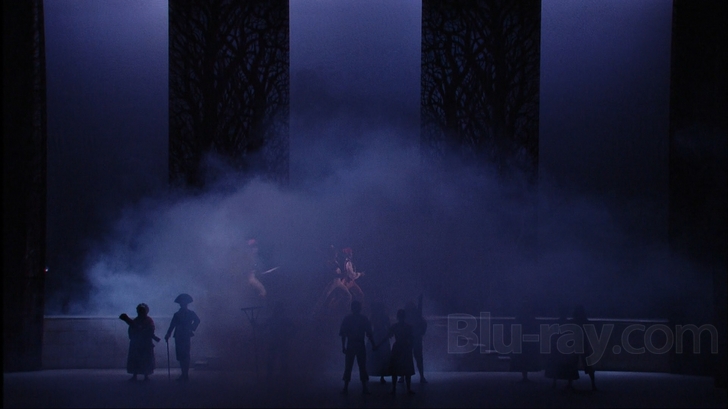
The Flames of Paris pirouhettes onto Blu-ray courtesy of BelAir Classiques with an AVC encoded 1080i transfer in 1.78:1. This is a very nice looking Blu-ray which for the most part is decently sharp and well defined. Colors are especially resplendent throughout the production, with the first act offering a riot of bright primary blues and reds and the second giving way to more opulent, gilt edged hues. Black levels are good, though due to stage lighting the image can temporarily look soft or suffer from moderate crush. There is exemplary contrast offered here, making the leads' white costumes bristle brilliantly against the dark backgrounds.
Asafiev: Les Flammes de Paris Blu-ray Movie, Audio Quality
The Flames of Paris is presented with two excellent lossless audio tracks, a DTS-HD Master Audio 5.1 mix and an LPCM 2.0 stereo fold down. The Bolshoi Thatre Orchestra under the very able direction of Pavel Sorokin sounds magnificent on the 5.1 track, with some especially robust brass work, notably in the opening scenes when we're treated to one big brass moment after another. Fidelity is superb throughout the evening, with excellent section separation but equally excellent blend, and an appealingly warm timbre prevalent throughout the performance. There's not much dynamic range offered in Asafiev's score, so we don't get bombastic highs and whisper quiet lows, but the DTS track is very flexible and supports the limited dynamics of this piece effortlessly. The music itself may not be everyone's cup of tea (it evidently wasn't mine), but the recording itself is superb.
Asafiev: Les Flammes de Paris Blu-ray Movie, Special Features and Extras
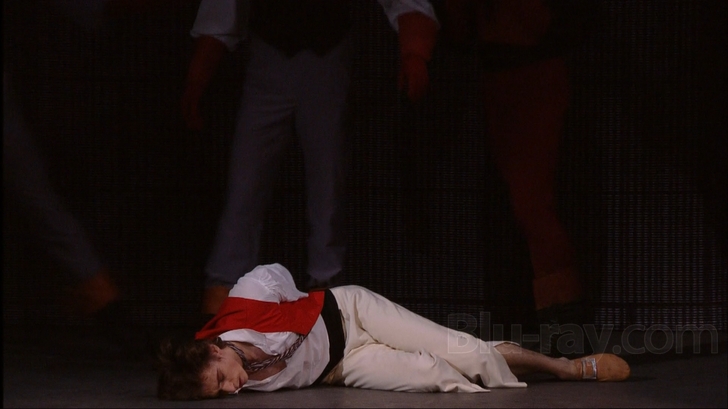
Bonus (1080i; 20:32) is a generically named featurette (yes, that's what it's actually called), which has Ratmansky talking about how he decided to resurrect this long forgotten piece. There are also copious interviews with various cast members as well as some interesting footage of Ratmansky working with the dancers.
Asafiev: Les Flammes de Paris Blu-ray Movie, Overall Score and Recommendation
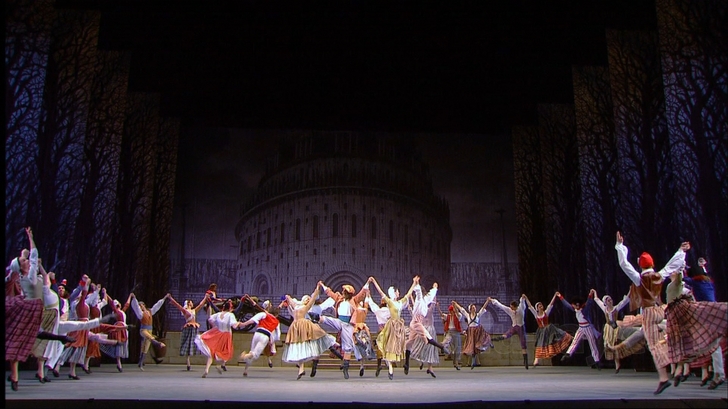
A lot of ballet fans have evidently been very excited about this release, a chance to finally see, in some form or other, one of the great classics of the Stalinist era. Unfortunately, what's here doesn't merit much excitement. It may in fact merit respect and appreciation, especially for its technical excellence, but this is one of the most oddly traditional pieces, especially considering the fact that it deals with Revolutionary fervor, in the entire ballet repertoire. Redolent of the big set pieces of Petipa and other 19th century masters, it actually boggles the mind that this piece was a huge hit in 1932, an era which saw other Soviet artists in any number of pursuits pushing the envelope in a rather formidable fashion. The envelope here is decidedly unpushed, but that may in fact recommend this piece to more conservative traditionalists. If you've been curious about this piece, this production certainly has a lot to recommend it, and I wouldn't hesitate to pick it up and check it out. If you're expecting some sort of latter day Le Sacre, you'll be in for a major disappointment.