Altered States Blu-ray Movie
HomeAltered States Blu-ray Movie 
Warner Bros. | 1980 | 103 min | Rated R | Jul 10, 2012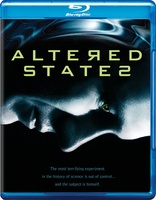

Movie rating
7.2 | / 10 |
Blu-ray rating
| Users |  | 3.6 |
| Reviewer |  | 4.0 |
| Overall | | 3.6 |
Overview
Altered States (1980)
An American researching different states of consciousness with the aid of mind altering drugs and an isolation chamber begins to experience disturbing physical changes in his body that point toward an evolutionary regression.
Starring: William Hurt, Blair Brown, Bob Balaban, Charles Haid, Thaao PenghlisDirector: Ken Russell
| Horror | Uncertain |
| Surreal | Uncertain |
| Psychological thriller | Uncertain |
| Drama | Uncertain |
| Sci-Fi | Uncertain |
| Fantasy | Uncertain |
| Thriller | Uncertain |
Specifications
Video
Video codec: MPEG-4 AVC
Video resolution: 1080p
Aspect ratio: 1.78:1
Original aspect ratio: 1.85:1
Audio
English: DTS-HD Master Audio 5.1 (48kHz, 24-bit)
Spanish: Dolby Digital 2.0
Subtitles
English SDH, French, Spanish
Discs
25GB Blu-ray Disc
Single disc (1 BD)
Playback
Region free
Review
Rating summary
| Movie | | 4.0 |
| Video | | 4.0 |
| Audio | | 4.0 |
| Extras |  | 0.5 |
| Overall | | 4.0 |
Altered States Blu-ray Movie Review
Half a Good Movie Is Better Than None
Reviewed by Michael Reuben July 6, 2012Altered States may no longer be widely known, but it makes a strong impression on its fans. The creators of the highly regarded TV series Fringe (now filming its fifth and likely final season) were so impressed that they borrowed major elements from the film: the use of sensory deprivation tanks combined with hallucinogens to unleash dormant mental powers; the belief that thought alone could open doors to other realities; and the actress Blair Brown portraying a brilliant woman hopelessly devoted to a possibly mad scientist who can never fully requite her love. But Fringe is only the most recent and sustained in a long line of homages, both serious and satirical, to Altered States. Once seen, it's a film that's hard to shake. Not that its original creative team didn't try. The film's screenwriter, three-time Oscar winner Paddy Chayevsky (Network), who had adapted his one and only novel from a long career of writing for TV, film and theater, took his name off the project in protest at the final result; the film's screenwriter is now listed as "Sidney Aaron". Arguments with Chayevsky had already led to the exit of the film's first director, Arthur Penn (Bonnie and Clyde). The original studio, Columbia Pictures, dumped the project when the budget grew beyond initial projections. Warner Brothers picked up the film and proceeded with director Ken Russell, who would later claim he was the twenty-seventh choice and whose disputes with Chayevsky, along with reportedly bad behavior on the set, would damage his career for years to come. In retrospect, there's tragic irony in the clash between Russell and Chayevsky, because they shared the same passion for overstatement, though in different registers, Chayevsky being more satirical, while Russell was more fantastical and bizarre. Unfortunately they also shared the same insistence on being in charge (or, at least, thinking they were; Russell would later claim that all of Chayevsky's previous directors were "malleable", but I doubt that anyone other than Sidney Lumet was in charge of Network). The two combatants needed an old-style producer from the heyday of the studio system to ride shotgun on both of them. Maybe then they could have done a better job reconciling the conflicting strands in Altered States than Russell was able to do by himself. Chayevsky had written a critique of the search for ultimate truth, but Russell, who had converted to Catholicism, understood the allure of such things—and also knew how to make that allure both creepy and fascinating, like all the best villains in horror movies. Russell succeeded so well that at times Altered States verges on self-parody, and by the end he has no satisfactory resolution to the story; so he winds it up quickly and rolls the credits.

In 1967, a medical prodigy, Dr. Eddie Jessup (William Hurt), is an associate professor of abnormal psychiatry at the Cornell Medical College in New York, where he becomes convinced that the schizophrenic patients he's studying aren't "mad" but have access to alternate planes of reality. Jessup and a colleague, Dr. Arthur Rosenberg (Bob Balaban), begin experimenting with a flotation tank for sensory deprivation to induce a similar mental state in non-schizophrenics, including Jessup himself, on a temporary basis. Jessup takes to the experience with a delight that should sound warning alarms. At a party given by Arthur and his wife, Sylvia (Dori Brenner), Jessup meets Emily (Blair Brown), another prodigy but in the field of anthropology. She's beautiful and intriguing, and when Jessup asks to go home with her, she says yes, because he's intense and on fire. When they're making love, she asks him what he's thinking about. He answers: "God. Jesus. Crucifixions."—and Emily is hooked. They marry, because Emily wants it. They get teaching positions at Harvard, move to Boston and seven years pass, during which two children are born (one of them played by Drew Barrymore, in her first film). Jessup chafes under the appearance of normalcy: husband, father, respectable professor. Then, an anthropologist friend at the University of Mexico, Echeverria (Thaao Penghlis), tells him about an obscure Mexican tribe whose members prepare a potion from a rare mushroom that is supposed to induce "a common experience in all users". Jessup accompanies Echeverria on an expedition to visit the tribe, where the Brujo (Charles White-Eagle) allows him to take part in the ceremony of consumption. Jessup experiences extreme hallucinations replete with images of Emily and religious portents. The next morning, Jessup isn't exactly sure what happened, but he leaves with a sample of the potion for Arthur to analyze and synthesize. Back in Boston, Jessup and Arthur locate another sensory deprivation tank, and the potent combination of the tank and the drug takes Jessup into dangerous new realms. Each experience unleashes more energy, as Jessup's visions begin exhibiting physical manifestations. Jessup's friend and skeptical colleague, Dr. Mason Parrish (Charles Haid), keeps proposing rational explanations, but they have the frantic tone and increasing volume of a man who's desperately trying to convince himself. In the midst of this deteriorating situation, Emily returns from an African field trip on which the children have accompanied her, and she demands that her husband stop his experiments. Naturally Jessup refuses, and his final effort to explore the mysteries of the universe goes so far that it literally generates a primal vortex (Fringe fans, take note!) into which he disappears—and Emily follows. Director Russell deploys all his formidable talents as a visual stylist to bring Jessup's visions to life, including rapid, almost subliminal cuts, odd superimpositions, lurid color schemes, Dick Smith's remarkable make-up effects, on-set pyrotechnics, snakes and lizards, and much more. When the visions begin to externalize, an array of practical effects come into play, including the astonishing agility of Miguel Godreau, a former lead Alvin Ailey dancer sometimes known as "the Black Nureyev", who leaps, run and swings through a varied landscape portraying a character identified in the film only as "Primal Man". But all of these elaborate effects wouldn't work—even now, there's a strong temptation at points to cry out, "Oh come on!"—except for the performances, especially the portrayal of Jessup by William Hurt, who was making his film debut. Jessup could have easily been an unlikeable, self-absorbed jerk, an R.D. Laing on amphetamines, but Hurt finds a way to make him fascinating, even sympathetic. Yes, Jessup is such a classic mad scientist that he can sit there watching his own body pulse and transform, like Max Renn's in Videodrome , while grimacing in agony and simultaneously grinning at the sheer joy of discovery. But on their first night together, Jessup also tells Emily how he lost his religious faith after watching his father die a lingering, miserable death from cancer, and Hurt manages to convey both the depth of Jessup's suffering and the degree to which it has informed his life ever since. (In the first major hallucination sequence, Jessup's dying father features prominently.) A tearful Emily says late in the film, "I was never real to him. Nothing in the human experience is real to him." Yet Hurt's performance conveys a more complex sense of Jessup than Chayevsky's dialogue, a sense that the human experience was all too real for him—so much so that he's devoted his life to looking for something solid, permanent and primal. Ultimately, though, Altered States ends before satisfactorily completing its story. Having taken Jessup to the point where he appears to have reached the end of his quest, where even Mason can no longer deny that something extraordinary has happened—"What we saw tonight was a physical phenomenon, an inexplicable physical phenomenon!" shouts Arthur—the film needs a whole second part, or at least a third act, showing how the characters deal with the new reality, or at least conclude that some borders weren't meant to be crossed (as they say on Fringe) and then make a joint decision to abandon this research and never speak of it again. Chayevsky probably wasn't interested in writing such a third act. For him it was sufficient to demonstrate the dangers of seeking absolute truth. He hadn't counted on Russell and Hurt making it so damn enticing. So all we get are a few lines of dialogue to tie off the story of Eddie and Emily Jessup. Every time I see the film, the ending leaves me unfulfilled, but getting there is a lot of fun.
Altered States Blu-ray Movie, Video Quality
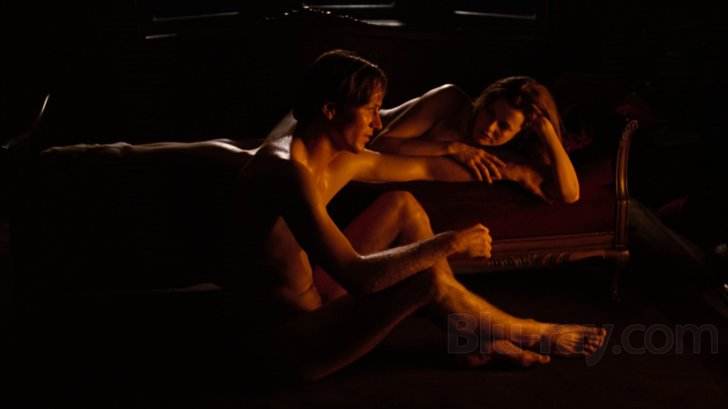
I saw Altered States when it first appeared in theaters in December 1980, and I still remember the experience vividly. The image on Warner's 1080p, AVC-encoded Blu-ray is a faithful rendition, but it's likely to strike new viewers as unusually dark. Rest assured that it's supposed to be. The cinematographer, Jordan Cronenweth, was just a few years away from shooting Blade Runner, another dark movie; Cronenweth was never afraid of dialing down the lighting on a scene, because he knew how to capture good detail and appropriate shadows even with minimal illumination. The purpose of the darkened scenes should be evident from the film's opening shot, which shows Jessup's face distorted through the window of the flotation tank in New York, surrounded by a bright blue-green light. Darkness and flat, dull colors in the everyday world establish a strong contrast with the brightly lit and intense, often psychedelic colors of Jessup's alternate universe(s). Indeed, one never knows where light will fall around Jessup, and whether it will be false or hallucinatory. When Emily first sees him at Arnold and Sylvia Rosenberg's party, Jessup is entering from outside, and he's bathed in a brilliant, white light as if he had just descended from heaven. The effect is both hokey and startling, but it aptly conveys the effect that the handsome young visionary has on Emily. A later and more elaborate sequence that recalls the "star gate" journey in Kubrick's 2001 (but with imagery that's more organic and less geometrically abstract) uses vividly saturated color to convey the depth of Jessup's journey to . . . somewhere else. Black levels and shadow detail are strong enough so that a tricky nighttime sequence involving a pursuit in the basement of a Harvard Medical School building and through the streets of Boston combines precisely the right amount of the visible and the concealed. Contrast levels are correctly set so that harshly lit and overexposed inserts like the quick shots of Eddie and Emily Jessup dressed as Victorians in Eddie's Mexican hallucination don't have their detail blown out. In motion, though not so readily in screencaps, the film's grain structure does not appear to have been artificially reduced or otherwise manipulated, although the image is frequently softened by the numerous opticals and other requirements of effects in the pre-CG era. I didn't spot any compression errors (but, let's face it, the rapid-fire editing in some sequences could hide a multitude of sins).
Altered States Blu-ray Movie, Audio Quality

Like Outland, Altered States was released in both Dolby Stereo and six-track sound on a 70mm blow-up; the latter utilized Warner's short-lived "Megasound" format, which enhanced the low frequencies for major effects. The Blu-ray's DTS-HD MA 5.1 track is probably taken from the six-track mix, very likely the Megasound version, because the bass extension is impressively deep and the surround field is used aggressively to extend and amplify the impact of Eddie Jessup's hallucinations and their physical manifestations. Of particular note is the unusual score by classical composer John Corigliano, who would later win an Oscar for scoring The Red Violin. Corigliano's score is constructed in such a manner that it sometimes blends indistinguishably with otherworldly sound effects being produced by Jessup's visions. The result can be unsettling, to such a degree that when, at a critical moment in the film, all sound abruptly halts and the track goes silent, you're both relieved and frightened. The dialogue is always clear, except when two characters are shouting over each other. Screenwriter Chayevsky apparently objected to the loud and fast speaking style that Russell directed the cast to adopt, which is an interesting perspective from the author of Network.
Altered States Blu-ray Movie, Special Features and Extras
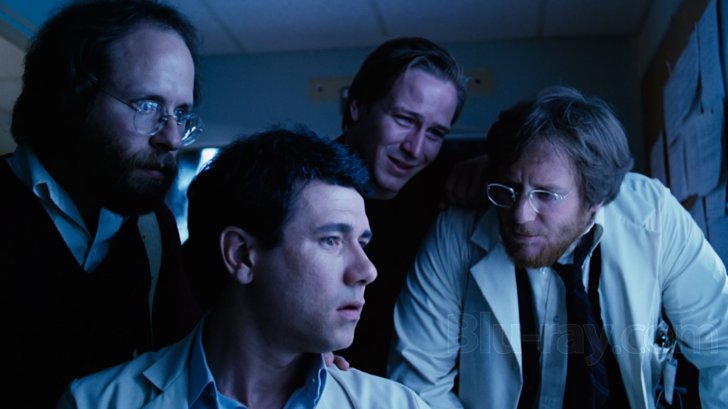
The only extra is the film's theatrical trailer (2:15), which is presented in standard definition and arguably shows too much, although it's all out of context. I never saw the trailer until it appeared on home video editions. As soon as I heard that Ken Russell had made something with a science fiction element, I had to see it.
Altered States Blu-ray Movie, Overall Score and Recommendation

For all its flaws, notably the abrupt ending and the over-the-top moments without which no Ken Russell film would be complete, Altered States is a one-of-a-kind viewing experience that every sci-fi fan should see at least once, if for no other reason than for the later work it has inspired. It also contains the auspicious debut of William Hurt's big-screen career, which would flower through the Eighties with a series of roles for Lawrence Kasdan in Body Heat, The Big Chill and The Accidental Tourist; with the tight ensemble work of Broadcast News; and with his Oscar-winning turn in Kiss of the Spider Woman. As fine as all those performances are, along with such mature work as the Oscar-nominated supporting role in A History of Violence, Hurt has never been more madly memorable than as Eddie Jessup, the man of science wrestling with both angels and demons, in Altered States. Highly recommended.


Similar titles
Similar titles you might also like

Demon Seed
Warner Archive Collection
1977

The Fly
1986

Day of the Dead
Collector's Edition
1985

Videodrome
Unrated Version
1983

The Omega Man
1971

México Bárbaro
2014

The Invisible Man 4K
1933

The Black Demon
2023

Cell
2016

Species: The Awakening
2007

The Giant Claw
1957

Puppet Master
1989

The Lighthouse
2019

The Fury
Limited Edition to 3000 - SOLD OUT
1978
Werewolf of London
1935

Monkey Shines 4K
1988

Dreamcatcher
2003

Phantoms 4K
1998

The Twilight Zone: Season One
2019

Viral
2016