Alleged Blu-ray Movie
HomeAlleged Blu-ray Movie 
Image Entertainment | 2010 | 94 min | Not rated | Nov 08, 2011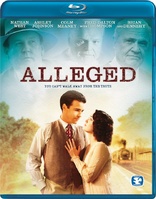

Movie rating
7.3 | / 10 |
Blu-ray rating
| Users |  | 0.0 |
| Reviewer |  | 1.5 |
| Overall | | 1.5 |
Overview
Alleged (2010)
Charles Anderson, a talented young reporter, feels trapped working for his deceased father's weekly newspaper and living in the tiny town of Dayton, TN in steep decline. Seeing in the Scopes Monkey Trial of 1925 a once-in-a-lifetime opportunity to break into the journalistic big leagues, Charles manages to insert himself into the middle of the "Trial of the Century."
Starring: Nathan West, Colm Meaney, Ashley Johnson, Fred Dalton Thompson, Brian DennehyDirector: Tom Hines (I)
| Drama | Uncertain |
| Romance | Uncertain |
| History | Uncertain |
Specifications
Video
Video codec: MPEG-4 AVC
Video resolution: 1080p
Aspect ratio: 1.78:1
Original aspect ratio: 1.85:1
Audio
English: DTS-HD Master Audio 5.1
Subtitles
English SDH
Discs
25GB Blu-ray Disc
Single disc (1 BD)
Playback
Region A (C untested)
Review
Rating summary
| Movie | | 1.5 |
| Video |  | 4.0 |
| Audio |  | 3.5 |
| Extras |  | 1.0 |
| Overall | | 1.5 |
Alleged Blu-ray Movie Review
Parrot the Spin. But the Wise Filmmaker Will Be a Servant to the Story.
Reviewed by Michael Reuben November 10, 2011The so-called Scopes Monkey Trial of 1925 remains a famous event in American history, though it didn't actually accomplish much. John Scopes, a Tennessee high school teacher, was convicted of violating the state's Butler Act, which prohibited the teaching of evolution. Scopes was ordered to pay a fine of $100, but his conviction was reversed by the Supreme Court of Tennessee on technical grounds. The state declined to retry him, but the Butler Act remained on the books for another 42 years. Still, never underestimate the power of popular culture. The Scopes Trial was all about symbols, not substance. The trial itself became a media circus, when the prosecution enlisted three-time presidential candidate and noted orator William Jennings Bryan to assist them. In response, the defense retained the most famous attorney of the day, Clarence Darrow. Reporters descended on the town of Dayton, Tennessee, eager to cover the Thunderdome-like clash of these oratorical titans. Chief among them was the Baltimore Sun's H.L. Mencken, whose acid diatribes against Bryan, the South, religion and pretty much everything that today would be denominated "red" were legendary. Inherit the Wind, the fictionalized version of the Scopes Trial, has largely defined the event for the contemporary imagination since the play was written in 1955, then adapted into a film by Stanley Kramer in 1960 starring Fredric March and Spencer Tracy. The story is admittedly fictionalized, but everyone knows who's who. John Scopes became Bertram Cates; Clarence Darrow became Henry Drummond; and William Jennings Bryan became Matthew Harrison Brady, whose success in the trial is undercut by the fact that he drops dead in the courtroom at the end. (In real life, Bryan died of diabetes and fatigue five days after the trial, having traveled extensively during that time giving speeches, an activity he could never resist.) Inherit the Wind continues to be watched and performed, because, like the trial on which it's based, it's a terrific drama. The central confrontation, in which Drummond puts Brady himself on the stand and examines him on the "truth" of the Bible, is based on Clarence Darrow's actual strategy against Bryan when the state court judge refused to allow any of his scientific experts to testify. It's an inherently exciting clash that great actors yearn to play. The most recent Broadway revival was in 2007, with Christopher Plummer as Drummond and Brian Dennehy as Brady. But Inherit the Wind is hardly the last word on the Scopes Trial. The trial itself was as much a PR showcase for conflicting forces as any modern media event, and Inherit the Wind was as much about the time when it was written as it was about the Scopes Trial. Like Arthur Miller's The Crucible, the play used a historical event as a vehicle to comment on the present, in this case to protest McCarthyist efforts to limit what could be said, written about or taught. There is certainly plenty of room to look at the Scopes Trial from other angles and with a different focus, especially since the issue--evolution vs. creationism--continues to roil the political and social waters of America. Which brings us to Alleged. Released through Slingshot Pictures, an avowed marketer of "faith-based" titles, Alleged positions itself as the antidote to Inherit the Wind by viewing the Scopes Trial through the eyes of an idealistic young reporter (an admittedly fictional character) who looks at this circus that's come to town with fresher eyes than the jaded players whose positions in the game are well known. It's a promising idea--until the filmmakers' hidden agenda spills onto the screen and sours the whole enterprise.
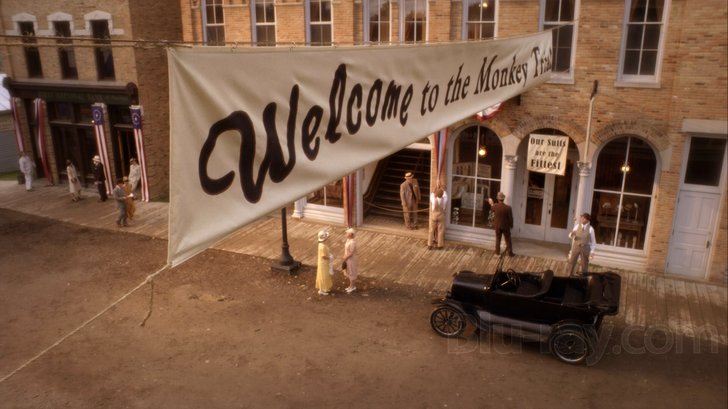
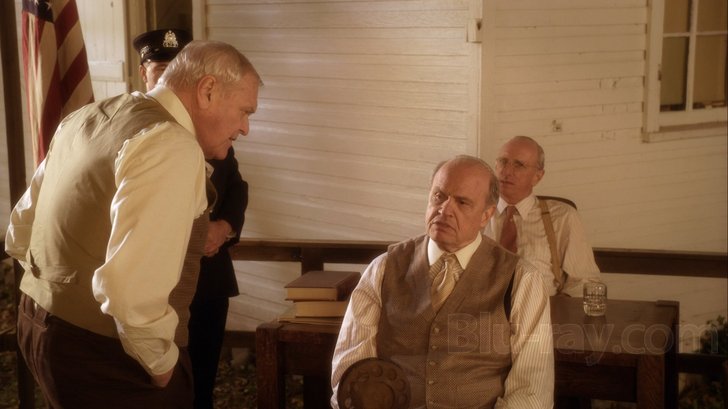
Charles Anderson (Nathan West) is a young reporter in Dayton, Tennessee, struggling to make a go of the newspaper of which his late father was editor. His real dream, though, is to work for a big city paper like the Baltimore Sun under the legendary H.L. Mencken (Colm Meaney). Still, Dayton has its compensations, especially the lovely Rose Williams (Ashley Johnson), who works with Charles at the paper. They grew up together, and they have the kind of easy familiarity that lets them greet each other with variations of "marco!" and "polo!" Marriage is something they've already agreed upon; it's just a matter of finances and opportunity. With the closing of the local coal mine, Dayton is facing hard times, but the town's movers and shakers, personified by George Rappleyea (JR Bourne), have an idea. They'll put Dayton on the map by making it the scene of a test case for the Butler Act. They enlist John Scopes (Jamie Kolacki), a local teacher who happened to use a textbook that mentions evolution on a day when he substituted for a colleague, line up the state attorney general to prosecute, and it's off to the races. Alleged is lively and entertainingly contemporary when it shows celebrities like William Jennings Bryan (Fred Dalton Thompson) being received by an adoring crowd, or calculating speculators like Rappleyea buying up land in the hope of a quick killing. And it's on familiar ground when it shows Mencken tempting Charles into compromising his journalistic principles with the promise of a job offer. In this instance, "compromising his principles" means writing what Mencken wants to hear, no matter what actually happens in the courtroom. Indeed, Mencken leaves town before the closing arguments by Bryan and Clarence Darrow (Brian Dennehy), because he says he can write about them without hearing them. (In real life, Mencken didn't even stay to hear Darrow put Bryan on the stand.) But the makers of Alleged get skittish whenever they get too far from Charles's ethical dilemma and find themselves at the actual Scopes Trial. They always seem in a hurry to cut away from the proceedings, which is a problem if one truly wants to provide a counterpoint to Inherit the Wind. Darrow/Drummond's examination of Bryan/Brady is the central event of that drama, but no sooner does it begin in Alleged than the film shifts to a subplot (about which more in a moment). The actual historical event lasted two hours. Couldn't the creators of Alleged find sufficient material to craft even a five-minute scene that would pay off the intense build-up? Apparently not, because all they provide is a disagreement between Mencken and Charles over who "won" the encounter, Darrow or Bryan. It's a classic example of telling when they should be showing. The sole extra on the Blu-ray, a "discussion guide" replete with Biblical citations, asks questions about Charles's dilemma over selling out for career advancement, but those questions are difficult to assess when we haven't seen what's caused Mencken and Charles to disagree. What if Charles got it wrong, and Mencken, the more experienced observer, knows better? If the point of Alleged is to show how a media circus can pre-judge the outcome of an event and shape both the public's and history's perception accordingly, skipping over Darrow's examination of Bryan leaves a huge dramatic hole. After all, the version of Bryan's testimony in Inherit the Wind wasn't intended to be literal history; it was condensed and shaped for a specific purpose, which wasn't to prove evolution or disprove religion, but simply to uphold the right of individuals to think and decide for themselves, a suitable theme for the age of McCarthyism. But Alleged apparently doesn't think we need to see the Darrow examination to know that Charles is right: Bryan came out on top, and Mencken is lying. Some things are just, well, obvious.

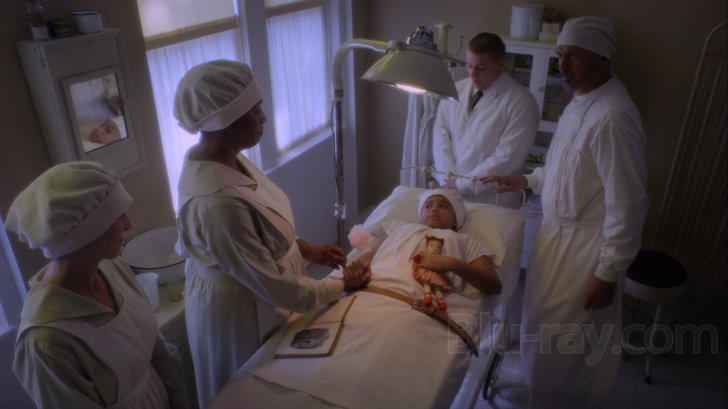
Hunter's Civic Biology was the leading biology textbook used in high schools in America. Under the general topic of human evolution (the only aspect of Darwin's theory prohibited in public schools under the Butler Act), many readers are shocked by its vicious statements regarding racial minorities, the poor, and the disabled.And what exactly does this have to do with whether evolution is legitimate science? Well, nothing. Welcome to guilt by textual association. If the legitimacy of an idea is to be judged by its proximity in a document to something offensive, then the very idea of constitutional government is in trouble, because the U.S. Constitution contains some pretty troubling stuff about slavery (art. 1, sec. 2, para. 3). I suppose it was too much to expect that a faith-based movie company could get behind a film about the Scopes Trial and settle for a critique based solely on the press's manipulation of public perception. There had to be true villains somewhere, and guess what? They turned out to be scientists and doctors.
Alleged Blu-ray Movie, Video Quality
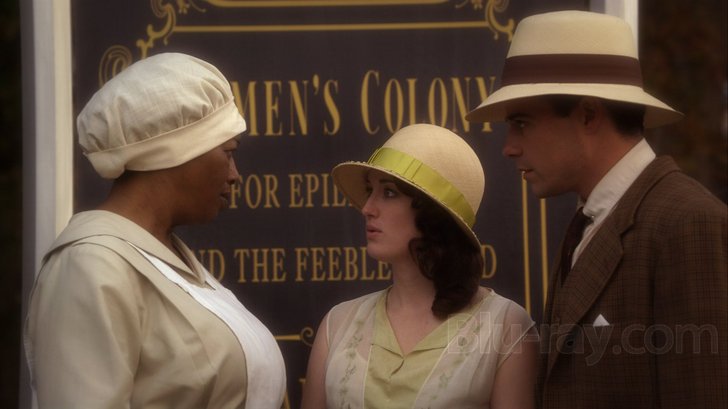
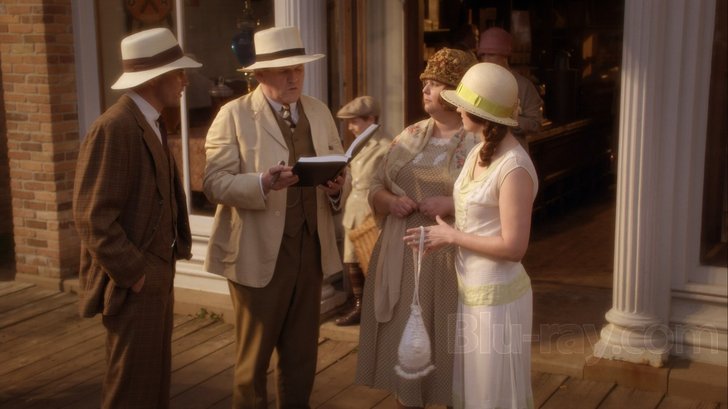
Alleged was shot on the Red One camera and finished on a digital intermediate, where the colors were fine-tuned to give it a nostalgic, picture postcard look. This is a kinder, gentler pastel past, and it's certainly pretty to behold. Detail and depth of field are excellent without the harsh edges or sharp contrasts often associated with digital cinematography. Black levels are solid and dark, although night scenes are frequently shaded more toward brown than black, especially if they're illuminated interiors. In general, earth tones predominate in town, and cool blues predominate in the women's facility that houses Abigail. Artifacts of any variety, whether aliasing, compression, filtering or ringing, were nowhere to be found.
Alleged Blu-ray Movie, Audio Quality
The DTS-HD MA 5.1 track provides a serviceable but unremarkable mix. There are no showy effects, merely dialogue (which is clear), a general sense of ambiance, and an energetic but generic score credited to John R. Graham.
Alleged Blu-ray Movie, Special Features and Extras
- Discussion Guide: This is certainly one of the most unusual special features I've
encountered. Subtitled "6 discussion topics for church and home group study using
biblical references and lessons to go along with the film", the guide uses the letters of the
title to organize its topics:
- Ambition at any cost
- Little white Lies
- End justifies the means
- Getting ahead, God's way
- Every action matters
- Destiny shaped by choices
Alleged Blu-ray Movie, Overall Score and Recommendation
Having spent much of my life subject to false assumptions about who I am because of my name (which is not indicative of my background) and where I live (which is nothing like where I was raised), I try to approach films with as little prejudgment as possible--which is relatively easy, since they don't require more than your attention and a few hours of your time. I sat down to watch Alleged really wanting to experience the Scopes Trial and Dayton, Tennessee of 1925 from a thoughtful new perspective. What I got instead was an insistent piece of propaganda. It may have lacked Mencken's focus, and it certainly didn't have his wit, but it was just as driven by bias and unstated assumptions. I have no problem with stories that reflect a strong point of view, but the point of view has to arise from the story, not vice versa. Inherit the Wind respected that principle. Alleged doesn't.
Similar titles
Similar titles you might also like
(Still not reliable for this title)

Breaker Morant
1980

Mutiny on the Bounty
1962

The Reader
2008

Quo Vadis
1951

The Caine Mutiny
1954

Cleopatra
1934

Men of Honor
2000

Fire Over England
The Vivien Leigh Anniversary Collection
1937

A Farewell to Arms
1957

Glorious 39
2009

In the Land of Blood and Honey
2011

The Pillars of the Earth
2010

War and Peace
1956

That Hamilton Woman
Lady Hamilton
1941

The Messenger
2009

Nomad: The Warrior
2005

Doctor Zhivago
45th Anniversary Edition
1965

Jefferson in Paris
1995

A Matter of Life and Death
1946

For Whom the Bell Tolls
1943